
PVC Flooring Supplier Capability: Factory, Capacity, SGS Scope
PVC Flooring Supplier Capability: Factory, Capacity, SGS Scope
A PVC flooring supplier's capability is only as strong as the evidence a buyer can inspect before the purchase order is signed. Factory floor area, annual output, quality-management certification and a third-party test report each answer a different question — and each one carries a scope limit that decides whether it applies to the product actually on the order.
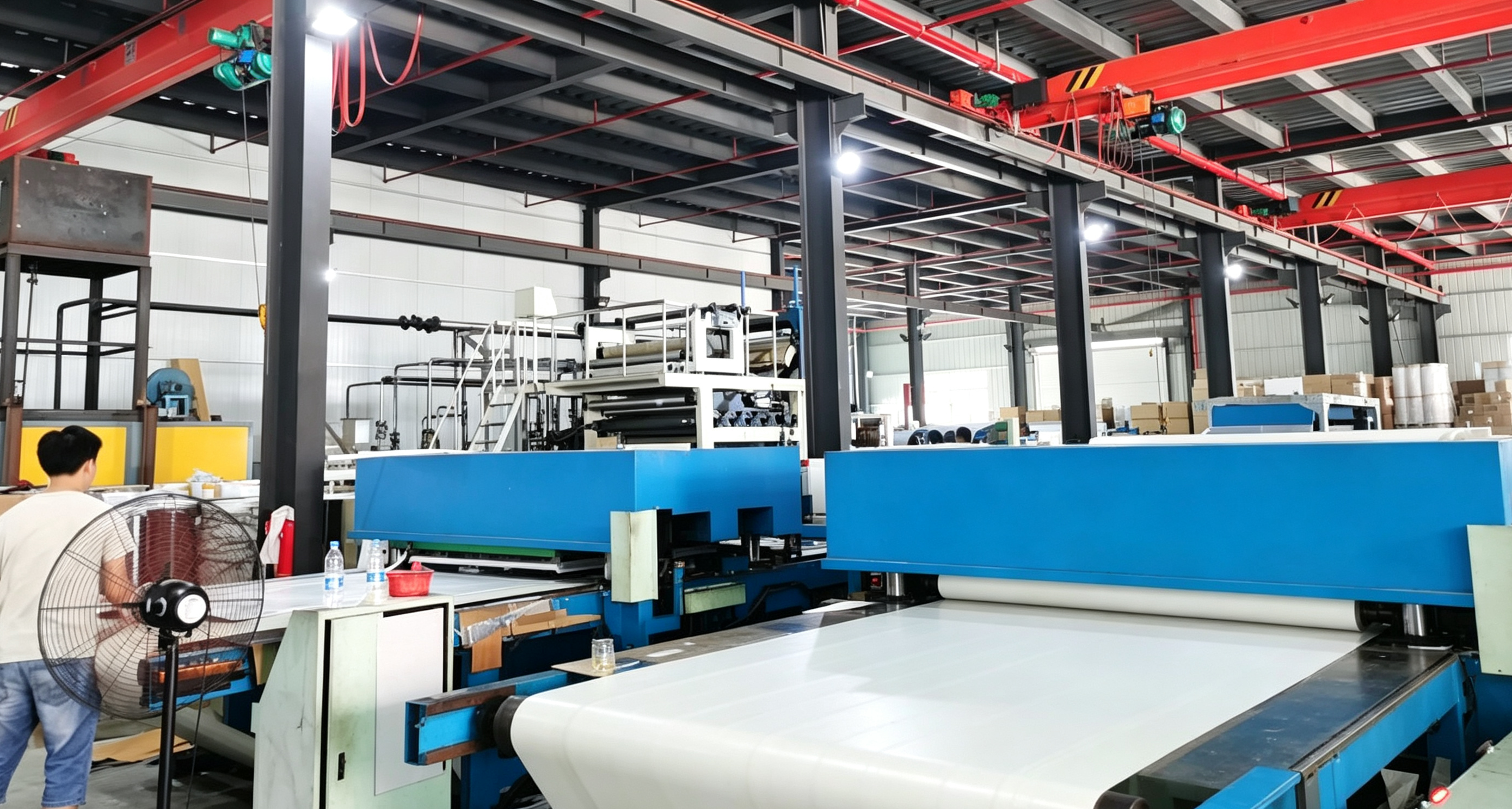
This article sets out how to read those four evidence types together, using Shanghai Yuanguan Rubber & Plastic Co., Ltd. as the working example. The Shanghai-based decorative materials manufacturer, which sells under the SXP Wall Panel brand, operates a 7,000-square-metre intelligent factory with automated production facilities, records annual output of 75,000,000 units, runs a 200-person team including 5 R&D engineers, and holds ISO9001 quality management system certification, 48 patents and 12 independent brands. About 90% of its output is exported to more than 80 countries and regions. Its PVC floor tile, model WB-PVC, is used here to show how a document check works in practice, including the SGS RoHS Test Report issued by SGS-CSTC against RoHS Directive (EU) 2015/863 for the EU market.
Why a Capability Claim Needs a Document Trail
Sourcing failures in PVC flooring are usually documentary before they are physical. Procurement risk guidance for decorative materials shipped to the EU points to three obligations that sit outside the product itself: CE-CPR construction-product certification, the REACH hazardous-substance regulation and the PPWR packaging rules. Missing valid certificates in that chain can result in customs detention, return shipment and fines — outcomes a low unit price does not offset.
The second failure mode is cheaper material sold as standard material. The price gap between quotations for the same nominal product usually traces back to raw material (virgin versus recycled), thickness, formulation, quality control and certification. Low-cost constructions built on recycled material may show dimensional deviation, fading and odour, and are more likely to arrive with certificates that do not survive an import inspection. The same risk guidance treats sample confirmation as mandatory before bulk ordering — which is the cheapest control in the process.
Scale makes the distinction sharper rather than softer. China was the leading exporter of floor, wall and ceiling coverings under HS 391810 in 2024, with exports valued at USD 4.97 billion, ahead of Vietnam at USD 1.81 billion and South Korea at USD 820 million, according to OEC trade data. A buyer selecting a PVC flooring supplier from a base of that size is not short of quotations. What separates suppliers is whether facility, capacity, quality system and product-specific test evidence form a coherent record that matches the order.
The Physical Layer: What 7,000 m² and 75 Million Units Actually Answer
Facility and capacity evidence answers a scheduling and repeatability question. It does not answer a performance question, and conflating the two is where most capability claims lose their value.
At Shanghai Yuanguan, the recorded physical base is a 7,000-square-metre intelligent factory equipped with automated production facilities, staffed by a 200-person team covering R&D, quality control, production and sales, with 5 R&D engineers and 48 patents behind the product lines. Standardised production and multi-stage quality inspection are applied to all batches before delivery, and the capability record states 100% testing as the quality-control position.
Two capacity figures appear in the company's records, and they are not interchangeable. Annual output is recorded as 75,000,000 units — a piece-based figure tied to the unit definition of a given product. Monthly capacity is separately recorded as 10+ million square metres — an area-based figure. A buyer comparing suppliers should ask which unit a quoted capacity is expressed in, and against which SKU, because a piece count and a square-metre count describe different things.
The same discipline applies to lead time and order thresholds. The capability record states a 30-day lead time, while minimum order quantities are recorded differently across the company's own documentation: a procurement record lists a 200 m² MOQ with FOB delivery and TT payment, and a capability record lists 1,000 m². That is not a contradiction to be settled by picking the more convenient number; it signals that MOQ is configuration-specific. The figure that governs the order is the one written into the quotation.
What this layer establishes is the ability to schedule, repeat and inspect production — the property that protects a buyer during a reorder, a specification change or a quality dispute. What it does not establish is that a given floor tile will meet a stated wear, slip-resistance, fire or emission performance in a given project. Those claims live in the document layer.
The Document Layer: Reading the SGS RoHS Report Properly
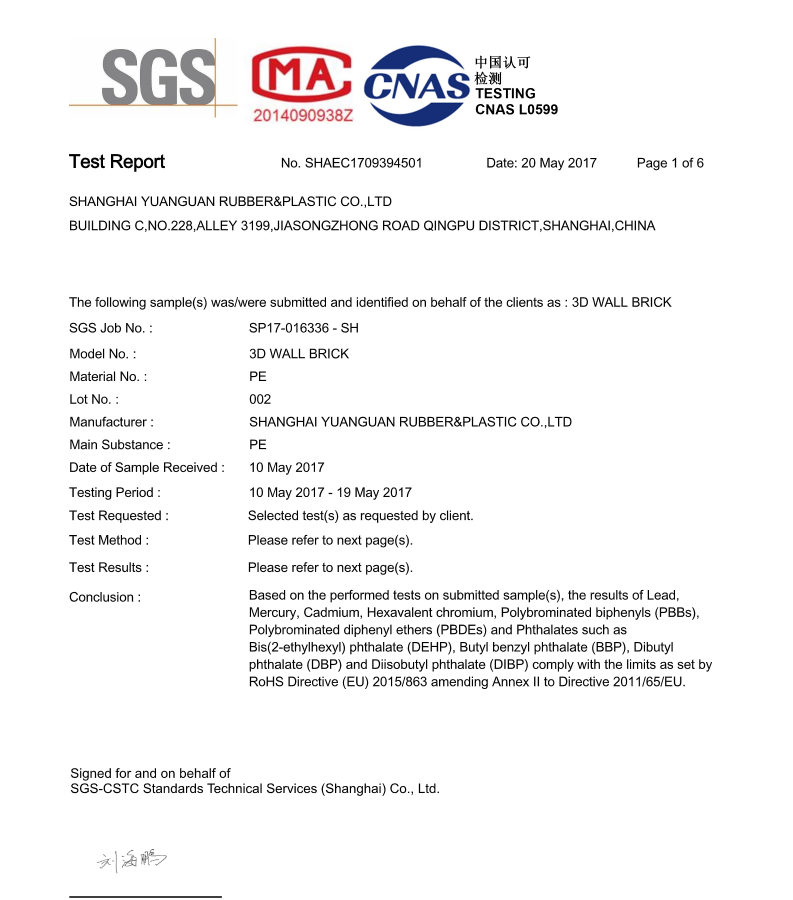
RoHS restricts the use of named hazardous substances. For the WB-PVC floor tile, the document recorded is a SGS RoHS Test Report numbered SHAEC1709394501, issued by SGS-CSTC, recorded as applicable to the EU market and issued against RoHS Directive (EU) 2015/863. The report is dated 20 May 2017, with a recorded validity date of 1 January 2099.
Issuer, report number, standard, market and date are what make the document auditable. A buyer should verify each one on the report itself rather than on a summary page, and keep the report number in the purchasing file so the original can be requested from the issuing laboratory if a copy is ever disputed.
Five checks, in order
- Issuing body and number. The report is issued by SGS-CSTC under number SHAEC1709394501. A test report is only useful if it can be traced to the laboratory that produced it.
- Standard cited. The recorded standard is RoHS Directive (EU) 2015/863. A report issued against a different or earlier version of the directive is a different document and should not be read as interchangeable.
- Market and product. The report is recorded as applicable to the EU market and is cross-referenced by the manufacturer to the WB-PVC product line, whose primary material is PVC.
- Date. The report was issued in May 2017. A test report is a historical record of the sample tested at that time, so the buyer should ask whether the material formulation, material source or production process for the ordered item has changed since, and whether this report is the version the supplier currently relies on.
- Declared scope. The check most often skipped. The report's stated scope is recorded as a 3D wall brick in PE material, manufactured by Shanghai Yuanguan Rubber & Plastic Co., Ltd., while the manufacturer's product cross-reference lists the WB-PVC flooring model under the same report. A buyer ordering WB-PVC flooring should ask the supplier to confirm in writing, before the PO, that the item being shipped falls inside the scope the report actually covers — by model, material and construction — or to supply a report that names the flooring item explicitly.
RoHS is also not the same question as indoor air quality. FloorScore certification verifies that hard-surface flooring complies with the volatile organic compound emission criteria of California Section 01350, according to SCS Global Services. That is a separate document answering a separate question: a RoHS report should not be accepted as evidence of VOC performance, and a FloorScore listing does not replace a restricted-substance test. Projects specifying low-emission flooring — schools, healthcare interiors, tightly sealed commercial space — should ask for both.
Fire performance follows the same rule. Industry reference material commonly classifies PVC flooring as Class B1 under GB 8624-97 and Cfl-s1 under EN 13501-1, but a classification belongs to a specific tested construction, not to the category "PVC flooring". A supplier describing a product as fire-resistant should be able to name the class and the report behind it.
Plasticizer content is the third document question. Tarkett has reported that by 2018, 100% of its vinyl production sites in Europe, North America, Serbia and China used phthalate-free technology built on alternative plasticizers such as DOTP — a public marker of where the category has moved. For a buyer, the useful step is to ask which plasticizer system the quoted product uses and to have the answer written into the specification, rather than inferred from a general environmental claim.
What each document covers — and what it does not
| Document | Question it answers | What the record shows | What it does not cover |
|---|---|---|---|
| SGS RoHS Test Report | Restricted-substance testing of a named sample | No. SHAEC1709394501, issued by SGS-CSTC against RoHS Directive (EU) 2015/863, EU market, issued 20 May 2017, cross-referenced to the WB-PVC line | VOC emissions, fire class, or any article outside its declared scope |
| Declared scope statement | Whether the tested article matches the ordered article | Recorded as a 3D wall brick in PE material, manufactured by Shanghai Yuanguan | Order-specific confirmation until the supplier confirms the match in writing |
| ISO9001 certificate | Quality management system | Held by Shanghai Yuanguan | The performance of any individual SKU |
| FloorScore (project-dependent) | VOC emissions against California Section 01350 | Separate certification, requested when a project specifies low-emission flooring | Restricted substances or fire performance |
| Fire classification (project-dependent) | Reaction-to-fire class of a tested construction | Classes industry references commonly cite: B1 (GB 8624-97), Cfl-s1 (EN 13501-1) | Any construction not tested to that class |
| CE-CPR / REACH / PPWR (EU) | Market-access and packaging obligations | Confirm per destination before shipment | Product performance data |
The documentation requirement matters in proportion to export exposure. About 90% of Shanghai Yuanguan's output is exported to more than 80 countries and regions, with Europe, North America, the Middle East, Asia and Oceania among the recorded markets — which means an EU-bound order is core business rather than an exception, and the document pack has to work as standard operating procedure rather than as a special effort.
What an Order Record Shows That a Brochure Cannot
Repeat orders are behavioural evidence. A supplier that has produced the same product for the same buyer more than once has shown something a catalogue cannot: that the item can be re-made, packed and shipped to the same specification.
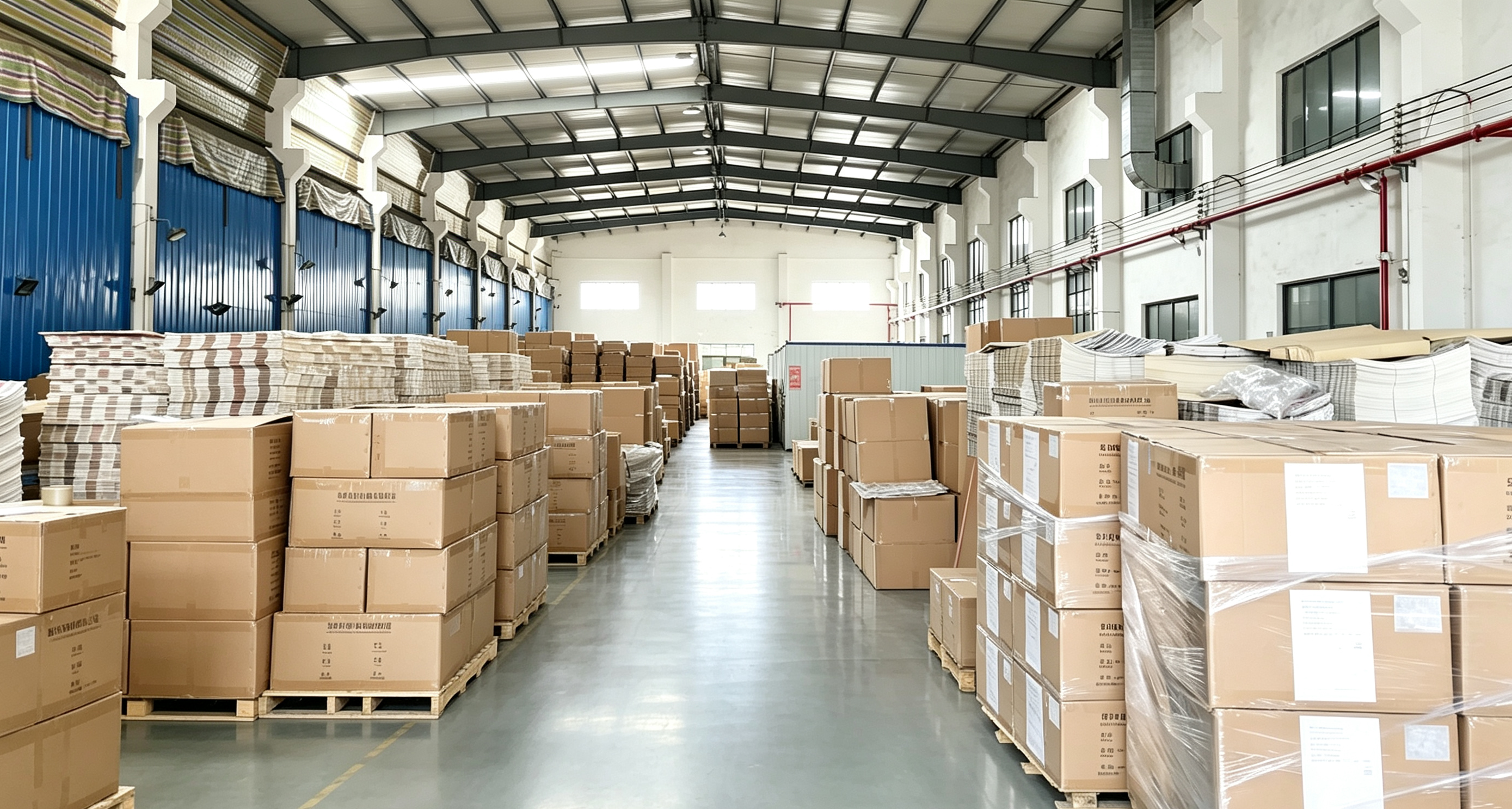
In the company's case record, an e-commerce platform customer ordered 100,000 units for residential and commercial interior decoration, covering apartment renovation, office fitting and retail store refurbishment work. The record states stable product performance with no quality complaints reported during the service period, a stated service life of 5–10 years, and three repeat orders placed within two years. The performance notes attach to wear resistance, water resistance and ease of installation, with colour and texture reported as stable in long-term use and suitable for high-frequency traffic.
That is a supplier-reported case and should be read as such. The value for a buyer is the pattern rather than the summary: repeat orders inside a two-year window, at a 100,000-unit quantity, in the same application set. Ask for the equivalent pattern in your own region and product configuration — order history, reorder intervals and the acceptance criteria used on those shipments — rather than accepting a case description at face value.
Product and Customization Fit: What WB-PVC Actually Specifies
The WB-PVC floor tile is recorded as PVC-based and available in sizes of 40, 60 and 120 × 300 cm with a thickness of 1.5 mm. On construction, the manufacturer states that the product provides a 22% increase in total material thickness, a 35% increase in glue coating weight and a 180% increase in wear layer thickness relative to standard wall and floor stickers from competitors.
Those are supplier-stated comparative figures. They are a starting point, not a conclusion: a buyer should ask which reference products, configurations and measurement method sit behind the percentages, because a thickness or coating comparison is only meaningful when both sides are measured the same way. If the reference products cannot be named, the figures belong in the marketing file rather than the specification file.
Customization is where capability becomes concrete. OEM and ODM production services are both offered, with customization recorded across size, colour, pattern and design, embossing texture, material structure, thickness, packaging, logo and private-label marking, custom labels, and new-product development. Each of those is a change-control decision: private-label packaging changes the packing line, an embossing change alters tooling, and a material-structure change can move the product outside the scope of an existing test report. Buyers should confirm, customization by customization, whether new documentation is required.
Application fit is equally specific. The recorded use conditions are indoor installation at normal room temperature, including typical humid environments such as bathrooms and dry kitchen zones, with long-term strong sunlight to be avoided. The product can be used on walls and floors, and the acceptable substrates are cement floors, tiled surfaces, latex-painted walls, plasterboard, plywood and other smooth solid bases. Powdery, sandy and loose surfaces are explicitly excluded, and the base must be flat, dry, free of dust and grease, with sufficient strength and no hollow spots. Installation uses a utility knife, scraper or roller, tape measure and spirit level, with a floor roller recommended for flooring work.
Recorded project types span old-house renovation, full apartment renovation, hotel rooms, homestays, chain-store refurbishment, office fit-outs, temporary exhibition booths, rental apartment upgrades and modular interior projects. Where a specification is more demanding — a hospital-grade, kindergarten or workshop requirement involving slip resistance, wear class, fire class or emission limits — the sequence should be reversed: identify the document that proves the required performance first, then confirm the product sits inside its scope. A general-purpose decorative floor tile will not automatically carry those documents.
Market Context: Why the Documents Decide More Than the Price
Grand View Research estimated the global vinyl flooring market at USD 28.0 billion in 2026, projecting USD 41.5 billion by 2033 at a 5.8% CAGR between 2026 and 2033, with the definition covering LVT, VCT and sheet vinyl. Definitions matter here: narrower "PVC flooring" definitions produce far smaller figures, so numbers from different reports should not be compared without checking what each one counts.
The supply side is correspondingly deep — the OEC figures cited earlier put China's 2024 exports of HS 391810 coverings at USD 4.97 billion. In a market of that shape, availability is not the constraint; verification is. When several suppliers can quote the same nominal product at different prices, the questions that separate them are documentary: which certificates exist, who issued them, what they cover, and whether the scope reaches the item being shipped.
A forward view should stay conditional. If the projected growth to 2033 materialises, pressure on shelf space in European and North American channels is likely to keep documentation quality, rather than headline price, as the deciding factor in supplier selection. That is a projection resting on the assumptions in the cited forecast, not an observed trend for any individual supplier.
Factory-Direct and Intermediated Sourcing: Comparing on Evidence
The factory-direct versus trading-company question is usually framed as a price question. It is more usefully framed as a document-ownership question.
- Who holds the test documents. A manufacturer that commissioned the test holds the original and can request a re-issue or a scope extension. An intermediary has to route the request through the producer.
- Who can re-run a batch. Batch re-runs depend on line access, tooling and scheduling control, which sit with the producer.
- Who owns change control. When a buyer changes thickness, embossing or packaging, someone has to decide whether the existing report still applies.
- Who answers for quality control. The inspection regime — multi-stage inspection, 100% testing — is executed at the production site.
Neither model is inherently compliant. A factory can be strong on production and thin on export paperwork, and a well-run intermediary can assemble a cleaner document pack than a disorganised producer. The comparison is only meaningful when it is made against documents a specific supplier can actually produce for a specific order.
For Shanghai Yuanguan, the boundaries worth writing into a supplier file are concrete. The RoHS report is a 2017 record whose declared scope must be matched to the ordered item in writing. MOQ appears at two different thresholds across the company's documentation, so the governing figure has to come from the quotation. The stated 30-day lead time is a planning figure, not a contractual guarantee. None of these is disqualifying — each is a question to close before the PO, which is exactly what a capability review is for.
A Verification Workflow Buyers Can Run in a Week
- Freeze the specification. Model, size, thickness, surface, packaging and destination market — before any document is requested. A report can only be matched to a defined article.
- Request the document pack as originals. The SGS RoHS report by number and date, the ISO9001 certificate, and any project-specific certificate. Summaries and screenshots are not substitutes.
- Match scope, model and date. Confirm the tested article description corresponds to the ordered article, and that the report date is compatible with the current formulation.
- Check the quality-system certificate. Verify the certificate holder name, the standard cited and the activities within scope.
- Fix the commercial terms in writing. MOQ, lead time, delivery terms (FOB recorded), payment terms (TT recorded) and the acceptance basis (pre-shipment test recorded).
- Confirm a physical sample. Sample confirmation before bulk production is the single cheapest risk control in the process.
- Write the acceptance criteria into the PO. What is inspected, at which stage, against which document, and what happens if the shipment does not match.
Run in that order, the review produces a file a buyer can defend internally — and it converts capability claims from assertions into either evidence or open questions.
Outlook
The direction of travel in PVC flooring procurement is toward scope-matched documentation rather than certificate counts. A supplier with a 7,000-square-metre automated facility, 75,000,000 units of recorded annual output and a 200-person organisation has the physical base to support repeat and customised orders; the SGS RoHS report gives the EU-bound buyer a specific, numbered document to test. The next step for that document is scope confirmation at order level, which is where most supplier packs are weakest and where the least effort produces the largest reduction in risk.
FAQ
What OEM and ODM capabilities can a PVC flooring buyer verify before ordering?
The manufacturer provides both OEM and ODM production services. The customization record covers size, colour, pattern and design, embossing texture, material structure, thickness, packaging, logo and private-label marking, custom labels, and new-product development. For verification, map each requested customization to a change-control question — whether it alters tooling, the packing line or material construction — and confirm whether the existing test documentation still applies after the change.
Does an SGS RoHS test report cover the exact PVC floor tile model being ordered?
It covers only the article described within its declared scope. The report recorded for the WB-PVC line is SHAEC1709394501, issued by SGS-CSTC against RoHS Directive (EU) 2015/863 for the EU market, and the manufacturer cross-references WB-PVC to it. The report's own stated scope is recorded as a 3D wall brick in PE material made by Shanghai Yuanguan. A buyer should therefore obtain written confirmation that the ordered model, material and construction fall inside that scope, or request a report naming the flooring item.
What does a 7,000 m² factory and 75,000,000-unit annual output indicate about order capacity?
They indicate production scale and scheduling capability: a 7,000-square-metre intelligent factory with automated facilities, a 200-person team and 75,000,000 units of recorded annual output. They do not indicate product performance. Capacity figures also need unit clarity — annual output is recorded in units, while monthly capacity is separately recorded as 10+ million square metres, and the two are not directly comparable.
How should ISO9001 be read alongside a product test report?
They answer different questions. ISO9001 certifies a quality management system — the processes governing production and inspection — while a test report describes the result of testing a specific sample against a specific standard. ISO9001 does not certify that an individual SKU meets a performance requirement, and a test report does not describe how consistently the product is made. Buyers should hold both and read the certificate's holder name and scope as carefully as the report's.
What evidence should accompany a customized PVC flooring order before shipment?
At minimum: the specification agreed in writing, the applicable test report matched to the customized construction, the quotation-stated MOQ and lead time, and the acceptance basis — pre-shipment testing is the recorded criterion, with FOB delivery and TT payment in the procurement record. Where a customization changes material structure or thickness, establish in advance whether the existing report still covers the item or whether new testing is required.
Shanghai Yuanguan Rubber & Plastic Co., Ltd. publishes its decorative materials range, including PVC flooring and wall panels under the SXP Wall Panel brand, through its official website. The product brochure is available for download as a PDF.
Shanghai Yuanguan Rubber & Plastic Co., Ltd. (SXP Wall Panel)
Building 5, No. 6066, Songze Road, Qingpu District, Shanghai, China
Website: Shanghai Yuanguan Rubber & Plastic Co., Ltd.
Product brochure: Shanghai Yuanguan Product Brochure (PDF)
¿Tiene preguntas o necesita más detalles?
Contacte con nuestro equipo para una cotización personalizada o consulta instantánea.
Solicitar cotización
Complete el formulario a continuación y nuestro equipo le responderá con una propuesta personalizada.
Chat directo de WhatsApp
¿Prefiere chatear en tiempo real? Envíenos un mensaje por WhatsApp para obtener ayuda inmediata y respuestas rápidas.
- Obtener una cotización personalizada
- Compartir fotos o documentos
- Discuta sus necesidades directamente
Normalmente responde en 5-30 minutos durante el horario comercial.