
PVC Flooring Qualification Pack: What SGS RoHS and ISO9001 Prove
A qualification pack is a folder of documents. A compliance decision is a mapping exercise. The two only meet when the buyer knows which document answers which question — and which one answers nothing at all.
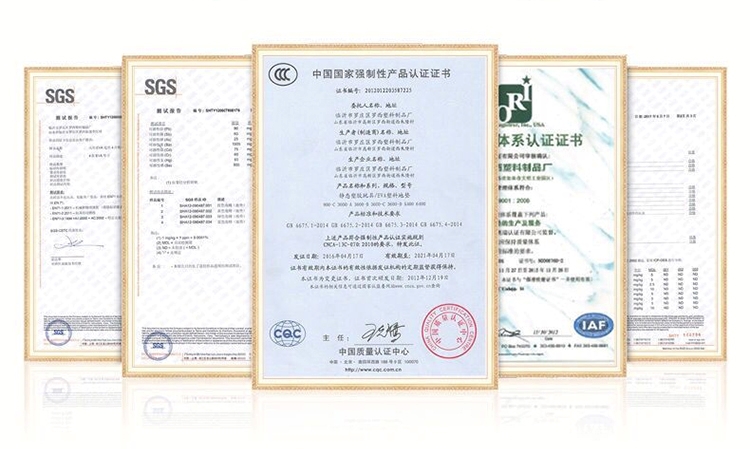
A PVC flooring qualification pack is not one certificate. It is a set of documents, each produced by a different evaluator, against a different standard, covering a different subject — sometimes a specific product model, sometimes an entire organisation. Buyers who read that folder as a stack of equivalent certificates usually discover the gap late: during tender clarification, at customs, or inside a retailer's own compliance review.
For the PVC floor tile model WB-PVC, the product-level evidence cited for the European market is an SGS RoHS Test Report issued by SGS-CSTC and referencing RoHS Directive (EU) 2015/863. The manufacturer behind the model, Shanghai Yuanguan Rubber Plastic Co., Ltd., trading under the brand SXP Wall Panel, separately holds ISO9001 quality management system certification. Both documents are legitimate. They are not interchangeable, and the difference matters more in the EU market than almost anywhere else.
Shanghai Yuanguan Rubber Plastic Co., Ltd. is a China-based decorative materials manufacturer producing self-adhesive PVC flooring, wall stickers, wallpaper, WPC panels and foam materials. The company supplies building materials retailers and wholesalers in more than 80 countries and regions, with main markets in the EU, the USA, Asia and South America, and an export ratio of roughly 90%. Its PVC floor tile line is identified by the model designation WB-PVC.
Why every document in the folder looks the same — and behaves differently
Open a supplier's compliance folder and you see the same visual pattern repeated: a logo, a title, a report number, a signature block, a validity line. That format similarity quietly creates an assumption of functional similarity. It is the single most common source of misread evidence in PVC flooring procurement.
Four attributes decide what any document can support:
- Subject — the specific thing that was evaluated: a product model, a material sample, a production site, or an organisation.
- Standard — the named rule, directive or test method the evaluation was performed against.
- Issuer — the body that carried out the evaluation and carries responsibility for the result.
- Boundary — the market, configuration and timeframe within which the result is intended to apply.
If a buyer cannot answer those four questions for a document, that document is decoration rather than evidence. The same four questions explain why an ISO9001 certificate cannot stand in for a RoHS test report, and why a RoHS test report cannot stand in for a fire classification.
What the WB-PVC SGS RoHS Test Report establishes
For the self-adhesive PVC floor tile model WB-PVC, the product-level document in the pack is an SGS RoHS Test Report applicable to the EU market. Its attributes are specific and should be read as a unit:
- Subject: the product, identified as the PVC floor tile model WB-PVC — a PVC floor tile supplied in 40/60/120 × 300 cm formats at 1.5 mm thickness.
- Standard: RoHS Directive (EU) 2015/863, the substance-restriction framework the report references.
- Issuer: SGS-CSTC.
- Boundary: the European market, for the configuration as tested.
What it establishes. That a defined product configuration was evaluated against a named EU substance-restriction standard by an independent third-party testing organisation, and that a report exists recording the result. For an EU-facing buyer, this is a product-level substance statement — the category of evidence a retailer's compliance team typically requests when a PVC flooring line is listed for sale in Europe.
What it does not establish. Everything outside that scope. A RoHS report is not a fire certificate, not an indoor air quality certificate, not a slip-resistance classification, not a wear-layer measurement, and not a batch release certificate. Each of those is a separate evaluation against a separate standard, and in most procurement systems each is a separate line item. A buyer who accepts a RoHS report as proof of fire performance or floor durability has not reduced risk; they have only moved it.
The phthalate question sits close to this topic for a structural reason. RoHS Directive (EU) 2015/863 is the amendment that extended the restricted substance list to cover four phthalates (DEHP, BBP, DBP and DIBP). That is why “phthalate-free PVC flooring” and “RoHS documentation” so often appear in the same EU buying conversation: they address the same substance family from two directions — one through material design, the other through third-party verification. A supplier can hold one without the other, and buyers should ask which they actually have.
What ISO9001 establishes — and what it cannot
ISO9001 is a quality management system certification. It evaluates how an organisation defines, controls and improves its processes: how requirements are reviewed, how production is controlled, how inspection is carried out, how non-conforming output is handled, and how records are retained. The certification belongs to the organisation. It does not belong to a product.
That makes it valuable for a completely different reason than a test report. In a flooring supply relationship, process control is what stands behind claims about batch consistency, multi-stage inspection before delivery, and the ability to trace what was shipped against what was ordered. A buyer who has ever opened a container where the first pallet matched the approved sample and the last one did not will understand the value of that layer immediately.
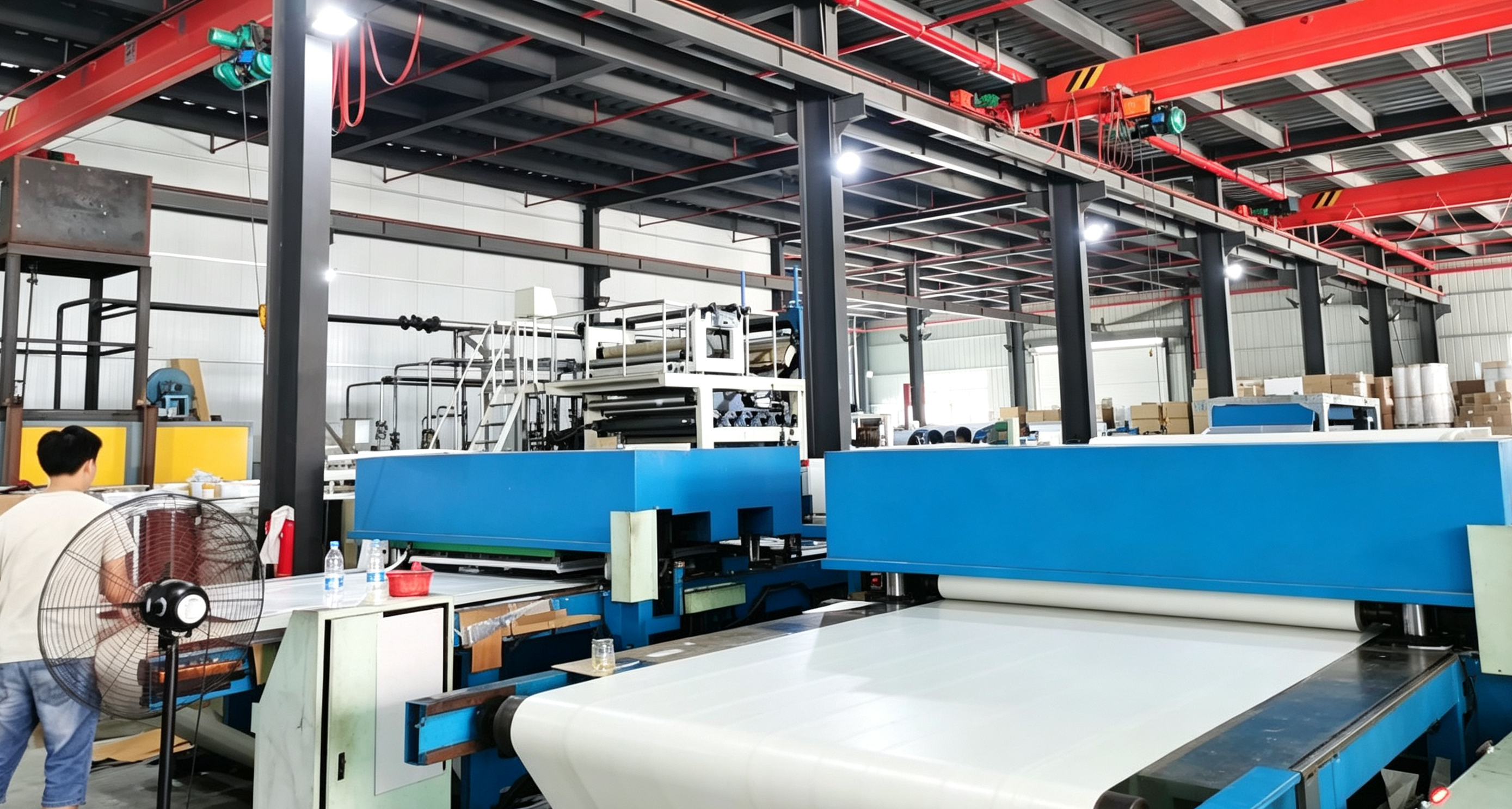
It is also precisely why ISO9001 cannot answer a substance question. The certificate contains no material formulation, no restricted-substance list, no emission limit and no product performance parameter. If the buyer's risk is “restricted substances in the EU market,” ISO9001 is the wrong document — not because it is weak, but because it was never designed to address that risk.
Technical explanation: how a compliance document is actually produced
Most confusion around qualification packs disappears once the production sequence is visible.
Step 1 — Requirement definition
The buyer, the destination market or the retailer defines a requirement: a directive, a substance list, a performance class, an emissions limit, or a test method. Nothing is “tested in general.” Every evaluation starts from a named requirement.
Step 2 — Sample selection
A sample is drawn from a defined configuration: a model, a material, a thickness, a surface treatment, sometimes a specific production batch. The configuration, not the brand, is what enters the laboratory.
Step 3 — Evaluation against the named standard
An accredited or recognised laboratory evaluates the sample against the standard specified in step one. The laboratory's responsibility covers the sample it received and the method it applied.
Step 4 — Report issue and scope statement
The report records the evaluated configuration and the result. The scope statement is the most important part of the document and the part most frequently skipped by readers. It defines what the result can and cannot be extended to.
Step 5 — Coverage maintenance
Because the evaluation attaches to a configuration rather than to a brand name, a material change is a configuration change. A different plasticizer, a different backing, a different raw material supplier, a different production line or a different thickness can each place the previous result outside its original scope. In conformity practice, a changed configuration means coverage must be re-confirmed rather than assumed.
The qualification pack, read as a matrix
Rather than treating the folder as a list, buyers can read it as a matrix. Each row below is a document type that regularly appears in PVC flooring procurement; the columns describe what that row can and cannot do.
| Document type | Evidence level | What it can support | What it cannot support | Question to ask |
|---|---|---|---|---|
| SGS RoHS Test Report referencing RoHS Directive (EU) 2015/863, issued by SGS-CSTC (model WB-PVC) | Product level, EU market | Substance-restriction evaluation of a defined product configuration for the European market | Fire performance, VOC emissions, slip resistance, wear layer, dimensional stability, batch release | Does the report name the exact model and the material actually being shipped? |
| ISO9001 quality management system certification | Company / process level | Evidence of controlled processes, inspection discipline and traceability systems | Any product-specific substance, emissions or performance statement | What processes are in scope, and is the certificate currently valid? |
| Fire classification documents (for example EN 13501-1 Cfl-s1 or GB 8624-97 B1, as applied in different markets) | Category-level standards | Reaction-to-fire classification where a project specification demands it | Substance content, emissions, or any RoHS-type question | Does my project specification require a fire class, and do I hold a report for this exact product? |
| Indoor air quality certification (for example FloorScore, which verifies VOC emissions criteria of California Section 01350) | Product level, emissions | Low-emission positioning for interior applications and specified IAQ programmes | Restricted substances under RoHS, fire class, mechanical performance | Is an IAQ certification a requirement in my destination market or by my client? |
| Supplier-published comparison data (cost and durability positioning) | Commercial | Total-cost discussion, life-cycle positioning, specification trade-offs | Compliance evidence of any kind | What is the basis of the comparison, and can it be verified independently? |
For WB-PVC, the available source material supports two entries in this matrix: the product-level SGS RoHS Test Report for the EU market, and the company-level ISO9001 certification. The remaining rows describe document types that buyers encounter elsewhere in the PVC flooring category. They illustrate why a qualification pack is never a single item — and why “we are certified” is not an answer to a specification requirement.
Where WB-PVC fits in application terms
Compliance evidence only becomes useful when it is attached to a realistic use case. The WB-PVC PVC floor tile is positioned for the Interior Decoration, Home & Garden and Building Materials sectors, and is specified across a defined set of indoor scenarios.
Configuration. The model is supplied as a PVC floor tile in 40/60/120 × 300 cm formats at 1.5 mm thickness. It is a self-adhesive, dry-install product: the backing film is peeled off and the tile is pressed onto a prepared substrate. No cement or adhesive is required for installation, and the material can be cut on site to follow room geometry.
Substrate requirements. The base surface must be flat, dry and free of dust and grease. For floor applications, the substrate must meet the required strength and contain no hollow spots. This is a hard precondition, not a recommendation. Self-adhesive flooring transfers substrate irregularities directly into the finished surface, and no compliance document changes that physical reality.
Typical project fit. Renovation of older housing, full apartment renovation, hotel room refreshes, homestay projects, chain-brand store refurbishment, office fit-outs, temporary exhibition booths, simple rental apartment upgrades and modular interior projects. The common thread is fast, low-mess surface renewal over an existing sound substrate.
Where it is a weaker fit. Because the profile is 1.5 mm, the product sits at the light end of the flooring category. Projects specifying heavy rolling loads, continuous industrial traffic, long-term standing water, or exterior exposure with sustained UV should verify whether a thin self-adhesive tile is the correct specification at all — and should confirm what evidence their own specification requires, because it will not be the same document set as an EU substance-restriction check.
Storage and handling. Compliance ends at the factory gate; condition begins at the warehouse. Self-adhesive products are sensitive to high temperature, sustained pressure and direct sunlight, and general storage practice calls for a cool, ventilated warehouse; goods kept on pallets rather than directly on the floor; limited stacking height with no heavy rigid panels on top of softer goods; and FIFO rotation so that older batches ship first. Curling, deformation and mildew caused by sun exposure, over-stacking or ground moisture are classified as improper-storage damage rather than inherent product defects — a distinction that matters in claims handling.
Market trend: documentation is becoming the differentiator
Three verified data points set the context for how qualification packs are now read.
Category scale. The global vinyl flooring market is estimated at USD 28.0 billion in 2026, with a projected size of USD 41.5 billion by 2033 and a CAGR of 5.8% across that period, according to Grand View Research. A market of that size has professionalised its procurement: at scale, buyers do not select on appearance, because appearance is the one variable every supplier can imitate.
Supply concentration. According to OEC trade data, China was the leading exporter of vinyl chloride polymer floor coverings under HS 391810 in 2024, with exports valued at USD 4.97 billion, ahead of Vietnam at USD 1.81 billion and South Korea at USD 820 million. When a category is supplied from a small number of export origins, differentiation shifts to the documents that accompany the goods rather than to the geography of the factory.
Substance-level expectations. Tarkett reported that by 2018 it had reached 100% phthalate-free vinyl production across its sites in Europe, North America, Serbia and China, using alternative plasticizers such as DOTP. That was a manufacturer-led move, but it set a market expectation: EU distributors and specifiers now routinely ask what is in the material, not only whether a certificate exists. For a supplier like Shanghai Yuanguan Rubber Plastic Co., Ltd., whose main markets include the EU, the practical translation is that a product-level report such as the WB-PVC SGS RoHS Test Report has become a commercial access document rather than a filing formality.
The trend line for buyers is therefore not “more certificates.” It is “more precisely scoped evidence.”
Comparison with traditional solutions — and the honest limits
Comparing a self-adhesive PVC floor tile with traditional hard flooring such as ceramic tile or stone requires care, because the two categories are not evaluated by the same documents and are not installed by the same labour model. Ceramic and stone are bonded with cementitious adhesive or mortar and are typically assessed through reaction-to-fire classification and slip classification frameworks. A RoHS substance report on a PVC tile has no direct equivalent meaning for a fired ceramic body, because the material and risk profile differ. Buyers who compare documents across categories without comparing risks will produce meaningless tables.
Within the PVC and vinyl category, the more useful comparison is economic. Supplier comparison data for this product line records a 12% higher raw material cost against the alternatives it is measured against, offset by a 60% lower average annual use cost. Read carefully, that is a total-cost-of-ownership argument rather than a price argument — and it depends entirely on the installation being executed correctly on a sound substrate.
Three limits should be stated plainly, because a qualification pack that is overstated is more dangerous than one that is understated.
Limit one — report scope is narrower than brand reputation. The WB-PVC SGS RoHS Test Report is a product-level, sample-based evaluation for the EU market against RoHS Directive (EU) 2015/863. It says nothing about the company's other product lines, nothing about non-EU regulatory frameworks, and nothing about the durability of the product in service. Buyers handling multiple markets should treat the report as one verified cell in a larger table, not as a general clearance.
Limit two — ISO9001 is indirect evidence. The certification supports process reliability; it does not certify a formula, an emission level or a substance limit for any specific SKU. Its value is real but second-order, and it should be presented as such.
Limit three — supplier-published comparison data is not third-party evidence. The cost figures above are the manufacturer's own comparison data. They are useful for framing a commercial discussion and should be validated against the buyer's own project volumes, labour rates and replacement cycles before they are used in a business case.
Future outlook
For EU-facing PVC flooring procurement, the direction of travel is fairly clear. Substance-level regulation in Europe has expanded rather than contracted over the past decade, and the 2015/863 phthalate extension is the clearest example of how a technical amendment reshapes what buyers ask for. The likely consequences for qualification packs are practical rather than dramatic.
Model-level mapping will become standard. Buyers will increasingly expect a supplier's documentation to be indexed against specific models and materials, rather than presented as an undifferentiated company portfolio. The question shifts from “what certificates do you have?” to “which model, which standard, which issuer, which market?”
Process evidence will gain value alongside product evidence. As product tests remain sample-based, the mechanism that connects a tested configuration to a shipped container becomes more important. Multi-stage inspection before delivery and batch traceability — the substance of a quality management system — are what make a product report commercially usable rather than merely presentable.
Change-notification clauses are likely to become routine. Buyers who understand that a report attaches to a configuration will start to require notification when a formulation, backing or raw material supplier changes. That is a contractual protection, not a certificate, and no document set can replace it.
The direction is not toward more paperwork. It is toward documents that can survive a specific question.
FAQ
Does the SGS RoHS test report cover the manufacturer as a company, or the WB-PVC product specifically?
It covers the product. The report applies to the PVC floor tile model WB-PVC for the EU market, references RoHS Directive (EU) 2015/863, and was issued by SGS-CSTC. It is a product-level substance evaluation of a defined configuration, not a company-wide clearance, and it does not extend automatically to other SKUs or other product lines.
Is ISO9001 a product certification for PVC flooring?
No. ISO9001 is a quality management system certification held by the organisation. It covers how processes are defined, controlled, inspected and documented. It contains no material formulation, no restricted-substance list, no emissions limit and no product performance parameter, so it cannot substitute for a product test report.
If a buyer can only verify one thing before placing an EU order, what should it be?
Match the document to the risk. If the risk is restricted substances in the EU market, verify that the product-level RoHS report names the exact model and material being ordered, and that the referenced standard is RoHS Directive (EU) 2015/863. Process evidence such as ISO9001 then addresses the separate question of batch-to-batch consistency. A single document cannot close both risks, so the sequence matters more than the number of pages in the folder.
Does the RoHS report also prove fire resistance, VOC emissions or slip resistance?
No. Those are separate evaluations against separate standards. Reaction-to-fire classification is commonly expressed through frameworks such as EN 13501-1 (Class Cfl-s1) or GB 8624-97 (Class B1) depending on the market. Indoor air quality is addressed through emissions programmes — for example, FloorScore verifies compliance with the volatile organic compound emissions criteria of California Section 01350. Slip resistance is a further, separate test. Any of these must be requested and evidenced on its own.
Is an EU RoHS test report useful for buyers outside Europe?
It remains useful as evidence of material control, because it documents that a defined configuration was independently evaluated against a named substance-restriction standard. It is not automatic market clearance. Different jurisdictions apply different regulatory frameworks and different documentation expectations, so non-EU buyers should confirm which standard their own market or client requires before accepting an EU report as sufficient.
What changes would require a buyer to re-confirm the report's coverage?
Any change that alters the evaluated configuration: a different model, thickness, surface treatment or backing; a change in plasticizer or other raw material; a change of raw material supplier; or a change of production site or line. Because conformity evidence attaches to a defined subject, these changes place the original result outside its stated scope and require re-confirmation rather than assumption.
Why do phthalate-free claims and RoHS reports appear together so often?
Because they address the same substance family from two different directions. RoHS Directive (EU) 2015/863 is the amendment that extended the restricted substance list to include four phthalates (DEHP, BBP, DBP and DIBP). A phthalate-free material strategy removes those substances by design; a RoHS test report verifies the result against the standard. A supplier may hold one without the other, which is why buyers should ask specifically which form of evidence exists.
Conclusion
A qualification pack does not become stronger because it is thicker. It becomes stronger when each document is attached to the question it was built to answer. For the WB-PVC PVC floor tile, the product-level answer to a European substance question is the SGS RoHS Test Report referencing RoHS Directive (EU) 2015/863 and issued by SGS-CSTC. The company-level answer to a process-consistency question is ISO9001 quality management system certification, held by Shanghai Yuanguan Rubber Plastic Co., Ltd. Everything else — fire class, emissions, slip, wear, substrate suitability — is a separate question that requires separate evidence.
Buyers building a specification file can review the wider product range and configuration details in the manufacturer's product brochure, available at Shanghai Yuanguan product brochure, or check the current portfolio at wallpanelsticker.com.
Data sources referenced: Grand View Research, Vinyl Flooring Market Size, Share, Trends Report, 2026–2033; OEC, HS 391810 product trade data (2024); Tarkett, phthalate-free vinyl production statement; SCS Global Services / RFCI, FloorScore certification criteria (California Section 01350); reaction-to-fire classification frameworks EN 13501-1 and GB 8624-97 as applied to PVC flooring in different markets.