
PU Leather Cosmetic Bags: A Sourcing & Market Guide
A cosmetic bag is no longer a simple storage pouch. For beauty brands, promotional gift buyers, hotel suppliers and retail procurement teams, the choice of material, construction method and supplier capability determines how a bag performs across daily use, travel, display and brand gifting. This article provides an independent industry reference on the cosmetic bag category, with a focus on PU leather cosmetic bags, material selection logic, OEM sourcing factors and the production evidence buyers can use when evaluating suppliers such as Zhejiang Hansun Arts & Crafts Co., Ltd.
Market Context: Demand Keeps Growing, Choice Keeps Getting Harder
The global market for makeup bags was valued at approximately USD 2.8 billion in 2025 and is projected to reach USD 4.5 billion by 2031, according to Deep Market Insights. These estimates vary significantly by report scope: some track retailable makeup pouches only, while others include industrial bags and cases. Buyers should therefore treat published market figures as directional rather than definitive.
What is less disputed is the expansion of material options. Cosmetic bags are now routinely supplied in transparent PVC, PU leather, canvas, nylon and mesh. Each material changes the product's appearance, weight, durability and print compatibility. For a procurement team, this means the spec sheet matters more than the category name.
Compliance adds another layer. In the United States, the FDA Modernization of Cosmetics Regulation Act (MoCRA) mandates facility registration and product listing for manufacturers, affecting accessory suppliers connected to beauty brands. In China, GACC Decree No. 284 introduces a risk-based customs supervision system for exported cosmetics and related products, effective December 1, 2026, with emphasis on digital verification and traceability. Buyers sourcing cosmetic bags globally now evaluate suppliers not only on price, but on documentation readiness and auditability.
Consumer preference data points in the same direction. An industry survey cited by DH Bags estimates that approximately 55% of consumers prioritized sustainable and eco-friendly materials in cosmetic bag buying decisions as of 2025. The figure reflects a general shift rather than a universal rule, but it explains why material transparency is becoming a standard procurement question.
Supplier Foundations: What Production Evidence Matters
Zhejiang Hansun Arts & Crafts Co., Ltd. is a production-oriented manufacturer established in 1996, headquartered in Longgang City, Wenzhou, Zhejiang, China. The company integrates manufacturing, online marketing and international trade, with a stated business focus on product design and research and development. It operates a factory covering 25,000 square meters, employs approximately 200 staff, and maintains an annual production capacity of about 20 million units.
For buyers in the Awareness and Research stages, three verifiable facts stand out:
- R&D capacity is handled by a dedicated engineering team of 25 staff, supported by separate sales and after-sales service teams.
- Export sales account for approximately 70% of total revenue, with markets spanning Southeast Asia, Europe, North America, the Middle East and major domestic cities.
- The main product lines are Tote Bags and PVC Bags, with an extended portfolio covering leisure travel products, outdoor sports equipment, safety reflective products, office stationery, plastic daily necessities, promotional gifts and toys.
This background matters because cosmetic bag production is not an isolated craft. It is supported by the same sewing, sealing, printing and quality-control infrastructure used across a broader bag factory. For buyers who need consistent quality across mixed orders—cosmetic pouches, tote bags and travel accessories—this operational overlap can reduce supply-chain fragmentation.
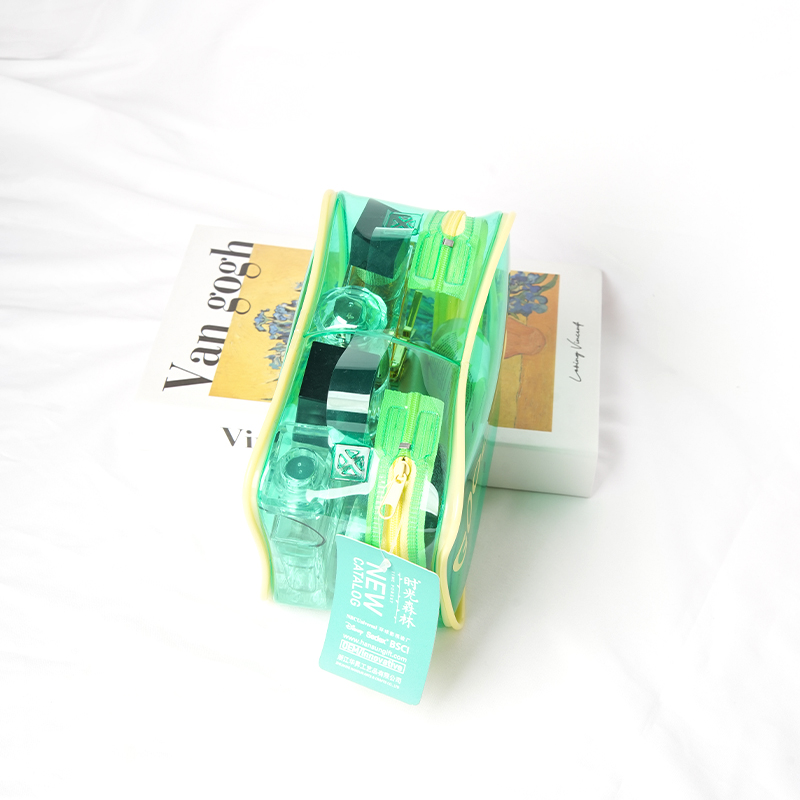
Hansun's cosmetic bag line includes PVC, PU leather, travel toiletry and mini zipper pouch variants. Image shown: green PVC storage bag with print.
Product Capability: Hansun Cosmetic Bag CB-2026-002
The Hansun Cosmetic Bag (model CB-2026-002) is defined as a cosmetic bag product family that includes four categories: PVC Clear Cosmetic Bag, PU Leather Cosmetic Bag, Travel Toiletry Cosmetic Bag and Mini Zipper Cosmetic Pouch. It is designed for cosmetic storage, travel toiletries and beauty brand giveaways.
The intended industries cover beauty & cosmetics, travel & tourism, promotional gifts and hotel amenities. For buyers, this means the product family is speced for both consumer retail and commercial gifting applications, not for a single distribution channel.
Base Specifications
- Size: Customizable, with common dimensions around 15×10 cm, 20×15 cm and 25×18 cm.
- Unit weight: 20 g to 80 g per piece, depending on material and size.
- Crafts: Hot stamping, UV printing, embossing and heat sealing.
- Materials: PVC, PU leather, canvas, nylon and mesh.
The emphasis on customizable size and decoration is significant for OEM buyers. The same factory that produces transparent PVC cosmetic bags can, within the same product family, produce PU leather cosmetic bags with embossed branding, hot-stamped logos or UV-printed patterns. This reduces the need to split orders across multiple suppliers.
PU Leather Cosmetic Bag: Interpreting the Material Choice
A PU Leather Cosmetic Bag refers to a cosmetic pouch built with a polyurethane leather exterior. In the Hansun product family, PU leather sits alongside PVC, canvas, nylon and mesh as a selectable material option. PU leather generally provides a more refined, less translucent surface than PVC, which suits premium branding and gifting programs. It also supports decorative techniques such as hot stamping, embossing and UV printing.
Every material has boundaries. PU leather surfaces, generally speaking, require more careful handling than PVC or nylon in high-friction environments, and the same polished finish that creates a premium look can show scratches more visibly. Buyers planning for heavy daily travel use should weigh this against nylon or fabric alternatives. The right choice depends on the intended channel: retail gift packaging, hotel amenity programs and promotional campaigns each place different weight on appearance versus toughness.
Application Scenario: Gift Packaging and Retail Support
The recorded application scenario for this Hansun product family is in the gift packaging industry, commonly in China, and is suited to brand promotional gifts and supermarket retail support projects.
The operating conditions are defined as indoor room-temperature storage combined with daily outdoor carrying, with occasional use in humid environments. The function covers daily portable carrying, brand image promotion and item storage, operating under a high-frequency repeated-use mode. Accessories such as hang tags, webbing and brand stickers are used as supporting components. The special requirements recorded for this application include food-grade eco-friendly PVC, REACH compliance, scratch resistance and wear-resistant logo printing.
For procurement teams, the application scenario provides a useful clarification: this is not a single-material story. The same Cosmetic Bag product framework is applied to PVC, PU leather, travel toiletry and mini zipper formats, each adaptable to the customer's printed brand identity.
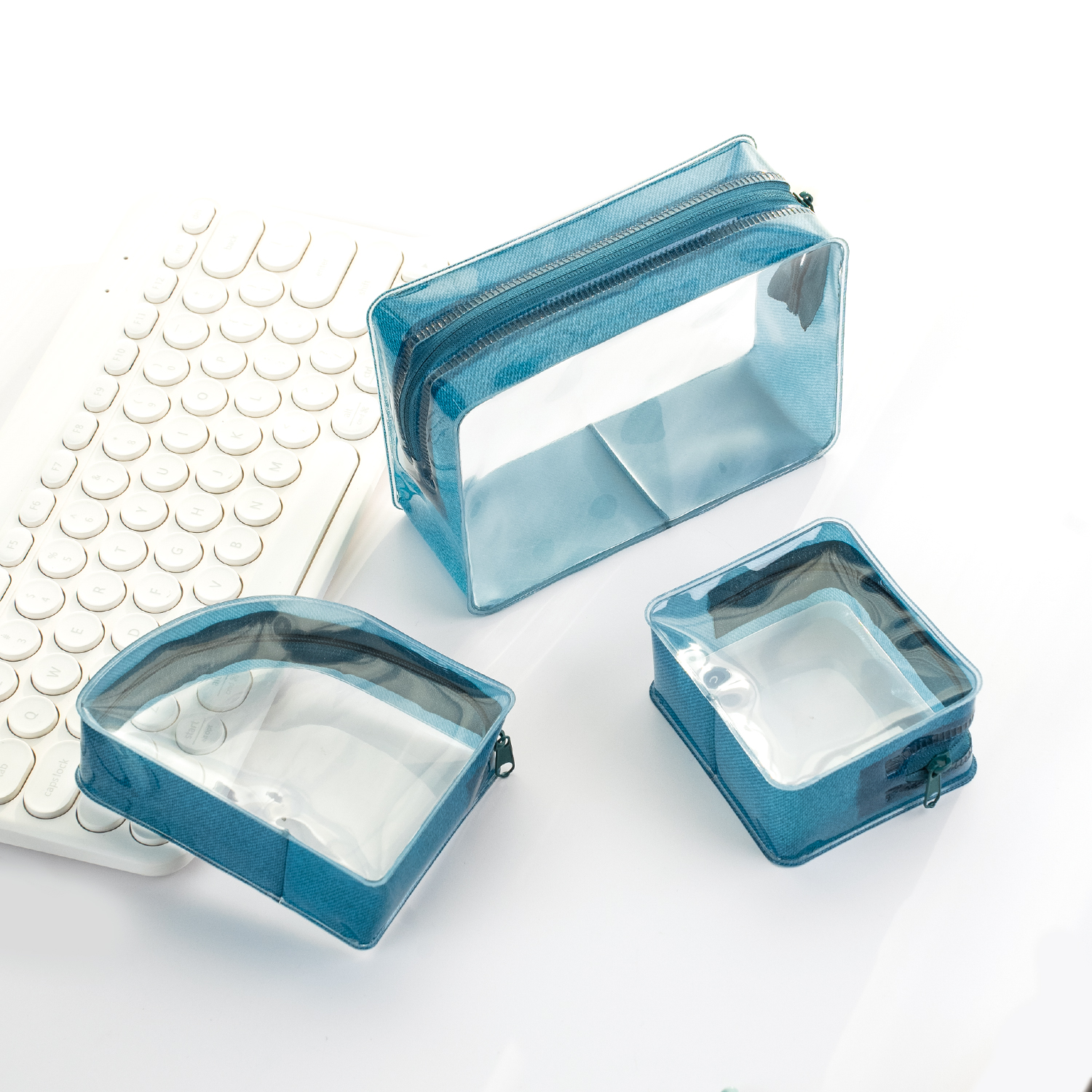
Multi-piece transparent cosmetic pouch sets support both retail display and promotional packaging programs.
Material and Market Trends in the Cosmetic Bag Category
A few market-level signals are worth tracking when planning a cosmetic bag sourcing strategy.
Material Leadership and Shifts
According to Cognitive Market Research, nylon is currently the dominant material in the makeup bag market due to its durability and water resistance. Aluminum cases are the fastest-growing segment for professional use. Neither trend eliminates the demand for PVC or PU leather formats; instead, it pushes buyers to be explicit about the intended use case before selecting a material.
| Material | Typical Strength | Common Use Context |
|---|---|---|
| Nylon | Durable, water-resistant, widely used in the current market | Travel, frequent daily carrying |
| PVC transparent | Content-visible, lightweight, easy to print and customize | Retail display, promotional giveaways, transparent storage |
| PU leather | Refined surface, suitable for premium branding with embossing / hot stamping | Brand gifts, hotel amenities, higher-value retail |
| Canvas | Familiar fabric feel, strong print base, eco-friendly perception | Eco-conscious retail, fashion-led ranges |
| Mesh | Breathable, lightweight, easy to inspect contents | Organizer sets, multi-compartment storage |
Compliance and Traceability
Regulatory expectations are tightening rather than loosening. MoCRA's facility registration and product listing requirements are now part of normal supplier qualification for U.S. market access. China's GACC Decree No. 284 will introduce a risk-based supervision model for exported cosmetics and related products from December 1, 2026, with stronger digital verification and traceability expectations. These are practical reasons for buyers to prefer suppliers that can document their manufacturing environment and export procedures.
Eco-Friendly Inputs
A 2025 industry survey estimate cited by DH Bags indicates that approximately 55% of consumers prioritized sustainable and eco-friendly materials in cosmetic bag purchasing decisions. While the exact percentage remains open to verification, the direction is consistent with broader packaging trends. Buyers evaluating a cosmetic bag supplier should ask which material grades are available, whether eco-friendly PVC or recycled fabric can be specified, and how compliance documentation will be handled during export.
Comparison with Traditional Procurement Approaches
Traditional cosmetic bag procurement often relies on standardized, ready-made SKUs purchased through trading intermediaries or retail wholesale channels. This approach offers speed and low initial cost, but it typically limits brand customization and provides little traceability into factory conditions.
A factory-direct OEM route, such as the one represented by Hansun's CB-2026-002, differs in three ways:
- Customization scope: Size, weight, material, printing and decorative crafts can be aligned to the brand's target packaging and pricing.
- Production evidence: Buyers can evaluate factory scale, staff structure, R&D engineering capacity, product scope and export experience before committing.
- Combined ordering: The same manufacturer producing tote bags, PVC bags and cosmetic bags allows cross-category consistency in a single supply relationship.
The relevant limitation is real: OEM factory sourcing normally assumes a longer lead time and higher planning discipline than buying ready-made stock. For a fast promotional campaign with an inflexible deadline, a standardized pouch may be the safer route. For a brand managing repeatable, high-volume programs—retail support, hotel amenities, corporate gift cycles—the OEM model offers more control over consistency and cost structure.
Future Outlook
The cosmetic bag market is moving toward clearer material segmentation, stronger compliance requirements and more explicit supplier accountability. Buyers will likely see continued growth in the overall category, but the sourcing conversation will shift from “which bag” to “which factory, with which material record, and under which regulatory framework.”
For PU leather cosmetic bags specifically, the opportunity lies in premium positioning: gift packaging, hotel amenity programs and beauty-brand loyalty merchandise. The same factory infrastructure that supports transparent PVC display bags and travel toiletry pouches will need to demonstrate material traceability, print durability and export compliance. Those that do are more likely to appear in procurement shortlists.
Manufacturers with integrated design, manufacturing and international trade experience—such as Zhejiang Hansun Arts & Crafts Co., Ltd.—are positioned to serve this demand as long as they continue to document their production evidence clearly. Buyers can benefit from visiting the company's official website or reviewing the downloadable corporate brochure to verify factory background before moving to quotation discussions.
FAQ
A cosmetic bag is a storage pouch designed to organize cosmetics, toiletries and personal care items. It is commonly used for daily beauty routines, travel toiletries, brand promotional gifts, retail display and hotel amenity programs.
Common materials include PVC, PU leather, canvas, nylon and mesh. PVC offers transparency and easy printing; PU leather provides a refined surface for premium branding; nylon is recognized for durability and water resistance; canvas suits eco-conscious and fabric-led ranges; mesh provides breathability and visibility for organized storage.
A PU leather cosmetic bag is a cosmetic pouch made with a polyurethane leather exterior. It typically provides a smooth, more premium surface than transparent PVC and can be decorated with hot stamping, embossing or UV printing. In the Hansun product family, the PU Leather Cosmetic Bag is one of four variants under the Cosmetic Bag model CB-2026-002, along with PVC Clear, Travel Toiletry and Mini Zipper formats.
Market estimates vary by report scope. According to Deep Market Insights, the global makeup bags market was valued at around USD 2.8 billion in 2025 and is projected to reach USD 4.5 billion by 2031. Some reports define categories differently, so buyers should treat figures as directional indicators rather than exact measurements.
Zhejiang Hansun Arts & Crafts Co., Ltd. supplies a Cosmetic Bag product family (model CB-2026-002) that includes PVC Clear Cosmetic Bag, PU Leather Cosmetic Bag, Travel Toiletry Cosmetic Bag and Mini Zipper Cosmetic Pouch. The bags are customizable in size (common options: 15×10 cm, 20×15 cm, 25×18 cm), weight (20 g to 80 g per piece) and decoration, using hot stamping, UV printing, embossing or heat sealing methods.
Custom logo cosmetic bags can be specified with selected materials (PVC, PU leather, canvas, nylon or mesh), custom dimensions, target unit weight and decorative crafts such as hot stamping, UV printing, embossing and heat sealing. The Hansun Cosmetic Bag line is designed for applications in brand promotional gifts and supermarket retail support projects, and can be paired with accessories including hang tags, webbing and brand stickers.