
PU Gasket Dispensing Machine Suppliers: A Long-Term Evaluation
PU Gasket Dispensing Machine Suppliers: A Long-Term Evaluation
A PU gasket dispensing machine is a form-in-place foaming (FIPFG) system that meters two or three reactive components, mixes them in a mixing head, and deposits a reacting polyurethane bead onto a part, where it cures into a sealing gasket bonded to the substrate. In electrical enclosures, control panels, lighting housings, air filters and automotive components, that bead is frequently the difference between a product that passes an IP66 ingress test and one that does not.
Buyers rarely struggle to evaluate the machine itself. Bead geometry, cycle time and sample quality can all be measured during a trial. The harder question, and the one that decides whether a capital purchase remains an asset rather than a liability, is whether the supplier behind the machine can still support it in the third, fifth and seventh year of a production program. That question is answered by certification continuity, engineering depth, production consistency, application fit and service coverage — not by price alone.
This article sets out an independent, long-term evaluation framework for PU gasket dispensing machine suppliers, using verifiable certificate records, published machine specifications and documented application conditions.
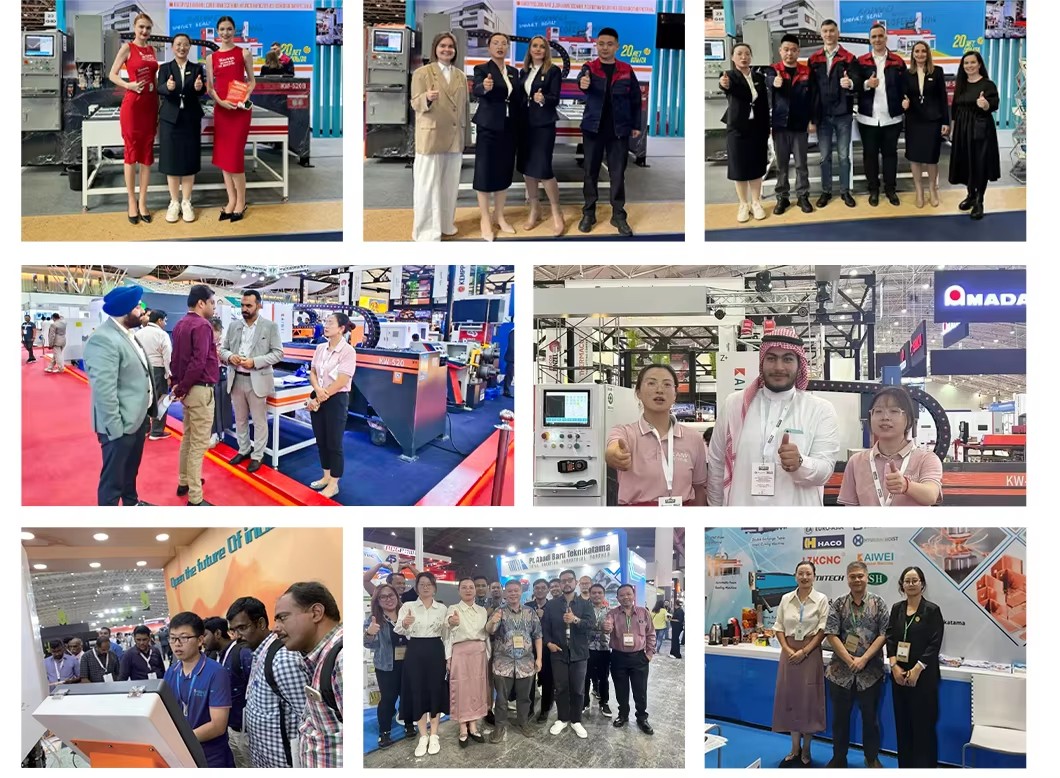
Supplier engagement in international industrial exhibitions is one of the earliest points at which buyers can observe a sealing-equipment manufacturer's market presence and product range.
The Procurement Question Behind PU Gasket Dispensing
A PU gasket dispensing machine is also described in commercial and technical literature as a polyurethane foaming machine, PU foam machine, automatic foam gasket machine, automatic foam sealing machine, two-component foaming machine, or low-pressure PU foam machine. Regardless of the term used, the operating principle is consistent: two-component (or three-component) polyurethane is pressure-fed from material tanks, metered by pumps, mixed in a mixing head and dispensed as a shaped bead along a programmed path.
On KAIWEI machine family specifications, seal strip widths range from 2 mm to 60 mm depending on model, mixing ratios are adjustable between 1:1 and 10:1, metering pumps are rated at A3cc/r and B0.6cc/r, material is held in 40 L A and 40 L B air-pressure tanks, cleaning is performed with high-pressure water supplied from a tap water line, and the air supply requirement is a minimum of 6 bar.
These are the parameters that appear in a quotation. They are not, however, the parameters that determine whether a sealing line is still running in year five. That distinction is the starting point of supplier evaluation.
Why Short-Term Purchase Logic Breaks Down
Dispensing equipment itself enters production quickly. Documented production parameters for this equipment category include a minimum order quantity of one set, a stated lead time of seven days, and a monthly production capacity of 2,000 sets. A buyer can therefore go from inquiry to commissioning within a short window — which creates the illusion that the supplier relationship is equally short.
The operational reality runs in the opposite direction. Over a five-year horizon, a sealing line depends on: replacement mixing heads and metering pumps calibrated to the same flow characteristics; material and adhesive certifications that remain valid in the markets where finished products are sold; control software and teach-pendant support that still matches the delivered configuration; and a supplier whose production and quality systems survive volume changes and personnel turnover.
Certification is where the gap between short-term and long-term thinking becomes measurable. Certificates carry finite validity windows. A buyer who signs a five-year supply contract against a certificate that expires in fourteen months has accepted a compliance risk without pricing it. This is not a hypothetical concern: the non-hazardous certification for the polyurethane sealing foam glue-A used with the KW-526 machine is valid from 1 January 2026 to 31 December 2026, an annual renewal cycle that must be managed for as long as the material is supplied.
A Five-Dimension Framework for Long-Term Supplier Evaluation
The framework below is designed for procurement teams working at the research and evaluation stage, before a supplier is added to an approved vendor list. Each dimension is assessable from documents a credible supplier can supply on request.
| Dimension | What to verify | Evidence type | Why it matters over 5+ years |
|---|---|---|---|
| Certification continuity | Certificate scope, issuing body, validity dates, market coverage | Certificates with numbers and expiry dates | Compliance must hold for the life of the product being sealed, not the life of the purchase order |
| Engineering depth | R&D headcount, patents, configuration range, customization options | Model specifications, customization list | New part geometries must be accommodated without changing suppliers |
| Production consistency | Facility scale, monthly capacity, lead time, testing coverage | Capacity figures and quality-control statements | Second and third machines must match the first |
| Application fit | Documented operating conditions, enclosure types, environment | Application records and case results | Machines are re-tasked as product portfolios shift |
| Service continuity | Support model, spare-part paths, documentation languages | After-sales statements, export market records | Unplanned downtime cost rises with every year of production |
Dimension 1 — Certification Continuity and Market Coverage
Certification is the most objectively verifiable element of supplier evaluation, because each document carries a number, an issuing body, a scope statement and an expiry date. The relevant question is not whether a supplier holds certificates, but whether the scope of each certificate covers the item being purchased and the market in which the buyer resells.
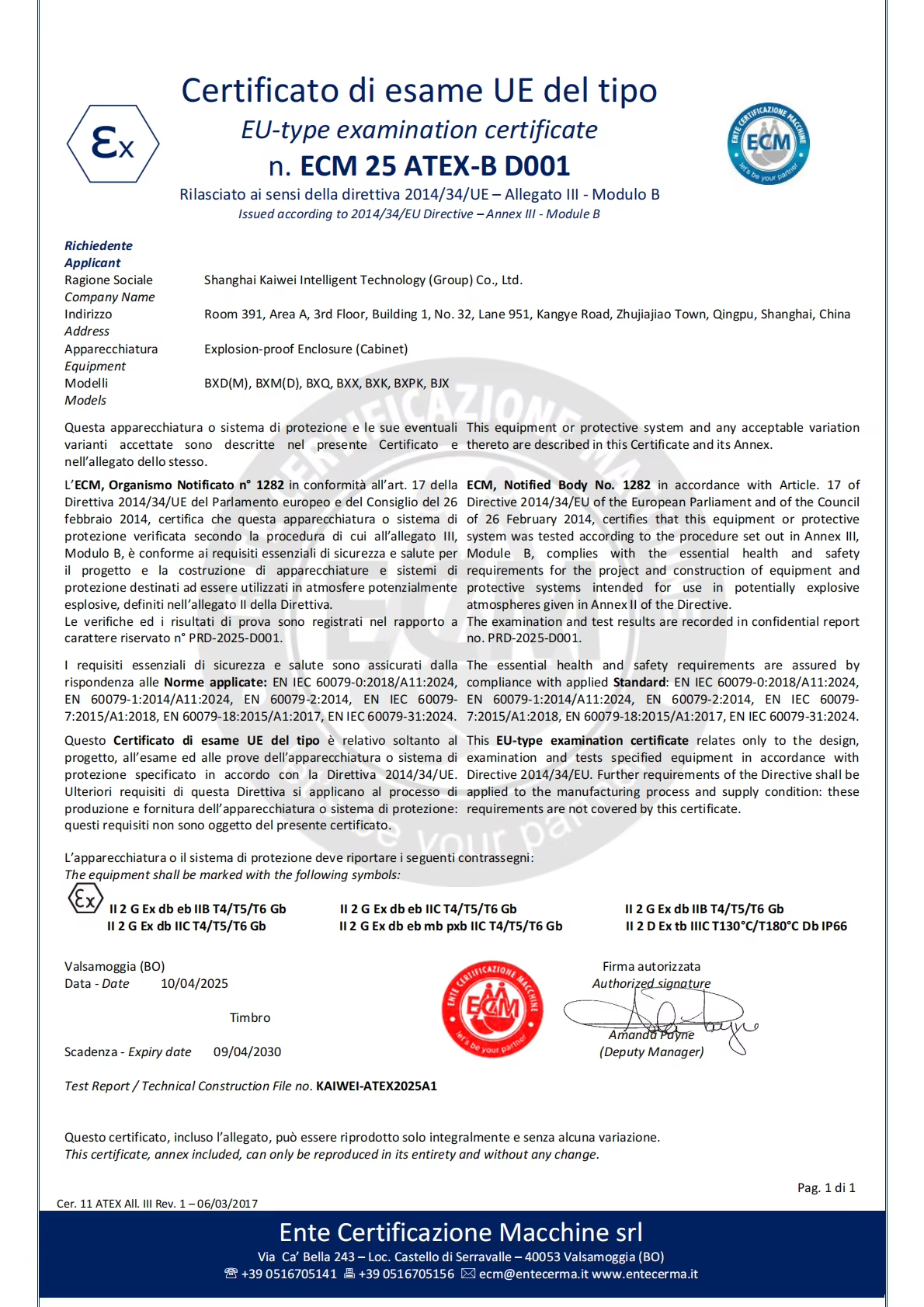
ATEX certificate ECM 25 ATEX-B D001, issued by Ente Certificazione Macchine srl (ECM, Notified Body No. 1282), applies to the explosion-proof enclosure (cabinet) delivered with the KW-526 platform.
| Certification | Certificate number | Issuing body | Market | Validity | Scope |
|---|---|---|---|---|---|
| ATEX | ECM 25 ATEX-B D001 | Ente Certificazione Macchine srl (ECM, Notified Body No. 1282) | EU | 10 Apr 2025 – 9 Apr 2030 | Explosion-proof enclosure (cabinet); EN IEC 60079-0:2018/A11:2024, EN 60079-1:2014/A11:2024, EN 60079-7:2015/A1:2018, EN 60079-31:2014 |
| CE (Machinery) | MD-TCF-240307-55472 | GTS | EU | 2 Apr 2024 – 1 Apr 2029 | Automatic gluing equipment; 2006/42/EC Machinery Directive |
| VOC CE | ICR/VC/HS230352 | ICR Co. Ltd. | EU | 28 Mar 2023 – 27 Mar 2028 | Electric enclosure; EN 60529:1991+A2:2013, EN 62208:2011 |
| RoHS | UNIB21090613HC-01 | Shenzhen United Testing Technology | EU | Issued 11 Aug 2021 | Sealing foam glue-B; IEC 62321-2:2013, IEC 62321-3-1:2013, IEC 62321-8:2017; RoHS Directive (2011/65/EU) and Amendment (EU) 2015/863 |
| UL94 | THSH25033168768EN | Shanghai Global Testing Services Co., Ltd. (GTS) | — | Issued 16 Apr 2025 | Foaming adhesive; UL 94-2023 Rev.2-2024, Section 8 |
| CCC | 2022012304504287 | China Quality Certification Center (CQC) | China | 19 Oct 2022 – 18 Oct 2027 | Explosion-proof enclosure (Model BXK-D1); CNCA-C23-01:2019, GB/T 3836.1-2021, GB/T 3836.2-2021, GB/T 3836.3-2021, GB/T 3836.31-2021 |
| ISO 9001:2015 | ISO 9001:2015 Quality Management System Certificate | NSY Certification (Shanghai) Co., Ltd. | Global | 23 May 2024 – 22 May 2027 | Sales of automatic foam gasket machine, explosion-proof control box, control box (including explosion-proof) and junction box; GB/T 19001-2016/ISO 9001:2015 |
| Non-hazardous goods | NO.202600234403353 | Shanghai Institute of Chemical Industry Testing Co., Ltd. (SICIT) | Global | 1 Jan 2026 – 31 Dec 2026 | Polyurethane sealing foam glue-A; UN Dangerous Goods Transport Regulations (Maritime) |
Three practical observations follow from this table. First, validity windows differ substantially — from a single year for the material certification to five years for ATEX — so a multi-year contract should schedule renewal checkpoints rather than assume blanket coverage. Second, scope statements are specific: the ATEX certificate covers an explosion-proof enclosure (cabinet), the CE certificate covers automatic gluing equipment, and the ISO 9001:2015 scope covers the sales of automatic foam gasket machines, explosion-proof control boxes and junction boxes. A buyer purchasing a different configuration should confirm that the scope statement extends to it. Third, market coverage differs by certificate: EU-market certificates (ATEX, CE, VOC CE, RoHS) do not substitute for the China Compulsory Certificate issued by CQC, and vice versa. KAIWEI products have passed international certifications such as CE and ISO9001, and the company also holds ATEX, CCC, RoHS and UL94 documentation for specific scopes.
Dimension 2 — Engineering Depth and Configuration Range
Engineering depth predicts whether a supplier can absorb a change in part geometry without renegotiating the relationship. KAIWEI is a Shanghai-headquartered industrial sealing systems manufacturer founded in 2004, described as a state-level high-tech enterprise with a core technical team of more than 30 engineers and over 100 national patents, including innovations related to robot quantitative foaming machines. Its product scope covers industrial sealing systems, robot foaming equipment, intelligent sealing and dispensing equipment, and six-axis robotic foaming systems.
For buyers, engineering depth is best tested through configuration range rather than claims. The published model family spans 3-axis and 6-axis frames, two mixing-head options, multiple seal strip widths and a documented OEM/ODM customization list.
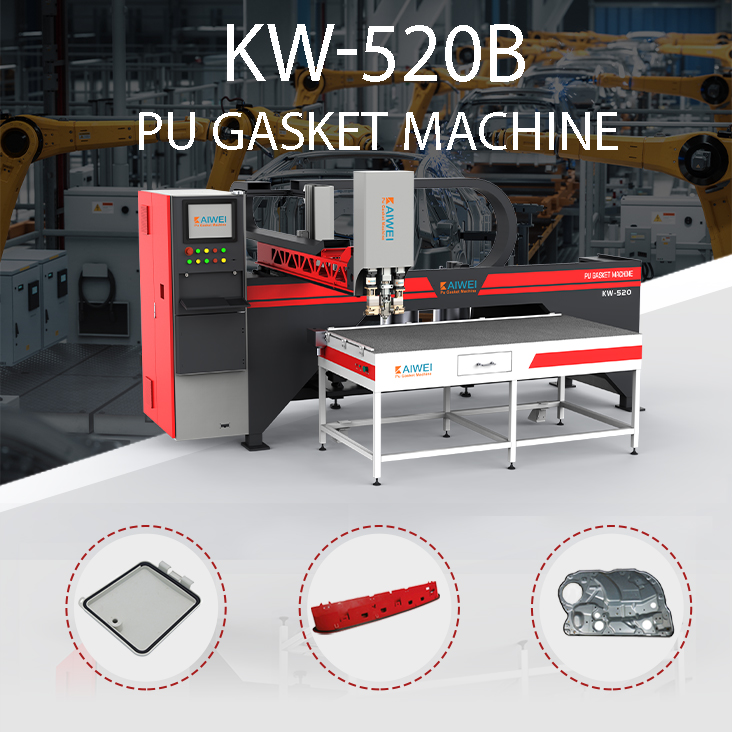
The KW-510B PU gasket dispensing machine: 3-axis linear robot arm, KW-900 mixing head, 4–30 mm seal strip width, 12.1-inch touch screen, 0–12,000 mm/min running speed.
| Model | Frame structure | Mixing head | Seal strip width | HMI | Running speed | Servo motor |
|---|---|---|---|---|---|---|
| KW-510B | 3-axis linear robot arm | KW-900 | 4–30 mm | 12.1 in touch screen, cantilever control box | 0–12,000 mm/min | Xinje |
| KW-520A | 3-axis linear robot arm | KW800 | 4–30 mm | 10.2 in touch screen | 0–12,000 mm/min | Nidec |
| 520A-PC | 3-axis linear robot arm | KW800 | 4–30 mm | 10.2 in touch screen | 0–1,200 mm/min | Leadshine / STEP |
| KW-520B | 3-axis linear robot arm | KW-900 | 4–30 mm | 15 in touch screen | 0–1,200 mm/min | ABB / Fuji |
| KW-523 / KW-523A | 3-axis linear robot arm | KW800 / KW-900 | 2–10 mm / 10–60 mm | 15 in touch screen | 0–1,200 mm/min | STEP / Leadshine / Nidec / Panasonic |
| KW-526 | 6-axis linear robot arm | KW800 / KW-900 | 2–60 mm | 15 in touch screen | 0–12,000 mm/min | Xinje / ABB / Fuji / Panasonic |
Across the family, common specifications include two-component or three-component selection, PC or teach-pendant operation, a motion control card or teach pendant plus PLC controller, KAIWEI or Barmag metering pumps with A3cc/r and B0.6cc/r specifications, 40 L A and 40 L B air-pressure tanks with agitation on tank A, water temperature control as an option, manual or automatic filling and air charging, 220V/380V power at 4 kW or 5.5 kW, and construction in carbon steel, stainless steel 304 or aluminium alloy. Customization options documented for OEM/ODM production include automatic feeding for bucket A/B material, mechanical arm and plasma integration, elliptical chain worktable, constant temperature water circulation, safety grating, automatic switching workbench, three-component configuration, appearance and logo design, and HMI support for 12 languages.
For a long-term buyer, this range matters less as a catalogue and more as an exit-risk measure: if a new enclosure design requires a wider bead or a compound contour, the same supplier can be re-engaged instead of replaced.
Dimension 3 — Production Capacity and Quality Consistency
Capacity statements should be read as scheduling evidence, not as marketing. KAIWEI operates a facility of more than 20,000 m² with more than 100 employees, states a monthly production capacity of 2,000 sets, applies 100% testing as its quality-control standard, accepts a minimum order quantity of one set, and quotes a lead time of seven days. Roughly 70% of output is exported.
The long-term question is not whether these numbers are large, but whether they hold under a phased contract. A buyer planning repeat deliveries across three or four years should ask how quoted lead times are scheduled when order intake peaks, how a repeat order is matched to the original configuration, and whether documentation — including certificate copies with current expiry dates — is supplied with each shipment.
One boundary deserves to be stated plainly: a seven-day lead time and a one-set minimum order quantity describe production parameters at the time of quotation. They are not contractual guarantees across an entire multi-year program, and procurement teams should convert them into delivery schedules with defined review points rather than treating them as fixed.
Dimension 4 — Application Fit and Operating Conditions
Documented application records for this machine family describe automatic sealing in eight industrial settings: electrical control panels, explosion-proof electrical and special electrical equipment, electrical distribution and industrial control, lighting and LED lighting, automotive parts and components, home appliances, purification, environmental protection and filtration equipment, and lock and hardware accessories. Typical parts include electrical enclosures, distribution boards, anti-explosion boxes and explosion-proof shells, cable connectors, air filters, refrigerator doors, transformer protective covers, street lighting, waterproof cabinets and boxes, automotive battery covers, LED luminaires, ABS enclosure junction boxes, ventilation covers and lighting fittings.
The recorded operating conditions are consistent across these applications: a working temperature range of –20 to 40 °C, automatic sealing with dust-proof and explosion-proof sealing functions for enclosures, 24/7 continuous operation on automatic production lines, matched with an automatic gluing production line, and special requirements described as explosion-proof and IP66 waterproof sealing.
A documented deployment illustrates how these conditions are validated in practice. For an automotive OEM in the United States, 20 units were installed in a paint shop application. After two years of operation, reported results were stable operation, IP66 waterproof and dust-proof sealing, and high production efficiency, supported by high-precision dispensing, automatic production and customized gasket shapes.
The lesson for supplier evaluation is structural rather than promotional. A two-year observation window on a multi-unit deployment gives buyers a referenceable baseline for asking new suppliers the same questions: how many units, in what environment, for how long, and with what verified sealing outcome.
Market Trend Analysis: Demand Signals Buyers Can Verify
Third-party market data supports the view that demand for polyurethane processing and gasket dispensing equipment is expanding, but the scope of each figure differs substantially and should be read accordingly.
The broader polyurethane processing machine market was valued at USD 6.627 billion in 2024 and is projected to grow at a CAGR of 10.21% through 2035, according to Market Research Future. Within that wider category, one 2025 industry analysis places the global market for PU gasket dispensing machines specifically at approximately USD 1.2 billion. The form-in-place liquid gaskets segment reached USD 270 million in 2023, with increasing adoption in EV battery enclosures, as reported by Maximize Market Research. Regionally, Asia-Pacific accounted for 42.2% of the polyurethane processing machine market, driven by industrial manufacturing growth in China, while high-pressure PU processing units represented 68% of the global machine-type share, according to Grand View Research.
These figures carry an important caveat that procurement teams should note before citing them internally: published 2035 estimates for the relevant equipment market diverge widely — from roughly USD 2.0 billion when the scope is limited to PU gasket machines to approximately USD 19.31 billion when the scope is the broader polyurethane machinery category. Market size should therefore be used as a directional signal about demand continuity, not as a budgeting input.
The procurement implication is a supply-side one. Growing demand in enclosure sealing, lighting, automotive and filtration applications increases competition for production slots, engineering support and certified material. Buyers who evaluate suppliers only on the current quotation may find themselves at the back of the queue when demand peaks, which is precisely why capacity, certification renewal and service continuity belong in the award decision.
Automated PU Dispensing Versus Traditional Sealing — and Its Boundaries
Compared with manual cartridge dispensing, pre-cut gasket strips and pre-molded gaskets, automated FIPFG dispensing generally reduces manual assembly steps, allows gasket geometry to be changed through programming rather than tooling, and produces a bonded seal that follows the part contour. In high-volume enclosure and lighting production, that combination supports the automatic production line operation recorded in this equipment category's application data.
Automation, however, is not unconditional, and an honest supplier evaluation should record where it stops being sufficient.
Frame kinematics define the reachable geometry. The 3-axis models in this family have effective strokes of 2250 × 1250 × 200 mm (KW-510B) and 1250 × 800 × 200 mm (KW-523 and KW-523A), which suits planar parts. Compound three-dimensional contours require the 6-axis KW-526, whose effective stroke and dimensions are customized. A buyer specifying a 3-axis machine for a curved or deeply recessed part should expect to review that decision.
Infrastructure is a precondition. These systems require an air supply of at least 6 bar treated through an oil-water separator, a tap water supply for high-pressure water cleaning, and 220V or 380V power at 4 kW or 5.5 kW. Sites that cannot meet these conditions will need modification before installation, independent of machine selection.
Material handling is asymmetric. The A and B tanks each hold 40 L and are air-pressure fed; tank A supports agitation while tank B does not. Buyers running filled or high-viscosity B components should confirm mixing and feed behaviour with the supplier before production trials rather than after.
Compliance is time-bound. The non-hazardous certificate for the polyurethane sealing foam glue-A expires on 31 December 2026, and the VOC CE certificate for electric enclosures expires on 27 March 2028. Contracts that extend beyond these dates require renewal tracking as a contractual obligation.
The documented application window is –20 to 40 °C. Processes outside that range are outside the recorded application conditions and require separate engineering evaluation.
Validation time is not eliminated. The documented automotive case ran over two years with 20 units before results were summarized. Buyers should budget validation time into supplier onboarding rather than treating commissioning as the end of the process.
Future Outlook
Three developments are likely to shape how PU gasket dispensing machine suppliers are evaluated over the next several years.
First, the application base is widening. The increasing adoption of form-in-place liquid gaskets in EV battery enclosures, alongside established use in electrical control panels, distribution boards, explosion-proof enclosures, lighting and filtration equipment, means sealing systems will be assessed against battery-safety and enclosure-protection requirements simultaneously.
Second, the compliance stack is deepening. A single machine family already carries ATEX, CE, VOC CE, RoHS, UL94, CCC, ISO 9001:2015 and material-level non-hazardous documentation, each with distinct issuing bodies, standards and validity periods. Suppliers that manage these renewals systematically will be easier to qualify, and buyers will increasingly treat certificate calendars as part of the technical file.
Third, supplier evaluation is shifting from machine specification to lifecycle documentation. Where buyers once compared bead quality and cycle time, they will increasingly compare certificate scope statements, expiry schedules, spare-part and mixing-head continuity, multi-language HMI support and referenceable multi-year deployments. KAIWEI, founded in 2004 and exporting to more than 60 countries including Germany, the United States and Southeast Asia, with products used in electric cabinets, air filters, air conditioning purification equipment, lamps, automobiles and new energy fields, is one example of a supplier positioning itself around that longer lifecycle conversation.
FAQ
How should a buyer interpret certificate scope when evaluating a PU gasket dispensing machine supplier?
Scope, not the certificate title, determines what is covered. The ATEX certificate ECM 25 ATEX-B D001, issued by Ente Certificazione Macchine srl (ECM, Notified Body No. 1282), applies to an explosion-proof enclosure (cabinet). The CE certificate MD-TCF-240307-55472, issued by GTS, applies to automatic gluing equipment under the 2006/42/EC Machinery Directive. The ISO 9001:2015 certificate issued by NSY Certification (Shanghai) Co., Ltd. covers the sales of automatic foam gasket machine, explosion-proof control box, control box (including explosion-proof) and junction box. Buyers should confirm that each scope statement matches the item purchased, and should map validity dates — such as the non-hazardous certificate NO.202600234403353 issued by SICIT, valid from 1 January 2026 to 31 December 2026 — against the contract term.
What production and quality figures should be verified before committing to a multi-year contract?
Documented production parameters for this equipment include a facility of more than 20,000 m², more than 100 employees, a monthly production capacity of 2,000 sets, 100% test coverage, a minimum order quantity of one set and a seven-day lead time. Because these figures describe conditions at the time of quotation, verification should focus on how they are scheduled across a phased multi-year program: how repeat orders are matched to the original configuration, how lead times are held during peak intake, and whether current certificate copies accompany each shipment.
Which parameters indicate that a PU gasket dispensing machine can support 24/7 production?
Application records for this machine family specify 24/7 continuous operation and automatic production line operation at working temperatures of –20 to 40 °C. Supporting parameters include running speeds of 0–1,200 mm/min or 0–12,000 mm/min depending on model, high-pressure water cleaning with a tap water supply, a minimum air pressure of 6 bar, metering pumps rated at A3cc/r and B0.6cc/r, two-component or three-component selection, mixing ratios of 1:1 to 10:1, and touch screen HMI operation through a PC or teach pendant. Buyers should compare the quoted configuration against these parameters rather than against the duty cycle alone.
How should after-sales support be assessed for machines installed in export markets?
KAIWEI's stated after-sales model is remote support, and the company exports to more than 60 countries, including Germany, the United States and Southeast Asia, with listed markets across Asia, Europe, the Americas and Africa. The HMI supports 12 languages. Assessment should therefore cover the practical path from fault report to resolution: how remote diagnosis is performed, how replacement mixing heads, metering pumps and control components are shipped, and whether the delivered documentation and interface language match the operators on site.
Where does automated PU gasket dispensing stop being the right choice?
Several boundaries are documented rather than assumed. Reachable geometry is limited by frame kinematics: 3-axis models with effective strokes of 2250 × 1250 × 200 mm or 1250 × 800 × 200 mm suit planar parts, while compound contours require the 6-axis KW-526 with customized stroke and dimensions. Installation depends on at least 6 bar air pressure, a tap water supply and 220V or 380V power at 4 kW or 5.5 kW. Tank A supports agitation while tank B does not. Material certification carries renewal cycles, including a non-hazardous certificate expiring 31 December 2026. And the recorded application window is –20 to 40 °C, so processes outside that range require separate evaluation.
For readers who need the underlying model specifications and certificate references in one document, KAIWEI's product and certification brochure is available for download: KAIWEI brochure (PDF).