
PU Gasket Dispensing Machine Shortlist for Explosion-Proof Sealing
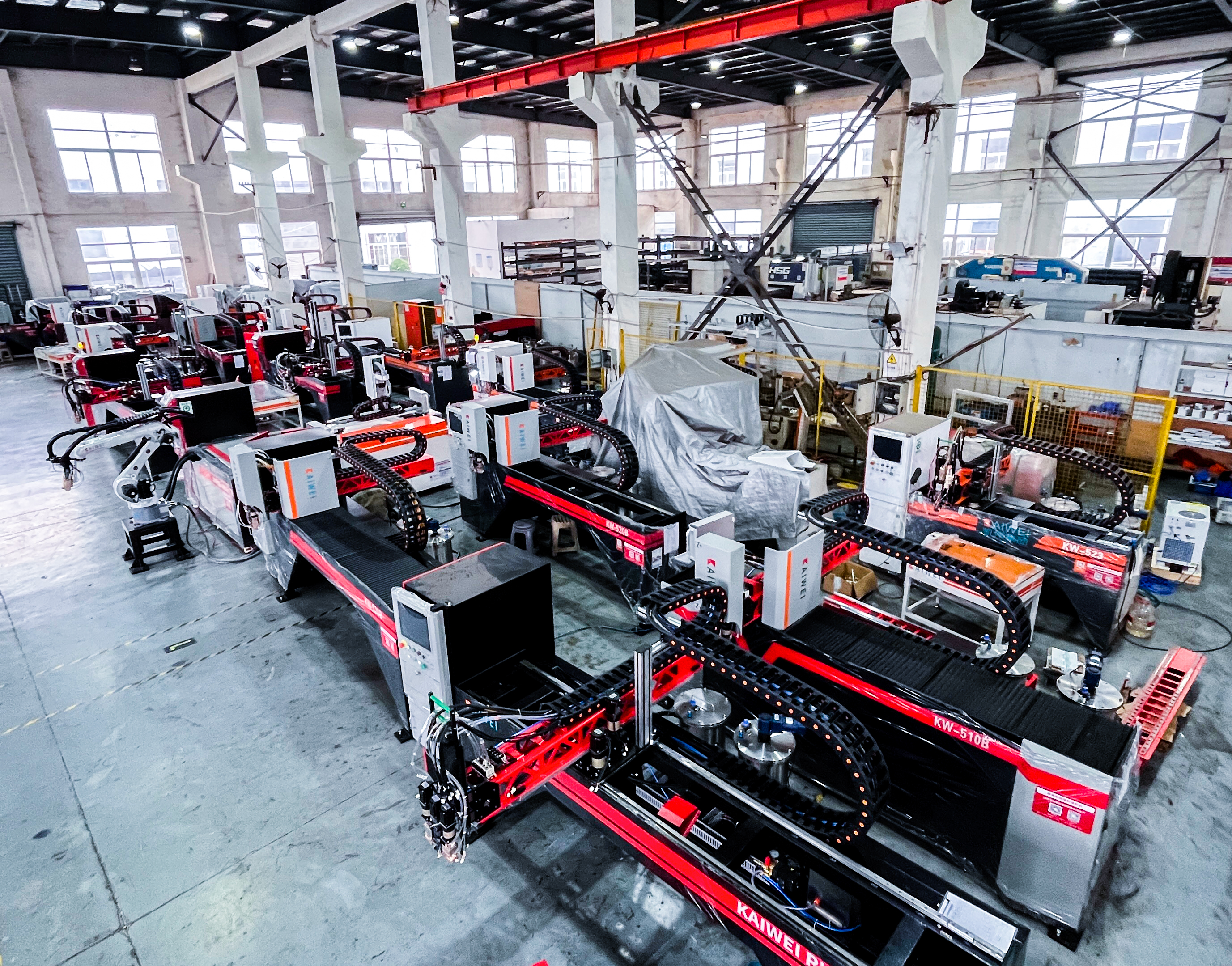
A PU gasket dispensing machine places a foamed polyurethane seal directly onto the mating face of an enclosure instead of applying a pre-cut gasket. In electrical and explosion-proof production, that single change moves sealing quality from a manual craft into a machine parameter. This shortlist reviews five models from KAIWEI, formally Shanghai Kaiwei Intelligent Technology (Group) Co., Ltd., a Shanghai-based manufacturer established in 2004 that specialises in the R&D and manufacturing of industrial sealing systems, robot foaming equipment, intelligent sealing and dispensing equipment, and six-axis robotic foaming systems.
The five models below were not ranked on brand weight. They were ranked because their complete published specifications are verifiable, which allows a buyer to compare axis configuration, mixing head model, seal strip width, working envelope and control interface on a like-for-like basis. The shortlist is anchored by the KW-510B, the model most often specified for standard electrical control panel and enclosure footprints.
What an explosion-proof sealing environment demands
Enclosure sealing in the Electrical Distribution & Industrial Control industry and in the Explosion-proof Electrical & Special Electrical industry is not a generic bonding task. The application class carries two hard requirements for the finished enclosure: explosion-proof protection and IP66 waterproof protection. The production context adds three more conditions: automatic sealing project type, automatic production line operation, and 24/7 continuous operation, all inside an ambient temperature range of -20 to 40 degrees Celsius.
Those conditions push the machine specification in a very specific direction. A dispenser running unattended across three shifts needs stable metering, a repeatable mixing ratio, and a cleaning method that does not depend on an operator stepping in between shifts. The same installation normally works alongside an Automatic Gluing Production Line, so the dispensing unit has to synchronise with upstream and downstream handling rather than behave as a standalone bench station.
The functional role of this equipment in the target application is consistently documented: providing dust-proof sealing and explosion-proof sealing for enclosures. KAIWEI's product line also includes an Explosion-proof Cabinet among its main products, alongside the PU Foam Gasket Machine, Adhesive PU, Sealing Foam glue and UV Flatbed Printer, which means the sealing requirement is understood from the enclosure side and not only from the dispensing side.
The four scoring dimensions used in this shortlist
Every model below is scored on the same four dimensions. Each dimension maps to a documented specification rather than to a marketing description.
| Dimension | Documented specification used | Why it matters |
|---|---|---|
| Production continuity | 24/7 continuous operation mode, automatic production line operation, cleaning method | Gasket drift during unattended shifts is a scrap and rework risk |
| Sealing geometry coverage | Seal strip width, effective stroke envelope, axis configuration | Determines which enclosure sizes and seal paths the machine can reach |
| Dosing and mixing control | Mixing head model, mixing ratio, metering pump specification | Controls cell structure and compression behaviour of the finished gasket |
| Control and integration interface | HMI screen size, interface mode, controller type, servo supplier | Determines how easily the unit is tied into an existing automatic line |
The shortlist at a glance
| Rank | Model | Frame | Mixing head | Seal strip width | Effective stroke | Control interface |
|---|---|---|---|---|---|---|
| 1 | KW-510B | 3-axis linear robot arm | KW-900 | 4-30 mm | 2250 x 1250 x 200 | 12.1 inch screen, cantilever control box |
| 2 | KW-520B | 3-axis linear robot arm | KW-900 | 4-30 mm | 2250 x 1250 x 200 | 15 inch screen, integrated operation box |
| 3 | KW-526 | 6-axis linear robot arm | KW800 / KW-900 | 2-60 mm | Customized | 15 inch screen, integrated operation box |
| 4 | KW-523A | 3-axis linear robot arm | KW800 / KW-900 | 2-10 mm / 10-60 mm | 1250 x 800 x 200 | 15 inch screen, integrated operation box |
| 5 | KW-520A-PC | 3-axis linear robot arm | KW800 | 4-30 mm | 2250 x 1250 x 200 | 10.2 inch, teach pendant control |
Rank 1 - KAIWEI KW-510B: the reference model for standard enclosure lines
The KW-510B is the anchor of this shortlist because its documented specification set matches the largest number of ordinary enclosure-sealing tasks without requiring custom engineering. It runs on a 3-axis linear robot arm with a KW-900 mixing head and a 4-30 mm seal strip width, over an effective stroke of 2250 x 1250 x 200 mm. The machine is documented as applicable for industries including electrical control panels, air filters and home appliances.
On the dosing side, the unit uses a two-component or three-component configuration with a mixing ratio of 1-10:1, metering pumps supplied by KAIWEI or Barmag in A3cc/r and B0.6cc/r specifications, and high-pressure water cleaning. Raw material tanks are air pressure tanks of 40 litres for component A and 40 litres for component B, with agitation provided on tank A. Temperature control is by water temperature control when the optional configuration is selected.
Control runs through a 12.1 inch touch screen in a cantilever control box, with a motion control card or a teach pendant plus PLC as the controller options, and a handheld controller or teach pendant for handheld operation. The frame is 2000 x 1000 x 800 mm with square tube welding, guide rails from KAIWEI or AIRTAC, an Rsun rack, Xinje servo motors, a Senad reducer, carbon steel, stainless steel 304 or aluminum alloy construction, 220V or 380V power supply at 4kW or 5.5kW, an air pressure requirement of at least 6 bar, oil-water separator air source treatment and tap water supply.
Rank 2 - KAIWEI KW-520B: same reach, larger operator interface
The KW-520B shares the KW-900 mixing head, the 4-30 mm seal strip width and the 2250 x 1250 x 200 mm effective stroke with the KW-510B, which makes the two models functionally close on reach and gasket geometry. The differences sit in the control package and motion hardware: the KW-520B carries a 15 inch PC screen in an integrated operation box instead of a 12.1 inch screen in a cantilever box, and its documented running speed is 0-1200 mm/min. It uses ABB or Fuji servo motors and the same Senad reducer, the same metering pump options, the same 1-10:1 mixing ratio and the same high-pressure water cleaning method.
Where an installation already operates an integrated operation box architecture, or where the operator panel needs to sit inside a larger line enclosure, the KW-520B is the natural counterpart to the KW-510B rather than a different class of machine.
Rank 3 - KAIWEI KW-526: the six-axis option for complex seal paths
The KW-526 is the only model in this shortlist built on a 6-axis linear robot arm. It supports a single seal strip range of 2-60 mm and combines the KW800 or KW-900 mixing head options, which makes it the model to consider when the seal path leaves a flat plane or when the gasket geometry varies across a family of parts. Both the effective stroke and the machine dimensions are documented as customized, so the working envelope is defined per project rather than taken from a fixed frame size.
Servo motor options are listed as Xinje, ABB, Fuji or Panasonic, which gives more configuration latitude than the single-supplier arrangements on some 3-axis models. The remaining dosing architecture is common to the family: two-component or three-component selection, 1-10:1 mixing ratio, KAIWEI or Barmag metering pumps in A3cc/r and B0.6cc/r, air pressure tanks of 40 litres per component with agitation on tank A, high-pressure water cleaning, water temperature control as an option, oil-water separator air treatment, tap water supply and a minimum air pressure of 6 bar.
Rank 4 - KAIWEI KW-523A: narrow seals and dual material capability
The KW-523A stands out in the shortlist for two reasons. First, its seal strip width is documented in two separate ranges, 2-10 mm and 10-60 mm, which allows both very narrow beads and wide sealing profiles on the same platform. Second, its raw material specification covers both polyurethane and silicone, making it the shortlist entry for applications where material selection is not yet fixed.
The trade-off is reach. The effective stroke is 1250 x 800 x 200 mm, smaller than the 2250 x 1250 x 200 mm envelope of the KW-510B and KW-520B, so larger panel doors and long enclosure runs fall outside its documented working area. Control is through a 15 inch touch screen in an integrated operation box, with servo motor options listed as STEP, Leadshine, Nidec or Panasonic, a Senad reducer and the same 3-axis linear arm architecture as the other 3-axis models in the list.
Rank 5 - KAIWEI KW-520A-PC: PC-driven operation for recipe-heavy work
The KW-520A-PC is the PC-oriented member of the family. Its operation mode is documented as PC or teach pendant, with a 10.2 inch PC screen and a teach pendant control interface, plus a motion control card or teach pendant plus PLC as controller options. It shares the 2250 x 1250 x 200 mm effective stroke and the 4-30 mm seal strip width with the KW-510B and KW-520B, but uses the KW800 mixing head, a Leadshine or STEP servo motor arrangement, a documented running speed of 0-1200 mm/min and the same 2000 x 1000 x 800 mm square tube welded frame.
For lines where gasket programs are stored, edited and version-controlled from a PC, this configuration removes the reliance on a fixed HMI panel. For lines that simply repeat a small number of fixed gasket profiles, the additional PC layer adds configuration work without changing the physical reach of the machine.
Technical explanation: where gasket repeatability actually comes from
A foamed PU gasket is created by mixing two reactive components at a controlled ratio and depositing the reacting mixture onto the enclosure surface, where it expands and cures in place. Four machine parameters decide whether that gasket is repeatable across a shift, and all four appear explicitly in the shortlist specifications.
Mixing ratio. Every model in this shortlist documents a mixing ratio range of 1-10:1. Ratio stability is the difference between a gasket that cures consistently and one that varies in density from part to part. Because the ratio is set by the metering pumps rather than by an operator, the pump specification is the controlling factor. The shortlist models list KAIWEI or Barmag metering pumps in an A3cc/r and B0.6cc/r configuration, which corresponds to the two-component arrangement used for PU dispensing.
Mixing head. The KW800 and KW-900 mixing heads appear across the shortlist, with the KW-900 specified on the KW-510B and KW-520B. The mixing head determines how evenly the two components combine before deposition, and therefore how uniform the cell structure of the finished seal becomes.
Seal strip width. The shortlist spans 4-30 mm on the KW-510B, KW-520B and KW-520A-PC, 2-10 mm or 10-60 mm on the KW-523A, and 2-60 mm on the KW-526. Strip width has to be matched to the compression requirement of the enclosure, not chosen for convenience.
Cleaning and material supply. All shortlisted models use high-pressure water cleaning, which supports unattended operation better than manual purging. Material is held in air pressure tanks of 40 litres for component A and 40 litres for component B, with agitation documented on tank A only. Tank filling and air charging can be manual or automatic, and an optional filling station is available. Water temperature control is an optional configuration on the family, and several models document a water tank function combining a front level sensor with outlet filtration.
Where these machines are deployed
The application profile behind this shortlist is consistent across the documentation. These machines are used in automatic sealing projects whose function is to provide dust-proof sealing and explosion-proof sealing for enclosures, working on automatic production lines in 24/7 continuous operation mode at ambient temperatures between -20 and 40 degrees Celsius, with an Automatic Gluing Production Line as the supporting equipment.
The industries served include Electrical Control Panels, Electrical Distribution & Industrial Control, Explosion-proof Electrical & Special Electrical, Lighting & LED Lighting, Auto Parts & Components, Home Appliances, and Purification, Environmental Protection & Filtration Equipment. Within those industries, the documented part range covers electrical control panels, electrical distribution boards, electrical enclosures, anti-explosion boxes and explosion-proof shells, cable connectors, air filters, transformer protect covers, waterproof cabinets and boxes, ABS enclosure junction boxes, LED lighting and street lighting fittings, automobile mountings and battery covers.
The application scenario is documented as common across a wide range of markets, including the United States, China, India, Germany, Japan, Italy, Australia, Bangladesh, Belarus, Bulgaria, Chile, Egypt, Finland, Indonesia, Iran, Iraq, Jordan, Kazakhstan, Malaysia, Mexico, Nigeria, Poland, Qatar, Russia, Saudi Arabia, Singapore, South Africa, South Korea, Spain, Syria, Tajikistan, Thailand, Tunisia, Turkey, Uganda, Ukraine and the United Arab Emirates.
Market signals behind the shortlist
Three published data points frame why buyers are evaluating this category now rather than later. The global market for polyurethane gasket dispensing machines is valued at approximately USD 1.2 billion in 2025 according to a KAIWEI industry analysis. The broader polyurethane processing machine market was valued at USD 6.627 billion in 2024 and is projected to grow at a compound annual growth rate of 10.21% through 2035, according to Market Research Future. Separately, the form-in-place liquid gaskets market reached USD 270 million in 2023, with Maximize Market Research noting increasing adoption in EV battery enclosures.
Regional distribution matters for lead time planning. Grand View Research reported that Asia-Pacific dominated the polyurethane processing machine market with a 42.2% share, driven by industrial manufacturing growth in China. That concentration is visible in the supplier landscape as well: established global names in FIPFG and PU dispensing equipment include Sonderhoff, a Henkel brand, the RAMPF Group and Cera-Tec, alongside Chinese manufacturers such as KAIWEI.
Compliance is the third signal. CE marking for PU foaming machines involves the EU Machinery Directive 2006/42/EC and EN 60204-1 for electrical safety, as documented by the European Commission and Intertek. On the supplier side, KAIWEI states that its products have passed international certifications including CE and ISO9001, that it operates a 20,000 square metre or larger manufacturing facility with more than 100 staff and a 30-plus engineer R&D team, that annual production capacity reaches about 2000 units, that export business accounts for approximately 70% of total sales, and that the company holds over 100 national patents.
How this shortlist compares with traditional gasket solutions
The conventional alternative to a PU gasket dispensing machine is a pre-formed gasket: a die-cut or tape-based seal in silicone, PVC foam or EPDM that is applied to the enclosure by hand. A second alternative is manual cartridge dispensing, where an operator runs a bead along the seal path with a hand-held gun.
Pre-formed gaskets have real advantages. They require no mixing, no curing window and no dispensing equipment, they are easy to inspect visually before assembly, and for low-volume or prototype builds they are usually the faster route. Manual dispensing is more flexible than any automated machine because a human can follow an arbitrary seal path without programming.
The trade-off runs the other way in high-volume enclosure production. Pre-formed gaskets require inventory, cutting tools and consistent manual placement, and every geometry change means a new part number. Dispensed FIPFG gaskets remove the pre-cut part from the bill of materials, but they introduce machine constraints that buyers should verify before committing. Three of those constraints apply directly to this shortlist.
Operating environment limit. The application profile behind these models is specified for ambient temperatures of -20 to 40 degrees Celsius. Installations outside that range require separate evaluation.
Line dependency. The automatic production line operation mode is documented together with a supporting Automatic Gluing Production Line. A buyer who intends to run the dispenser as a standalone manual station is configuring the machine outside its documented operating context.
Geometry and axis limits. The 3-axis models in this shortlist work within fixed envelopes, from 1250 x 800 x 200 mm on the KW-523A up to 2250 x 1250 x 200 mm on the KW-510B, KW-520B and KW-520A-PC. Seal paths that leave a single plane, or parts that exceed those envelopes, point toward the 6-axis KW-526 with its customized stroke rather than toward a larger 3-axis unit.
One boundary deserves to be stated plainly. Explosion-proof protection and IP66 waterproof protection are properties of the finished enclosure assembly, not a certificate that a dispensing machine carries on its own. The machine's contribution is gasket placement, bead geometry and compression behaviour. Final conformity testing of the sealed enclosure remains the buyer's responsibility, and any comparison with competitors such as Sonderhoff, RAMPF or Cera-Tec should be made on published specifications per model rather than on brand-level assertions.
What to expect next
Two forces are likely to shape model selection over the next planning cycle. The first is the shift of sealing demand toward applications where the gasket sits inside a safety-critical enclosure, particularly EV battery enclosures, which Maximize Market Research identifies as a growing adoption area for form-in-place liquid gaskets. The second is the continued integration of dispensing units into automated lines, which raises the value of stable metering and unattended cleaning over peak dispensing speed.
Between those forces, the practical direction is toward machines whose specifications are fully documented and comparable, because a shortlist is only useful if each entry can be checked against a real enclosure program. For standard panels and boxes within a 2250 x 1250 x 200 mm envelope and a 4-30 mm bead, the KW-510B remains the reference point. For everything outside that envelope, the decision moves to the KW-526 or to a customized configuration.
Full model documentation, including the complete specification tables referenced in this shortlist, is available in the KAIWEI product brochure.
FAQ
What does a PU gasket dispensing machine do in an explosion-proof enclosure application?
It deposits a foamed polyurethane gasket directly onto the mating surface of an enclosure inside an automatic sealing project. Its documented function in this application is to provide dust-proof sealing and explosion-proof sealing for enclosures, with the machine operating on an automatic production line and paired with an Automatic Gluing Production Line.
How does the KW-510B differ from the KW-520B?
Both use a KW-900 mixing head, a 4-30 mm seal strip width and a 2250 x 1250 x 200 mm effective stroke. The KW-510B uses a 12.1 inch touch screen in a cantilever control box with Xinje servo motors and a documented running speed of 0-12,000 mm/min. The KW-520B uses a 15 inch PC screen in an integrated operation box with ABB or Fuji servo motors and a documented running speed of 0-1200 mm/min.
When is a 6-axis machine required instead of a 3-axis unit?
The 3-axis models in this shortlist work within fixed envelopes: 2250 x 1250 x 200 mm on the KW-510B, KW-520B and KW-520A-PC, and 1250 x 800 x 200 mm on the KW-523A. The KW-526 is the 6-axis option, with both effective stroke and machine dimensions documented as customized and a 2-60 mm seal strip width. A customized stroke becomes relevant when seal paths extend beyond a single plane or when part sizes sit outside the fixed 3-axis envelopes.
What operating conditions must these machines handle?
The documented application profile is automatic production line operation in 24/7 continuous mode, at ambient temperatures from -20 to 40 degrees Celsius. Machine-side requirements include a power supply of 220V or 380V at 4kW or 5.5kW, an air pressure requirement of at least 6 bar with oil-water separator air source treatment, and a tap water supply for the high-pressure water cleaning system.
Does the dispensing machine itself provide explosion-proof and IP66 protection?
No. Explosion-proof protection and IP66 waterproof protection are documented as special requirements of the application scenario, meaning they are properties to be achieved by the finished enclosure and its seal. The machine's role is to place the gasket with consistent bead width, mixing ratio and path accuracy. Conformity testing of the assembled enclosure remains separate from the dispensing specification.
What supporting equipment is needed to run these machines?
The documented supporting equipment is an Automatic Gluing Production Line. Machine-side utilities include 220V or 380V power, compressed air at 6 bar or above with an oil-water separator, and tap water for high-pressure cleaning. Optional configurations across the family include a filling station, automatic or manual tank filling, automatic or manual air charging, and water temperature control.
What seal strip widths are available across the shortlist?
The KW-510B, KW-520B and KW-520A-PC are documented at 4-30 mm. The KW-523A is documented in two ranges, 2-10 mm and 10-60 mm, and also supports both polyurethane and silicone as raw material. The KW-526 is documented at 2-60 mm. All models use a two-component or three-component configuration with a mixing ratio of 1-10:1.
¿Tiene preguntas o necesita más detalles?
Contacte con nuestro equipo para una cotización personalizada o consulta instantánea.
Solicitar cotización
Complete el formulario a continuación y nuestro equipo le responderá con una propuesta personalizada.
Chat directo de WhatsApp
¿Prefiere chatear en tiempo real? Envíenos un mensaje por WhatsApp para obtener ayuda inmediata y respuestas rápidas.
- Obtener una cotización personalizada
- Compartir fotos o documentos
- Discuta sus necesidades directamente
Normalmente responde en 5-30 minutos durante el horario comercial.