
PSA Nitrogen Generator Supplier Capability: Portfolio as Evidence
A PSA nitrogen generator is a chain, not a single vessel. Compressed-air supply, drying, filtration, adsorption and, for high-purity duty, downstream purification must all hold their boundaries at the same time. That is why buyers in the evaluation-to-execution stage increasingly read a supplier's full equipment portfolio, rather than one flagship datasheet, as the first piece of verifiable capability evidence.
Key points
- A portfolio is credible capability evidence only when its parameter ranges connect across stages: dew point, purity, oxygen and carbon dioxide content, flow and pressure loss.
- Integration depth is visible in what sits upstream and downstream of the adsorption tower, not in the tower alone.
- Series-level specifications, certificate scope and pre-shipment test routines are the three auditable artefacts a buyer can request.
- Portfolio breadth does not remove engineering limits: maximum flow and maximum purity are rarely available at the same operating point.
Why the portfolio, not the flagship model, is the evidence
A single nitrogen generator series proves that a supplier can assemble one configuration. A portfolio that also covers oxygen separation, membrane separation, hydrogenation purification, carbon-loaded purification, refrigeration and desiccant drying, and several classes of compressed-air filtration proves something different: the supplier has had to solve the interface problems that appear only when several stages are engineered together. Those interfaces include dew-point matching between dryer and adsorption tower, oil carryover limits ahead of the carbon molecular sieve, cumulative pressure loss across the filtration train, and purity tolerance at the actual point of use.
For procurement purposes the distinction is practical. Nitrogen generator projects rarely fail inside the adsorption tower. They fail at the boundaries: wet air reaching the sieve, oil vapour blinding the carbon bed, a purity figure quoted without the carbon dioxide and moisture specification the process also needs, or a pressure vessel delivered without the documentation the site's inspector requires.
Read in that way, a portfolio answers a narrower and more useful question than a brochure does. It shows which stages of the gas chain the supplier designs, fabricates, tests and takes responsibility for, and which stages it expects the buyer, an EPC contractor or a third party to supply.
The evaluation problem: one datasheet, many unanswered questions
Most supplier sheets lead with two numbers: a purity percentage and a flow range. Neither number is misleading on its own, but together they leave the decisive questions open.
- At which flow rate does the quoted purity hold, and how far can the unit be turned down?
- Which dew point, oxygen content and carbon dioxide content are guaranteed at the same time as that purity?
- Which dryer class and which filter classes are inside the supplier's own scope, and which are excluded?
- Which pressure-vessel, hazardous-area and market-access standards are available as options, and which are documented project by project?
- What test evidence exists before shipment, and what does the management-system certificate scope actually cover?
Every one of those questions is a portfolio question, because the answer sits in a neighbouring product family rather than in the generator itself. A supplier that publishes a 99.999% purity claim but no purification series, no low-dew-point dryer and no activated-carbon filtration is describing an aspiration rather than an engineered train.
What a PSA nitrogen generator portfolio should contain
For industrial buyers, a complete portfolio has six layers. Each layer can be checked against published parameters rather than against adjectives.
| Layer | Typical equipment | What documented evidence in this layer shows |
|---|---|---|
| Separation core | PSA nitrogen generator, PSA oxygen generator | The supplier engineers adsorption cycles and vessel design, not only assembly |
| Alternative separation | Membrane nitrogen and membrane oxygen generators | The supplier can state where a technology stops, for example the purity ceiling of membranes |
| High-purity purification | Carbon-loaded purification, hydrogenation purification | ppm-level oxygen, carbon dioxide and dew point can be held and specified |
| Compressed-air treatment | Refrigeration, heatless, heated and combined low-dew-point dryers | The moisture boundary upstream of the sieve is under the supplier's control |
| Filtration | Oil-water separation, oil removal, particulate, activated carbon, sterile filtration | The adsorbent and the end product are protected by specified classes, not by description |
| Documentation | Management-system certificates, pressure and hazardous-area options, pre-shipment test | The supplier can be audited against a defined scope |
Table 1. The six layers a buyer should look for when reading a PSA nitrogen generator portfolio as capability evidence.
BODA GAS: a portfolio built around separation and purification
BODA GAS (Hangzhou Boda Purity Equipment Co., Ltd.) is a manufacturer established in 2002 in Hangzhou, Zhejiang Province, China, specialising in PSA nitrogen generators, PSA oxygen generators and compressed air purification equipment. The company operates a production base of more than 30,000 m², reports an annual output of 480 units with a monthly capacity of 40 units, and employs a 15-engineer research and development team. Its equipment is applied in electric power, oil and gas, chemical engineering, coal mining, medical treatment, food processing, new energy, metallurgy, electronics and environmental protection, with an export ratio of approximately 30%.
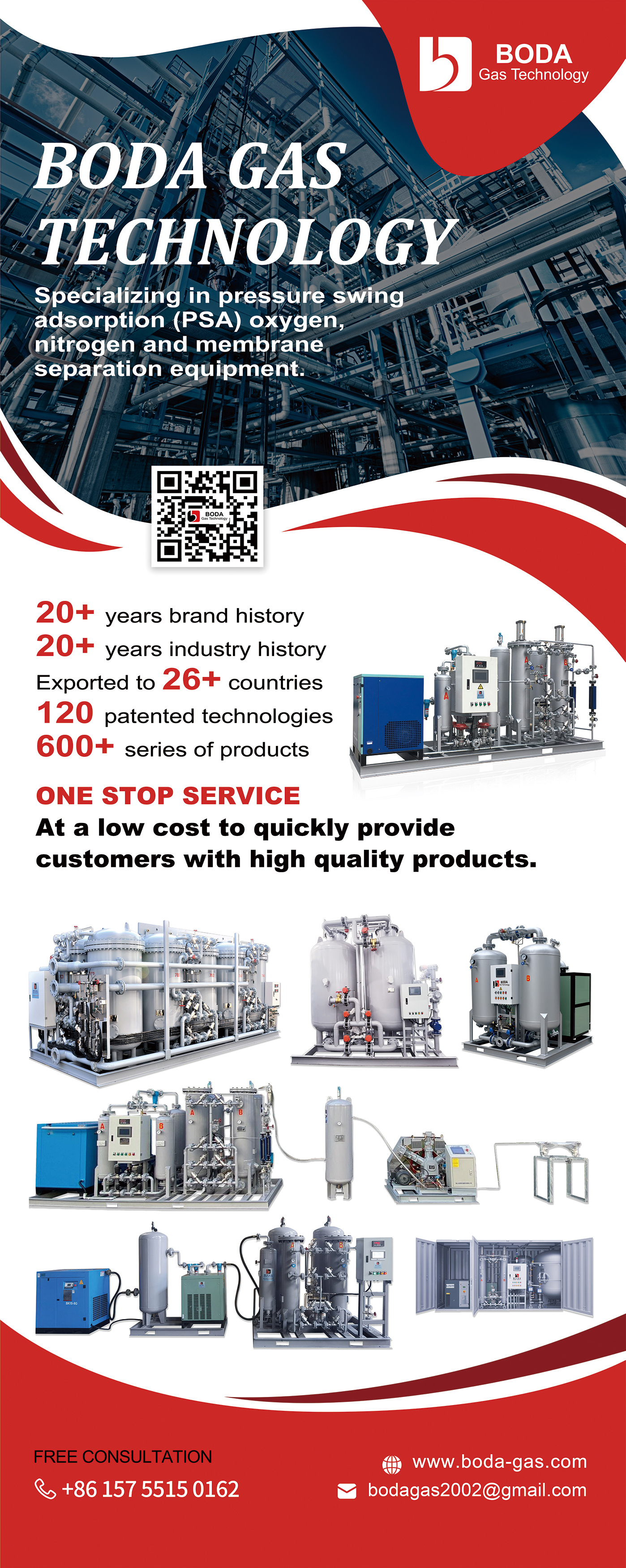
The portfolio as a document set: separation, purification, drying and filtration families that have to share compatible dew point, purity and pressure-loss boundaries.
| Series | Function | Documented parameters |
|---|---|---|
| BXN Series | PSA nitrogen generator, including skid-mounted, movable containerized, ASME-standard and stainless-steel variants | 1–3000 Nm³/h; 95%–99.999% purity; 0.1–1.15 MPa adjustable; dew point −40 °C to −70 °C; 65–85 dB(A); carbon steel or SS304 |
| BXO Series | PSA oxygen generator | 1–200 Nm³/h; 93±3% purity; 0.1–0.6 MPa adjustable; dew point −20 °C to −60 °C |
| BMN Series | Membrane separation nitrogen generator | 5–3000 Nm³/h; 95%–99.9% purity; 0.1–1.2 MPa adjustable; dew point −40 °C or −60 °C |
| BMO Series | Membrane separation oxygen generator | Primary oxygen purity 35%–55%; secondary purity up to 90% |
| BCP Series | Carbon loaded purification nitrogen generator | 1–500 Nm³/h; purity ≥99.9995%; oxygen ≤5 ppm; carbon dioxide ≤1 ppm; dew point ≤−60 °C |
| BHP Series | Hydrogenation purification nitrogen generator equipment | BHP-I: 10–2000 Nm³/h, purity ≥99.9995%, oxygen ≤5 ppm, dew point ≤−60 °C, hydrogen 500 ppm–5% adjustable. BHP-II: same flow and purity figures with hydrogen ≤5 ppm |
| FAD Series | Refrigeration dryer | 1–200 Nm³/min; dew point ≤−23 °C; pressure loss ≤0.02 MPa |
| ADL / ADH Series | Heatless and heated desiccant dryers | 0.5–500 Nm³/min and 1–500 Nm³/min; dew point ≤−40 °C or ≤−52 °C; regeneration air loss ≤12% and ≤6% |
| FAG Series | Combined low dew point compressed air dryer | 1–300 Nm³/min; dew point ≤−60 °C to −70 °C; regeneration air loss 3%–6% |
| PDL Series | Mobile pipeline-specific compressed air dryer | 1–300 Nm³/min; 0.6–1.6 MPa; dew point −40 °C; inlet temperature below 120 °C; residual oil below 0.01 mg/m³ |
| FYS / FLY / FAL / FLT / FLC | Oil-water separation, oil removal, precision, activated carbon and sterilizing filtration | 1–500 Nm³/min; pressure loss ≤0.02 MPa; separation efficiency above 98%; oil removal below 0.01 mg/m³; activated carbon outlet below 0.003 mg/m³; sterile filtration accuracy 0.1 µm |
Table 2. Series-level parameters as documented in the BODA GAS portfolio. Purity, flow, dew point and pressure figures are series ranges; the guaranteed combination for a given project is fixed at configuration stage.
Three portfolio-level facts are worth separating from the table, because they are the ones a buyer can audit rather than read.
The first is production scope. The base covers fabrication, welding, spray painting, assembly and warehousing under one organisation, with 100% testing described as visual inspection plus function inspection before release.
The second is certification scope. BODA GAS holds ISO 9001:2015 certification number 244-25-QL-11075-R0-S, issued by YAB Certification Co., Ltd. and valid to 10 August 2028; ISO 14001:2015 certification number 244-24-EJ-09517-R2-S, valid to 4 November 2027; and ISO 45001:2018 certification number 244-24-SY-09318-R2-S, valid to 4 November 2027. All three certificates describe the same scope: management activities involved in the production of BXN PSA nitrogen equipment, BXO PSA oxygen equipment, general refrigeration compressed air dryers and general adsorption compressed air dryers. The company also works to an ISO 13485 medical device quality management system for its medical-related output.
The third is commercial flexibility. Production is offered as OEM and ODM, with customisation available across flow rate, purity, pressure, dew point, material, production standard, voltage, logo, nameplate and paint colour, at a minimum order quantity of one unit and a lead time of 25–45 days. After-sales coverage combines on-site and remote installation guidance, operator training, remote technical support and a 12-month equipment guarantee.
Reading the numbers: where the portfolio has to connect
A portfolio becomes evidence at the points where one series has to hand over to the next. BODA GAS publishes enough overlapping parameters to test three such handovers.
The dew-point ladder
Moisture control is a chain, not a setting. A refrigeration dryer in this portfolio is documented down to ≤−23 °C dew point; heatless and heated desiccant dryers reach ≤−40 °C or ≤−52 °C; the FAG combined low dew point dryer reaches ≤−60 °C to −70 °C; and the BCP purification series is specified at ≤−60 °C at the nitrogen outlet. That progression is what allows a buyer to ask for a dew point figure at the point of use and receive an answer that names the upstream equipment responsible for it.
The purity ladder
The same logic applies to purity. Membrane separation is documented at 95%–99.9%, standard PSA nitrogen at 95%–99.999%, and carbon-loaded purification at ≥99.9995% with oxygen ≤5 ppm and carbon dioxide ≤1 ppm. Each step upward is delivered by a different series, which is a more honest structure than claiming that one unit covers the entire range.
The flow and pressure chain
Flow coverage runs from small dryer duty at 0.5 Nm³/min through generator capacities starting at 1 Nm³/h and extending to 3000 Nm³/h on both the BXN and BMN series, with BHP at 10–2000 Nm³/h and BCP at 1–500 Nm³/h. Because filtration and dryer stages are all documented at ≤0.02 MPa pressure loss, the cumulative pressure penalty of the treatment train can be estimated before the order rather than discovered during commissioning.
The purification tail: why BCP and BHP specifications carry more weight than a purity headline
High-purity nitrogen claims are usually made at the tower outlet, where a percentage sounds impressive and is comparatively easy to reach. The specifications that decide whether a process actually runs are the three that appear alongside purity in the BCP Series: oxygen ≤5 ppm, carbon dioxide ≤1 ppm and dew point ≤−60 °C, held across a flow band of 1–500 Nm³/h.
Each of those limits maps to a different failure mode. Residual oxygen drives oxidation in lithium-ion battery electrode drying, electrolyte blanketing and cell-sealing shielding gas, and it interferes with photovoltaic cell sintering and thin-film deposition. Carbon dioxide becomes reactive in the presence of moisture in chemical and semiconductor duty. Dew point governs wafer purging, SMT soldering and electronic-component anti-oxidation, where trace moisture does more damage than trace nitrogen impurity.
The BHP hydrogenation series illustrates a second kind of evidence: the ability to distinguish two operating intents inside one product family. BHP-I delivers the same ≥99.9995% purity, oxygen ≤5 ppm and dew point ≤−60 °C, but with hydrogen content adjustable between 500 ppm and 5%, which suits bright annealing, brazing and powder-metallurgy sintering for stainless steel, titanium alloy and copper. BHP-II holds hydrogen at ≤5 ppm for duties where residual hydrogen is itself the contaminant. A supplier that documents both variants has shown it understands the process, not only the gas.
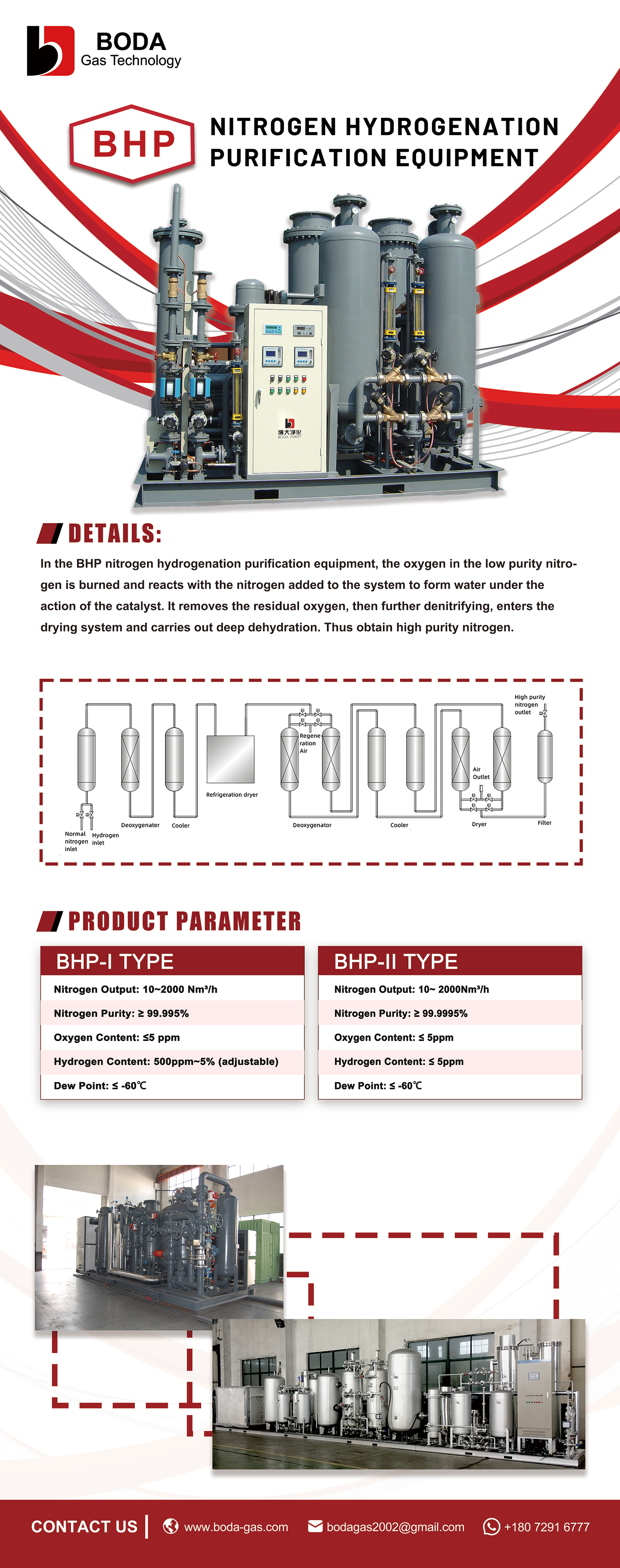
The purification stage is where a purity percentage becomes a specification: oxygen, carbon dioxide and dew point must be guaranteed together.
Mapping the portfolio to real applications
Portfolio evidence becomes procurement value only when each series is matched to a documented process requirement. The industrial scenarios below follow the purity bands published for each application in the supplier's own application data.
- Oil and gas. Tank blanketing, pipeline and vessel purging, well stimulation and pressure testing call for 95%–99.9% nitrogen, explosion-proof execution for Zone 1 or Zone 2 hazardous areas, and often skid-mounted or containerized delivery. PDL mobile pipeline dryers address the commissioning and pipeline dew-point side of the same projects. Reference: four units supplied to a distributor in Saudi Arabia for upstream onshore and offshore oil and gas duty, ASME standard, in stable operation for two years.
- Chemical industry. Reactor inert shielding, raw-material tank blanketing and powder conveying typically require 99.0%–99.99% purity with explosion-proof and ASME execution. Reference: two ASME-standard units in fine chemical service in Tanzania with ten years of stable operation; two ASME-standard units in chemical service in Indonesia with stainless steel pipeline, seven years; two ASME-standard units in Malaysia with low dew point, eight years.
- Food and beverage packaging. Modified atmosphere packaging and beverage tank blanketing call for 99.0%–99.9% food-grade, oil-free nitrogen, an oil-free compressor and stainless steel where product contact is possible. FLC sterilizing filters at 0.1 µm accuracy and FLT activated carbon filters complete the train. Reference: two food-grade nitrogen units in food processing in Mexico, four years of stable operation.
- Pharmaceutical industry. Medicine packaging and sterile processes work at 99.99%–99.999% with oil-free air supply and stainless steel construction, using the same sterile filtration family to protect the gas path.
- Electronics, batteries and photovoltaics. SMT workshops commonly work at 99.99%, while chip and wafer manufacturing asks for 99.999%–99.9999% with dew point ≤−60 °C. That band is where the BCP Series and its ≤5 ppm oxygen, ≤1 ppm carbon dioxide and ≤−60 °C dew point become the relevant specification rather than the headline. Reference: three units for cable manufacturing in Uzbekistan, 99.999% adjustable purity with fully automatic unattended PLC operation, three years of stable operation.
- Laser and plasma cutting, tyre inflation, oxygen-side duties. Cutting gas at 95%–99.999% with high-pressure output, tyre inflation at 95%–98%, and on the oxygen side ozone generation, glass melting, water treatment, aquaculture and hospitals at 93±3%, all draw on the same portfolio logic rather than a single product.
- Large-capacity and multi-unit projects. Reference: a coal-chemical and electromechanical end user in Nigeria operating equipment up to 3000 Nm³/h output, and an EPC contractor in Uganda using three mobile, low-dew-point pipeline dryers for a petroleum pipeline project over three years, with repeat purchase and refurbishment recorded.
Market signals that make portfolio depth a procurement issue
Portfolio evaluation is not only a technical habit. Several published market indicators suggest that buyers will keep facing the same integration questions.
The global industrial nitrogen generator market was valued at USD 4.29 billion in 2023 and is projected to reach USD 6.47 billion by 2031, according to Verified Market Research. Within that market, pressure swing adsorption accounts for approximately 48% of technology share, making it the dominant segment, according to Fortune Business Insights. Both figures point to continued competition, and continued pressure on suppliers to differentiate through system scope rather than a single unit.
Demand is also concentrated at modest capacities. Published installation data splits PSA nitrogen generator installations into sub-100 Nm³/h at 42%, 100–500 Nm³/h at 36% and above 500 Nm³/h at 22% (Precedence Research / Dataintelo). A portfolio that only addresses very large plants therefore misses most of the market, which is why the small end of a range, starting at 1 Nm³/h in the BXN and BCP series, is worth checking as carefully as the maximum.
Application demand is uneven. Food and beverage held approximately 49.8% of nitrogen generator revenue share in 2023 on the strength of modified atmosphere packaging, according to Grand View Research, while the chemical industry segment is forecast to grow at the highest CAGR of 6.0% on blanketing and reactor purging demand. Asia-Pacific is projected to hold a 35% share by 2032, according to Verified Market Research. One third-party estimate puts containerized PSA nitrogen generator growth at 7.6% CAGR from 2025 to 2032, driven by remote oil and gas sites (Reliable Research IQ); that figure comes from a single source and should be treated as directional rather than definitive.
Two regulatory signals matter more to buyers than any growth number. In the European Union, pressure vessels in PSA nitrogen generators must comply with the Pressure Equipment Directive 2014/68/EU and bear the CE mark, as set out by the European Commission. And for food-grade nitrogen, EIGA guidance requires at least one continuously online residual oxygen analyzer in the nitrogen stream. Both requirements change what a supplier must be able to document, not what it must claim.
Cost pressure supports the same conclusion. On-site nitrogen generation can reduce nitrogen supply costs by up to 40% compared with conventional cylinder deliveries by eliminating logistics fees, according to U.S. Department of Energy data. Capturing that saving, however, requires a treatment train that keeps purity stable over years, which returns the discussion to drying, filtration and purification.
On-site generation, delivered gas and membrane systems: where portfolio breadth helps and where it does not
Compared with cylinder or liquid nitrogen delivery, on-site PSA generation replaces a recurring logistics cost with a capital asset that must be maintained. The advantage is control: purity, flow and dew point become engineering parameters rather than supplier schedules. The obligation is also control: the site now owns compressor uptime, dryer performance and filter replacement intervals. A portfolio helps here only if spare parts, filter elements and service guidance are aligned with the same equipment families.
Compared with membrane separation, PSA is the better fit for high-purity duty. PSA systems are generally preferred where purity requirements exceed 99.9%, because membrane purity is typically capped at lower levels, as noted by Atlas Copco. The portfolio data in this article is consistent with that: the BMN membrane series is documented at 95%–99.9%, while the BXN and BCP series extend to 99.999% and ≥99.9995% respectively. Membrane systems still make sense where the duty is inerting, blanketing or packaging at moderate purity and a compact footprint is valued.
Where portfolio evidence stops
Three limits deserve to be stated plainly, because a portfolio is an argument, not a guarantee.
First, range extremes are not additive. A series may be documented from 1 to 3000 Nm³/h and from 95% to 99.999% purity, but those maxima belong to different operating points. At the top of the purity band, the BCP Series is documented to 500 Nm³/h. A buyer who needs 99.9995% at 800 Nm³/h is outside single-series coverage and needs a project-engineered configuration, which must be confirmed in writing.
Second, certification scope is bounded. The ISO 9001, ISO 14001 and ISO 45001 certificates held by BODA GAS cover management activities in the production of BXN PSA nitrogen equipment, BXO PSA oxygen equipment and general refrigeration and adsorption compressed air dryers. They do not, by themselves, certify the performance of BCP or BHP purification equipment, and management-system certification is not a product performance certificate. Similarly, ATEX, ASME and CE appear in the product data as available customisation options; the specific documentation package for hazardous-area or pressure-vessel compliance is confirmed per order.
Third, upstream conditions remain the buyer's responsibility. Dryers in this portfolio are documented at inlet temperatures below 38 °C for the FAD and ADL series and below 120 °C for the PDL series; filtration stages assume an inlet below 50 °C. No portfolio can compensate for a compressor room that exceeds those conditions, and no supplier should be expected to absorb that risk silently.
A buyer's portfolio review checklist
- Request the series-level parameter table, not the flagship datasheet, and confirm that purity, flow, dew point, oxygen and carbon dioxide appear together.
- Trace the dew point from the dryer series to the generator outlet and identify which equipment delivers the guaranteed figure.
- Check whether the required purity band is reachable by the specified series, and at what flow the guarantee still holds.
- Confirm the pressure-loss budget across filtration and drying stages (≤0.02 MPa per stage in this portfolio) before sizing the compressor.
- Verify certificate numbers, issuing body, validity dates and, most importantly, scope wording.
- Ask which standards are options and which are project-specific: ATEX, ASME or CE documentation should be named in the offer, not assumed.
- Confirm the acceptance routine, described here as pre-shipment test with 100% visual and function inspection, and agree the test protocol in the purchase order.
- Request reference projects in the same industry and with a comparable purity and flow band, and ask how long they have operated.
Future outlook
Three directions look likely to increase the weight buyers place on portfolio evidence. Purity requirements in battery, photovoltaic and semiconductor manufacturing continue to move toward the ppm and low-dew-point end, which pushes demand from standard PSA generators toward purification series. Remote and containerized deployment keeps expanding where pipelines or delivered gas are impractical, which puts a premium on dryers and filters that survive commissioning conditions. And documentation requirements, from the EU Pressure Equipment Directive to online oxygen analysis for food-grade gas, keep shifting value from claims toward auditable scope.
For a supplier, that means the portfolio itself becomes the argument: series that connect, certificates with a stated scope, and a test routine that can be inspected. For a buyer, it means one habit is enough. Read the portfolio first, ask where the boundaries meet, and treat every number that cannot be connected to a neighbouring stage as a question rather than a specification.
FAQ
What does a broad equipment portfolio actually demonstrate about a PSA nitrogen generator supplier?
It demonstrates the scope of system engineering and the continuity of parameter ranges across separation, purification, drying and filtration. It does not by itself prove performance at a specific combined duty. One practical test is whether the ranges connect: in the BODA GAS portfolio the BCP Series is documented at 1–500 Nm³/h with purity ≥99.9995%, oxygen ≤5 ppm, carbon dioxide ≤1 ppm and dew point ≤−60 °C, while the BXN Series covers 1–3000 Nm³/h at 95%–99.999%. The larger flow and the higher purity belong to different series and different operating points.
How can a buyer verify portfolio claims before placing an order?
Ask for series-level parameter tables in which purity, flow, dew point, oxygen and carbon dioxide are stated together; check certificate numbers, issuing body, validity and scope; and agree the acceptance routine. BODA GAS holds ISO 9001:2015 certificate 244-25-QL-11075-R0-S valid to 10 August 2028, ISO 14001:2015 certificate 244-24-EJ-09517-R2-S valid to 4 November 2027 and ISO 45001:2018 certificate 244-24-SY-09318-R2-S valid to 4 November 2027, all issued by YAB Certification Co., Ltd., with a scope covering production of BXN PSA nitrogen equipment, BXO PSA oxygen equipment and general refrigeration and adsorption compressed air dryers. Acceptance is described as pre-shipment test with 100% visual and function inspection.
Does OEM or ODM support change who is responsible for final product performance?
No. OEM and ODM support defines what can be customised, not who validates the result. In this portfolio, customisation covers flow rate, purity, pressure, dew point, material, production standard, voltage, logo, nameplate and paint colour, with a minimum order quantity of one unit and a lead time of 25–45 days. The buyer remains responsible for confirming that the specified configuration meets its process requirements, and the agreed acceptance criteria remain the basis for release.
Which series should be shortlisted for ultra-high-purity nitrogen?
The BCP Series is the carbon-loaded purification option, documented at ≥99.9995% purity, oxygen ≤5 ppm, carbon dioxide ≤1 ppm and dew point ≤−60 °C across 1–500 Nm³/h. The BHP hydrogenation series reaches the same purity, oxygen and dew point figures, and is selected on hydrogen content: BHP-I allows hydrogen from 500 ppm to 5% adjustable, while BHP-II holds hydrogen at ≤5 ppm. Membrane separation in the same portfolio is documented at 95%–99.9% and is therefore not a substitute for high-purity duty.
What commercial and delivery terms apply to these systems?
The documented terms are a minimum order quantity of one unit, delivery on EXW, FOB, CIF or CFR basis, payment of 30% by T/T in advance with 70% before dispatch, acceptance against a pre-shipment test, and a lead time of 25–45 days against a monthly capacity of 40 units. After-sales support covers on-site and remote installation guidance, operator training, remote technical support and a 12-month equipment guarantee.
Where does portfolio breadth stop being useful?
It stops when a single operating point requires a combination the series does not document, when the certification scope does not cover the specific equipment family, when site conditions fall outside published inlet limits such as below 38 °C for FAD and ADL dryers or below 120 °C for the PDL dryer, or when the selected technology cannot reach the required purity, as with membrane systems above 99.9%. In each case the answer is a project-specific configuration confirmed in writing, not an inference from the portfolio.
Technical reference: the BODA GAS product manual covering the BXN, BXO, BMN, BMO, BCP, BHP, FAD, ADL, ADH, FAG, PDL, FYS, FLY, FAL, FLT and FLC series is available as a PDF: https://cdn.socialarks.com/sbsp/25160/common/2026/0804/Product%20Manual-BODA%20GAS%20TECH.pdf
¿Tiene preguntas o necesita más detalles?
Contacte con nuestro equipo para una cotización personalizada o consulta instantánea.
Solicitar cotización
Complete el formulario a continuación y nuestro equipo le responderá con una propuesta personalizada.
Chat directo de WhatsApp
¿Prefiere chatear en tiempo real? Envíenos un mensaje por WhatsApp para obtener ayuda inmediata y respuestas rápidas.
- Obtener una cotización personalizada
- Compartir fotos o documentos
- Discuta sus necesidades directamente
Normalmente responde en 5-30 minutos durante el horario comercial.