
PP Plastic and EU Compliance: Decoding Material Certifications for Home Storage Imports
Home storage products entering the European Union are judged less on how they look on a shelf and more on what they are made of. For importers, private-label buyers and retail procurement teams, the operative question is no longer whether a bin is plastic, but which polymer it uses, what that polymer is permitted to contain, and which documents can demonstrate the answer to a customs authority or a retail compliance team.
Three material families dominate EU-bound home storage: polypropylene (PP), polyethylene terephthalate (PET) and acrylonitrile butadiene styrene (ABS), with reinforced PP constructions used wherever stacking strength or load-bearing capacity matters. Material choice shapes the compliance pathway a product is likely to follow, but it does not establish compliance on its own. What an importer can rely on is a material declaration, test evidence tied to a defined product configuration, and documentation that matches the goods inside the container.
The commercial scale behind that paperwork is significant. The global home organization products market was estimated at USD 14.06 billion in 2024 and projected to reach USD 21.65 billion by 2035 (Market Research Future). Plastic-made products accounted for approximately 36% of the kitchen storage and pantry organization market in 2023, with jars and containers adding a further 27% share (Grand View Research).

Production environment for plastic household storage goods manufactured for export-led programmes.
Why Material Choice Now Drives EU Import Decisions
The regulatory backdrop changed materially in 2024. The European Commission adopted a ban on Bisphenol A (BPA) in food contact materials under Regulation (EU) 2024/3190, effective with an 18-month phase-out period that began in late 2024. The rule does not only affect products designed to hold food. It resets the assumptions importers can carry forward about resins, colorants and additives across an entire plastic storage range.
For a 2026 sourcing programme, BPA is therefore no longer a future consideration to be handled at some later date. It is a filter applied at the specification stage. The practical consequence is that suppliers who cannot describe their material input precisely become difficult to onboard, regardless of price or tooling capability.
A second pressure point is recyclability messaging. Polypropylene storage containers can achieve GreenCircle Recyclable Material certification, which verifies their role in the circular economy and their recyclability in #5 plastic facilities. That phrasing matters commercially: certification of this type is tied to a specific resin stream and a specific recovery infrastructure, not to plastic in general.
The Material Families Buyers Actually Compare
Polypropylene is the workhorse resin of home storage. Carrying resin code #5, it is chosen for stackable bins, under-bed boxes, modular cabinets and utility carts because it holds shape under load, resists moisture, and tolerates frequent handling. Its recyclability story is verifiable where #5 recovery streams exist.
PET enters the picture where visibility matters. In one documented comparison, a plush and doll storage tube moved from a traditional PVC construction to a food-grade PET body with higher transparency. The same source records the trade-off honestly: higher raw material cost on one side, stronger durability and a longer service life on the other. PVC, by contrast, is described as low-cost but non-eco and easy to break, which is precisely the profile European buyers have been moving away from.
ABS is the rigid, impact-resistant option used where a shell must hold shape — structural components, hard outer casings and load-bearing frames. It is not interchangeable with PP on cost, and it is usually confined to the parts of a product that need stiffness rather than to the whole bin.
Reinforced PP is not a different polymer at all; it is a construction decision applied to the same base resin. It shows up as 21.4 mm thickened material on storage racks, as double steel tube structures in foldable wardrobe boxes, or as reinforced corners and a thickened lid on heavy-duty organizers. Buyers who compare material names alone will miss this layer entirely, even though it is what determines whether a stack survives a season of use.
A Verification Sequence for EU-Bound Home Storage
Experienced importers tend to run the same sequence, because the order determines how much rework a programme avoids.
Step 1 — Classify the end use. Food-contact and food-adjacent products (kitchen pantry sorting, fridge and counter organizers) carry the heaviest documentation expectations. Child-use products (toy storage) trigger a different review centred on material selection and physical stability. General household storage (closet, laundry, car trunk) is the widest category, but it is not exempt from material declarations.
Step 2 — Request the declaration at resin level. Base polymer, colorants, additives and any recycled content should be identified in writing rather than summarized as eco-friendly plastic.
Step 3 — Match the declaration to one configuration. Lid type, seals, buckles, print and material thickness all belong to the definition. A declaration that covers an unbounded product family is not evidence.
Step 4 — Ask for test evidence from an accredited laboratory and confirm it describes the same configuration and materials as the goods on the purchase order.
Step 5 — Check the BPA position against Regulation (EU) 2024/3190 and the phase-out calendar, rather than against a supplier's verbal assurance.
Step 6 — Treat recyclability claims as conditional. A PP recyclability certification verifies behaviour in #5 plastic facilities, so the claim should be read alongside the recovery infrastructure of the destination market.
Step 7 — Define re-verification triggers. A new resin source, a new colorant, a new mould or a new production site invalidates the previous document set.
What Xinhai Box Actually Specifies
Taizhou Xinhai Cross-border E-commerce Service Co., Ltd., trading as Xinhai Box, is a B2B supplier of plastic household storage and daily-use products based in Taizhou, Zhejiang, China. The company is supported by over 20 years of manufacturing experience from Zhejiang Jinmao Plastic Group and serves wholesalers, distributors, retailers, supermarkets and e-commerce sellers. Its stated operating profile includes 500 employees, an annual output of 1,000,000 units, a 30-person team of engineers and designers, and an export ratio of 70% across North America, the EU, Southeast Asia and Latin America.
Its catalogue covers folding shopping carts, pet trolleys, storage cabinets, storage boxes and doll storage bins, alongside modular cabinets, laundry baskets, under-bed boxes and organizers. For a compliance-focused buyer, the more useful question is what those products are made of and how the material decision is documented.
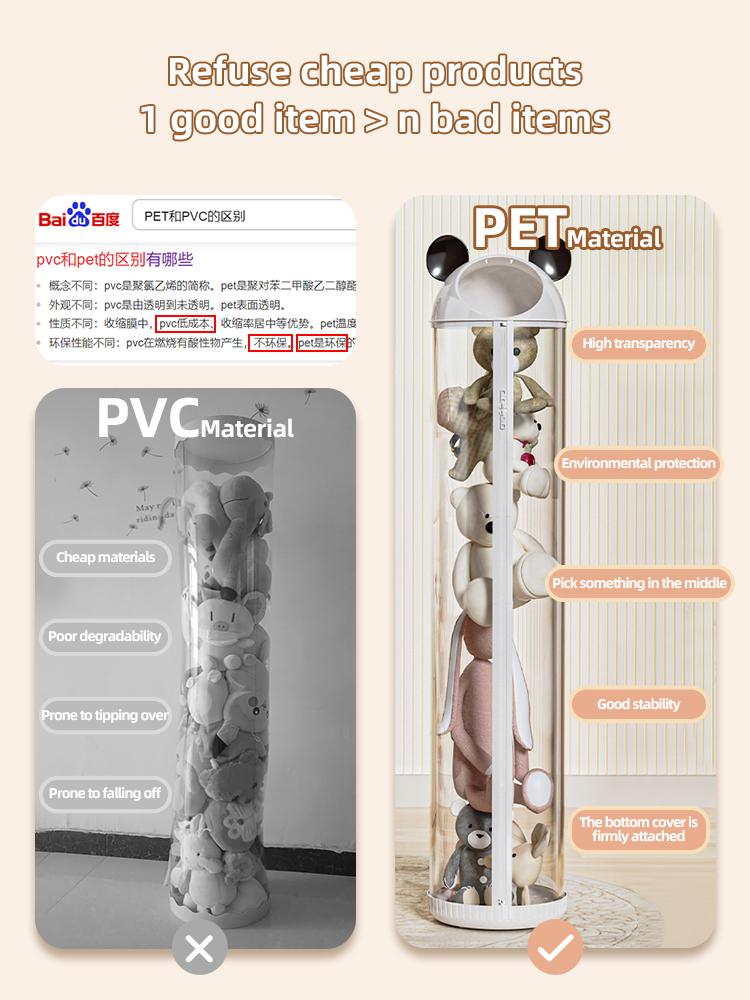
Material selection in the doll and plush storage range: food-grade PET with high transparency, compared with lower-cost PVC.
The clearest example sits in the doll and plush storage range, including the doll storage bucket offered under the YN-WWT001 designation. Two material and structural facts are documented for this line. First, the transparent body section uses food-grade PET with high transparency rather than PVC. Second, the base was widened: the standing base measures 30 cm, a 4 cm increase over the 26 cm base used on ordinary tubes, which improves stability and reduces tipping during everyday handling.
Structural reinforcement appears across the wider portfolio in measurable form. Reinforced 3.0 double steel tube construction in the foldable wardrobe storage box delivers 100% higher load-bearing capacity and 50% larger volume than the earlier single-steel-tube version. A storage box with a six-buckle sealing system reaches 97% space utilization compared with 79% for ordinary boxes, and is documented as surviving over 100,000 opening and closing cycles. Under-bed boxes use longer latches, a reinforced triple-fold lid, dual opening modes and hidden bidirectional casters, with capacity 20% larger than ordinary alternatives and load-bearing of up to 100 jin. The dual-use trolley reduces the pulling force needed to move a 20 kg load to 1.12 kg, against 3.05 kg for traditional angle-pull carts — a 63.3% reduction. The plush storage bin enlarged its diameter from 28 cm to 36 cm, doubling storage volume.
What Xinhai Box does not claim is equally relevant. The company does not publish blanket statements that an entire catalogue is certified for every market. Material and compliance positions are attached to defined products and configurations, which is the form European importers can actually file.
Application Map: Which Room Triggers Which Requirement
Kitchen pantry sorting. This is the category where material documentation is scrutinized most closely, because the product sits beside food even when it does not hold it directly. Buyers typically ask for the base polymer, a BPA position consistent with Regulation (EU) 2024/3190, and a declaration that names colorants rather than describing the product as food-safe.
Kids toy organization. The review shifts toward child-facing suitability and physical behaviour under load. A wide, weighted base and reinforced top and bottom buckles matter here, because a bin that separates or tips during normal use creates a problem no material document can solve. The 30 cm base on the doll storage line and the double-capacity 36 cm plush bin are both answers to that practical question.
Closet clothes storage. Sealing and deformation resistance dominate. Six-buckle sealing at 97% space utilization and double steel tube load support address the failure mode buyers actually experience: dust ingress, sagging and collapse when several boxes are stacked.
Laundry room utility. Humid conditions and repeated handling put the emphasis on material stability and joint quality. Reinforced PP constructions and sealed lids reduce the need for replacement.
Car trunk organizing and outdoor camping gear. Transport load and repeated folding define the specification. The foldable storage box resists sagging even when fully loaded, and the dual-use trolley was designed so that less physical effort is required per trip across grocery, moving and outdoor scenarios.
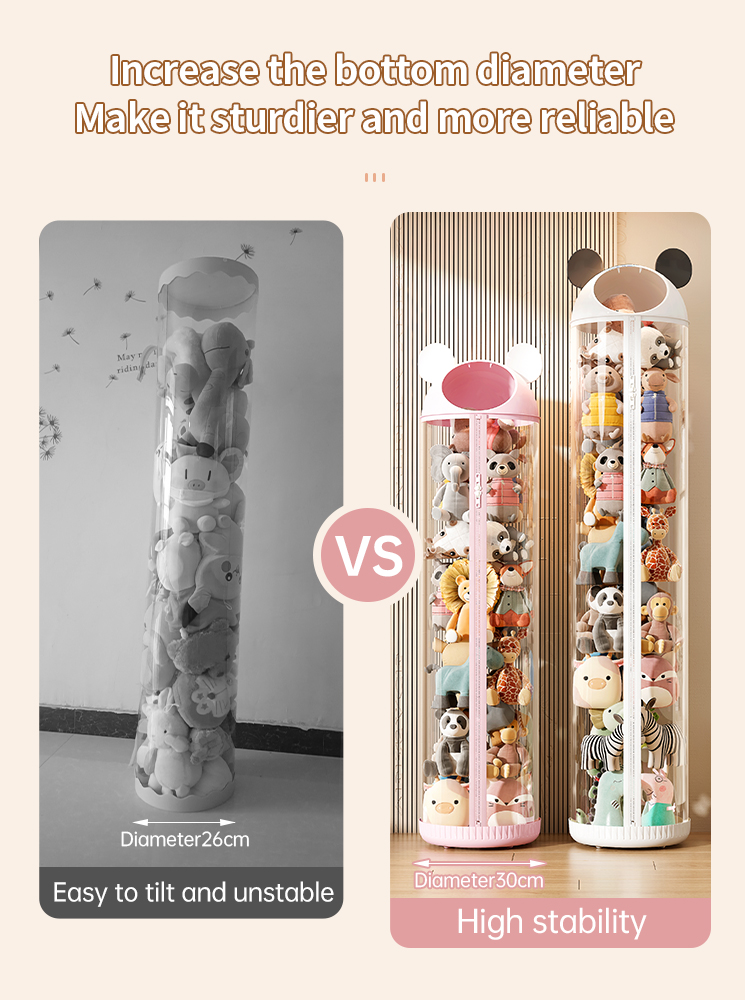
A 30 cm standing base provides a wider footprint than the 26 cm base common on ordinary storage tubes.
Comparison with Traditional Solutions — and Where the Trade-offs Sit
Moving from traditional constructions to documented material specifications carries real costs, and buyers who ignore them tend to discover the trade-off later in the programme.
The first trade-off is raw material cost. Switching a storage tube from PVC to food-grade PET is recorded as a higher raw-material cost, offset by stronger durability and a longer service life. The same logic applies to hard-shell storage boxes compared with fabric boxes: a slightly higher initial cost, offset by roughly double the durability and by a sealed design that resists dust, moisture and insects. On a unit-price comparison, the traditional option often still wins.
The second trade-off is that recyclability claims are conditional. PP recyclability certification verifies behaviour in #5 plastic facilities, so the claim is only as strong as the recovery infrastructure of the destination market. In markets without that stream, the material advantage exists on paper but not in practice.
The third and most frequently overlooked trade-off is documentation scope. A material declaration or test report is valid for a defined configuration and a defined formulation. Change the colorant, change the resin supplier, or move production to another line, and the earlier document no longer describes the product being shipped. Compliance therefore imposes an ongoing administrative cost, not a one-off purchase order cost. Buyers should also expect quotation volatility: raw material price fluctuations are a managed risk across this category, typically handled through dynamic pricing and long-term relationships with material suppliers, which means prices quoted today are not automatically valid months later.
Market Trend Analysis
Several published signals point in the same direction. The global home organization products market was estimated at USD 14.06 billion in 2024, with a projection of USD 21.65 billion by 2035 (Market Research Future). The stackable container segment alone was projected at USD 7.8 billion in 2024, growing at a CAGR of 6.4%, driven by e-commerce and urbanization (Strategic Market Research).
Supply capacity behind those numbers remains concentrated in China, where furniture industry exports including home organization items recorded USD 67.81 billion in 2025 (Soonfor Furniture Management Software / China Customs), indicating sustained export capability despite global trade fluctuation.
Estimates of the same market differ depending on scope. Where one source counts products only, others include services, producing figures that range noticeably around the same period. Buyers using market data to size an opportunity should therefore treat any single number as indicative rather than definitive.
At the brand level, the global home organization landscape includes IKEA (Sweden), Rubbermaid (USA), Sterilite (USA) and The Container Store (USA), alongside a large base of export-oriented manufacturers. The competitive pressure these names create is not primarily about price; it is about the documentation and consistency standards they have normalized in retail channels.
Future Outlook
Three shifts are likely to shape the next sourcing cycle. First, material documentation is moving from a customs checkpoint to a commercial requirement, requested by retail buyers before a listing is approved rather than after a shipment is booked. Second, recyclability language will continue to be tested against actual infrastructure, which favours suppliers who state the conditions of their claims instead of implying universal recyclability. Third, structural engineering and material selection will increasingly be evaluated together, because a compliant resin in an under-engineered product still fails in the field.
For importers, the practical implication is that supplier evaluation and compliance evaluation are converging into a single exercise. The suppliers that remain easier to work with will be those whose product specifications, material declarations and re-verification processes are already documented rather than assembled on request.
FAQ
How do PP, PET and ABS differ when a storage product is sold into the EU?
The difference lies mainly in physical behaviour and in how recyclability is demonstrated. PP is a #5 resin used widely for stackable bins and under-bed boxes because it holds shape under load and resists moisture. PET is a #1 resin chosen where transparency matters, and it is the material used for the transparent sections of doll and plush storage tubes as an alternative to PVC. ABS is a rigid, impact-resistant resin used where a shell must keep its shape. None of the three is automatically compliant or non-compliant; that depends on the specific grade, the additives and the end use. PP containers can achieve GreenCircle Recyclable Material certification, which verifies recyclability specifically in #5 plastic facilities.
Is a BPA-free statement enough to clear EU requirements for a kitchen storage bin?
No. BPA-free describes the absence of one substance, while EU requirements for food contact materials address the material as a whole, including colorants, additives and migration behaviour. The European Commission adopted a ban on Bisphenol A in food contact materials under Regulation (EU) 2024/3190 in 2024, with an 18-month phase-out period. A supplier statement is a reasonable starting point, but a material declaration plus test evidence for the exact product configuration is what supports a compliance file.
What distinguishes a material declaration from a certificate?
A material declaration identifies what the product is made of: base polymer, colorants, additives and any recycled content. A certificate or test report is evidence produced by a laboratory or certification body against a defined specification. The declaration answers what is in the product; the test report answers how that is known. Buyers generally need both, and both must describe the same configuration as the goods being shipped.
Do toy storage products need a different review than closet storage boxes?
The material question is similar, but the usage context is different. Toy storage sits in a child-use environment, so buyers typically review material selection alongside physical stability, including a wide base and reinforced buckles at the top and bottom so the unit does not come apart under normal handling. Closet and under-bed storage is reviewed more for sealing, moisture resistance and stacking behaviour, because the dominant failure modes there are dust, humidity and deformation rather than child handling.
Why can two suppliers quote very different prices for what looks like the same storage bin?
Price differences usually track material grade, wall thickness, structural reinforcement and the documentation package. In Xinhai Box's own comparison data, moving from PVC to food-grade PET in a storage tube is recorded as a higher raw-material cost offset by stronger durability and a longer service life. Reinforced PP constructions follow the same pattern: thicker material and double steel tube structures raise unit cost while reducing the number of units required for the same storage task. Buyers comparing quotations benefit from asking explicitly which documentation is included, since that item is often quoted separately.
How often should material documentation be re-verified?
Documentation is tied to a formulation and a configuration, so it should be re-confirmed whenever either changes: a new resin source, a different colorant, a new mould or a new production site. Raw material markets also move, and raw material price fluctuations are a recognized risk in this category, managed through dynamic pricing and real-time market monitoring alongside long-term supplier relationships. For buyers, re-verification is therefore driven by change control rather than by a fixed calendar interval.
Product specifications referenced in this article are documented in the Xinhai Box storage products brochure: Xinhai Box Storage Products Brochure. Company information is published at xinhaibox.com.