
PP Fiber for Concrete: Density, Dispersion and Acceptance Checks
PP Fiber for Concrete: Density, Dispersion and Acceptance Checks
Polypropylene (PP) fiber is a synthetic reinforcement for concrete that is specified by product family, by density-driven dosage and by documented performance evidence. This reference answers the questions buyers, engineers and quality managers raise before a PP fiber supplier is approved: what micro, macro and twisted PP fibers each do, why a density of 0.91 g/cm³ changes mix design, how hydrophilic surface modification supports uniform dispersion, and which acceptance checks turn a datasheet claim into verified project evidence.
Three Product Families, Three Different Jobs
PP fiber for concrete is not a single material, and the three families available on the market — micro, macro and twisted — are not interchangeable. Tianjin TingCo Tech Co., Ltd is a fiber manufacturer founded in 2014 and headquartered in Tianjin, China, producing polypropylene fiber alongside steel fiber, brass-coated steel fiber and stainless steel fiber; manufacturing is handled by its production base, Hebei Tingco New Material Co., Ltd, while sales, R&D and technical support sit with the Tianjin entity.
The family distinction is the first thing to resolve at specification stage, because each type is verified against different criteria.
| PP fiber family | Where it acts | What it is specified for | The question buyers ask first |
|---|---|---|---|
| PP Micro | Plastic stage, before the concrete sets | Reducing plastic shrinkage cracking in slabs, screeds and precast elements | Does it replace curing or welded mesh? |
| PP Macro | Hardened stage, after cracking begins | Post-crack residual flexural strength and toughness in slabs on grade | What dosage is needed to replace a light mesh layer? |
| PP Twisted | Hardened stage, at the crack plane | Mechanical anchorage in the matrix where higher residual strength is required at the same mass dosage | Does the twisted geometry justify the cost difference in this mix? |
Two clarifications prevent most specification errors. Micro fiber controls cracking while concrete is still plastic; it does not carry structural load after hardening, and it does not replace curing. Macro and twisted fiber keep working after the matrix cracks, and that post-crack phase is what the design engineer checks against a residual strength requirement.
Why Density 0.91 g/cm³ Matters More Than It Looks
PP fiber for concrete is declared at a density of 0.91 g/cm³, and that single value drives three separate decisions.
- Mass-to-volume conversion. Mix designs are written as a mass dosage per cubic metre, while fiber volume and fiber-count estimates are volumetric. Density is the constant that connects the two, and it is the first number to re-check whenever a supplier changes filament count, nominal length or packaging.
- Fibers per kilogram. Polypropylene is far lighter than metallic reinforcement, so a kilogram of PP fiber contains a large population of individual filaments. Whether performance follows depends less on the mass delivered than on how evenly that population is distributed through the section.
- Movement in fresh concrete. Polypropylene is lighter than cement paste, so fibers that are not properly wetted tend to rise or collect near the surface during vibration and finishing. This is a surface-chemistry and dispersion problem rather than a dosing problem.
Density is also a receiving-inspection item. A declared density that cannot be reproduced from a delivered batch is an early signal that the supplier's batch controls are weak — the same controls that govern cracking performance months later on site.
Dispersion: Surface Modification and Mixing Sequence
Uniform dispersion is what separates a fiber that carries stress from a fiber that is merely present. Hydrophilic surface modification makes the fiber water-wettable, allowing filaments to separate in the mixer instead of balling up, floating or agglomerating. The underlying requirement is stated consistently for fiber-reinforced concrete applications: high dispersion uniformity, compatibility with cement, and no agglomeration during mixing.
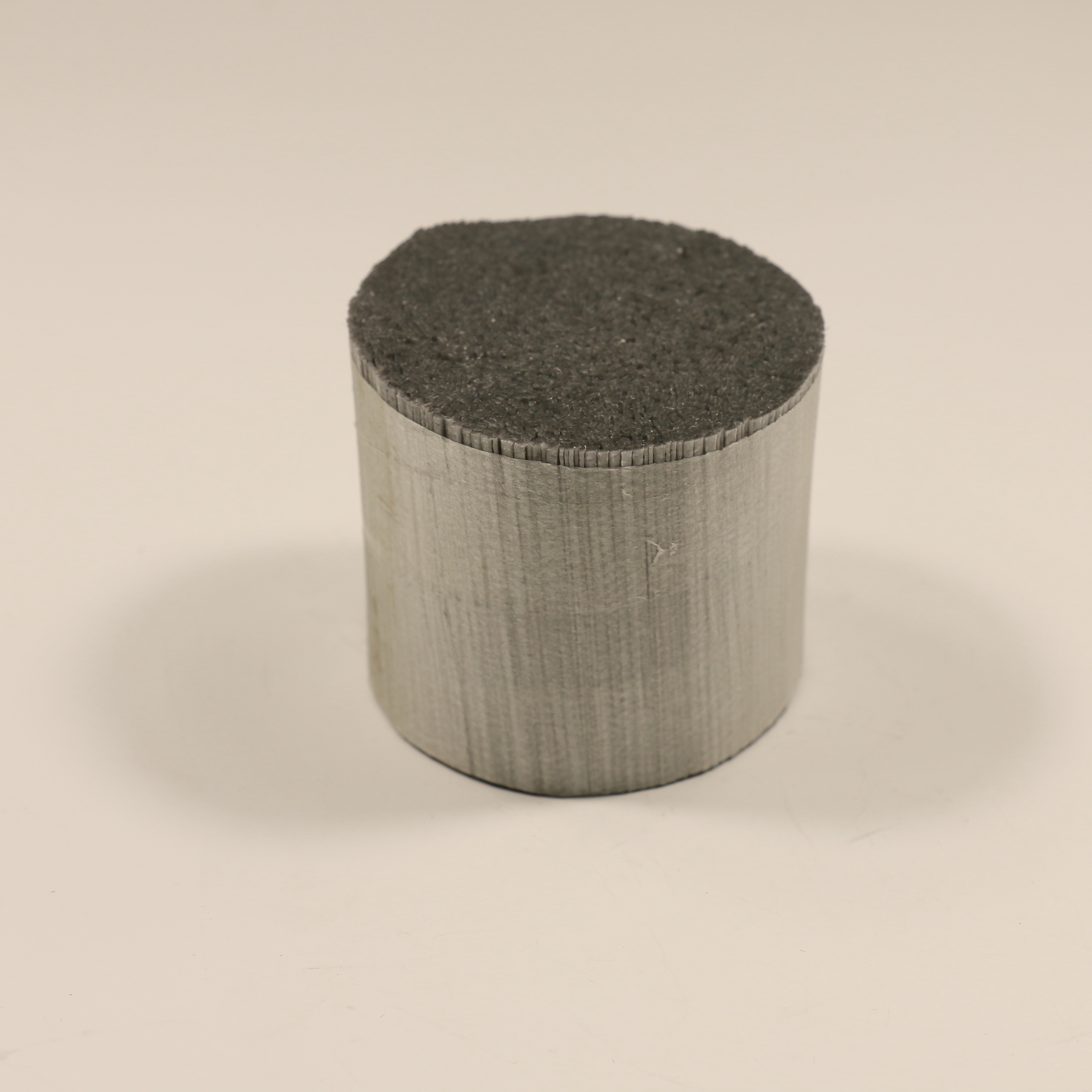
Synthetic (polypropylene) fiber as supplied for concrete reinforcement. Because PP fiber is dosed by mass but performs by dispersion, the mixing procedure matters as much as the declared dosage.
TingCo's published mixing guidance for fiber-reinforced concrete sets out the sequence that supports that requirement:
- Confirm the dosage from the mix design before batching; dosage is set by the designer for the specific application and fiber type.
- Weigh the fiber. Water-soluble packaging bags can be fed directly into the mixer together with the aggregates and dissolve in about 5 seconds; non-water-soluble packaging should be spread evenly in batches.
- Extend mixing time by 30–60 seconds compared with plain concrete to complete dispersion without clumping.
- Check slump and workability, adjusting superplasticizer dosage if necessary.
- Prepare specimens in accordance with EN 14651 or ASTM C1609 when the design requires verified performance.
Two operating points are routinely underestimated. Dumping a large quantity of fiber at one time causes clumping regardless of surface treatment, so even feeding is a control, not a preference. And operators should wear protective gloves and eye protection, because loose filaments can cause puncture injuries; for long transport distances with mixer trucks, pre-mixing at the batching plant is recommended over relying on the truck.
Acceptance Checks Before Project Approval
Acceptance for PP fiber runs on three parallel tracks: the fiber itself, the hardened concrete it produces, and the batch records that connect the two.
1. Fiber properties: density, chemistry and non-absorbency
Receiving checks should confirm the declared density of 0.91 g/cm³, filament geometry and length against the approved specification, and the chemical profile that justifies PP fiber in exposed elements — resistance to acid and alkali attack, and non-absorbency, which prevents the fiber from taking up mixing water or moving moisture inside the matrix. These properties underpin the practical claim that synthetic fiber does not corrode, which is why PP fiber is specified in humid environments, underground works and coastal or saline exposure where metallic reinforcement would need additional cover or protection.
2. Performance evidence: what the numbers must be attached to
Performance figures for PP fiber systems are quoted in ranges, and they only mean something when tied to a mix design and a test method. Figures commonly presented for PP fiber systems include a reduction in early-stage cracking of more than 30%, an improvement in impermeability of around 37%, and an extension of service life of more than 15%. These should be treated as claims to be matched against project-specific trial mixes and test reports rather than as transferable constants: the same fiber in a different cement content, water-cement ratio or curing regime will produce a different result.
Toughness testing is the standard evidence base behind those figures. Three-point bending beam tests to EN 14651, beam tests to ASTM C1609 and panel tests to ASTM C1550 are the recognised methods for verifying the residual flexural strength and toughness index of fiber-reinforced concrete, and they are the core basis for engineering design and acceptance.
3. Batch consistency and documentation
Batch consistency is verified in the factory rather than at the site. TingCo applies in-line inspection during production and pre-shipment inspection before dispatch, with specifications, quantity and packaging all confirmed before goods are released; monthly capacity is 2,000 tons and typical production lead time is 10–15 days.
One documentation point deserves specific attention. TingCo holds CE certificate 1301–CPR–2456, issued by TSUS under EN 14889-1:2006 for steel fibres for concrete (Group I) used in the reinforcement of concrete, mortars and cementitious mixes, valid from 13 May 2025 to 12 May 2030, and its factory is ISO 9001 certified. That CE certificate covers steel fiber, not polymer fiber. Buyers specifying PP fiber should therefore request the polymer-relevant declaration and test evidence separately instead of assuming a steel fiber certificate transfers across product families — a check that applies to any supplier, not only to TingCo.
Standards frameworks make the documentation request easier to structure. ASTM A820/A820M-16 specifies requirements for steel fibers used in fiber-reinforced concrete, and EN 14889-1:2006 defines definitions, specifications and conformity for steel fibers in the European Union. Neither covers polypropylene, but both show what a complete fiber declaration looks like, which is a useful template when drafting an acceptance checklist for PP fiber.
| Acceptance item | Evidence to request | Risk if the check is skipped |
|---|---|---|
| Declared density | Batch document stating 0.91 g/cm³, confirmed by receiving inspection | Dosage converted incorrectly between mass and volume; unexpected fiber count in the section |
| Surface treatment and dispersion | Supplier statement on hydrophilic surface modification plus the approved mixing procedure | Agglomeration, surface float and uneven crack control |
| Chemical resistance | Declared acid and alkali resistance and non-absorbency | Premature deterioration in humid, saline or chemically exposed elements |
| Cracking, impermeability, service-life claims | Trial mixes and test reports tied to the project mix design | Datasheet figures that do not reproduce in the actual concrete |
| Residual flexural strength | EN 14651, ASTM C1609 or ASTM C1550 test evidence | No design basis for the specified dosage |
| Batch consistency | In-line inspection and pre-shipment inspection records | Batch-to-batch variation discovered after placement |
| Packaging and labelling | Confirmed specification, quantity and packaging before dispatch | Wrong fiber type or dose delivered to site |
Procurement Terms and Delivery Planning
Published commercial terms are a useful planning benchmark for a PP fiber order: minimum order quantity of 24 tons for trial project orders, typical production lead time of 10–15 days, and monthly production capacity of 2,000 tons. TingCo runs OEM/ODM production with logo and design customization, exports to the EU, South East Asia and the Middle East, and reports an export ratio of 70% with wider markets covering the EU, Africa, South East Asia and the Middle East. After-sales support covers remote technical support, quality problem compensation and construction consultancy.
Supply reliability is best judged on programmes already delivered. In Thailand, TingCo supplied 2,000 tons of fiber over a one-year period to a wholesaler client with technical support capability, for heavy-duty industrial warehouse flooring, logistics park flooring and jointless flooring. That programme used steel fiber at a 20 kg/m³ dosage (80/60, 1200 MPa), and the pile layout was rearranged to better suit the slab-on-pile structure. It is a steel fiber reference rather than a PP fiber one, but it demonstrates the two capabilities PP buyers also purchase: sustained volume across a project cycle, and design-side technical input rather than bag delivery alone.
Limits: Where PP Fiber Is Not the Right Specification
PP fiber has a lower elastic modulus than steel — the modulus is specified at ≥3500 MPa — while steel fibers from the same manufacturer reach tensile strengths of 1,200–2,500 MPa at diameters of 0.55–0.90 mm and lengths of 35–60 mm. These are different metrics and should not be read as a like-for-like comparison, but the practical consequence is consistent: to reach the same post-crack stiffness class, a PP macro fiber system generally requires a higher dosage or a different section thickness than a steel fiber system. Market structure reflects where each material is preferred — hooked-end steel fibers held 58.89% of the steel fiber type segment in 2026, and industrial floors accounted for 37.28% of application share in the same year (Fortune Business Insights).
Two further boundaries apply. PP micro fiber controls plastic shrinkage cracking but carries no structural load, so it is not a substitute for structural reinforcement or for macro fiber where residual strength is a design requirement. And because polypropylene softens at elevated temperatures, it is not the right specification for refractory or other high-temperature service conditions, where heat-resistant reinforcement is required.
The advantages run in the other direction and are equally concrete: PP fiber does not corrode, resists acid and alkali attack, absorbs no water, and adds negligible mass to the element — which is why it appears in humid environments, underground works and structures where metallic reinforcement would require extra cover or corrosion protection.
Market Trend: Synthetic Growth Alongside Steel
The global polypropylene fiber market for construction is expected to grow at a CAGR of 6.4% from 2026 to 2034 (Fortune Business Insights). That growth is additive rather than substitutional: the global steel fiber market is projected to reach approximately USD 2.87 billion by 2026 (Fortune Business Insights). Trade data shows how concentrated supply remains — China accounted for 51.85% of the steel fiber (HS 7326) import volumes identified in the specialised customs dataset reviewed, a figure best read as historical context rather than a current-period measurement.
For buyers the more consequential trend is procedural: specification is moving from fiber type toward documented performance — which test method produced the residual strength figure, which batch records support consistency, and which declarations cover which product family. That favours suppliers able to generate their own concrete data rather than quote third-party tables. TingCo operates an in-house steel fiber reinforced concrete testing lab where product lines are checked through beam bending, compression and toughness tests, and its technical team works with TR34 and EFNARC design codes and external design teams on flooring and tunnel segment design.
Future Outlook
Growth in PP fiber demand is most likely to be concentrated where corrosion resistance, chemical resistance and low added mass matter more than stiffness: industrial and logistics flooring, precast elements, underground and humid works, and repair applications where metallic reinforcement would demand additional cover. As the market expands at the projected 6.4% CAGR to 2034, the differentiator between suppliers is unlikely to be the fiber itself, but the evidence package around it. Buyers who write density declarations, dispersion procedures, test methods and batch inspection records into the purchase order before approval will have fewer disputes at handover, and a clearer basis for comparing one supplier against another.
Frequently Asked Questions
What is the density of PP fiber for concrete?
Polypropylene fiber for concrete is declared at a density of 0.91 g/cm³. Density determines how a mass dosage in kilograms per cubic metre converts into fiber volume in the mix, and it is the constant used when estimating how many individual filaments a given dose delivers. It is also a practical receiving-inspection value: a delivered batch whose density cannot be confirmed against the declaration indicates weak batch control.
What elastic modulus should buyers expect from PP fiber?
TingCo's PP fiber is specified at an elastic modulus of ≥3500 MPa. Elastic modulus governs how stiffly the fiber bridges a crack, and it is the metric that explains why polypropylene requires a higher dosage than steel fiber to reach the same post-crack stiffness class. Buyers should request modulus data alongside residual flexural strength results from EN 14651, ASTM C1609 or ASTM C1550 testing, because modulus alone does not describe performance in a given mix.
How does PP fiber achieve uniform dispersion in concrete?
Hydrophilic surface modification makes the fiber water-wettable so filaments separate in the mixer rather than balling up or floating. Dispersion is completed by the feeding method and mixing time: water-soluble packaging can be added with the aggregates and dissolves in about 5 seconds, non-water-soluble packaging should be spread evenly in batches, and mixing time should be extended by 30–60 seconds versus plain concrete. Slump and workability are then checked, with superplasticizer adjusted if required.
Are PP fibers resistant to acid and alkali, and do they absorb water?
PP fiber is specified with acid and alkali resistance and non-absorbency, meaning it does not take up mixing water or transport moisture within the matrix. Those two properties, together with the absence of corrosion, are the main technical reasons polypropylene fiber is selected for humid environments, underground works and saline or chemically exposed elements. They are declared properties and should be confirmed in the supplier's batch documentation.
What performance improvements are claimed for PP fiber in concrete?
Figures commonly presented for PP fiber systems include a reduction in early-stage cracking of more than 30%, an improvement in impermeability of around 37%, and an extension of service life of more than 15%. These depend on the mix design, cement content, water-cement ratio and curing regime, so they should be verified against project trial mixes and test reports rather than accepted from a product datasheet.
How can a buyer verify batch quality consistency?
Batch consistency is verified through factory inspection records rather than site observation. TingCo applies in-line inspection during production and pre-shipment inspection before dispatch, confirming specification, quantity and packaging. Buyers can reinforce this with receiving checks on declared density, filament geometry and packaging integrity, and by requiring batch-level records to be retained with the delivery documents.
Which test methods provide FRC performance evidence?
The recognised methods are the three-point bending beam test to EN 14651, the beam test to ASTM C1609 and the panel test to ASTM C1550. These verify the residual flexural strength and toughness index of fiber-reinforced concrete and are the core basis for engineering design and acceptance. Specimen preparation should follow the selected method, and results should be reported against the specific mix design used on the project.
What are the purchasing terms for PP fiber?
Published terms for TingCo fiber orders include a minimum order quantity of 24 tons for trial project orders, a typical production lead time of 10–15 days and monthly production capacity of 2,000 tons. OEM/ODM production with logo and design customization is available, exports cover the EU, South East Asia and the Middle East, and after-sales support includes remote technical support, quality problem compensation and construction consultancy.
What are the limitations of PP fiber compared with steel fiber?
PP fiber has a lower elastic modulus than steel, so a PP macro fiber system generally needs a higher dosage or a different section thickness to reach the same post-crack stiffness class. PP micro fiber controls plastic shrinkage cracking but is not structural reinforcement, and polypropylene softens at elevated temperatures, so it is not specified for refractory or high-temperature service. Its advantages — no corrosion, acid and alkali resistance, non-absorbency and negligible added mass — apply in the conditions where those limits do not bind.
Tianjin TingCo Tech Co., Ltd publishes its product range, factory information and project references in its company brochure: TINGCO company and project introduction (PDF).