
POS Terminals in 2026: Types, Features and Buying Basics
A POS terminal is no longer just the machine where customers tap a card. In 2026, the term covers countertop cash registers, handheld payment devices, self-service kiosks, ticket validators, and AI-assisted checkout stations. For buyers at the awareness and research stage, the category can feel broad and the technical vocabulary difficult to navigate. This reference explains the main POS terminal types, the hardware and certification points that matter, and how to read today's market data when starting a shortlist.
What Is a POS Terminal?
A POS terminal is a hardware device that enables a merchant to complete a sale and process payment at the point of transaction. Modern terminals go beyond card acceptance: they run operating systems, host retail or hospitality applications, connect to peripherals, and synchronize transaction data with cloud or back-office systems.
In practice, a POS terminal can be a fixed countertop unit in a supermarket, a handheld device used by a waiter, a self-service kiosk in a fast-food restaurant, or a validator mounted at a transit gate. The form factor differs, but the core job is the same: identify the purchase, accept payment, produce a receipt, and record the transaction.
For procurement teams and distributors, the practical question is not "which POS terminal is the best" but "which category of terminal fits the operating model, and what hardware capabilities are required to run the intended software and payment schemes."
Main Types of POS Terminals
The POS terminal market has split into several well-defined hardware categories. Each category addresses a different customer journey: staffed checkout, mobile checkout, self-checkout, and automated entry or validation.
Countertop and All-in-One POS Terminals
Countertop POS terminals, also known as Cash Register POS, Touch Screen POS, or All-in-One POS machines, are designed for fixed checkout counters in retail, restaurants, hotels, and service counters. They typically combine a touchscreen, a thermal printer, payment modules, and multiple peripheral interfaces in one unit.
A current example is the Telpo C9, an Android Cash Register POS with a 15.6-inch industrial-grade display, fingerprint security, under-display NFC payment compatible with SoftPOS, and flexible dual-screen configurations of 15.6"+10.1" or 15.6"+15.6". The C9PD dual-screen variant adds a built-in 80mm Seiko thermal printer with 250mm/s printing speed and real-time sales data sync. For Windows-based environments, the C9W offers Intel processors up to i5 with 10 cores and six USB ports, allowing direct compatibility with existing Windows POS software.
Two other countertop models are worth noting in this category. The M10 is a 10-inch Android POS with a 4-inch customer display, an 80mm printer at 200mm/s, GMS certification, and fiscal-ready hardware with dedicated fiscal module space. The M8 provides a compact 8-inch plus 3.27-inch dual-screen design with a 58mm printer, NFC contactless payment, and custom acrylic branding inserts.
Handheld and Mobile POS Terminals
Handheld POS terminals, also called Mobile Terminals or Wireless POS devices, let staff process payment wherever the customer is. Common deployments include pay-at-table restaurants, room service, delivery, field sales, ticketing, and queue-busting at busy counters.
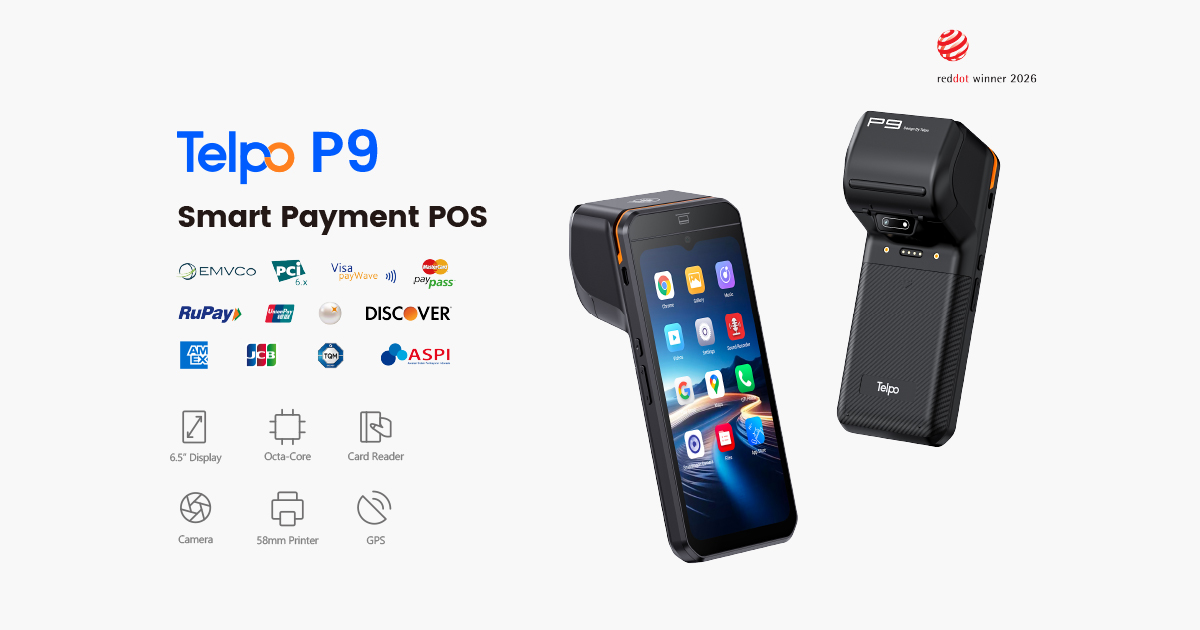
Examples in this category include the Telpo M1, a handheld ticketing POS with a 6-inch HD display, a 58mm thermal printer, NFC, QR, MSR, and IC card payment support, GPS, dual-band Wi-Fi, 4G, and 11.3 hours of continuous operation. The P9 series offers a financial version for payment processing and a non-financial version for Android POS functions, with a 6.5-inch display, dual SIM, eSIM, a 58mm printer, and optional barcode scanner modules. The P8 M5 is an ultra-lightweight smart payment terminal at 389g, rated for 1.5-meter drops and splash resistance, with 13+ hours of continuous operation.
Self-Service POS Kiosks
Self-service POS terminals transfer checkout to the customer. They are common in quick-service restaurants, canteens, convenience stores, supermarkets, cinemas, and food courts. Kiosks range from compact countertop units to floor-standing models with large touchscreens.
The Telpo K10, for example, is a self-service kiosk with a 15.6-inch FHD display, Android 14, an octa-core 2.2GHz processor, a built-in QR code scanner, an NFC reader for prepaid card payments and membership management, and an 80mm printer with 220mm/s maximum speed and auto-cutter. The larger K8M adds a 21.5-inch FHD touchscreen with 10-point touch, optional barcode scanning as fast as 0.2 seconds, and support for external EFTPOS integration. The K1 provides under-display NFC payment, modular Pogo Pin expansion, and desktop, floor-stand, or wall-mount installation.
POS for Ticketing and Events
For transit and events, POS hardware is built as ticket validators with high durability ratings, multiple security module slots, and support for both closed-loop and open-loop payment. The Telpo T10 and T20 validators handle EMV contactless, QR and barcode scanning, and paper ticket validation. The T20 offers IP65 and IK08 protection, a 7-inch anti-glare display at 500 cd/m², eight SAM card slots, and optional Linux or Android operating systems. The T10 is E24-certified for vibration resistance, supports pole-mount installation with safety locks, and includes six SAM card slots.
AI Checkout POS Terminals
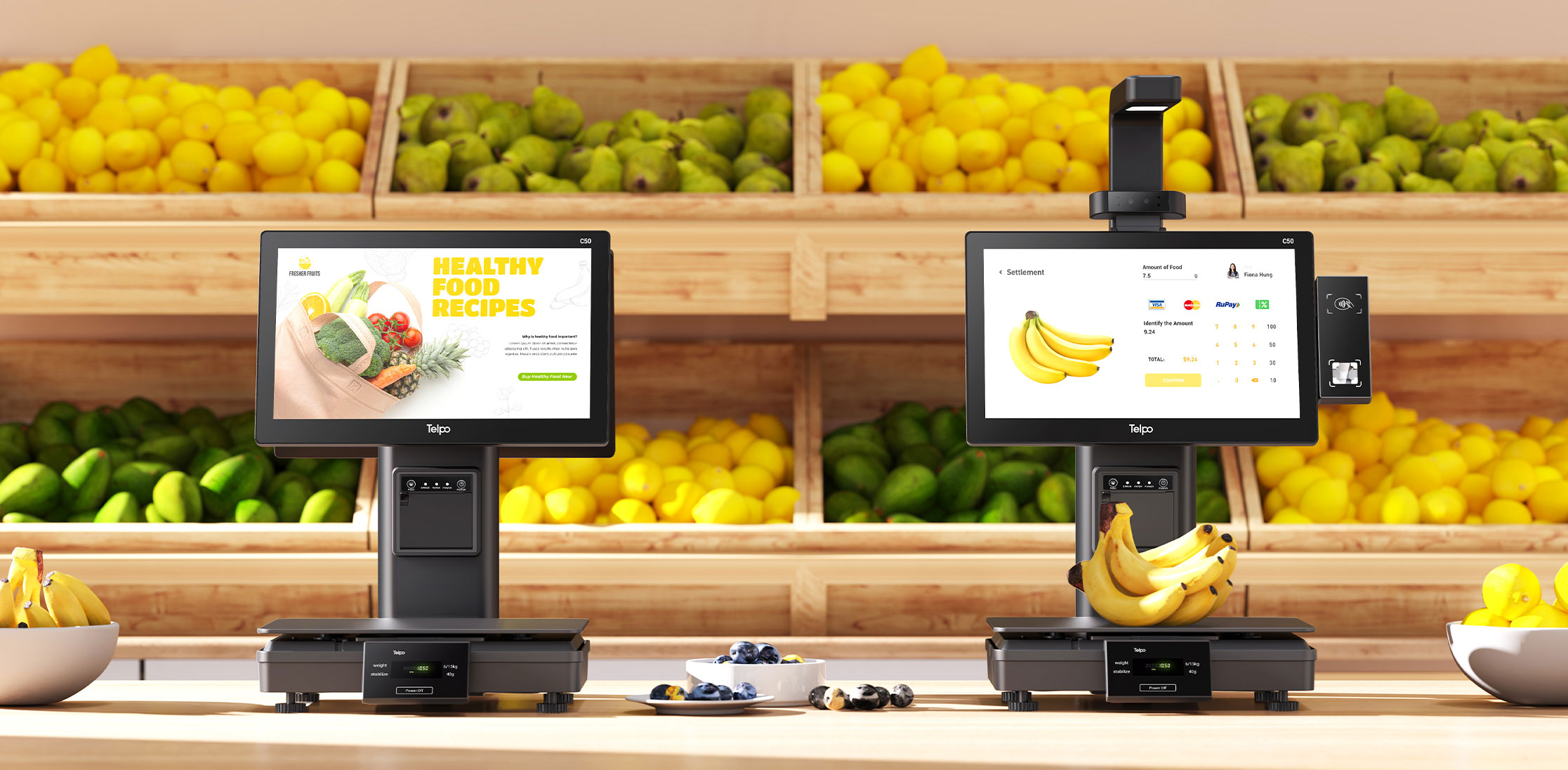
AI POS terminals add on-device vision recognition to the checkout process. The Telpo C50 is an AI Self-Checkout POS with an octa-core 2.7GHz processor, 12 TOPS of on-device AI compute, and 99.8% recognition accuracy at 0.1 second per item. It identifies both barcoded and barcode-free items, supports QR code and NFC contactless self-payment, and offers an optional 15kg scale with 2g precision and optional facial recognition. It is intended for supermarkets, grocery stores, convenience stores, fresh food retail, bakeries, self-service restaurants, delis, and grab-and-go retail.
| Category | Typical Form | Common Environments |
|---|---|---|
| Countertop / All-in-One POS | Fixed touchscreen terminal with printer and payment module | Retail, hotels, restaurants, service counters |
| Handheld / Mobile POS | Portable device with battery, printer, and wireless connectivity | Pay-at-table, delivery, field sales, ticketing |
| Self-Service Kiosk | Countertop or floor-standing customer-facing screen | Quick-service restaurants, canteens, supermarkets, cinemas |
| Ticket Validator | Pole-mount or panel-mount validator | Transit, metro, tram, ferry, event venues |
| AI Checkout POS | Fixed countertop with vision camera and optional scale | Supermarkets, bakeries, canteens, grab-and-go retail |
Why the POS Terminal Category Is Expanding
Several industry pressures explain why the POS terminal market now includes so many form factors.
First, payment methods have multiplied. Merchants must accept chip cards, NFC contactless, QR codes, digital wallets, and increasingly biometric authentication. A single-purpose card reader is no longer sufficient; the terminal has become a multi-method payment hub.
Second, labor and queue pressure pushed operators toward self-service. Unattended checkout, self-ordering kiosks, and AI vision checkout reduce reliance on cashiers. These deployments require a different class of hardware designed for customer interaction, durability, and in some cases on-device AI processing.
Third, software ecosystems have changed. Android-based POS terminals now host rich retail and hospitality applications, and GMS certification ensures access to mainstream app stores and services. The same hardware family can support a local boutique, a regional restaurant chain, and a global transit operator through different software stacks.
Fourth, regulatory requirements are stricter. Fiscal control, electronic invoicing, and tamper-evident transaction logging are now part of hardware design in many markets, not optional extras. Dedicated fiscal POS terminals include purpose-built UART/USB ports for fiscal modules, physical tamper-evident lead-sealed screws, electronic tamper logging, and external RTC circuits for accurate timekeeping.
Key Technical Features to Evaluate
For buyers researching POS terminals, the following technical areas determine whether a device will perform in a specific operation.
Payment Acceptance and Security Certification
At a minimum, a modern POS terminal should support magnetic stripe (MSR), EMV chip cards, NFC contactless, and QR code payment. Security certification is not optional: payment terminals generally require PCI PTS and EMV Level 1 and Level 2 compliance; contactless acceptance relies on EMV Contactless Level 1 and scheme certifications such as Paywave and Paypass. Some models add an FBI-certified fingerprint scanner for biometric verification, which is relevant for KYC and identity-sensitive use cases.
Operating System and Ecosystem
Android has become the dominant platform for Smart POS terminals because of its application ecosystem. Devices such as the Telpo M10 and M8 are GMS-certified, meaning they can run Google Mobile Services and mainstream Android POS apps. Windows-based terminals remain relevant for operators with legacy POS software: the C9W runs Intel i3 or i5 processors and provides six USB ports for broad peripheral compatibility.
Printing and Peripheral Expansion
Receipt printing speed and reliability matter in high-volume environments. Printers vary from 58mm units at 80mm/s to 80mm industrial printers with auto-cutters at 200mm/s or 250mm/s. Peripheral expansion determines whether a terminal can connect cash drawers, barcode scanners, customer displays, kitchen display systems, and fiscal modules. Some terminals use Pogo Pin modular expansion for plug-and-play card readers without opening the device.
Durability for the Operating Environment
Environmental ratings should match the deployment site. Transit validators typically need IP65 or IP54 protection and IK07 or IK08 impact resistance. Handheld payment devices used outdoors may need drop protection and splash resistance: the Telpo P8 M5 is rated for 1.5-meter drops and brief exposure to rain. Fixed indoor terminals prioritize long service life and heat dissipation over ruggedization.
Connectivity and Fleet Management
Wireless connectivity keeps the terminal online and synchronized. Common options include 4G/3G/2G cellular, dual-band Wi-Fi, Bluetooth, and Ethernet. For mobile workforces, dual SIM and eSIM support provide network resilience across carriers. GPS is useful for delivery, field service, and transit route tracking. For operators managing hundreds of devices, remote device management capability simplifies updates and configuration.
Matching Terminal Type to Use Case
Because POS hardware is now scenario-specific, buyers should map the terminal category to the operating environment before comparing models.
- Retail and supermarket checkout — dual-screen countertop terminals such as the C9, C9PD, or M10 provide merchant and customer displays, fast thermal printing, and real-time sales data synchronization.
- Restaurant and café — a hybrid deployment is common: a countertop terminal for orders and payments plus a handheld device for pay-at-table service. The M10 works at the counter; the P9 or M1 supports table-side NFC, QR, and receipt printing.
- Convenience store and pharmacy — compact all-in-one terminals such as the M8 fit limited counter space and support NFC, QR payment, receipt printing, loyalty membership, and fiscal module connection.
- Transit and events — ticket validators such as the T10 and T20 handle closed-loop and open-loop cards, QR tickets, and paper validation with IP/IK protection and multiple SAM slots.
- Unattended retail and canteens — AI checkout terminals such as the C50 and self-service kiosks such as the K10 reduce staffing dependency and speed up customer throughput.
- Field delivery and logistics — handheld terminals with barcode scanning, GPS, and full payment support, such as the P8 M5 or P9 PDA, enable cash-on-delivery elimination and electronic receipt proof.
- Government and agent banking — payment terminals with optional biometric identity verification, such as the TPS900, support utility fee collection, social welfare payment, and KYC enrollment.
What the Market Data Says
For buyers building a business case, current market estimates provide useful context.
- The global POS terminal market reached approximately USD 123.2 billion in 2025 (Grand View Research).
- The handheld POS segment is projected to grow from USD 33.15 billion in 2025 to USD 89.52 billion by 2035 (Grand View Research).
- Android POS terminals accounted for roughly 27% of all POS terminals sold globally in recent tracking (ResearchAndMarkets / Berg Insight).
- The SoftPOS market was estimated at USD 365.0 million in 2024, with a projected CAGR of 23.1% through 2030 (Grand View Research).
- The retail self-service kiosk market is forecast to reach USD 37.8 billion by 2030, with Telpo Technology identified as a leading corporation in this sector (The Business Research Company).
Major global manufacturers commonly cited in the market include Ingenico (Worldline), Verifone, PAX Technology, SUNMI, and Newland Payment Technology. Newer ODM-focused manufacturers such as Telpo compete through production scale, customization depth, and certification coverage rather than through a single retail product.
Traditional Checkout Hardware vs Modern POS Terminals
The shift from traditional checkout hardware to modern Smart POS terminals is not only about adding a touchscreen.
| Dimension | Traditional Cash Register | Modern Smart POS Terminal |
|---|---|---|
| Software | Closed firmware, fixed functions | Open Android or Windows platform with app ecosystem |
| Payment methods | Cash only or single card scheme | MSR, EMV chip, NFC contactless, QR, digital wallets, optional biometrics |
| Connectivity | Offline or local network | 4G, dual-band Wi-Fi, Bluetooth, Ethernet, GPS, cloud sync |
| Peripherals | Limited or proprietary | USB, RJ12, Pogo Pin expansion for printers, cash drawers, scanners, fiscal modules |
| Upgrade path | Hardware replacement for new features | Software updates, app additions, modular hardware expansion |
Modern POS terminals are not a universal replacement for every legacy system. Hardware is only half of the deployment: operators with deeply customized Windows applications need to validate driver compatibility and migration paths before switching to Android terminals. Android POS availability also depends on the local app ecosystem and acquiring-bank certification. In markets where certified acquirer applications are limited, an older certified payment terminal may remain the only compliant option. Additionally, cloud-synchronized and fiscal terminals depend on network reliability, so offline tolerance should be part of the evaluation.
How to Shortlist a POS Terminal Manufacturer
At the research stage, buyers should evaluate the manufacturer as much as the product. Three signals are particularly useful.
Certification portfolio. A manufacturer that maintains PCI PTS, EMV Level 1 and Level 2, EMV Contactless Level 1, and regional scheme certifications across multiple products can reduce time-to-market for payment projects. Telpo's TPS900, for example, carries PCI PTS V6.x, EMV L1/L2, EMV Contactless L1, Paywave, Paypass, and additional scheme certifications.
Manufacturing and quality infrastructure. Hardware reliability depends on production process control and testing. Telpo operates a facility of approximately 45,000 square meters with an annual production capacity of 2,000,000 units, supported by about 600 staff including a 200-engineer R&D team. In 2025, the company upgraded its CNAS laboratory to approximately 900 square meters across 12 testing zones covering areas such as OTA darkroom, EMC chamber, and climate testing.
ODM capability. Many global buyers do not sell a manufacturer's brand; they sell their own. ODM support includes logo and color customization, material selection, pre-loaded software, MDM integration, and compliance documentation. Telpo, founded in 1999, focuses on four core overseas business segments: Smart Retail, Smart Payment, Smart Transportation, and Biometric Security. Export business accounts for 60% to 80% of total sales, with major markets in Asia, Africa, the Middle East, Europe, Latin America, and North America.
Future Outlook
Several trends will shape POS terminal procurement over the next few years.
On-device AI will move further into checkout. Terminals such as the C50 already perform 0.1-second product recognition with 99.8% accuracy using 12 TOPS of local compute. As AI models improve, vision-based checkout will expand beyond canteens and supermarkets into more unattended formats.
SoftPOS will complement dedicated hardware. The projected 23.1% CAGR of the SoftPOS market suggests that contactless acceptance will increasingly run on general-purpose devices. However, dedicated terminals will remain necessary for environments requiring receipt printing, durability, peripheral integration, and PCI-certified security.
Biometric payment will become a standard option. Fingerprint authentication is already available on payment terminals, and facial recognition is an option on kiosks and AI checkout devices. Buyers should consider whether their target markets will require biometric identity verification for KYC or payment authorization.
Self-service and kiosk deployments will grow. With the retail self-service kiosk market forecast to reach USD 37.8 billion by 2030, terminals designed for customer-facing operation will take a larger share of the POS terminal category.
For procurement teams, the practical implication is that hardware selection should be made with a five-year view: the terminal must support software updates, new payment schemes, and evolving security certifications, not just the transaction types of today.
FAQ
What is a POS terminal?
A POS terminal is a hardware device used at the point of sale to complete transactions and process payments. Modern POS terminals typically combine payment acceptance (chip card, magnetic stripe, NFC contactless, QR code), receipt printing, connectivity, and an operating system that supports retail or hospitality software.
What are the main types of POS terminals?
Common categories include countertop or all-in-one POS terminals (cash registers), handheld or mobile POS terminals, self-service kiosks, ticket validators, and AI checkout terminals. The right type depends on the deployment scenario — for example, a fixed checkout counter, table-side payment, unattended retail, or transit entry.
What payment methods can a POS terminal accept?
That depends on the hardware. Many modern terminals accept magnetic stripe cards, EMV chip cards, NFC contactless payments, QR code payments, and digital wallets. Some models add biometric authentication such as fingerprint scanning for identity verification.
What security certifications matter for POS terminals?
Payment terminals generally need to meet PCI PTS (PIN Transaction Security) and EMV Level 1 and Level 2 standards. For contactless acceptance, EMV Contactless Level 1, including schemes such as Paywave and Paypass, is relevant. Terminals used for ticketing or transit may also require certifications such as E24 vibration resistance and IP or IK protection ratings.
What is the difference between a traditional cash register and a Smart POS terminal?
A traditional cash register is typically a closed device with fixed functions, limited to recording sales and opening a cash drawer. A Smart POS terminal runs on an operating system such as Android or Windows, supports software applications, accepts multiple payment methods, connects to peripherals, and can synchronize data with cloud systems in real time.
How do I choose between a countertop POS and a handheld POS terminal?
Countertop POS terminals suit fixed checkout counters with high transaction volumes and multiple peripherals. Handheld terminals suit mobile scenarios such as pay-at-table, field delivery, ticketing, and mobile sales, where staff move to the customer. Some operators deploy a hybrid model: fixed countertop units plus handheld devices for queue-busting or off-counter payment.
For a wider view of the product families mentioned in this article, the Telpo Products Brochure (Payment and Retail) is available for public download: Telpo Products Brochure — Payment & Retail V4.