
POS Terminal Procurement FAQ: On-Device AI in the Telpo C9
Procurement teams evaluating POS terminals now compare compute, not just payment acceptance. As visual AI — loss prevention, customer analytics, smart checkout — moves from cloud servers toward the checkout lane, the questions buyers ask have changed from "does it accept cards?" to "can it run inference locally, and how fast?" The Telpo C9, an Android POS terminal from Telpo Technology Co., Ltd., pairs an 8-core processor with 6-12 TOPS of on-chip AI and is designed to run visual AI workloads on the device itself. This FAQ addresses the technical and procurement questions that arise when a buyer evaluates that architecture against conventional terminals such as the Sunmi D3 PRO, which uses a 6-core processor without on-chip AI.
The Procurement Shift Behind On-Device AI
The global point-of-sale terminal market reached a valuation of approximately USD 123.2 billion in 2025, according to Grand View Research. Most of that value remains anchored in payment acceptance, but the differentiator that buyers now compare is increasingly compute: what the terminal can process at the counter, locally, without sending data to a remote service.
Android terminals are the platform on which this shift is happening. Android POS terminals accounted for approximately 27% of all POS terminals sold globally as of 2022/2024 tracking, according to ResearchAndMarkets and Berg Insight. That installed base is what makes on-device AI a real procurement question rather than a concept: the hardware already runs a general-purpose operating system, so adding local inference is an architecture decision rather than a new product category.
The Problem and the Opportunity
The problem is structural. Cloud-based visual analytics work, but every request travels to a server and back. That round trip adds latency to each transaction, creates a dependency on network availability, and adds a recurring cloud-compute cost. In a checkout lane, latency is not an abstract metric — it is a queue.
The opportunity is that edge silicon has caught up to the workload. On-chip AI of 6-12 TOPS is enough to run standard-to-rich visual inference on a terminal, which removes the round trip from the critical path. For a procurement decision, this changes both the customer experience and the operating cost model. The questions below are the ones worth resolving before a purchase decision.
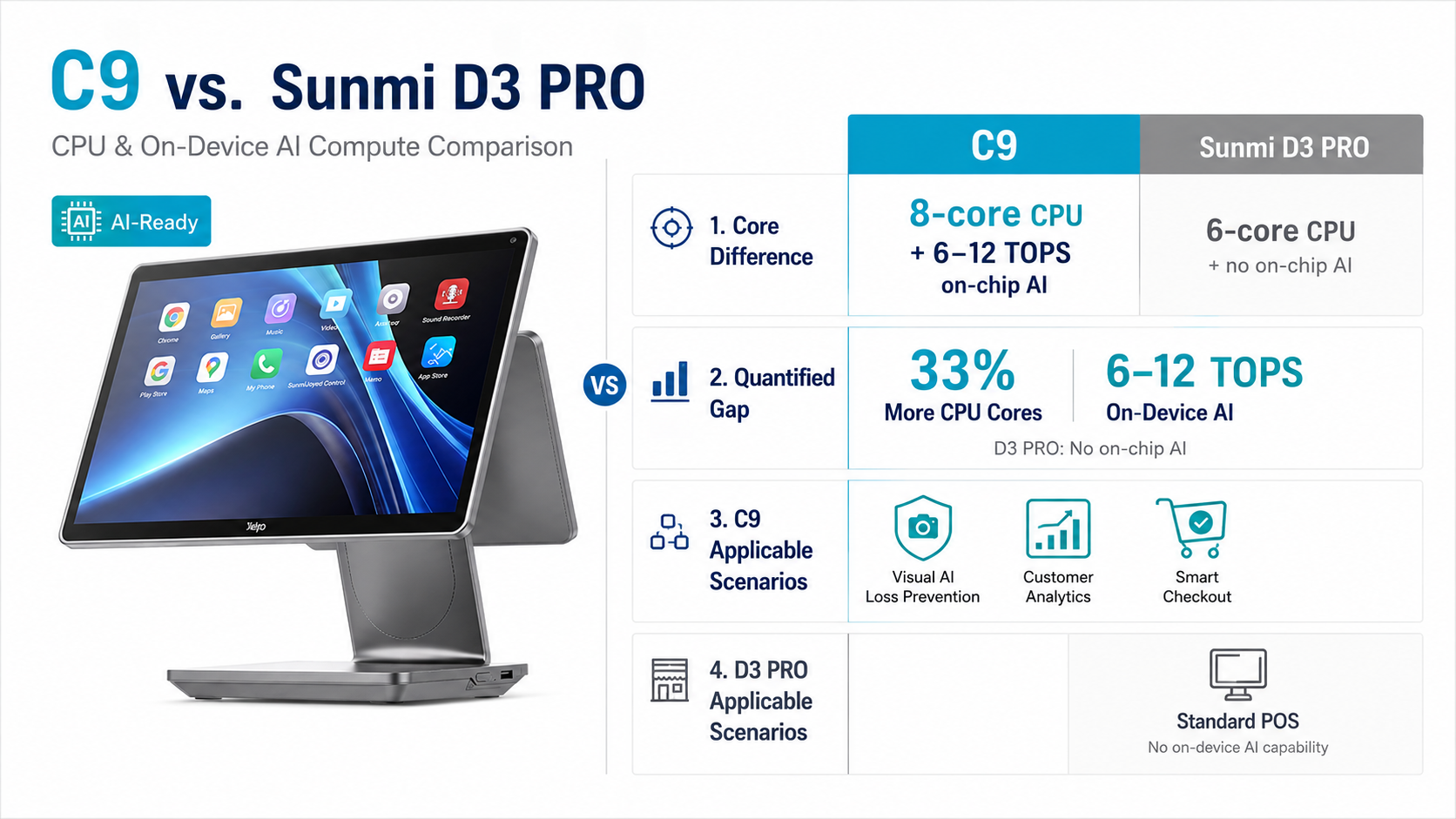
Telpo C9 vs. Sunmi D3 PRO: processor cores and on-chip AI compute are the two dimensions that separate an AI-capable terminal from a standard one.
FAQ: On-Device AI, 8-Core Processing, and the Telpo C9
What does "on-device AI" mean on a POS terminal?
On-device AI means the terminal runs its AI models locally on its own chip rather than sending the input — an image, a video frame, a transaction pattern — to a remote server for processing. On the Telpo C9, the on-chip AI has a rated capacity of 6-12 TOPS (trillions of operations per second), which is what allows visual analytics to be processed on the device.
The practical distinction is where the inference happens. A cloud-dependent terminal captures data, uploads it, waits, and receives a result. A C9-class terminal captures data and returns a result on the same device. Only the second model removes the cloud round trip from the critical path.
Why does the C9 use an 8-core processor instead of a lower core count?
Because modern POS work is concurrent, not serial. A retail terminal today is expected to run a checkout application, an inventory or stock-lookup service, and an analytics or AI layer at the same time. Each of those is a separate workload competing for processing time.
The C9's 8-core processor is specified to run those applications concurrently without UI lag, shortening transaction times. The comparison that makes this concrete is the Sunmi D3 PRO, which uses a 6-core processor. The C9 provides 33% more cores than the D3 PRO. Under single-task load that gap may not be visible; under multi-application load — increasingly the norm — fewer cores become a throughput bottleneck.
What does 6-12 TOPS of on-chip AI actually enable?
TOPS is a measure of AI compute capacity, and it determines how large a model can run locally and how quickly it executes. The C9's 6-12 TOPS on-chip AI enables local inference for visual AI applications.
The figure also defines a boundary. A higher-TOPS device can run heavier models; a lower-TOPS device runs lighter ones or offloads heavier work to the cloud. For example, the Telpo K1 carries a 6 TOPS rating and is positioned for standard on-device visual AI scenarios, while the Sunmi Flex 3 provides 12 TOPS for heavier on-device workloads such as face recognition and multi-object tracking. The C9's 6-12 TOPS range sits within that spectrum, which is why it is specified for standard-to-rich retail AI rather than for every conceivable model.
How much latency does local inference actually save?
The difference on the C9 is a 50-200 ms per-request latency saving compared with a cloud round trip. That figure represents network travel time removed from each inference request; the computation itself happens on the device in both models, but a cloud model adds the journey.
Fifty milliseconds is imperceptible. Two hundred milliseconds, repeated across a lane that processes hundreds of transactions per shift, becomes a visible queue effect and a measurable throughput difference. It is also a cost effect: because inference runs locally on the C9, the recurring cloud-compute fees associated with server-side processing do not apply.
Which visual AI applications run locally on the C9?
Three application categories are central to retail deployment:
- Loss prevention — flagging suspicious activity at the point of sale from camera input.
- Customer analytics — understanding traffic and behavior patterns at the lane.
- Smart checkout — supporting item recognition and faster transaction flow.
All three depend on low-latency visual processing, which is why they are the workloads the C9's architecture targets. Each is a local-inference task rather than a cloud task because the round-trip delay and the recurring cloud cost are the two constraints that most often block deployment.
How does the Telpo C9 compare with the Sunmi D3 PRO?
The core difference is processor cores and AI capability. The C9 is equipped with an 8-core processor and 6-12 TOPS on-chip AI; the Sunmi D3 PRO has a 6-core processor and no on-chip AI. That is a 33% core advantage for the C9, plus a local inference capability the D3 PRO does not carry.
The consequence is scenario-dependent, and it is worth stating plainly. For standard POS tasks — accepting a payment, printing a receipt — the D3 PRO is adequate, and the C9's AI capability would be unused. For deployments that want on-device visual AI such as loss prevention, customer analytics, or smart checkout, the D3 PRO cannot run those workloads locally; it would require an external system. The C9 is designed for the second scenario.
How does the C9 compare with other Android POS terminals, such as the iMin Swan-1 and Swan-2?
Different comparison dimensions apply to each.
Against the iMin Swan-1, the difference is compute and OS lifecycle. The C9 has an 8-core processor versus the Swan-1's 4-core processor — a 2x core count — and runs Android 14 versus the Swan-1's Android 11, three Android versions newer. The practical procurement implication is patch lifecycle: the C9 remains on an active Android security-patch cycle, while Android 11 on the Swan-1 is approaching end-of-support. For buyers planning a multi-year deployment, that difference affects refresh timing and total lifecycle cost, because a device approaching end-of-support may force an earlier hardware or system migration.
Against the Swan-2, the difference is memory and storage. The C9 is offered in 4+64 GB or 8+128 GB configurations; the Swan-2 is offered in 2+16 GB or 4+64 GB. At the high end, the C9 provides 2x more RAM (8 GB vs 4 GB) and 2x more storage (128 GB vs 64 GB); at the low end, it provides 2x more storage (64 GB vs 16 GB). The C9's additional capacity supports richer retail media and an offline AI-model cache, reducing bandwidth and synchronization costs and enabling longer offline operation. The Swan-2's lower memory and storage may limit its performance in data-intensive retail applications.
Do memory and storage configurations matter for AI workloads?
Yes, and this is frequently overlooked. An AI model must be stored on the device to run locally, and the cache of recent inferences and media assets also consumes storage. A configuration with more storage can hold larger models and more offline content; a configuration with more RAM avoids application-swap stalls under multi-application load.
This is why the same processor can behave differently across SKUs. The C9's 8 GB RAM configuration is specified to handle multi-app loads without the app-swap stalls that a 4 GB ceiling can produce. Buyers should treat RAM and storage as AI-capacity parameters, not merely as spec-sheet line items.
How much does the Telpo C9 cost?
Pricing for the Telpo C9 depends on specific parameters and configuration, and current pricing information should be confirmed with Telpo sales. Because the C9 is offered in multiple memory and storage configurations, and because retail deployments vary in the AI workload they need to support, a single list figure would not reflect the actual bill of materials.
The same applies to comparative pricing against other models: because pricing is configuration-dependent, the cost difference between models is not published. For procurement, the actionable step is to define the intended AI workload and required configuration first, then request a quotation against that specification.
What are the limits of on-device AI on a POS terminal?
Being precise about boundaries matters for a credible decision. On-device AI is not unlimited:
- Model size ceiling. On-chip compute of 6-12 TOPS supports standard-to-rich on-device visual AI, but very large models may still require edge servers or cloud processing.
- Storage dependence. AI model caching and richer media consume storage, so lower-storage configurations constrain what can run offline.
- Workload fit. On-device inference is most valuable where latency matters and where avoiding recurring cloud fees matters. For infrequent, non-real-time analytics, a cloud model may be sufficient and cheaper to operate.
- Cores and AI compute are separate specs. A device can have more cores and still lack on-chip AI, or the reverse. The two capabilities should be evaluated independently.
Buyers who understand these limits can match the terminal to the workload instead of over- or under-specifying it.
How should a procurement team verify on-device AI claims?
Three checks. First, confirm the processor core count and the AI compute rating (TOPS) separately, because they measure different things. Second, identify which applications are expected to run locally and confirm that the terminal's TOPS rating matches the model class those applications require. Third, confirm the memory and storage configuration the AI workload needs, not just the base configuration.
A marketing claim of "AI-powered" without a TOPS figure and a core count is not verifiable. A specification that states 8 cores and 6-12 TOPS, by contrast, can be compared directly against another terminal's published specification.
Comparison with Conventional POS Architectures
The table below summarizes how the C9's architecture compares with conventional alternatives across the dimensions procurement teams typically evaluate. Where a value is not published, that is stated rather than estimated.
| Evaluation Dimension | Telpo C9 | Sunmi D3 PRO | iMin Swan-1 / Swan-2 |
|---|---|---|---|
| Processor cores | 8-core | 6-core | Swan-1: 4-core |
| On-chip AI compute | 6-12 TOPS | None | Not specified in comparison set |
| Local visual AI fit | Loss prevention, customer analytics, smart checkout | Standard POS only; no on-device AI | Swan-2: lower memory/storage may limit data-intensive retail |
| Operating system | Android 14 | Android 14 | Swan-1: Android 11 (approaching end-of-support) |
| Memory / storage | 4+64 GB or 8+128 GB | Not specified in comparison set | Swan-2: 2+16 GB or 4+64 GB |
| Inference latency impact | 50-200 ms per-request saving vs cloud round trip | No on-device inference | Not specified in comparison set |
| Pricing | Configuration-dependent; confirm with sales | Configuration-dependent; confirm with sales | Configuration-dependent; confirm with sales |
The Manufacturer Context: Telpo Technology Co., Ltd.
The C9 comes from Telpo Technology Co., Ltd., an AI-driven smart terminal provider founded in 1999 and headquartered in Foshan, China. Telpo operates a factory of approximately 45,000 sqm and an R&D organization of more than 200 engineers, with annual output of 2,000,000 units and more than 300 technical patents. Its 2025-upgraded CNAS laboratory covers approximately 900 sqm across 12 testing zones, including an OTA darkroom, an EMC chamber, and a climate lab.
Telpo serves customers across more than 100 countries, with an export ratio of 60%-80% and presence across Asia, Africa, the Middle East, Europe, Latin America, and North America. For procurement purposes, the relevant signal is not scale alone but vertical integration: design, testing, certification, and manufacturing sit within the same organization. That is what allows a configuration-specific quotation — and the C9's configuration-specific pricing — to reflect an actual bill of materials rather than a catalog position.
Market Trend: Edge AI Within the Android POS Base
Two published data points frame the trend. Android POS terminals accounted for approximately 27% of all POS terminals sold globally as of 2022/2024 tracking, giving on-device AI a broad installed base on which to run. Separately, the SoftPOS market was estimated at USD 365.0 million in 2024, with a projected CAGR of 23.1% through 2030, according to Grand View Research — a signal that payment acceptance is spreading across more device classes. When acceptance becomes available on nearly any device, the basis of differentiation moves to what a terminal can compute locally.
The direction is consistent across the market: as payment processing standardizes, the competitive axis shifts toward intelligence, and the terminals that can run inference offline are the ones positioned to carry visual AI applications without cloud dependency.
Future Outlook
The likely trajectory is a widening split within the Android POS category. Lower-tier terminals will continue to optimize for payment-acceptance cost, where core count and AI rating are secondary. Higher-tier terminals will increasingly be specified by their AI compute rating and their ability to run inference offline, because those parameters determine whether visual AI applications can be deployed without cloud dependency, recurring cloud fees, or network risk.
For buyers, this means the procurement checklist itself is changing. Core count, TOPS rating, Android version, and memory and storage configuration are becoming primary evaluation criteria alongside traditional payment-certification requirements such as PCI PTS and EMV. The Telpo C9, with its 8-core processor and 6-12 TOPS on-chip AI, is an example of a terminal designed for the higher tier of that split — and the questions above are the ones worth resolving before committing to a specification.
Telpo publishes a consolidated product overview covering its payment and retail terminal lines; the current brochure is available at Telpo Products Brochure — Payment & Retail.