
PLT-120 vs PLT-210 vs PLT-198: Drive Wheel Buyer Comparison
An independent, specification-based comparison of three 48 V drive wheel models for AGV, AMR and automated forklift programmes — plus the purchasing and acceptance questions that should be settled before the order is released.
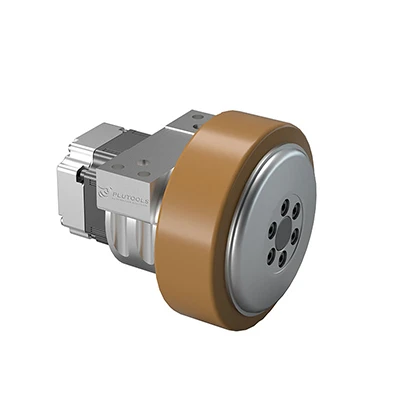
PLT-120 differential drive wheel — the lightest of the three models compared here, rated at 150 kg drive wheel load with IP65 protection.
What This Comparison Covers
Drive wheel selection for AGV, AMR and automated forklift projects is a scenario-fitting exercise, not a search for the largest number on a specification sheet. A 150 kg differential unit and a 1500 kg planetary horizontal unit are not substitutes for one another. They belong to different vehicle weight classes, different steering strategies, and different acceptance procedures at goods-in.
This buyer reference compares three verified drive wheel models: the PLT-120 Differential Drive Wheel, the PLT-210 Forklift Drive Wheel (recorded as a Parallel Horizontal Drive Wheel with Steering), and the PLT-198 Horizontal Drive Wheel (recorded as a Planetary Horizontal Drive Wheel with Steering). All three share a 48 V electrical architecture, polyurethane (PU) tread, and carbon steel construction — yet each sits in a different project weight class and a different steering philosophy.
The three models are produced by Shanghai Plutools Automation Corporation Co., Ltd. (Plutools), a Shanghai-based manufacturer focused on AGV drive wheels and founded in 2017. The company operates a 10,000 m² production facility with around 100 employees, a 60-engineer R&D team and an annual output of 10,000 units. Approximately 70% of production is exported to the EU, USA, Southeast Asia, South America, the Middle East, Japan and South Korea.
Why Drive Wheel Architecture Comes Before Model Number
Two questions decide the architecture, and both should be answered before any model number is discussed.
- How much load must each drive wheel carry? Drive wheel load ratings are stated per wheel, not per vehicle. Vehicle mass, payload, wheel count and load distribution determine whether a given rating is workable.
- How must the vehicle steer? A differential drive wheel rotates a vehicle through speed difference between paired wheels. A parallel horizontal drive wheel with steering adds a dedicated steering function to the drive unit.
Independent market analysis reflects the same logic. Dual differential drive wheels allow a zero-turn radius and are widely used in smaller logistics robots. At the same time, integrated steering drive modules are increasingly replacing discrete components in order to reduce assembly time and maintenance complexity. Both patterns appear in the three models below: PLT-120 represents the differential pattern, while PLT-210 and PLT-198 represent the integrated steering-module pattern.
Tread material is a further scenario variable. Forklift drive wheel tyres commonly use polyurethane (PU) to provide higher load capacity and floor protection in indoor settings — which is consistent with the PU tread specified across the PLT-120, PLT-210 and PLT-198.
The Three Models Side by Side
The table below reproduces the published specification record for each model. Values marked “listed” come directly from the data sheet and should be confirmed item by item during quotation.
| Parameter | PLT-120 | PLT-210 | PLT-198 |
|---|---|---|---|
| Recorded product name | Differential Drive Wheel | Forklift Drive Wheel | Horizontal Drive Wheel |
| Recorded type | Differential Drive Wheel | Parallel Horizontal Drive Wheel with Steering | Planetary Horizontal Drive Wheel with Steering |
| Rated voltage | 48 V | 48 V | 48 V |
| Power | 400 W | 3000 W | 3000 W |
| Rated current | 11.2 A | 68 A | 68 A |
| Rated speed | 3000 rpm | 3000 RPM | 3000 RPM |
| Rated torque | 1.28 Nm | 9.55 Nm | 9.55 Nm |
| Reduction ratio | 9 and 20 (I), as listed | 32 | 32 |
| Rated output torque | 10 and 21 Nm, as listed | 260 Nm | 260 Nm |
| Maximum torque | 20 and 42 Nm maximum acceleration and braking torque, as listed | 576 Nm | 576 Nm |
| Maximum load | 150 kg drive wheel load | 1200 kg | 1500 kg |
| IP protection | IP65 | Not stated in the available record | Not stated in the available record |
| Unit weight | 5 ± 2 kg | Not stated in the available record | Not stated in the available record |
| Tread / construction | PU tread, carbon steel | PU tread, carbon steel | PU tread, carbon steel |
PLT-120: Differential Drive Wheel for Light AGVs and AMRs
The PLT-120 is a 48 V differential drive wheel rated at 400 W and 11.2 A, with a 3000 rpm rated speed, 1.28 Nm rated torque, IP65 protection, a drive wheel load of 150 kg and a total unit weight of 5 ± 2 kg. Its recorded transmission ratio values are 9 and 20 (I), with rated output torque listed as 10 and 21 Nm and maximum acceleration and braking torque listed as 20 and 42 Nm.
For project fit, that combination points to a specific vehicle class: compact AGVs and AMRs where the chassis has limited mounting space, the electrical budget is modest, and two differential units are paired to provide manoeuvrability and in-place rotation. The 11.2 A rated current is materially lower than the 68 A drawn by the other two models, so battery capacity, motor driver rating and thermal design should be sized accordingly rather than assumed.
IP65 is also a scenario variable in its own right. It is the only IP rating stated in this comparison set, which makes PLT-120 the natural candidate where dust ingress or water splash is part of the specification — for example in areas adjacent to washdown zones or semi-outdoor industrial environments. Buyers should still confirm that the stated protection level matches the actual cleaning method and fluid exposure of the site.
PLT-210: Forklift Drive Wheel with Integrated Steering
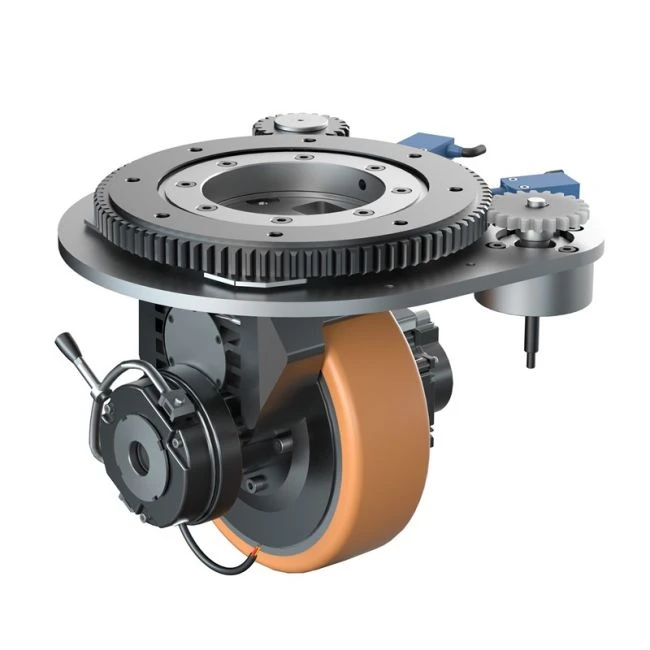
PLT-210 parallel horizontal drive wheel with steering — rated to 1200 kg maximum load and 576 Nm maximum torque.
The PLT-210 is a 48 V parallel horizontal drive wheel with an integrated steering function, rated at 3000 W and 68 A, with a 3000 RPM speed, 9.55 Nm rated torque, a 32:1 reduction ratio, 260 Nm output torque, 576 Nm maximum torque, and a maximum load of 1200 kg. Tread is PU on a carbon steel construction.
This is an automated forklift and heavy material-handling unit, not an upscaled small-robot wheel. Three specifications matter most in evaluation. First, 576 Nm maximum torque determines whether the vehicle can start, accelerate and brake a loaded pallet under control, including on the ramps and transitions common in production logistics. Second, a 32:1 reduction ratio converts a high-speed motor into controlled low-speed traction, which is what positioning accuracy depends on. Third, the integrated steering function removes the need to specify and align a separate steering actuator, reducing the number of interfaces that a system integrator has to engineer and maintain.
The trade-off is spatial and electrical. A parallel horizontal layout occupies more lateral and mounting volume than a compact differential unit, and a 3000 W drive at 68 A rated current requires a battery pack, controller and cabling sized for that draw. Where a project needs the 1200 kg class but not the highest load in the range, PLT-210 is the closer fit; where 1500 kg per drive wheel is required, the PLT-198 becomes the relevant model.
PLT-198: Planetary Horizontal Drive Wheel for the Heaviest Loads
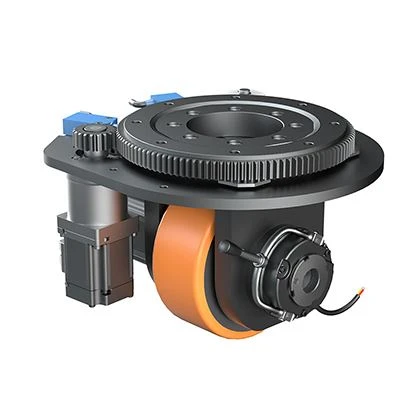
PLT-198 planetary horizontal drive wheel with steering — 1500 kg maximum load with customizable load and speed options.
The PLT-198 is a 48 V planetary horizontal drive wheel with steering, rated at 3000 W and 68 A, 3000 RPM, 9.55 Nm rated torque, a 32:1 reduction ratio, 260 Nm output torque, 576 Nm maximum torque, and a maximum load of 1500 kg. Like the PLT-210 it uses a PU tread and carbon steel construction, and its product record lists customizable load and speed options.
The practical distinction between PLT-210 and PLT-198 is not the torque figure — both list 260 Nm output torque and 576 Nm maximum torque — but the structural rating and the gear architecture: a planetary horizontal design rated to 1500 kg, against a parallel horizontal design rated to 1200 kg. For projects moving steel coils, dense palletised goods, or heavy transfer carts where a single drive unit must carry a larger share of the vehicle load, that 300 kg difference per wheel changes how many drive units the vehicle needs, and therefore changes cost, control complexity and maintenance scope.
Customization is where heavy projects are usually won or lost. The manufacturer's customization scope covers load capacity, wheel diameter, motor power, voltage, rated speed, reduction ratio, mounting dimensions, encoder type, brake system, connector, cable length, logo and packaging — the parameters that determine whether an off-the-shelf unit can actually be bolted into an existing chassis design.
Matching a Model to a Project Scenario
The following decision framework converts specification values into project indicators. It is intended for Research and Evaluation stage buyers who need to shortlist a configuration before requesting a quotation.
| Project indicator | What to check | Closer model fit |
|---|---|---|
| Light vehicle, limited mounting space, tight aisles, in-place rotation | Drive wheel load up to 150 kg, low rated current, IP65 stated | PLT-120, typically used as paired differential units |
| Automated forklift or heavy AGV/AMR, 1200 kg per drive wheel | 3000 W, 68 A, 260 Nm output torque, 576 Nm maximum torque, integrated steering | PLT-210 |
| Heavy transfer or ultra-heavy-duty platform, 1500 kg per drive wheel | Planetary horizontal structure, customizable load and speed | PLT-198 |
| Dust, splash or cleaning exposure | Stated IP level; confirm for models where the record does not state one | PLT-120 carries IP65 in the available record; confirm IP requirement for PLT-210 and PLT-198 in the RFQ |
| Floor type and traffic pattern | Concrete, epoxy, steel or slightly uneven floors; narrow aisles; frequent start/stop | Applies to all three; confirm tyre hardness and tread wear expectations per site |
Application conditions are consistent across the range. These drive wheels are used in indoor factories, automated warehouses, production workshops and logistics centres, and in semi-outdoor industrial environments; typical operating profiles include continuous running, frequent starting and stopping, forward and reverse movement, narrow aisles, heavy loads, dust, vibration and temperature variation. They are matched with AGVs, AMRs, automated forklifts, transfer robots, inspection robots and cleaning robots, together with servo motors, drivers, encoders, brakes, vehicle controllers, batteries, safety scanners, LiDAR and fleet-management software. Special versions are described for low-temperature warehouses, high-humidity areas, cleanrooms, dusty workshops and heavy-duty industrial applications — requirements that should be written into the specification rather than assumed.
Field Evidence: A 200-Unit Heavy-Duty AGV Programme
One documented project involved an AGV manufacturer and industrial automation system integrator in Brazil that sourced 200 drive wheel units for an ultra-heavy-duty AGV with multiple navigation modes. The application covered drive, differential steering and precise motion control. After two years of operation, the reported outcomes were stable operation under heavy-load conditions, accurate route tracking, flexible steering and reliable material transportation, with high load capacity, high output torque, precise differential control and multi-navigation compatibility identified as the deciding factors.
For buyers, the transferable lesson is not the unit count but the selection sequence: load per wheel and steering requirement were fixed first, system integration (navigation, encoder feedback, braking) second, and model number last.
Where These Solutions Stop: Limits and Trade-offs
An integrated drive wheel is not a universally better answer than a conventional motor-gearbox-wheel assembly, and buyers should price in the following boundaries.
- Serviceability is modular, not component-level. Because motor, gearbox, wheel, encoder and — on PLT-210 and PLT-198 — steering are integrated, a fault is serviced at module level. A stated lead time of 30–45 days makes spare-unit planning more important than it would be for discrete components that can be replaced individually.
- IP ratings are not uniform across the range. Only PLT-120 has a stated protection level (IP65) in the available record. Buyers specifying washdown, high-humidity or dusty areas must confirm the IP requirement for PLT-210 and PLT-198 rather than assuming parity.
- PLT-120 is a light-duty unit by design. At 150 kg drive wheel load, heavier vehicles need multiple units, which adds wheel count, wiring and control complexity compared with a single high-capacity unit.
- Horizontal units need more chassis space. Parallel and planetary horizontal layouts are larger than a compact differential unit and must be matched against mounting dimensions and steering envelope early in the mechanical design.
- Differential and steering layouts solve different problems. Differential pairs deliver in-place rotation through speed difference; parallel horizontal units add a dedicated steering function. A specification that needs per-wheel steering cannot be satisfied by adding differential pairs alone.
- Compliance applies at vehicle level. Frameworks that procurement teams commonly reference include ISO 3691-4:2023 for driverless industrial trucks, covering steering and braking; EN 1175:2020 for electrical and electronic safety requirements of industrial trucks; and ANSI/ITSDF B56.5 for driverless industrial vehicles. Component documentation should be requested separately against these frameworks.
Purchasing Terms and Acceptance Criteria: A Pre-Order Checklist
This is the step where specification comparisons are most often undermined. The three models carry similar names and identical electrical architecture, so the purchase order and the goods-in inspection should be unambiguous.
| Stage | What to confirm |
|---|---|
| Model identification | Record the full name and type: Differential Drive Wheel PLT-120; Forklift Drive Wheel PLT-210 (Parallel Horizontal Drive Wheel with Steering); Horizontal Drive Wheel PLT-198 (Planetary Horizontal Drive Wheel with Steering) |
| Paired specification values | PLT-120 lists two transmission ratio values (9 and 20), two rated output torque values (10 and 21 Nm) and two maximum acceleration/braking torque values (20 and 42 Nm). Specify in writing which combination applies to the ordered configuration |
| Load definition | State vehicle mass, payload, number of drive wheels and load distribution so that the per-wheel rating (150 kg, 1200 kg, 1500 kg) is validated against the full vehicle |
| Weight tolerance | PLT-120 is listed at 5 ± 2 kg; confirm the measurement condition and whether the tolerance matters to the chassis design |
| Environmental rating | Confirm the required IP level for each model, particularly where the datasheet record does not state one |
| Mechanical and electrical interfaces | Mounting dimensions, encoder type, brake system, connector, cable length, reduction ratio and speed options — all within the manufacturer's stated customization scope |
| Commercial terms | Minimum order quantity of 2 units, lead time of 30–45 days and monthly capacity of 12,000 units; availability should be checked against project schedule rather than assumed |
| Quality documentation | The manufacturer states 100% test. Agree in advance which test record, labelling and documentation accompany each unit |
| Goods-in acceptance | Verify nameplate data against the purchase order, including 48 V rated voltage, 11.2 A rated current on PLT-120 and 68 A on PLT-210 and PLT-198, and 3000 rpm/RPM rated speed; then run no-load speed, torque, brake and steering function checks, and confirm encoder output and connector type |
Market Context: Why These Specifications Are Being Re-Read
The commercial backdrop explains the growing scrutiny on per-wheel load ratings and torque figures. Third-party research puts the global AGV wheel drives market at approximately USD 1.2 billion in 2024, projected to reach USD 3.5 billion by 2034, a compound annual growth rate of 11.5% driven by logistics and warehouse automation. Within the broader AGV market, the industrial logistics segment is projected to grow fastest, at a CAGR of 11.6%, and Asia Pacific held a 37.6% revenue share of the global AGV market in 2025.
Electrification reinforces the same trend on the forklift side: electric forklifts now command over 70% market share in many regions as a replacement for combustion models, which pulls demand toward electrically driven, integrated drive and steering units in the 1200–1500 kg class. Integrated steering modules replacing discrete components, and the wider adoption of PU treads for load capacity and floor protection, are consistent with the architecture of the PLT-210 and PLT-198.
Future Outlook
Three directions are visible from the specification data and market signals. First, the 48 V architecture is already common across the light, mid-heavy and heavy classes compared here, which simplifies fleet-level electrical standardisation for buyers running mixed vehicle sizes. Second, load capacity per drive unit continues to move upward in material-handling applications, making the 1500 kg planetary class relevant to more projects than before. Third, customisation of load, speed, reduction ratio and mounting dimensions is becoming a normal procurement requirement rather than a special-order exception — which raises the importance of concluding interface and acceptance agreements during quotation, not after delivery.
Frequently Asked Questions
How much load can a single drive wheel carry in an AGV or AMR project?
In this comparison set, the published ratings are 150 kg drive wheel load for PLT-120, 1200 kg maximum load for PLT-210 and 1500 kg maximum load for PLT-198. These are per-drive-wheel values. The correct project question is how many drive wheels the vehicle will use and how the total vehicle mass and payload are distributed across them, since that determines whether a given per-wheel rating is adequate.
When is a parallel horizontal drive wheel with steering a better fit than a differential drive wheel?
A differential drive wheel such as PLT-120 suits light vehicles that rotate through speed difference between paired wheels and have limited mounting space. A parallel horizontal drive wheel with steering such as PLT-210 or PLT-198 suits heavier vehicles that require a dedicated steering function together with higher output torque (260 Nm), higher maximum torque (576 Nm) and higher load ratings (1200 kg and 1500 kg respectively). Independent analysis notes that dual differential drive wheels enable a zero-turn radius and are widely used in smaller logistics robots, while integrated steering modules are increasingly adopted to reduce assembly and maintenance complexity.
What does the PLT-198 specification mean for heavy material handling projects?
PLT-198 is a 48 V planetary horizontal drive wheel with steering, rated at 3000 W, 68 A, 3000 RPM, 9.55 Nm rated torque, a 32:1 reduction ratio, 260 Nm output torque, 576 Nm maximum torque and a maximum load of 1500 kg, with PU tread and carbon steel construction. Customizable load and speed options are listed in its product record. It is aimed at automated forklifts, heavy transfer platforms and material-handling vehicles where the highest load per drive unit in this set is required.
Which parameters should be confirmed in the RFQ before ordering?
Confirm the exact model name and type, the validated load per drive wheel, the applicable gear ratio and torque values, the IP requirement where the datasheet record does not state one, and the mechanical and electrical interfaces including mounting dimensions, encoder type, brake system, connector and cable length. PLT-120 in particular lists paired values — transmission ratio 9 and 20, rated output torque 10 and 21 Nm, maximum acceleration and braking torque 20 and 42 Nm — and a weight of 5 ± 2 kg. Commercial terms include a minimum order quantity of 2 units and a lead time of 30–45 days.
What acceptance criteria apply when drive wheel units arrive?
Acceptance should start with nameplate verification against the purchase order: 48 V rated voltage on all three models, 11.2 A rated current on PLT-120 against 68 A on PLT-210 and PLT-198, and 3000 rpm/RPM rated speed. Functional checks typically cover no-load speed, torque output, brake function on units so equipped, steering function on the horizontal steering models, and encoder output and connector type. The manufacturer states 100% test prior to shipment, so the test record and labelling agreed at quotation stage are the reference point for goods-in inspection.
Which operating environments do these drive wheels suit?
They are applied in indoor factories, automated warehouses, production workshops and logistics centres, and in semi-outdoor industrial environments, on concrete, epoxy, steel or slightly uneven floors, under continuous operation with frequent starting and stopping, narrow aisles, dust and vibration. PLT-120 carries IP65 protection in the available record; the specification records for PLT-210 and PLT-198 do not state an IP rating, so that requirement should be confirmed case by case. Special versions for low-temperature warehouses, high-humidity areas, cleanrooms, dusty workshops and heavy-duty applications are described as design options rather than standard configurations.
Reference
The PLT drive wheel selection handbook is available for download and covers the wider range of drive wheel configurations for AGV, AMR and forklift projects: PLT Selection Handbook (2026.03.26).
¿Tiene preguntas o necesita más detalles?
Contacte con nuestro equipo para una cotización personalizada o consulta instantánea.
Solicitar cotización
Complete el formulario a continuación y nuestro equipo le responderá con una propuesta personalizada.
Chat directo de WhatsApp
¿Prefiere chatear en tiempo real? Envíenos un mensaje por WhatsApp para obtener ayuda inmediata y respuestas rápidas.
- Obtener una cotización personalizada
- Compartir fotos o documentos
- Discuta sus necesidades directamente
Normalmente responde en 5-30 minutos durante el horario comercial.