
PLT-120 Tech FAQ: Load Capacity, Materials, and IP Ratings
A differential drive wheel is a self-contained traction module in which two wheels are driven independently, so a vehicle turns by varying wheel speed rather than by steering a wheel. The PLT-120 is the differential drive wheel published by Shanghai Plutools Automation Corporation Co., Ltd., and its specification set is compact enough to be quoted in a single line: 150 kg drive wheel load, 400 W motor rated at 48 V and 11.2 A, a total drive wheel weight of 5±2 kg, IP65 protection, a carbon steel construction, and a polyurethane (PU) wheel tread. Those values decide more integration outcomes than any other part of the datasheet, and they are also the values most often read one level too literally. This reference explains what each published figure constrains, where it stops applying, and what a buyer should confirm before design freeze.
Why the Interpretation Layer Now Matters More Than the Datasheet
Drive wheels are purchased as modules and commissioned as systems. The vehicle builder specifies the drive unit, the castors, the battery, the motor controller and the payload deck separately, then discovers during integration that the load share per wheel, the current draw on a shared DC bus, or the sealing at a cable entry behaves differently from the arithmetic written on the specification sheet. In the Evaluation-to-Execution phase — after the shortlist is closed and before design freeze — the productive work is less about collecting more supplier quotations and more about closing the interpretation gaps on the configuration already selected.
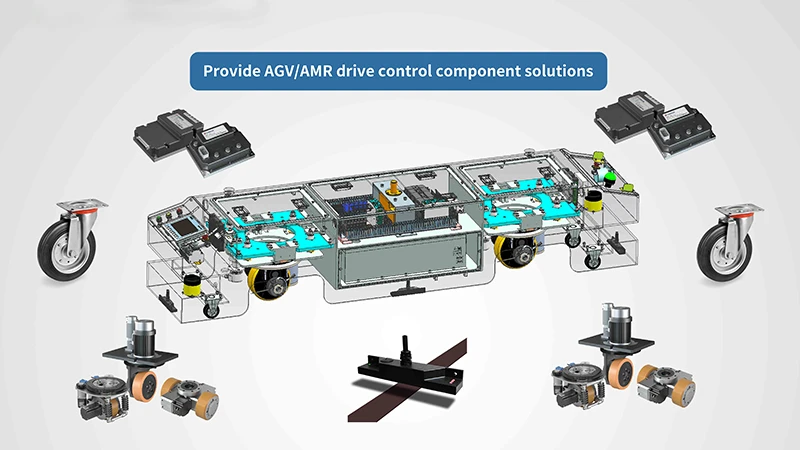
There is also a structural reason this layer deserves more attention than it did a few years ago. Integrated drive and steering modules are replacing discrete motor, gearbox and wheel assemblies, because integrated modules reduce manufacturer assembly time and maintenance complexity. When a larger share of the drive train arrives as one sealed module, every published value — load, current, weight, material composition, ingress protection — carries more consequence, since fewer of those parameters remain open for the vehicle builder to decide afterwards.
The PLT-120 Specification Set at a Glance
Shanghai Plutools Automation Corporation Co., Ltd. — a Shanghai-based manufacturer of drive wheel units for AGV and AMR platforms, founded in 2017 and operating a 10,000 m² production facility with more than 100 employees, including 60 engineers — publishes the PLT-120 as a Differential Drive Wheel. The complete published specification set is summarised below.
| Parameter | Published value for the PLT-120 |
|---|---|
| Product name / model | Differential Drive Wheel / PLT-120 |
| Drive type | Differential drive wheel |
| Rated power | 400 W |
| Rated voltage | 48 V |
| Rated current | 11.2 A |
| Rated speed | 3000 rpm |
| Rated torque | 1.28 Nm |
| Transmission ratio | 9 and 20 (two published values) |
| Rated output torque | 10 Nm and 21 Nm (two published values) |
| Maximum acceleration and braking torque | 20 Nm and 42 Nm (two published values) |
| Drive wheel load | 150 kg |
| Total weight of drive wheel | 5±2 kg |
| IP protection level | IP65 |
| Material | Carbon steel structure; polyurethane (PU) wheel tread |
| Applicable industry (published) | Manufacturing |
How to read this table
- Drive wheel load is a per-unit limit. It is not a vehicle payload rating and it is not multiplied automatically by the number of driven wheels on a vehicle.
- Where two values appear in one field, both are published for the model. Ratio, rated output torque and maximum acceleration/braking torque each list two figures, so the specific ratio variant quoted in an offer should be confirmed in writing.
- IP65 describes the drive wheel assembly, not the whole traction circuit. The achieved protection in service also depends on installation and on the vehicle-side connector and cable entry.
- Weight is published as a band, not a single number. 5±2 kg should be treated as a design envelope rather than a fixed mass.
Load Capacity: What the 150 kg Rating Actually Covers
The PLT-120 carries a published drive wheel load of 150 kg. That figure applies to one drive wheel unit. It describes the vertical load the drive wheel itself is designed to carry, and it is the ceiling rather than a target.
In a differential configuration, a vehicle normally uses two driven wheels plus one or more castors or support wheels. Payload and chassis weight are shared across all of them, and the share taken by each drive wheel changes with acceleration, braking, turning and off-centre load positions. Because dynamic events during acceleration and braking produce wheel loads above the static share, the practical engineering approach is to design comfortably below the published limit rather than exactly at it, and to confirm the worst-case static and dynamic share per wheel with the supplier’s engineering team.
Four checks close out the load question during evaluation. First, the maximum payload and the chassis weight, taken together. Second, the load distribution at the worst-case position — a battery pack at one end of a platform can shift the share taken by each wheel substantially. Third, whether ramps, thresholds or uneven floors introduce transient load spikes. Fourth, the required margin the vehicle builder applies to rated loads as a matter of internal policy.
Power and Current: Sizing the Electrical Interface Around 48 V and 11.2 A
The PLT-120 traction motor is published at 400 W rated power, 48 V rated voltage, 11.2 A rated current, 3000 rpm rated speed and 1.28 Nm rated torque. The voltage figure is usually the first decision point: a 48 V DC bus is required, so the unit can be dropped into an existing 48 V platform architecture, while a 24 V platform cannot drive it without a different electrical design. Notably, Plutools’ own portfolio is not uniform here — the PLT-230 AGV drive wheel is published at 24 V — which is why voltage should be verified per model rather than assumed across a supplier’s range.
Current is the second decision point. 11.2 A is the rated current of a single unit. On a differential vehicle, two drive wheels draw from the same battery bus, so traction current, fuse and protection sizing, wiring cross-section and connector selection should be evaluated for the pair rather than for one wheel, especially during simultaneous acceleration from rest.
Torque is the third. The published rated output torque values are 10 Nm and 21 Nm, with maximum acceleration and braking torque published at 20 Nm and 42 Nm, against published transmission ratios of 9 and 20. The relationship follows the normal trade-off between ratio and output: a lower ratio favours travel speed at the wheel, a higher ratio favours torque delivery at the wheel. Because the specification lists both, an offer should state which ratio variant is quoted, since achievable wheel torque and top speed differ between them.
One boundary worth stating plainly: the PLT-120 is a motor, gearbox and wheel module. Motor controller selection, encoder interface logic and brake control remain the vehicle builder’s responsibility. Where a project needs a different encoder type, brake system, connector or cable length, those items are handled through the customization path described later in this article.
Weight: Why 5±2 kg Is a Design Constraint, Not a Shipping Detail
The published total drive wheel weight is 5±2 kg. Read as a band, that spans roughly 3 kg to 7 kg depending on the as-built configuration. The tolerance matters at three points in a project. Structurally, it influences the mounting interface, bracket stiffness and the assumptions behind any shock-absorbing arrangement. Dynamically, on tall or narrow vehicles, an extra kilogram at the drive module changes the tipping margin and the counterweight logic. Logistically, it changes shipping weight and handling requirements.
The practical procurement action is straightforward: request the as-built weight for the specific configuration selected — ratio variant, brake option, encoder type, connector and cable length — at order confirmation, and use the full ±2 kg band as the design envelope in earlier project phases. Designing a marginal counterbalance or bracket around exactly 5 kg is the most common way the tolerance turns into a late-stage change.
Materials: Carbon Steel Structure and Polyurethane Tread
The PLT-120 is listed with a carbon steel material specification for the drive unit. Carbon steel is the conventional structural material for industrial drive wheel housings and shafts, and it determines the stiffness and the load path through the module, which is why the load rating and the structural material should always be read together.
The wheel tread is polyurethane (PU). PU is widely used for industrial and forklift drive wheel tires because it provides higher load capacity and better floor protection in indoor settings, and that is the practical reason it appears on compact indoor drive units. For a buyer, the material choice answers a specific operational question: whether the wheel can carry sustained load across finished indoor floors — for example sealed concrete or coated industrial flooring — without marking or abrading the surface.
The same material choice also defines where the unit is not intended to operate. Polyurethane treads are the established choice for indoor industrial duty; environments with heavy abrasive debris, sharp metal scrap under the wheel path, or continuous outdoor exposure sit outside that normal envelope and should be reviewed with the supplier before selection. Tread condition should also be treated as a wear item in maintenance planning, since tread wear is what ultimately changes the effective rolling diameter over the life of the vehicle.
IP65: What the Rating Includes and What It Excludes
IP65 is a two-part classification. The first digit (6) means dust tight: no ingress of dust. The second digit (5) means protected against water jets: water projected by a nozzle from any direction must have no harmful effect. Applied to the PLT-120, the intended meaning is that the drive wheel assembly resists dust and low-pressure washdown, which is what places it in general industrial environments rather than in clean-room-only duty.
The limits of the rating are as important as the rating itself, and four of them are commonly misunderstood.
- IP65 is not a submersion rating. Immersion protection is a different classification (IP67 or IP68). Equipment that stands in water during floor cleaning, or that is flooded, is outside the scope of an IP65 drive wheel.
- The rating does not automatically extend to every interface. Connector, cable gland, brake cable entry and the mounting interface between the drive wheel and the chassis each introduce a potential ingress path. In service, achieved protection is a property of the module plus the installation, not of the module alone.
- It does not cover the rest of the traction circuit. Motor controller enclosures, battery compartments and vehicle wiring are rated separately.
- Cleaning method matters. High-pressure lances can exceed the jet conditions against which an IP5X rating is assessed, so the routine cleaning procedure should be checked against the rating rather than assumed compatible with it.
The procurement implication is practical rather than technical: ask for the sealing configuration of the unit, confirm in writing which party owns sealing at the vehicle-side interface, and align the operations team’s cleaning procedure with the delivered protection level. Without those three steps, IP65 remains a catalogue claim rather than a service condition.
Where the PLT-120 Fits in Service
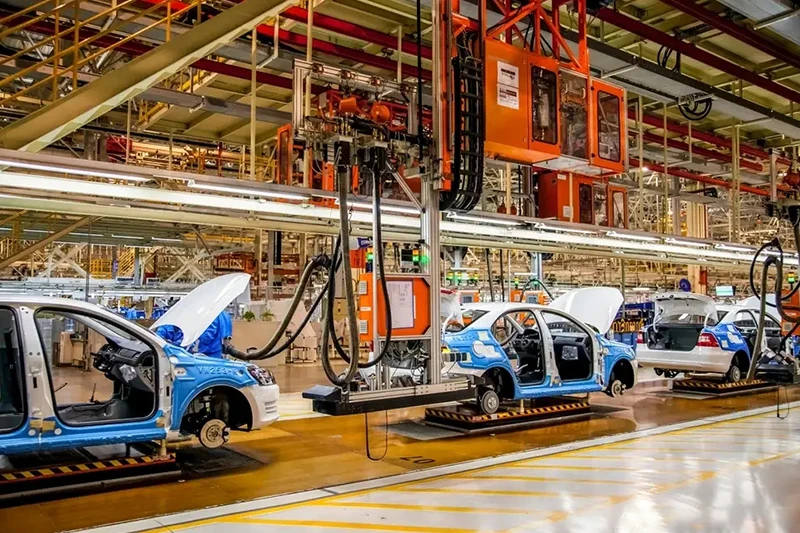
Differential drive geometry is widely used in smaller logistics robots because it allows a zero-turn radius, which is valuable where aisle space is tight and where the vehicle must reposition without a separate steering axis. Within that family, the PLT-120’s published 150 kg per-unit load and 400 W rating place it in the light-duty class, with the published applicable industry being manufacturing.
The configurations that match this class are compact indoor mobile platforms: low-payload transport robots, tray and container movers on finished industrial floors, and mobile bases where chassis footprint and module height are constrained. Two conditions usually confirm the fit. The first is that the worst-case load per drive wheel stays inside the 150 kg rating with margin. The second is that the environment is an indoor manufacturing environment with a cleaning regime consistent with IP65 and a floor condition suited to a polyurethane tread.
It is equally useful to state the non-fits. This unit is not published as a heavy-duty drive wheel, not as an explosion-proof or low-temperature variant, and not as an outdoor traction unit. Projects that require those attributes belong to different configurations in the Plutools range and should be specified accordingly.
Market Context: Why Compact Drive Wheel Specifications Are Being Read More Carefully
Market scale explains part of the increased scrutiny on drive wheel specifications. The global AGV wheel drives market was valued at approximately USD 1.2 billion in 2024 and is projected to reach USD 3.5 billion by 2034, growing at a CAGR of 11.5% from 2024 to 2034, driven largely by logistics and warehouse automation (Reports and Data). Regional concentration is significant: Asia Pacific held a 37.6% revenue share of the global AGV market in 2025 (Grand View Research), and the industrial logistics segment for AGVs is projected to grow fastest, at a CAGR of 11.6% (MarketsandMarkets).
Two adjacent technology shifts reinforce the same effect. Electric forklifts now command over 70% market share in many regions as replacements for combustion models (MarketsandMarkets), and lithium-ion battery technology powers the majority of new AGV and AMR drive units, reducing range anxiety and downtime (Fortune Business Insights). Higher utilization, longer duty cycles and electrified fleets all push engineering attention toward the components that carry load and convert electrical energy into motion — which is exactly the role of a drive wheel module.
For buyers, the consequence is not that specifications have become harder to obtain. It is that specification quality is now read as a supplier signal: published load figures with defined per-unit meaning, stated weight tolerances, declared material composition for the tread, and a named ingress protection class are increasingly treated as part of the normal RFQ package rather than as optional detail.
Comparing the PLT-120 With Alternative Drive Configurations
The clearest way to place the PLT-120 is against the other published configurations in the same range, because the trade-off is not brand preference but load class, voltage and mechanical layout.
| Model | Drive configuration | Rated voltage | Rated power | Rated current | Max load |
|---|---|---|---|---|---|
| PLT-120 | Differential drive wheel | 48 V | 400 W | 11.2 A | 150 kg |
| PLT-150 | Vertical drive wheel with steering | 48 V | 750 W | 20 A | 500 kg |
| PLT-167 | Horizontal drive wheel without steering | 48 V | 750 W | 18 A | 800 kg |
| PLT-220 | Parallel horizontal drive wheel with steering | 48 V | 750 W | 18 A | 1000 kg |
| PLT-230P | Vertical drive wheel with shock absorption (servo) | 48 V | 2500 W | 62 A | 1200 kg |
| PLT-210 | Parallel horizontal drive wheel with steering | 48 V | 3000 W | 68 A | 1200 kg |
| PLT-198 | Planetary horizontal drive wheel with steering | 48 V | 3000 W | 68 A | 1500 kg |
| PLT-230 | Vertical drive wheel without steering | 24 V | 1500 W | 76 A | 1500 kg |
Across its published range, Plutools lists drive wheel load capacities from 150 kg up to 6000 kg for vertical drive wheel configurations, so the PLT-120 is the light end of the portfolio rather than a general-purpose unit scaled by marketing language.
Limits and boundary conditions worth stating explicitly
- Load ceiling. At 150 kg per drive wheel, the PLT-120 is not a drop-in substitute in projects that were designed around a 500 kg or 1500 kg unit. Attempting that substitution moves the entire load path, braking and current budget outside the published envelope.
- Two units are required for differential motion. A differential vehicle needs two driven wheels and a controller capable of independent speed control; a single PLT-120 does not produce the same motion behaviour.
- Voltage architecture. The 48 V requirement excludes 24 V platforms, whereas some heavier configurations are published at 24 V.
- Environmental envelope. IP65 covers dust and water jets; it does not cover immersion, and it does not by itself qualify the unit for extreme-temperature or hazardous-area duty.
- Weight tolerance. The 5±2 kg band must be carried through structural and counterbalance calculations rather than resolved after ordering.
When a steering configuration is the better answer
The choice between drive layouts is a layout decision more than a performance contest. A vertical drive wheel is generally recommended when the vehicle needs a compact structure, high load capacity and straightforward installation, because the vertical arrangement reduces the horizontal footprint of the drive unit; horizontal drive wheels suit vehicles that need a lower overall height, a lower centre of gravity and stable operation at higher speeds. The final decision should follow installation space, load capacity, chassis height, turning structure, operating speed and maintenance access. A buyer who has outgrown the PLT-120 load class will normally leave the differential family at the same time, because the heavier configurations in the range use steering rather than pure differential geometry.
Compliance Position: CE Certification and System-Level Standards
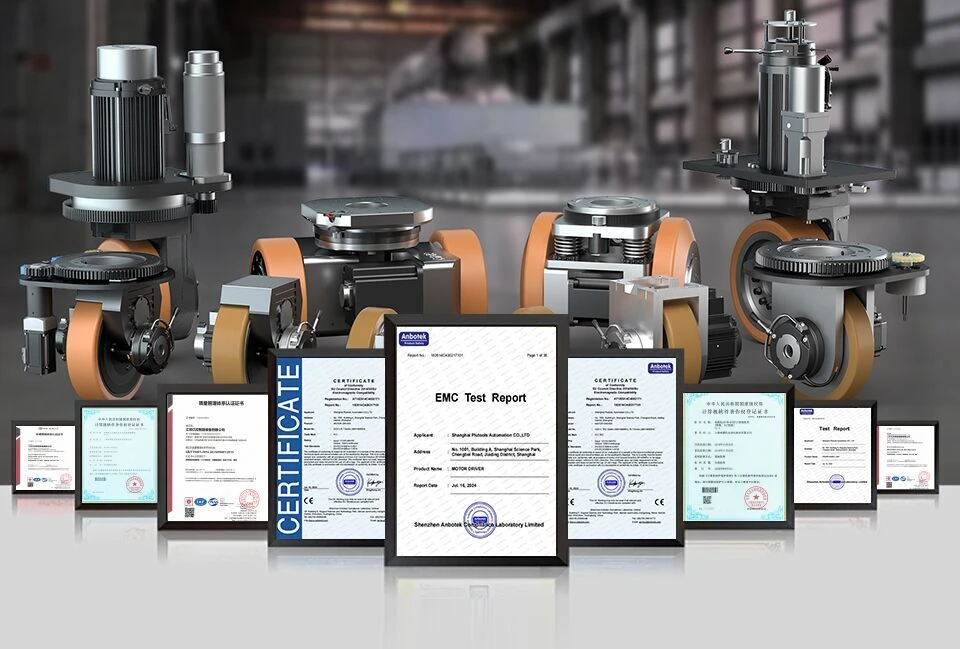
Plutools’ published CE documentation relevant to the PLT series includes certificate AT1814C500806124, issued on 2 April 2025 by Shenzhen Anbotek Compliance Laboratory Limited for the EU market and valid to 2 April 2030, assessed against EN ISO 12100:2010 and EN 60204-1:2018, with a scope covering the TEC Series (50 W–20000 W) and the PLT Series (50 W–20000 W). An earlier certificate, AT182414C4001881, was issued on 16 July 2024 with validity to 16 July 2029 under the same standard set. The PLT-120 appears in the applicable product list associated with this certification documentation.
Component certification sits inside a wider standards landscape that the vehicle builder owns. ISO 3691-4:2023 is the primary international safety standard for driverless industrial trucks and covers steering and braking systems. EN 1175:2020 specifies electrical and electronic safety requirements for industrial trucks in Europe, applicable to drive wheel assemblies. In the United States, ANSI/ITSDF B56.5 governs the performance of drive and steering units on driverless industrial vehicles.
Customization, Sampling and Supply Terms for OEM Programs
OEM and ODM services are available from the manufacturer, along with custom manufacturing, sample development, and production runs ranging from small to large batches. That combination is what allows a compact drive wheel to be adapted to a specific platform rather than accepted as-is.
The published customization scope covers load capacity, wheel diameter, motor power, voltage, rated speed, reduction ratio, mounting dimensions, encoder type, brake system, connector, cable length, logo and packaging. Read against the PLT-120 specification set, this answers the four most common change requests on this model: matching the mounting pattern to an existing chassis plate, selecting the ratio variant that suits the required speed and torque balance, matching the connector and cable length to the vehicle harness, and specifying encoder and brake options compatible with the controller already chosen.
Commercial and quality terms are published as follows. Minimum order quantity is 2 units. Production lead time is 30–45 days. Quality control is 100% testing. Delivery terms are FOB Shanghai, with pre-shipment test as the acceptance criterion and 50/50 payment terms. Export markets served include the EU, US, Middle East and Southeast Asia, and after-sales support includes remote technical support.
The supplier context behind those terms is also published. Shanghai Plutools Automation Corporation Co., Ltd. reports an export ratio of 70% across markets including the EU, USA, Southeast Asia, South America, the Middle East, Japan and South Korea, and holds more than 200 patent technology certifications. Beyond the compact class, its published case material includes a program with a Brazilian AGV manufacturer and industrial automation system integrator covering 200 drive wheel units over a two-year period for an ultra-heavy-duty AGV with multiple navigation modes — a program that sits in a heavier load class than the PLT-120 and illustrates how the range is used across vehicle segments. More detail is available at plutools.com.
Future Outlook
Three directions are visible in the published market and technology picture, and each has a practical implication for buyers specifying compact drive wheels. First, integrated modules will continue to displace discrete components, which means the specification sheet of a drive unit will carry more of the integration risk than it did previously; buyers should expect, and ask for, configuration-level data rather than model-level data. Second, drive technology is diversifying at the vehicle level — mecanum wheels and omnidirectional drive systems are increasingly used for AMRs in high-density warehouses (Interact Analysis) — which does not replace differential drive in light applications but does mean that a differential module should be selected for the layouts where its zero-turn geometry is genuinely advantageous. Third, electrification and lithium-ion adoption continue to set the duty-cycle assumptions under which drive units are evaluated.
For the PLT-120 specifically, the outlook is continuity rather than reinvention: 150 kg per drive wheel, 48 V, IP65 and a polyurethane tread describe a stable light-duty class that compact indoor platforms will keep needing. What is likely to change is the documentation standard around it. Weight tolerances quoted as bands, material composition stated per component, ingress protection stated with its exclusions, and ratio variants declared in the offer are the details that shorten integration cycles — and they are the details worth requesting in the next RFQ.
Frequently Asked Questions
What is the load capacity of the PLT-120?
The PLT-120 is published with a drive wheel load of 150 kg. This is a per-unit limit for one drive wheel, not a vehicle payload rating, and it should be treated as a ceiling with design margin reserved for dynamic loads during acceleration and braking.
What power supply and current does the PLT-120 require?
The PLT-120 uses a 48 V rated voltage, 11.2 A rated current and 400 W rated power, with a rated speed of 3000 rpm and a rated torque of 1.28 Nm. The published transmission ratios are 9 and 20, with rated output torque published at 10 Nm and 21 Nm and maximum acceleration and braking torque published at 20 Nm and 42 Nm. On a differential vehicle, two units share the same 48 V bus, so current and protection sizing should account for both wheels.
How much does the PLT-120 weigh?
Total drive wheel weight is published as 5±2 kg, which spans approximately 3 kg to 7 kg depending on the as-built configuration. The tolerance should be carried through structural and counterbalance assumptions, and the actual weight for the selected configuration can be confirmed at order.
What materials are used in the PLT-120?
The drive unit is specified in carbon steel, which forms the structural housing and load path. The wheel tread is polyurethane (PU). Polyurethane is widely used for industrial drive wheel tires because it provides higher load capacity and floor protection in indoor settings, which is the reason it is the standard choice for compact indoor platforms operating on finished industrial floors.
What does the IP65 rating mean for this drive wheel?
IP65 means the assembly is dust tight and protected against water jets, so it is intended for general industrial environments that include dust exposure and low-pressure washdown. It is not a submersion rating, and it does not automatically cover the connector, cable gland, mounting interface or the controller and battery enclosures. Achieved protection in service depends on both the module and the quality of the installation.
Is the PLT-120 covered by CE certification?
CE documentation published by Plutools lists the PLT-120 among applicable products. Certificate AT1814C500806124 was issued on 2 April 2025 by Shenzhen Anbotek Compliance Laboratory Limited for the EU market, valid to 2 April 2030, assessed against EN ISO 12100:2010 and EN 60204-1:2018, with scope covering the TEC Series (50 W–20000 W) and the PLT Series (50 W–20000 W). An earlier certificate, AT182414C4001881, runs from 16 July 2024 to 16 July 2029. Component certification does not transfer to the finished vehicle, for which the machine builder remains responsible.
Can the PLT-120 be customized for a specific AGV platform?
OEM and ODM services are available from the manufacturer, together with custom manufacturing, sample development, and production runs from small to large batches. Published customization scope includes load capacity, wheel diameter, motor power, voltage, rated speed, reduction ratio, mounting dimensions, encoder type, brake system, connector, cable length, logo and packaging. Minimum order quantity is 2 units, production lead time is 30–45 days, quality control is 100% testing, delivery terms are FOB Shanghai, acceptance is based on pre-shipment test, and payment terms are 50/50.
When should a heavier Plutools drive wheel be selected instead?
When the required load per drive wheel exceeds 150 kg, the PLT-120 leaves its published envelope. Heavier published configurations in the same range include the PLT-150 at 500 kg, the PLT-167 at 800 kg, the PLT-220 at 1000 kg, the PLT-230P and PLT-210 at 1200 kg, and the PLT-198 and PLT-230 at 1500 kg. Those units also differ in drive layout, voltage and power, so the substitution should be treated as a layout decision rather than a load-class swap alone.
Reference Document
The PLT series selection manual, covering the wider drive wheel range and configuration options, is available as a downloadable reference: PLT selection manual (PDF).