
PET Produce Trays vs Containers: An Independent Format Comparison
PET Produce Trays vs Containers: An Independent Format Comparison
For wholesale buyers evaluating fruit & vegetable packaging, the choice between a thermoformed tray and a lidded container is rarely a question of which product is better. Both formats are produced from rigid PET sheet. Both can be supplied food-grade and BPA-free. Both move through the same filling halls, reefer containers and retail back rooms. What separates them is the stage of the supply chain each format is engineered to survive — the MAP filling line, the cold chain, the display shelf, or the last-mile parcel.
The spend attached to that decision is substantial. Market Research Future valued the global produce packaging market — the segment focused specifically on fruits and vegetables — at approximately USD 38.08 billion in 2024. Spherical Insights & Consulting estimated the broader fresh food packaging market at USD 134.60 billion in 2024 and projected USD 240.50 billion by 2035. Rigid thermoformed packaging sits inside that growth: Grand View Research expects the global thermoformed plastics market for food packaging to expand at a CAGR of 4.9%, reaching USD 20.66 billion by 2030.
This comparison treats trays and containers as two separate purchasing decisions rather than two variants of one product. It draws on documented specifications from the PET range manufactured by Weifang Chuanhe New Material Co., Ltd., trading as CHUAN HE, a thermoformed packaging producer based in Weifang, Shandong Province, China. No format is declared universally superior, no supplier is ranked, and every performance figure below is tied to a stated basis rather than to a general impression.
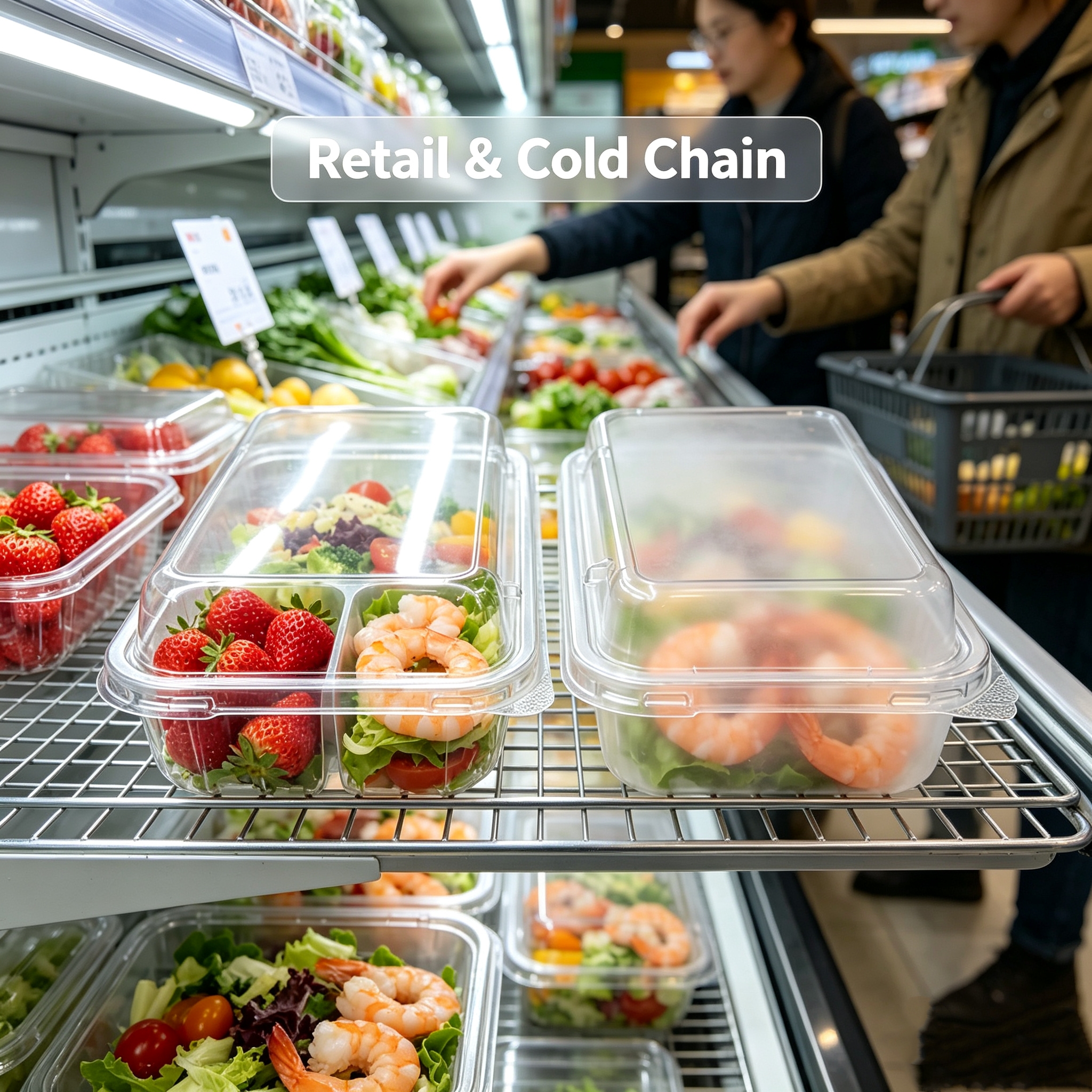
Trays and containers are not two versions of the same pack
A PET produce tray is an open-top rigid thermoformed tray. Produce sits in a shallow cavity, and the pack is closed with a lidding film, typically on a modified atmosphere packaging (MAP) line. The documented reference model is HB-T9576, a tray with overall dimensions of 19.4 × 11.4 × 5.8 cm. It is made of PET, described as food-grade BPA-free plastic, has a rigid structure, is stackable, and is compatible with MAP packaging production lines. The same range includes multiple sizes for produce, bakery, meat, poultry and ready meals.
A PET fresh produce container closes on itself. An integrated lid or hinged cover replaces the film seal, which changes how the pack is filled, stacked, shipped and reopened. The documented reference model is HB5053, a salad container measuring 15.2 × 10.2 × 5.3 cm, made of food-grade BPA-free PET plastic. It features a leakproof and airtight lid, a stackable structure, and an optional compartment design; custom logo printing is available, and multiple size options are offered.
| Attribute | PET produce tray — HB-T9576 | PET container — HB5053 |
|---|---|---|
| Documented dimensions | 19.4 × 11.4 × 5.8 cm | 15.2 × 10.2 × 5.3 cm |
| Material | PET, food-grade BPA-free plastic | Food-grade BPA-free PET plastic |
| Closure logic | Lidding film, compatible with MAP lines | Leakproof, airtight integrated lid |
| Structure | Rigid, stackable | Stackable, optional compartment design |
| Branding options | Not specified in the source specification | Custom logo printing available |
| Documented range | Multiple sizes for produce, bakery, meat, poultry, ready meals | Multiple size options, salad and prepared fresh produce |
That contrast is the core of the buying decision. A tray optimises the filling and sealing sequence. A container optimises containment and reopening. Buyers who treat the two as interchangeable usually discover the difference at the point of leakage, breakage or consumer complaint rather than at the quotation stage.
Why the format decision carries commercial weight
The costs that follow a format mismatch are rarely packaging costs. They are spoilage, repacking, returns and lost shelf turnover. Production risks in this category are documented as chemical migration, physical breakage, microbial contamination and unqualified raw materials, and they are managed through food-grade raw material inspection, production hygiene control, temperature resistance testing and stack load testing alongside migration and physical testing, a clean production environment and batch tracing.
Documented performance claims for this PET range address the same risk list from the packaging side:
- Sealing tightness improves by 32% over the stated comparison baseline, which the manufacturer links to a 26% reduction in food spoilage rate. The sealing edge is uniform and stable for automatic packaging assembly lines.
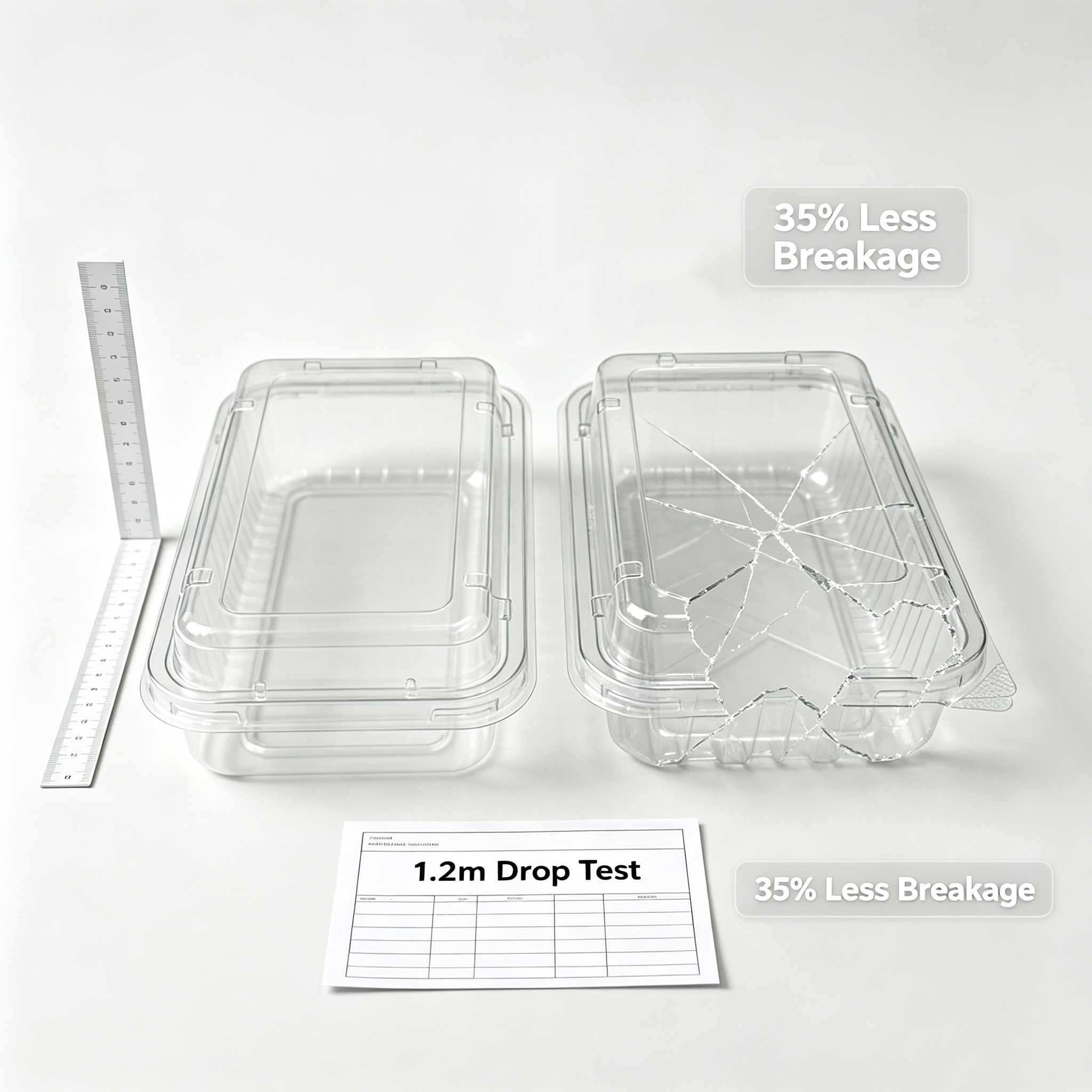
- Drop breakage rate falls by 35%, and the reinforced container withstands a 1.2 m vertical drop without rupture.
- Visibility retention rate rises by 40% with an anti-fog coating that holds clarity in 0–8 °C cold storage.
- Impact resistance is 30% higher than ordinary disposable plastic food containers, with food-grade raw material and anti-breakage toughness as the stated core difference.
- Temperature tolerance spans −18 °C to 120 °C, with heat deformation rate reduced by 38% and low-temperature cracking rate reduced by 32%.
Read together, these figures describe what buyers are actually purchasing: fewer rejected pallets, fewer repacked cases, and a display face that stays readable through a cold chain.
Technical differences that decide the purchase
Sealing and leak containment
A tray relies on a film seal; a container relies on a formed lid interface. The container format is documented as blocking the ingress of air and moisture and achieving a leak-proof seal once closed, with sealing tightness improved by 32% and food spoilage reduced by 26% against the stated baseline. For buyers, that means the container format carries the containment argument in wet or prepared applications, while the tray format carries the throughput argument on automated MAP lines.
Drop resistance and structural rigidity
Thin-wall blister packaging deforms under impact; a thickened reinforced structure does not. The documented container construction is described against ordinary thin-wall PET blister packaging as delivering a 35% reduction in drop breakage rate, surviving a 1.2 m vertical drop, and producing fewer broken fragments on automated lines — which lowers maintenance requirements and reduces repacking.
Shelf visibility and anti-fog behaviour
Fogging is a cold-chain problem, not a cosmetic one. Untreated PET blister containers cloud up when refrigerated or when temperature shifts sharply. An anti-fog coating is documented as raising visibility retention by 40% and holding a clear appearance in 0–8 °C storage, with no frequent cleaning required and stable performance during long refrigeration. For clear clamshell fresh food containers used in supermarket produce packaging, that clarity is the difference between a shopper picking up the pack or passing it.
Temperature range across cold and heat
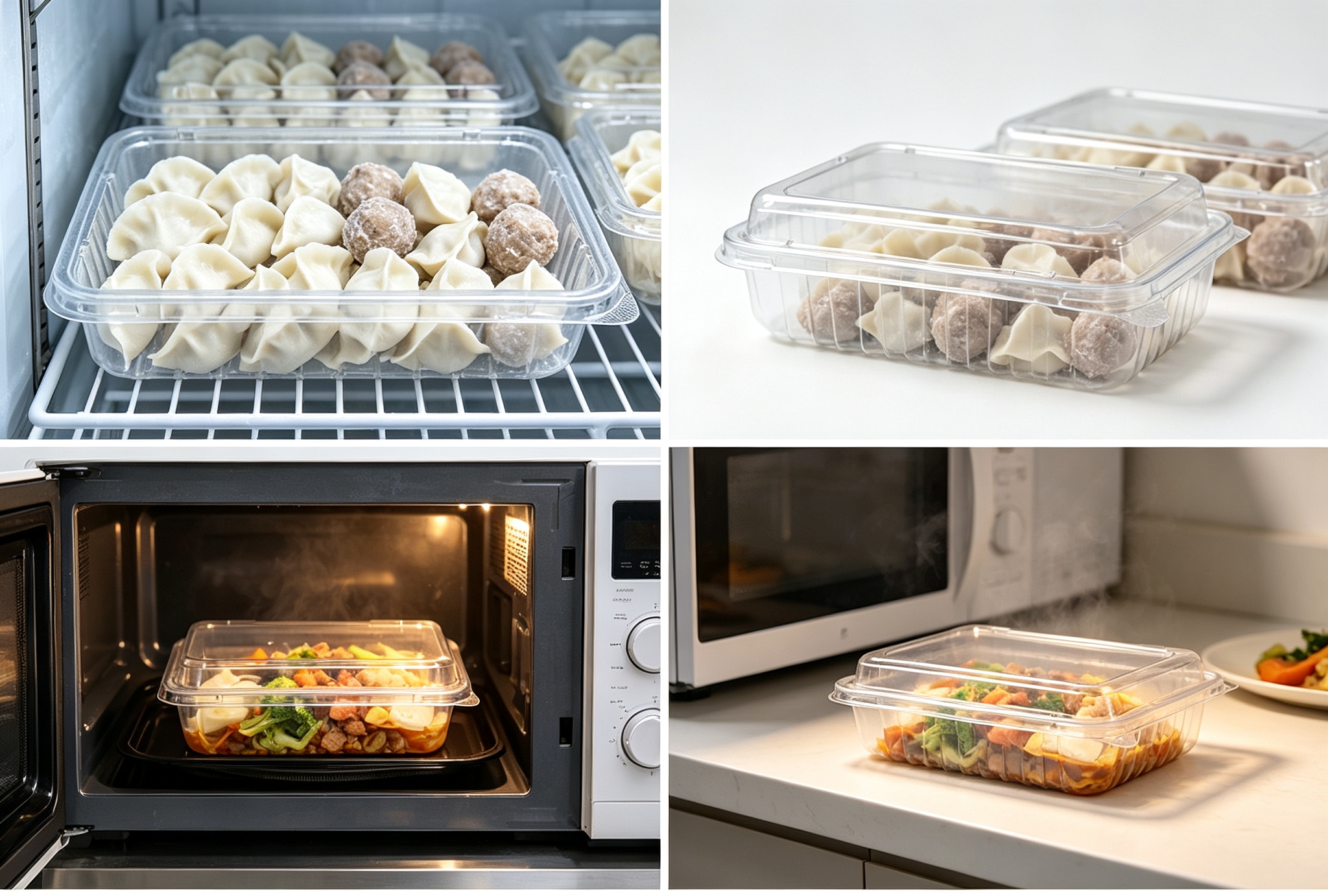
A pack that only works in one temperature zone forces buyers to hold two stock lines. The documented blister container maintains stable performance from −18 °C to 120 °C, with heat deformation reduced by 38% and low-temperature cracking reduced by 32%. That range covers freezing, cold transport, microwave heating and ready-to-eat use without switching material.
Tamper evidence and closure integrity
Anti-tamper construction uses a locking structure that cannot be restored once opened. After initial closure, any subsequent opening causes irreversible damage to the locking tab, so tampering is visible at the delivery point. The trade-off is explicit: the closure is single-cycle, and the cost is slightly higher than a comparable pack without the feature.
| Performance dimension | Documented claim | What it changes for the buyer |
|---|---|---|
| Sealing tightness | 32% improvement; 26% lower spoilage rate | Fewer rejected wet packs in cold-chain transport |
| Drop resistance | 35% lower breakage; 1.2 m drop without rupture | Less repacking and fewer fragments on automated lines |
| Anti-fog visibility | 40% higher visibility retention in 0–8 °C | Display face stays readable through refrigeration |
| Temperature tolerance | −18 °C to 120 °C; −38% heat deformation; −32% cold cracking | One stock line covers freezing, transport and reheating |
| Tamper evidence | Irreversible locking tab after first opening | Visible proof of interference at delivery |
The manufacturing context behind the specifications
Weifang Chuanhe New Material Co., Ltd. (CHUAN HE) is a thermoformed packaging manufacturer founded in 2013 and located in Weifang, Shandong Province, China, adjacent to Qingdao Port. The company specialises in the design and customised production of PET and PP thermoformed packaging containers, including fruit and vegetable packs, bakery packaging, frozen food trays and dry fruit containers.
Its manufacturing base covers more than 62,000 m² and operates 20 fully automatic thermoforming machines and 20 standard thermoforming machines, including 4 Kiefel machines imported from Germany. The site also runs 4 PET sheet extrusion lines and 2 PP sheet extrusion lines, plus an in-house mold workshop. Annual output is 54,000 tonnes, and the company states that 100% of production is exported, serving North America, Europe, Australia, Southeast Asia, the Middle East and Latin America.
On compliance, the company holds CE, BRC, FDA, EU and SGS quality management system certifications. Its packaging is certified to the BRCGS Global Standard for Packaging Materials under certificate number CN26/00005423, issued by SGS and applicable to the NA, EU, ME, SEA and LATAM markets. For buyers, the practical value of a certificate is that it can be checked: standard number, issuing body and scope are all identifiable rather than asserted.
The wider supplier landscape for produce packaging includes established international groups such as Amcor PLC, Berry Global Group, Sealed Air Corp, Mondi Group and Smurfit Kappa, according to Mordor Intelligence. Buyers comparing a specialised thermoformer against that field should compare like for like: mould development capability, extrusion control, and the specific compliance documents that apply to their destination market.
Format fit across retail, export and e-commerce channels
The documented intended market for this PET range is produce wholesalers, supermarket chains, agricultural exporters, bakeries and food retailers, and e-commerce brands seeking custom packaging. That list maps closely onto the format split.
Farm markets, in-store display and supermarket produce packaging
Display-led channels prioritise visibility and stack stability. A clear tray sealed on a MAP line presents an uninterrupted product face; an anti-fog treated container keeps that face readable after hours in a chilled cabinet. Stackable structures and lightweight design also reduce transport energy and warehouse space, which matters when pallets are rebuilt daily in store back rooms.
Export and long-haul cold chain
Exporters absorb the cost of every failed pack. Where the pack must survive compression, handling and multi-temperature transfer, the leak-proof container format and the reinforced structure carry the argument. The anti-tamper locking option adds a delivery-point check that does not require extra accessories or extra labour.
E-commerce and direct-to-consumer produce
Parcel networks are less gentle than pallet networks. Drop resistance, closure integrity and tamper evidence matter more than display geometry, because the consumer opens the pack without a store associate present. A rigid lidded container that survives a 1.2 m drop and shows irreversible evidence of interference addresses the two most common complaint triggers in this channel.
Market trend: regulation is becoming a format decision
Buyers who plan packaging in three-year cycles now have to plan around regulation as well as product. Three EU instruments define the frame. Regulation (EC) No 1935/2004 sets the general framework for all food contact materials, requiring that they do not release constituents into food at levels harmful to human health. Regulation (EU) No 10/2011 governs plastic materials and articles intended to come into contact with food, including PET and PP containers. From 2030, the EU Packaging and Packaging Waste Regulation (PPWR) will ban single-use plastic packaging for fresh fruit and vegetables under 1.5 kg.
The commercial context is not shrinking, which makes the regulatory shift a re-design question rather than an exit question. The Europe fresh food packaging market was valued at USD 15.2 billion in 2024, with a projected CAGR of 4.5% through 2033 according to Market Research Future. Demand is intact; the specification is changing.
Manufacturers positioned in the EU supply chain are responding with material-level controls rather than marketing claims: EU-approved raw materials, migration and physical testing, GMP, batch traceability and documentation such as declarations of compliance, with formulations adjusted to meet EU 10/2011, PPWR and PFAS limits and with regulatory updates tracked over time.
Comparing PET trays and containers with older packaging formats
Against ordinary disposable plastic food containers, the documented difference is material and toughness: food-grade raw material with good toughness and anti-breakage properties, and 30% higher impact resistance. Against ordinary thin-wall PET blister packaging, the difference is wall structure: a thickened reinforced design with a 35% lower drop breakage rate. Against blister containers without anti-fog treatment, the difference is surface treatment: a 40% higher visibility retention rate. Against packaging without a tamper-evident locking design, the difference is closure behaviour: irreversible evidence of opening.
The cost position is stated plainly in the source data. Food-grade PET runs about 5% higher than low-grade containers, while remaining competitive within the food-grade category. Anti-fog treatment and thickened reinforcement each add a modest amount of raw material cost. In all three cases the manufacturer frames the higher unit cost against lower loss expense — broken packages, spoiled product and repacking labour.
Limits and boundaries buyers should accept
An honest comparison has to state where these formats stop working well.
- Single-cycle tamper closures. Once the locking tab is opened, it cannot be restored. The feature protects delivery integrity but makes the pack unsuitable for applications that need repeated resealing.
- Higher unit cost than low-grade packaging. Food-grade PET sits roughly 5% above low-grade containers. On price-per-unit-only tenders, this format will not win.
- Added cost for performance features. Anti-fog coating and thickened reinforcement each raise raw material cost. They need to be justified by a specific spoilage, breakage or visibility problem.
- Regulatory exposure in the EU. The PPWR ban from 2030 targets single-use plastic packaging for fresh fruit and vegetables under 1.5 kg. Buyers shipping those pack sizes into the EU must plan recyclability, recycled content or format substitution rather than assume current specifications continue unchanged.
- Closure-dependent performance. Leak-proof and airtight behaviour is defined once the pack is correctly closed. Incomplete lid engagement or a mis-set film seal invalidates the claim, which makes line training and seal inspection part of the packaging decision.
- Not a universal replacement. Rigid thermoformed formats solve containment and display problems; they are not automatically the right answer for every produce category, pack weight or filling line configuration.
A buyer checklist for choosing between trays and containers
| Decision point | Choose a tray when | Choose a container when |
|---|---|---|
| Filling line | The line is built around film lidding and MAP | The line fills and closes a formed lid instead |
| Product moisture | Dry or semi-dry produce with stable drainage | Wet, dressed or prepared produce needing leak containment |
| Display priority | The product face itself sells the pack | The pack must stay presentable after handling and re-opening |
| Transport risk | Palletised, controlled handling | Parcel, mixed-load or repeated handover |
| Reopening behaviour | Single-use consumer experience | Repeated access or portioned compartments required |
| Branding | Film or label carries the brand | Custom logo printing on the container is available |
| Compliance target | Destination market documentation is confirmed | Destination market documentation and PPWR planning are confirmed |
Before committing, buyers should request the dimension drawing, the material declaration, the food contact documentation for the destination market, and one production-line trial under real filling conditions. Specifications on paper transfer to the line imperfectly, and the trial is where that gap appears.
Future outlook
Three forces are likely to shape the tray-versus-container decision over the next several years. The first is regulation: the PPWR timeline pushes buyers to model recyclability and material reduction as design inputs rather than afterthoughts, particularly for sub-1.5 kg fresh produce packs in Europe. The second is format convergence: lightweight design and stackable structures already reduce transport cost, and further weight reduction without loss of drop performance is the obvious next engineering target. The third is documentation depth: as buyers in North America, Europe, the Middle East and Latin America apply different compliance regimes, the ability to produce market-specific declarations and traceable batch records becomes part of the purchasing decision rather than a back-office detail.
For producers, the differentiator is likely to be mould development and extrusion control rather than headline capacity. In-house mold workshops and sheet extrusion lines shorten the loop between a buyer's dimension requirement and a validated sample, which is precisely the loop that determines whether a packaging project ships on schedule.
Frequently asked questions
What is the practical difference between a PET produce tray and a PET fresh produce container?
A tray is an open-top rigid thermoformed pack closed with a lidding film, typically on a MAP line; the documented reference model HB-T9576 measures 19.4 × 11.4 × 5.8 cm and is made of PET described as food-grade BPA-free plastic, with a rigid stackable structure. A container closes on itself with an integrated leakproof and airtight lid; the documented reference model HB5053 measures 15.2 × 10.2 × 5.3 cm in food-grade BPA-free PET and offers an optional compartment design. The practical difference is where the pack is sealed, how it is reopened, and which handling risks it is built to absorb.
How do buyers compare sealing, drop resistance and visibility between the two formats?
Compare them on documented, measurable claims rather than on appearance. In the source data, sealing tightness improves by 32% against the stated baseline and is linked to a 26% reduction in food spoilage rate; drop breakage falls by 35% with a 1.2 m vertical drop survived without rupture; and anti-fog treatment raises visibility retention by 40%, holding clarity in 0–8 °C cold storage. Sealing and anti-fog claims favour the container format in wet and chilled applications, while lidding-based trays are documented as compatible with MAP production lines.
Which format suits refrigerated retail display and cold-chain transport?
Refrigerated display rewards visibility: anti-fog treatment is documented as maintaining a clear appearance in 0–8 °C storage and is positioned for fresh fruit, ready meals, seafood, cold chain transportation and supermarket retail display. Cold-chain transport rewards containment and structural strength: the leak-proof, airtight closure and the reinforced structure that survives a 1.2 m drop are documented for fresh produce, baked food, seafood and cold-chain circulation. Where both requirements apply, the container format addresses both; where only display clarity is required, a tray with a clear film seal can serve the same shelf.
What does food-grade and BPA-free mean on a PET tray or container in practice?
It describes both the raw material and the controls around it. Documented risk controls for PET food packaging cover chemical migration, physical breakage, microbial contamination and unqualified raw materials, and they are implemented through food-grade raw material inspection, migration and physical testing, a clean production environment, batch tracing, production hygiene control and stack load testing. On the compliance side, Regulation (EC) No 1935/2004 requires food contact materials not to release constituents into food at harmful levels, and Regulation (EU) No 10/2011 specifically governs plastic materials and articles in contact with food, including PET and PP containers.
Where does cost actually differ between trays and containers?
The stated cost position is that food-grade PET runs about 5% above low-grade containers while remaining competitive within the food-grade category. Optional features add cost: anti-fog treatment and thickened reinforcement each raise raw material cost modestly, and a tamper-evident locking structure also adds a small amount. The offsetting economics are documented as reduced loss expense from fewer broken packages, lower spoilage through improved sealing, and a lightweight, stackable design that reduces logistics and warehouse cost.
What does the EU PPWR ban from 2030 mean for buyers choosing PET produce packaging?
Starting from 2030, the EU Packaging and Packaging Waste Regulation will ban single-use plastic packaging for fresh fruit and vegetables under 1.5 kg. For a wholesale buyer, that means pack sizes and materials sold into the EU need a recyclability and material-reduction plan now, not at the deadline. In parallel, manufacturers operating in this segment are documented as using EU-approved raw materials, conducting migration and physical testing, running GMP, building batch traceability and adjusting formulations to meet EU 10/2011, PPWR and PFAS limits, with declarations of compliance and complete records maintained.
A downloadable technical brochure covering the PET and PP thermoformed packaging range, including tray and container formats, is available here: Chuanhe packaging brochure (PDF).