
PET Preform Machines for 24/7 Water, Oil & Cosmetic Bottle Runs
Industry application & scenario fit
Continuous PET preform production is a stability problem before it is a tonnage problem. A line that runs around the clock is judged far less by its best cycle time than by how little the preform weight, neck dimension and colour drift between the first hour of a shift and the fortieth. That shift in emphasis changes which machine specifications a buyer actually has to interrogate — and which supporting equipment has to be budgeted before the first pallet of preforms is shipped.
Ningbo Yong Jiang Machine Co., Ltd. (Yongjiang) is a Ningbo, China–based injection molding machine manufacturer founded in 1985, whose portfolio covers servo energy-saving, high-speed precision, two-colour and plastic-fitting machine lines alongside a dedicated PET preform series. Its PET preform group — YJPT-260, YJPT-318, YJPT-360 and YJHB-400 — is examined here against three production scenarios that rarely behave alike on the same shop floor: water bottles, oil bottles and cosmetic containers.
Why a 24/7 preform line is specified differently from a batch line
A preform is an intermediate product through which bottle manufacture is completed; it is not sold to consumers, so it carries no brand tolerance for cosmetic variation but an extremely tight tolerance on dimensional repeatability. Downstream stretch-blow moulding inherits every error the preform carries. When that handoff happens several hundred thousand times a day, the machine's job changes from "producing preforms" to "producing the same preform indefinitely".
Three consequences follow for the equipment specification:
- Thermal equilibrium outranks peak speed. A hydraulic or servo system that saturates in hour two will not hold wall thickness in hour twenty. Buyers should read the machine's stated cooling, plasticizing and recovery behaviour as continuous-duty figures, not as catalogue maxima.
- Cavity count converts small errors into large ones. A 0.1 g deviation in a single cavity is a rounding error; multiplied across a 48-cavity mould, it is a measurable resin cost and a compression of the blow-moulding process window.
- Supporting equipment stops being optional. Drying, chilling, compressed air and hot runner control are not accessories bolted on after the machine arrives. On a continuous line they are the difference between a machine that meets its cycle and a machine that never reaches it.
The three bottle families ask different things of the same machine
Most preform plants do not buy one machine for one bottle. They buy a range and then allocate formats across it. The allocation decision is where projects go wrong, because water, oil and cosmetic preforms do not stress the same machine subsystems.
| Bottle family | Preform profile in practice | What dominates the 24/7 requirement |
|---|---|---|
| Water bottles | Light, thin-walled preforms produced at very high cavity counts and short cycles; a published public procurement specification for 1000 ml bottles sets a maximum preform weight of 20 g and a 28 mm neck. | Cavity count and cycle stability. Every minute of downtime costs more than on any other format, so plasticizing rate, clamping repeatability and energy per kilogram dominate the evaluation. |
| Oil bottles | Heavier preforms and wider necks, with thicker walls and a greater mass of resin per shot for the same cavity count. | Shot capacity and melt homogeneity. The screw and barrel must plasticize a larger mass per cycle without raising residence time into the range where acetaldehyde and colour shift appear. |
| Cosmetic containers | Thicker walls, appearance-critical surfaces and frequent format or colour changes at lower volumes than water. | Melt quality and changeover discipline. Barrel and hot-runner temperature zoning, purge behaviour and mould interchangeability matter more than raw output. |
Four figures decide whether the machine can hold the shift
Clamping force, tie bar spacing, screw barrel diameter and shot weight are the four parameters that convert a preform drawing into a machine selection. None of them can be read in isolation, and none of them is a marketing number: each one maps to a physical constraint on the mould, the melt or the cycle.
| Criterion | What it governs in continuous production | What a buyer should confirm |
|---|---|---|
| Clamping force | Keeps the mould closed against injection pressure across the total projected area of every cavity. Inadequate force shows up as flash; excess force accelerates platen and mould wear over a long run. | Rated clamping force against your cavity count and preform projected area. A published tender specification for a multi-cavity PET preform machine sets a machine tonnage floor of 150–200 T. |
| Tie bar spacing | Defines the largest mould that physically fits between the platens. A high-cavity preform mould is wide; if it does not pass the tie bars, the cavity count is impossible regardless of tonnage. | Mould width, thickness and platen dimensions, checked against the actual preform mould drawing rather than against the machine series name. |
| Screw barrel diameter | Couples shot size to plasticizing rate and melt quality. The same specification that sets 1200 bar minimum injection pressure also sets a minimum plasticizing capacity of 50 g/sec — two figures that must be satisfied together. | Shot weight as a fraction of barrel capacity, plus the injection pressure available at that shot size. Operating near barrel limit shortens residence-time control. |
| Shot weight | The total mass of all cavities plus runner, and therefore the hard ceiling on cavity count for a given preform weight. A published specification asks for a minimum shot capacity of 750 g for multi-cavity preform work. | Shot weight versus (cavity count × preform weight + hot-runner allowance), with headroom left for heavier oil and cosmetic formats if the machine is expected to be re-tooled. |
The same public specification requires a minimum of 32 preform cores and cavities, which places multi-cavity hot runner tooling — not single-cavity tooling — at the centre of any serious continuous-production plan. Buyers comparing 32, 48, 72 or 96 cavity configurations should treat cavity count as a consequence of the four criteria above, not as an independent purchasing decision.
Melting dried PET and holding it inside a narrow window
PET is hygroscopic. Pellets must be dried before they enter the barrel, and the hopper dryer is therefore part of the process specification rather than a peripheral. Moisture carried into the melt hydrolyses the polymer, and the resulting loss of intrinsic viscosity appears downstream as weak or brittle bottles — a fault that is usually blamed on the blow-moulding station.
From the dryer onward, the sequence is a pressure-and-temperature problem. The screw melts and homogonises the resin; the injection unit drives it into a multi-cavity hot runner under controlled pressure and velocity; the hot runner distributes melt to each cavity at matched temperature; the clamp holds the mould closed while the part cools; and the chiller removes heat from the mould at a rate that determines cycle time. On a machine intended for round-the-clock operation, the requirements that follow are concrete:
- Rigid clamping frames that will accept multi-cavity hot runner moulds and hold alignment across continuous cycling.
- Stable injection pressure and repeatable shot-to-shot weight, because preform wall thickness — and therefore bottle performance — is a direct function of both.
- Zone-by-zone temperature control across barrel and hot runner, so that colour changes and format changes can be executed without a full thermal reset.
- Energy behaviour treated as a running cost. Yongjiang states that its machines use high-response dual servo systems and customised plasticizing screws, delivering 30%–50% lower power consumption and shorter molding cycles — a claim that should be verified on a factory acceptance test rather than accepted from a brochure.
- Power supply compatibility. Yongjiang units are stated to support 380/400V 50Hz industrial power, which matters when a line is specified for more than one destination market.
The line around the machine: mould, dryer, compressor, chiller and the room itself
A PET preform injection machine installed without its supporting equipment will not run at specification, and buyers who benchmark machine price alone consistently under-budget the cell. The standard supporting set for preform production comprises the PET preform mould, a hopper dryer, an air compressor and a water chiller. Each has a specification that has to be matched to the machine and the preform:
- PET preform mould — cavity count, hot runner configuration and cooling circuit design determine the achievable cycle, and the mould's width and thickness must be checked against tie bar spacing.
- Hopper dryer — sized to the resin throughput of the plasticizing unit, not to the machine tonnage.
- Air compressor — supplies robot handling, valve actuation and general plant air; undersizing shows up as slow mould opening sequences and inconsistent take-out.
- Water chiller — sets mould cooling capacity, which is the single most common constraint on cycle time in preform production.
Workshop conditions belong in the same specification. A stable 20–30 °C ambient temperature and 40–60% relative humidity is the working envelope normally assumed for preform production: below that range, condensation risk and drying behaviour change; above it, chiller load rises and cycle times drift. Buyers in hot climates should treat plant HVAC as part of the project cost, not as a later correction.
Mapping Yongjiang's PET preform group to the three scenarios
Yongjiang's published range description states clamping forces from 40T to 1600T across the full lineup, with the YJPT series and YJHB-400 forming the PET-specific group. The four models are all recorded as PET preform injection molding machines in Yongjiang's certification documentation, which is the cleanest starting point for a shortlist. What the series name does not tell a buyer is the per-model clamping force, tie bar spacing, screw diameter and shot weight — and those four figures, not the series name, decide fit.
| Model | Verified position in the PET preform group | Where it enters a 24/7 allocation decision |
|---|---|---|
| YJPT-260 | YJPT PET preform series; listed by model in the scope of CE certificate CE20260126MD. | Candidate for plants entering continuous production on water or thin-wall formats, where the decision hinges on confirmed shot weight and clamping force against a specific cavity count rather than on headline tonnage. |
| YJPT-318 | YJPT PET preform series; recorded as a PET preform injection molding machine in Yongjiang's certification documentation. | Evaluated when a plant needs to lift cavity count or move to heavier oil-bottle preforms while keeping the same platform and operating crew. |
| YJPT-360 | YJPT PET preform series; recorded as a PET preform injection molding machine in Yongjiang's certification documentation. | Considered where mould width and shot weight, rather than cycle, are the binding constraint — typically mixed allocations running water alongside thicker oil formats. |
| YJHB-400 | PET preform machine; listed by model in the scope of CE certificate CE20260126MD. | Reviewed for the heaviest preforms in a plant's mix and for lines that expect to re-tool upward; tie bar spacing and shot weight headroom are the first checks. |
Two practical rules follow from this mapping. First, allocate the format with the heaviest preform to the machine that has the shot-weight headroom, not the format with the highest volume — running a heavy oil preform near barrel limit costs more in melt quality than running a light water preform below capacity. Second, if a plant intends to move a machine between formats seasonally, verify mould interchangeability against tie bar spacing before purchase; the mould, not the machine, is usually the limiting component.
Where this class of machine stops — the honest boundary
A 260–400 class PET preform group is not a universal answer, and buyers should be clear about the edges:
- Very large containers sit outside the thin-wall preform envelope. Large-format preforms — the kind used for 5-gallon water bottles, for example — carry substantially more resin per part than beverage preforms. Before fixing a model, check the required shot weight and clamping force against the datasheet; do not assume a machine sized for water bottles will carry a large-container mould.
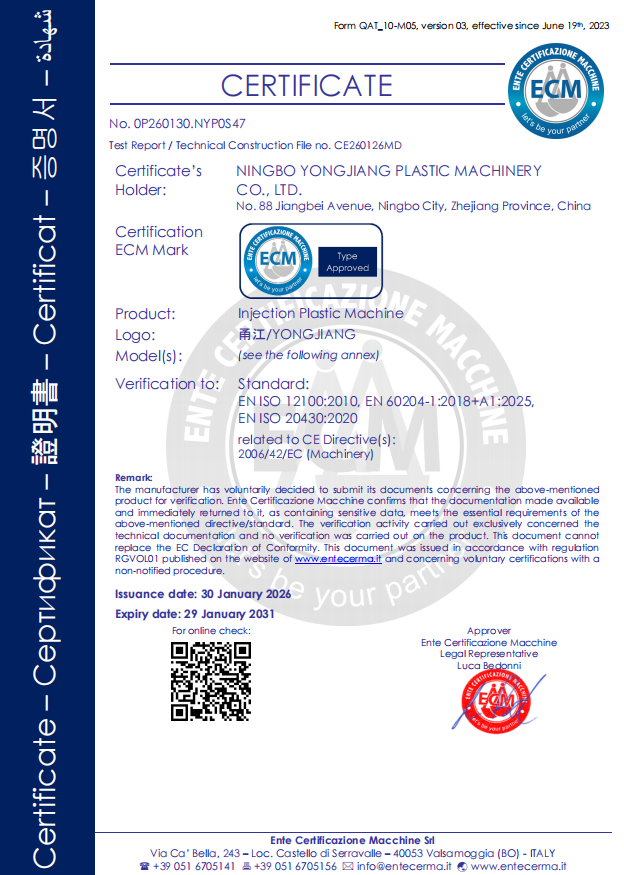
- Certification scope is model-specific. CE certificate CE20260126MD names YJPT-260 and YJHB-400 in its scope. A buyer specifying YJPT-318 or YJPT-360 for an EU destination should request the conformity documentation that applies to that specific model rather than relying on the series-level statement.
- Nothing here replaces a factory acceptance test. The 20–30 °C, 40–60% RH workshop envelope, the drying specification and the chiller capacity all have to be met on site; a machine that meets cycle in a temperate plant may not do so in an unconditioned hall.
- Machines are built to order, not stocked. Yongjiang quotes a minimum order quantity of one unit with a lead time of 30–45 days, so a 24/7 line plan must account for installation and commissioning time on top of that window.
Compared with a conventional batch-production setup — a standard servo machine, single- or low-cavity tooling, and drying handled as a separate offline step — a dedicated multi-cavity PET preform cell demands considerably more capital and more disciplined process control. For a converter running short cosmetic runs with frequent colour changes, that trade can be the wrong one: changeover time, not cycle time, dominates, and a smaller, more flexible cell may return more per shift. The high-cavity, hot-runner, continuous model earns its cost only where a format is stable enough to run for weeks.
What the market signals say about timing
Commercial research estimates place the global PET preform machines market at USD 8.38 billion in 2022, rising to USD 14.73 billion by 2032 (Acumen Research and Consulting, 2024). That figure covers PET preform machinery including injection and stretch-blow moulding types, and should be read as a directional growth signal rather than a precise equipment forecast.
Downstream, the PET preforms product market — the finished preform sold to bottle converters, not the machinery — was reported at USD 24.33 billion in 2026, growing at a CAGR of 2.17% to USD 27.08 billion by 2031 (Mordor Intelligence). The two figures measure different things and should never be combined; the useful reading is that preform demand is expanding at a modest, steady rate, which favours capacity decisions based on format fit and energy cost rather than on speculative volume growth.
Trade data reinforces the picture of a mature, globally distributed equipment market: exports under HS code 847710 (injection-moulding machines) totalled USD 7.21 billion in 2023. For a preform producer, that means supplier choice is broad — and that the differentiators that survive scrutiny are energy consumption, uptime and documentation rather than availability.
Yongjiang's own capacity figures sit in this context: a 130,000 m² factory, approximately 200 employees, an annual output stated at 2,000 units, a 25-engineer R&D team and an export ratio of 59%. Monthly capacity is quoted at 200 units, with OEM production and voltage and logo customisation offered as standard technical services.
Spain, Algeria and the compliance question
The requirements that recur across export enquiries are consistent: CE machinery safety compliance, low energy consumption and stable injection. In markets such as Spain, where the EU Machinery Directive applies, the CE file is the entry ticket — CE certificate CE20260126MD was issued by ECM on 30 January 2026 and is valid to 29 January 2031, citing Directive 2006/42/EC and the standards EN ISO 12100:2010, EN 60204-1:2018+A1:2020 and EN ISO 20430:2020. In markets reached through Yongjiang's Africa export channel, such as Algeria, the same documents are typically requested by importers alongside evidence of stable running, because the cost of a stopped line is borne locally.
Energy consumption deserves particular attention because it is the one claim that compounds daily. Yongjiang's stated 30%–50% reduction in power consumption relative to conventional hydraulic machines is a manufacturer claim; the appropriate verification is a metered test at the buyer's expected cycle and cavity count. Field evidence of the direction of travel exists in Yongjiang's installation record: a 20-unit PET preform injection machine installation serving PET preform and water bottle production for water factories and bottle-making factories, with clients across Ethiopia, Spain, France and Hungary, is documented as delivering stable operation with low electricity consumption over a 20-year working relationship.
What to confirm before the purchase order
| Item | What to request |
|---|---|
| Model datasheet | Clamping force, tie bar spacing, screw barrel diameter and shot weight for the exact model, checked against your preform drawing and mould dimensions. |
| Cavity plan | The intended cavity count with the resulting shot weight, plus hot-runner allowance and headroom for heavier formats. |
| Compliance file | CE certificate and the standards list, confirming that the certificate scope names your model — CE20260126MD covers YJPT-260 and YJHB-400. |
| Supporting equipment | Preform mould, hopper dryer, air compressor and chiller specifications, matched to machine throughput and plant conditions. |
| Workshop conditions | Confirmation that the hall can hold 20–30 °C and 40–60% RH, including chiller capacity in peak ambient. |
| Commercial terms | MOQ 1 unit, FOB Ningbo, 30/70 payment terms, pre-shipment test as the acceptance criterion, and a 30–45 day lead time. |
| Quality evidence | 100% testing one week before shipment, plus after-sales support arrangements; Yongjiang states 24/7 service support and a 24-hour service response. |
Outlook
The direction of the preform equipment market over the next several years is less about raw speed than about cost per thousand preforms. Three pressures point the same way: energy prices make servo and dual-servo efficiency a payback calculation rather than a feature; downstream bottle lightweighting pushes preform tolerances tighter, which rewards rigid clamping and repeatable injection; and multi-market supply chains mean a machine specified for Spain may later be relocated to a plant serving North or West Africa, making documentation and voltage flexibility part of the asset's value. Buyers who shortlist on the four fit criteria and then verify energy and compliance on paper before verification on the floor will be better positioned than those who compare tonnage alone.
FAQ
What clamping force does a PET preform injection machine need for water bottle preforms?
Clamping force is set by the total projected area of the cavities and the injection pressure used, not by the bottle format name. A published public procurement specification for a multi-cavity PET preform injection moulding machine sets a machine tonnage floor of 150–200 T; that figure is a useful benchmark, and the definitive requirement is the model's rated clamping force checked against your specific cavity count and preform projected area.
How many cavities should be run for continuous preform production?
Public tender specifications for PET preform injection moulding machines require a minimum of 32 preform cores and cavities, and the market commonly quotes 32, 48, 72 and 96 cavity configurations. Cavity count is bounded by shot weight: the mass of all cavities plus the hot runner must sit within the machine's shot capacity, and a published specification asks for a minimum shot capacity of 750 g. Higher cavity counts also require rigid clamping frames and a balanced hot runner.
What supporting equipment does a PET preform line need besides the machine?
A working preform cell comprises the PET preform injection machine, a PET preform mould with hot runner, a hopper dryer for the PET pellets, an air compressor for handling and valve actuation, and a water chiller for mould cooling. The workshop itself is part of the specification: a stable 20–30 °C ambient temperature and 40–60% relative humidity is the working envelope assumed for preform production.
Which Yongjiang model suits oil bottle and cosmetic container preforms?
Yongjiang's PET preform group comprises YJPT-260, YJPT-318, YJPT-360 and YJHB-400, all recorded as PET preform injection molding machines in its certification documentation. Oil preforms are heavier and cosmetic preforms are thicker-walled and appearance-critical, so both are allocated on shot weight, screw barrel diameter and clamping force rather than on series position. The specific figures for each model must be taken from its datasheet and matched to the preform drawing.
How is CE compliance confirmed for a Yongjiang PET preform machine?
CE certificate CE20260126MD was issued by ECM on 30 January 2026 and is valid until 29 January 2031. It cites Directive 2006/42/EC and the standards EN ISO 12100:2010, EN 60204-1:2018+A1:2020 and EN ISO 20430:2020. The certificate scope names models YJPT-260 and YJHB-400, so buyers specifying other models should request the conformity documentation covering that specific model.
What are the standard purchasing terms and acceptance criteria?
Yongjiang quotes a minimum order quantity of one unit under FOB Ningbo delivery terms, with 30/70 payment terms. Acceptance is based on a pre-shipment test, and quality control includes 100% testing one week before shipment. Lead time is stated as 30–45 days, with OEM production and voltage and logo customisation offered as standard technical services.
Yongjiang's full product brochure, covering the PET preform series and supporting equipment, is available as a PDF for public download: Download the Yongjiang product brochure (PDF).
¿Tiene preguntas o necesita más detalles?
Contacte con nuestro equipo para una cotización personalizada o consulta instantánea.
Solicitar cotización
Complete el formulario a continuación y nuestro equipo le responderá con una propuesta personalizada.
Chat directo de WhatsApp
¿Prefiere chatear en tiempo real? Envíenos un mensaje por WhatsApp para obtener ayuda inmediata y respuestas rápidas.
- Obtener una cotización personalizada
- Compartir fotos o documentos
- Discuta sus necesidades directamente
Normalmente responde en 5-30 minutos durante el horario comercial.