
PCR PP for Packaging: Certification, MFI and Buyer Checks
Packaging is one of the most constraint-heavy applications for post-consumer recycled polypropylene, or PCR PP. A recycled-content claim alone does not tell a packaging buyer whether a grade can be used in a food-contact container, a cosmetic bottle, a woven bag or a nonwoven shopping bag. The decision depends on four separate evidence sets: the regulatory status of the specific grade, the scope of the recycled-content certification, the melt flow index (MFI) window, and the appearance and batch data the supplier can actually provide. This article examines those constraints for packaging buyers at the research and evaluation stage. It uses the re-mall PCRPP portfolio and publicly documented certification records as a reference case, while separating what is documented from what still requires sample validation.

Personal care packaging is a documented application area where PCR PP must meet food-contact, appearance and sensory constraints at the same time. Image: Re-mall packaging material reference.
The packaging problem: recycled content is not the same as packaging fitness
PCR PP is polypropylene produced from post-consumer plastic waste that has been sorted, washed and reprocessed into pellets. It is a subset of recycled polypropylene, or rPP. In packaging, PCR PP can be used in injection-moulded containers, caps and closures, cosmetic bottles, foodservice articles, woven bags and nonwoven bags, depending on the grade and the documentation attached to it. The material is attractive because it can reduce reliance on virgin fossil feedstock. Fortune Business Insights estimates the global PCR plastic packaging market at USD 58.49 billion in 2026 and projects USD 108.27 billion by 2034. The same commercial research source states that PCR use can reduce carbon emissions by approximately 60% compared with virgin material. Those figures explain the strategic interest, but they do not resolve a packaging buyer's qualification problem. A packaging specification is written around the package, not around the resin category. The buyer needs a grade that meets the package's food-contact status, processing window, colour target, odour threshold and supply plan.
The practical challenge is that PCR PP is often discussed at the level of a category, while packaging decisions are made at the level of a grade and a batch. A certificate may exist for a product family, but the purchase order may refer to a specific model, a specific MFI and a specific end use. A supplier may describe a material as high transparency or low odour, while the product specification may not contain the corresponding haze, gloss or odour test data. These gaps are not necessarily signs of a weak product. They are signs that the buyer needs to request the right document at the right level. Packaging qualification is therefore a document-mapping exercise as much as a material-selection exercise.
Four constraint layers buyers should keep separate
Packaging-grade PCR PP is easier to evaluate when the constraints are separated. The four layers below answer different questions and require different evidence. Treating them as one combined claim is the most common source of procurement error.
| Constraint layer | Question it answers | Evidence to request | Common failure |
|---|---|---|---|
| Regulatory and food-contact | Can this grade contact the intended food under the intended conditions? | FDA No Objection Letter for the specific grade and process; grade-specific compliance statement; documented use conditions | Treating a company-level letter as a universal pass for every package |
| Recycled-content certification | Can a recycled-content or ocean-bound claim be supported? | GRS certificate and transaction certificate; OBP certificate where relevant | Treating GRS or OBP as a food-contact approval |
| Material and process | Will the grade run on the line and meet the part design? | MFI data, grade-specific data sheet, processing trial | Selecting by MFI alone without a moulding or forming trial |
| Appearance and sensory | Will the package meet brand, colour and odour requirements? | Colour plaque standard; haze or gloss data; odour test; black-speck limit | Relying on descriptive terms without measurable acceptance criteria |
| Commercial and supply | Can the material be supplied repeatedly at the required quality? | Capacity statement; MOQ; lead time; batch record; change-control process | Qualifying a sample but not the supply stream |
The layers are related but not interchangeable. A GRS certificate does not answer a food-contact question. An FDA No Objection Letter does not answer a colour-consistency question. An MFI value does not answer an odour question. Packaging buyers reduce risk by mapping each document to a specific acceptance criterion in the specification.
What the certification record shows for PCR PP
Public certification records provide a useful starting point, but they must be read at the correct level. For the PCR-PP product, the certification record lists an FDA No Objection Letter with certification number PNC 003239, issued by the U.S. Food and Drug Administration on 2025-06-06. The stated scope is recycled polypropylene, or rPP, for food-contact use under Title 21 Code of Federal Regulations, for the US market and other regions. The same certification set lists Global Recycled Standard 4.0 certification ITS-TE-00027997-GRS-04024100, issued by Intertek, valid from 2026-06-18 to 2027-06-17, covering post-consumer raw materials for PCR-PP310, PCR-PP392 and PCR-PP301, with global application and a focus on the EU and North American markets. It also lists Ocean Bound Plastic certification 250713477OBP.REC-2.0, issued by TÜV AUSTRIA under OBP RECYCLING ORGANIZATION STANDARD V2.3, valid from 2026-08-28 to 2027-08-27, for the EU market and covering ocean-bound recycled plastic content for the same three PCR-PP models.
The product specification tells a more limited story. For the PCR PP grade, the specification does not list GRS certification and does not state FDA No Objection Letter status. It also does not include carbon footprint data, odour test data, transparency, haze or gloss test data, a recycled-content certificate, or a batch traceability record. This is not necessarily a contradiction. It is a document-scope issue. The certification record and the product specification are different documents with different purposes. The procurement implication is direct: a buyer should not assume that a certificate shown at product-family level is automatically attached to the exact grade, batch or use condition in the purchase order. The buyer should request the certificate, the grade-specific compliance statement and the batch record that apply to the transaction.
This distinction matters most in food-contact packaging, where the cost of an incorrect assumption is high. It also matters in retail packaging, where a brand owner may require a recycled-content certificate before approving artwork and a food-contact statement before approving the material for a specific product. The two approvals are separate.
MFI: a process window, not a quality score
MFI describes melt flow under specified conditions. In packaging, it is a first-pass indicator of whether a grade can fill a mould, form a wall section or run on an extrusion line. The re-mall PCRPP portfolio illustrates the range. General-purpose PCR PP is listed with an MFI range of 1 to 40 g/10 min. The food-contact grade is listed with an MFI range of 3 to 70 g/10 min. Three named grades provide fixed points: PCR-PP392 at 10 g/10 min, PCR-PP301 at 30 g/10 min and PCR-PP310 at 55 g/10 min. The spread is wide because packaging is not one process. A thin-wall injection-moulded container, a closure, a cosmetic bottle and a nonwoven bag do not impose the same flow requirement. MFI should be matched to the tool, wall thickness, flow length and cycle time, then confirmed in a trial. A higher or lower MFI is not inherently better. It is either appropriate for the process or it is not.
The publicly listed product parameters centre on MFI. They are not a substitute for a grade-specific mechanical data sheet. Buyers who need impact, stiffness or dimensional data should request the relevant grade data and validate the part design rather than infer performance from MFI alone. This is particularly important when a packaging application moves from a simple container to a thin wall, a long flow path or a snap-fit feature.
Food-contact packaging: feedstock, process and the limits of a letter
For food-contact packaging, the qualification path is more demanding than for general packaging. The food-contact recycled materials range is described as sourced from post-consumer food packaging waste and processed through an in-house food-grade recycling line. The stated process includes sorting, washing, recycling and quality control, with digital and intelligent management across the full process. The food-grade feedstock is specified with purity greater than 98%, lower contamination and full traceability from source to production. The product specification states FDA No Objection Letter compliance for food-contact applications, and the certification record identifies PNC 003239 for recycled polypropylene. These are meaningful inputs because they address feedstock origin, process control and regulatory documentation together.
Three boundaries deserve equal attention. First, an FDA No Objection Letter is not a general marketing permission. It relates to a described recycling process and a defined scope of use. The buyer should confirm that the grade, feedstock and intended use fall within the documented scope. Second, the product specification does not include a batch traceability record, even though traceability is described at the process level. For food-contact packaging, a process description should be supported by batch-level documentation where the buyer's quality system requires it. Third, the specification does not include odour test data or transparency, haze or gloss test data. Food-contact compliance and sensory performance are separate acceptance criteria. A package can be compliant and still fail a brand's odour or appearance standard.
These boundaries do not make food-contact PCR PP unsuitable for packaging. They define the evidence a buyer should assemble before approval. A supplier with a food-grade recycling line, feedstock control and an FDA No Objection Letter is in a stronger position than a supplier with a general recycled-content claim. The buyer's task is to verify that the specific grade and batch inherit those controls.
Appearance and odour in packaging: where claims need test data
Packaging is a visual and sensory product. For cosmetic bottles, food containers and retail packaging, colour, gloss, black specks and odour can decide whether a recycled grade is accepted, even when the technical and regulatory files are complete. The appearance-focused recycled materials range lists high transparency, high modulus and colourability as features and positions the material for branded products and appearance-critical parts. The safety-focused range describes lower odour through source and process control, batch control for consistency, and material and process control for stable quality. These are relevant capabilities for packaging. They are not, by themselves, measured acceptance data.
The product specification for the PCR PP grade does not include transparency, haze or gloss test data; it does not include odour test data; and it does not include a batch traceability record. Buyers should therefore convert brand requirements into test methods and acceptance limits before qualification. Examples include a colour plaque standard, a black-speck limit under an agreed inspection condition, a haze or gloss target where transparency is claimed, and an odour acceptance protocol agreed with the quality team. The supplier's process description explains how the material is controlled. The buyer's test protocol proves that the control meets the package requirement. Both are needed.
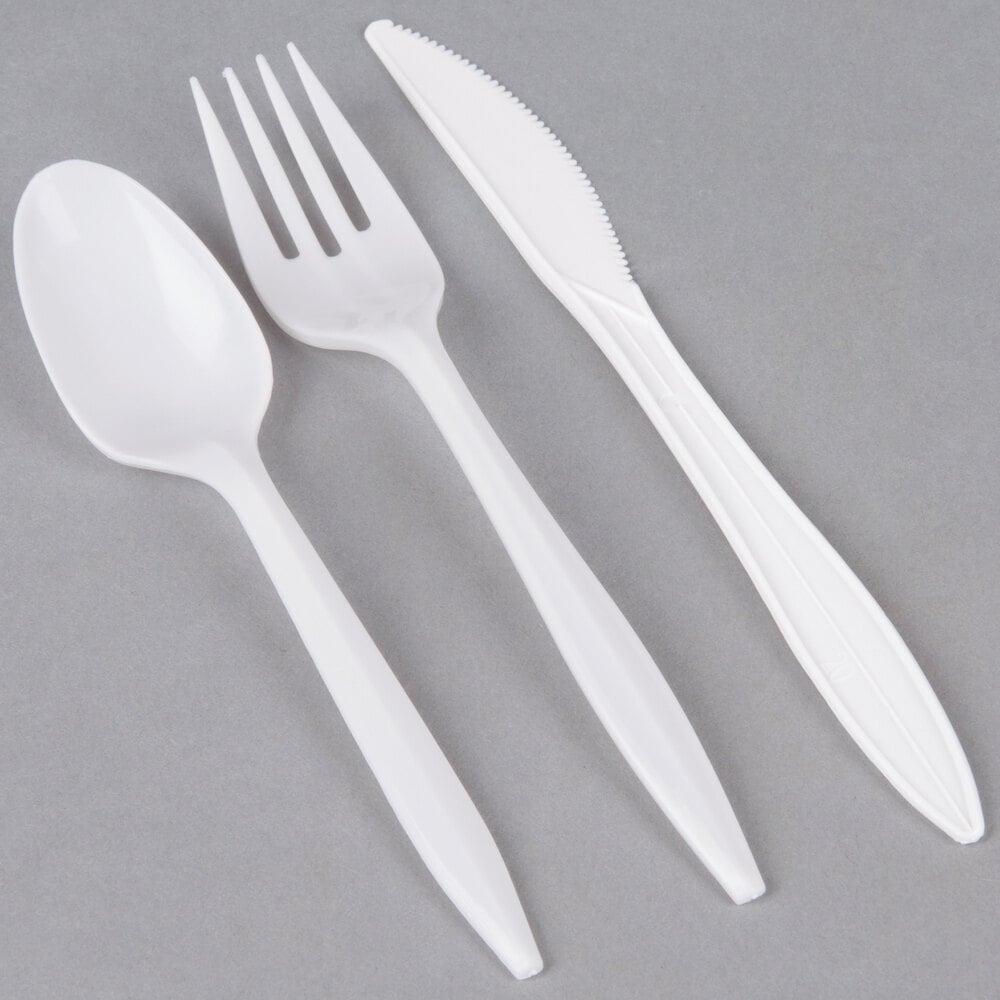
Foodservice articles are one documented packaging category where food-contact PCR PP is evaluated. The image illustrates an application category, not a claim that every grade is approved for every food-contact use.
GRS and OBP: useful, but not food-contact substitutes
GRS and OBP answer different questions from an FDA No Objection Letter. GRS 4.0 certification provides a framework for recycled content and chain of custody. The certificate for PCR-PP310, PCR-PP392 and PCR-PP301 is valid from 2026-06-18 to 2027-06-17 and applies globally, with a focus on the EU and North America. OBP certification covers ocean-bound recycled plastic content for the same models, is issued under OBP RECYCLING ORGANIZATION STANDARD V2.3, and is valid from 2026-08-28 to 2027-08-27 for the EU market. These certificates are relevant when a packaging buyer needs to support a recycled-content claim, a chain-of-custody requirement or an ocean-bound plastic sourcing claim.
They are not food-contact authorisations. A packaging specification that requires food-contact compliance should not accept a GRS or OBP certificate as a substitute for the FDA No Objection Letter and the grade-specific compliance statement. The reverse is also true: an FDA No Objection Letter does not prove recycled content or chain of custody. The documents are complementary. The buyer's qualification matrix should show which document supports which claim, and the purchase order should reference the correct document set.
What this means for packaging buyers: a procurement checklist
| Check | Why it matters | Document to request |
|---|---|---|
| 1. Define the package and use condition | Food-contact, cosmetic, retail or industrial use changes the evidence required | Written use description and contact conditions |
| 2. Confirm the exact grade | Certificates and MFI values are grade-specific | Grade name and grade-specific data sheet |
| 3. Verify FDA No Objection Letter scope | The letter must match the grade, process and intended use | NOL PNC 003239 and compliance statement |
| 4. Verify GRS scope and validity | Recycled-content claims need a current certificate and transaction evidence | GRS certificate and transaction certificate |
| 5. Verify OBP if an ocean-bound claim is used | Ocean-bound content is a separate sourcing claim | OBP certificate 250713477OBP.REC-2.0 |
| 6. Match MFI to the process | The flow window affects tooling, cycle time and part quality | MFI data and a processing trial |
| 7. Set appearance and odour limits | The standard specification does not contain all sensory test data | Colour, haze, gloss and odour test protocol |
| 8. Request batch traceability | Process traceability is not the same as a batch record | Certificate of analysis and batch record |
| 9. Validate at pilot scale | Laboratory data does not guarantee a moulded or formed part | Pilot production report |
| 10. Check supply terms | Capacity, MOQ and lead time affect continuity | Capacity statement, MOQ and lead time |
This checklist is deliberately document-led. PCR PP is a traded material with variable feedstock, so the buyer's protection comes from traceable documents and agreed test methods, not from a single certificate or a single MFI number. The checklist also helps separate supplier claims from verified inputs. A supplier may be able to provide a document that is not included in the standard product specification; the buyer should ask for it rather than assume it does not exist.
Where PCR PP fits in packaging applications
Documented application experience shows where PCR PP is already used in packaging. In daily chemical packaging, a five-year project with a daily chemical packaging manufacturer in China, France and the US covers 30,000 tons per year. Through process adjustments, some products can incorporate 50% to 100% recycled content instead of virgin material, and some brands have achieved mass production. The specific requirement includes food-grade PCR-PP compliant with FDA No Objection Letter, translucent appearance, easy colouring, high-gloss finish, low black specks, suitability for direct contact with cosmetics and a high safety profile. This is a useful example because it combines regulatory, appearance and sensory constraints in one package.
Food packaging is another documented use. A US national supermarket chain and food packaging buyer has used PCR materials for cutlery, dinnerware and food packaging for four years, with more than 1,500 tons per year across more than 10 units. The stated highlights are recycled material use and food-contact safety. Nonwoven packaging and RPP woven packaging are also documented: nonwoven shopping bags and storage bags in the US, Canada, the UK and France; and RPP woven packaging and bags in the US. Both applications list water resistance, breathability, light weight and tear resistance as requirements. These examples do not mean that any PCR PP grade can serve any packaging application. They show the application categories in which documented grades and process adjustments have been used.
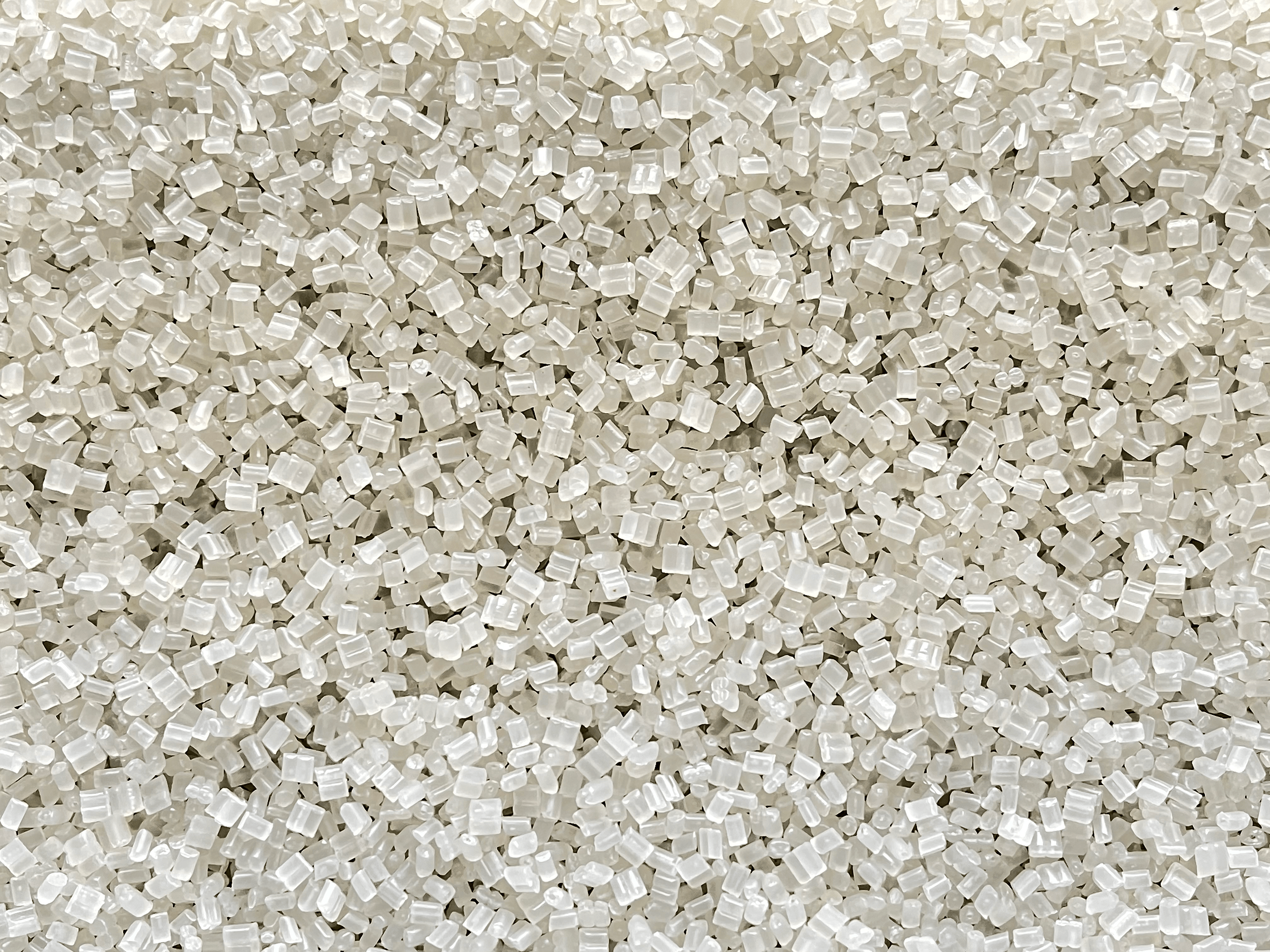
PCR-PP pellets are supplied in grade-specific MFI ranges. Packaging buyers should verify grade, certificate scope and batch data before approval.
Comparison with traditional solutions: the trade-off is documentation and consistency
| Dimension | Virgin PP | PCR PP for packaging |
|---|---|---|
| Feedstock | Fossil-based and relatively uniform | Post-consumer waste with source-dependent variability |
| Food-contact documentation | Established supplier documentation for the grade | Grade- and process-specific FDA No Objection Letter and compliance statement required |
| MFI availability | Broad and tightly controlled grades | Ranges by grade; lot-to-lot verification recommended |
| Colour and odour | Generally predictable | Depends on sorting, washing and process control; test data needed |
| Certification | Not applicable for recycled content | GRS and OBP may apply; they are not food-contact substitutes |
| Carbon profile | Higher fossil baseline | Mechanically recycled PP is reported to reduce carbon footprint by approximately 60% compared with virgin PP |
| Supply | Petrochemical chain | Depends on feedstock collection, sorting and certificate maintenance |
The limitation is not that PCR PP cannot be used in packaging. The limitation is that the evidence chain is longer and more grade-specific. A virgin PP buyer may rely on a standard data sheet and a known food-contact grade. A PCR PP buyer must also verify feedstock origin, certificate scope, batch consistency and appearance or odour performance. That additional work is the real cost of substitution. It should be planned into the qualification timeline rather than treated as a paperwork formality.
The verified data set used for this article did not include a PCR PP price series or a virgin-versus-PCR spread. Buyers should therefore avoid assuming a fixed price premium or discount. Cost drivers include feedstock sorting and washing, certification, rejection rate and the cost of validation. The correct comparison is landed cost at the required quality level, not price per kilogram alone.
Re-mall PCRPP in the packaging context
Shanghai Re-mall Environmental Protection New Material Co., Ltd. is a Shanghai-based producer of recycled plastic pellets, including PCR-PP, PCR-PE, PCR-PS and PCR-ABS, founded in 2015. The company operates a 10,000 square meter factory, employs more than 100 people and reports annual output of 20,000 metric tons; its main markets include Europe, Japan, Southeast Asia, South Asia and North America. The re-mall PCRPP portfolio is relevant to packaging buyers because it combines PCR-PP grades, food-contact recycled materials and safety-focused recycled materials with certification records for FDA No Objection Letter, GRS and OBP.
On the supply side, the company lists OEM production, custom modification of recycled plastics, injection moulding and melt spinning services, monthly capacity of 1,500 to 2,000 tons, a lead time of 7 to 10 days, a MOQ of 10 tons, staged quality inspection throughout the process and remote technical support. These are procurement-relevant facts, not a guarantee of fit. A packaging buyer should still map the specific grade to the package, verify the certificate scope and run a pilot. The company's broader quality infrastructure includes a recycled plastics testing centre, a CNAS-accredited laboratory through its subsidiary Shanghai Re-poly Environmental Technology Co., Ltd., and participation in national and industry standard drafting. That infrastructure is relevant to the documentation burden described above, but it does not replace the buyer's own acceptance criteria.
Future outlook
Three developments are likely to shape PCR PP for packaging. First, the market is expanding. Fortune Business Insights projects the global PCR plastic packaging market to reach USD 108.27 billion by 2034 from USD 58.49 billion in 2026. Growth will not remove the constraint layers; it will make documentation discipline more important as more grades and suppliers enter the market. Second, certification scope will remain a differentiator. The current records for PCR-PP show that GRS, OBP and FDA No Objection Letter each cover a defined scope and validity period. Buyers should expect certificate maintenance and renewal to be part of supplier qualification. Third, appearance and odour will become more explicit in purchase specifications. As recycled content moves into cosmetic and food packaging, brand owners are likely to convert high transparency and low odour into measurable acceptance criteria. Suppliers that can provide test data, batch records and consistent grade definitions will be easier to qualify.
The direction is clear: PCR PP will compete less on the word recycled and more on documented fitness for the package. That shift favours buyers who define their evidence requirements before sampling and suppliers who can answer those requirements at grade and batch level.
FAQ
Does FDA No Objection Letter PNC 003239 cover all PCR PP packaging applications?
No. The certification record states that PNC 003239 covers recycled polypropylene for food-contact use under Title 21 Code of Federal Regulations, issued on 2025-06-06 and applicable to the US market and other regions. It does not establish that every grade, every package design or every use condition is covered. The product specification for the PCR PP grade does not state FDA No Objection Letter status, so a buyer should request the grade-specific compliance statement and confirm the intended use against the documented scope.
Is GRS certification enough for food-contact packaging?
No. GRS 4.0 certification ITS-TE-00027997-GRS-04024100, issued by Intertek and valid from 2026-06-18 to 2027-06-17, applies to PCR-PP310, PCR-PP392 and PCR-PP301 and covers post-consumer raw materials. It supports recycled-content and chain-of-custody claims. It is not a food-contact authorisation and should not be used as a substitute for an FDA No Objection Letter or a grade-specific food-contact compliance statement.
Which MFI is right for a packaging application?
There is no universal answer. The general-purpose PCR PP range is 1 to 40 g/10 min; the food-contact grade range is 3 to 70 g/10 min; and the named grades PCR-PP392, PCR-PP301 and PCR-PP310 are 10, 30 and 55 g/10 min respectively. The correct MFI depends on the process, wall thickness, flow length and cycle time. Buyers should select a candidate grade and confirm it in a trial rather than treating a higher or lower MFI as a quality ranking.
What data is missing from the PCR PP product specification?
For the PCR PP grade, the product specification does not list GRS certification and does not state FDA No Objection Letter status. It also does not include carbon footprint data, odour test data, transparency, haze or gloss test data, a recycled-content certificate or a batch traceability record. These gaps do not mean the data do not exist elsewhere; they mean the buyer should request the relevant certificate, test report or batch record for the specific grade and transaction.
What does OBP certification add to a PCR PP packaging claim?
OBP certification 250713477OBP.REC-2.0, issued by TÜV AUSTRIA under OBP RECYCLING ORGANIZATION STANDARD V2.3, is valid from 2026-08-28 to 2027-08-27 for the EU market and covers ocean-bound recycled plastic content for PCR-PP310, PCR-PP392 and PCR-PP301. It supports an ocean-bound plastic sourcing claim. It does not replace food-contact compliance or a GRS transaction certificate.
How should a buyer evaluate supply continuity for PCR PP packaging?
Start with capacity, MOQ, lead time and quality control. The available capability information lists monthly capacity of 1,500 to 2,000 tons, a MOQ of 10 tons, a lead time of 7 to 10 days and staged quality inspection throughout the process. Then add feedstock traceability, certificate validity, batch records and pilot validation. Supply continuity is a document-and-process question, not only a tonnage question.
Is PCR PP always more expensive than virgin PP?
The verified data set used for this article did not include a PCR PP price series or a virgin-versus-PCR spread, so a general price conclusion would be unsupported. Cost drivers include feedstock sorting and washing, certification, rejection rate and qualification effort. Buyers should compare landed cost at the required quality level and certification status, not price per kilogram alone.
¿Tiene preguntas o necesita más detalles?
Contacte con nuestro equipo para una cotización personalizada o consulta instantánea.
Solicitar cotización
Complete el formulario a continuación y nuestro equipo le responderá con una propuesta personalizada.
Chat directo de WhatsApp
¿Prefiere chatear en tiempo real? Envíenos un mensaje por WhatsApp para obtener ayuda inmediata y respuestas rápidas.
- Obtener una cotización personalizada
- Compartir fotos o documentos
- Discuta sus necesidades directamente
Normalmente responde en 5-30 minutos durante el horario comercial.