
PCR PP Procurement FAQ: Resolve These Questions Before an RFQ
PCR PP Procurement FAQ: Resolve These Questions Before an RFQ
PCR PP Technical and Procurement FAQ: Questions to Resolve Before an RFQ
Before requesting a quotation for PCR PP, buyers should define the application and processing route, identify the material family, and specify the evidence needed to qualify the grade. A resin name alone is not enough: the listed MFI ranges vary by product line, while appearance, safety, food-contact and fiber applications call for different evaluation questions.
This FAQ organizes those questions around the PCR-PP families described by Re-mall: general-purpose, appearance-focused, safety-focused or food-contact, and fiber-grade materials. It is intended as a technical and procurement reference for the research stage, not as a claim that every grade fits every application. The product details below come from the supplied Re-mall material records; application claims and regulatory scope should be checked against the specific grade and intended end use.
1. Which PCR PP family should be shortlisted first?
Start with the part’s function and manufacturing process, then choose the family whose stated application focus most closely matches those requirements. The Re-mall product records describe four relevant routes:
| Product family | Stated application focus | Questions to define in the RFQ |
|---|---|---|
| General-purpose recycled materials | Daily necessities, home appliances, and general injection-molded or blow-molded parts. | What process, part function, stiffness or toughness needs, and appearance limits apply? |
| Appearance-focused recycled materials | Daily chemical packaging, homeware, storage and organization, and decor. | What color, transparency, surface finish, gloss, and visible-defect criteria must the part meet? |
| Safety-focused recycled materials | Daily chemical packaging, food-contact materials, toys, and office stationery. | What is the exact end use, applicable safety or food-contact scope, and validation requirement? |
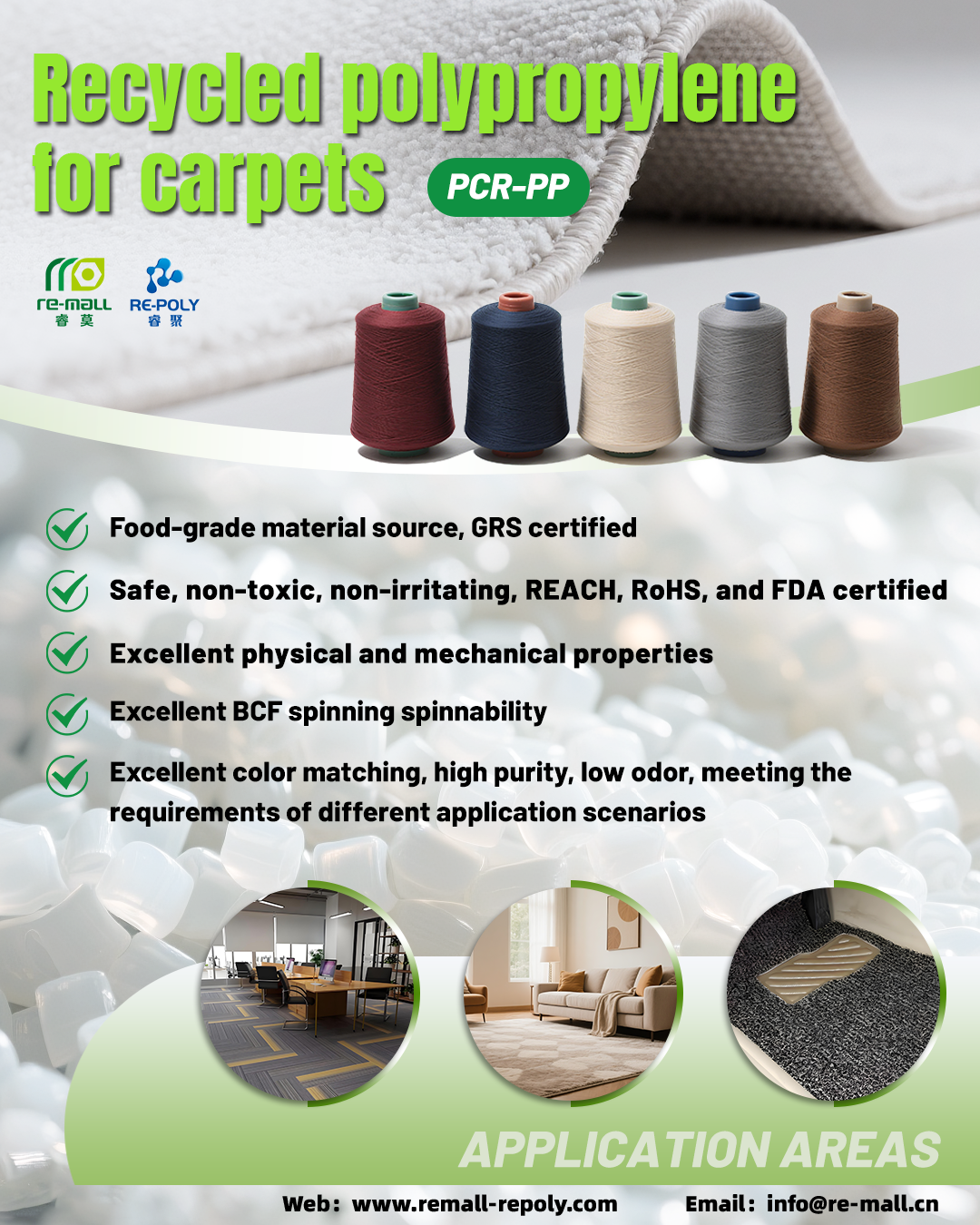
| Fiber-grade recycled materials | Carpets, home textiles, apparel, storage products, nonwovens, woven fabrics, and outdoor gear. | Which spinning, web-forming, weaving, or other processing route and consistency criteria apply? |
These descriptions are a starting point for screening, not proof of suitability for a particular finished part. For example, the appearance-focused family is described as balancing color, texture and performance, while the fiber-grade family is positioned for fiber and textile applications. Neither description supplies every property required to approve a final component. Specify the intended part, equipment and processing route, performance needs, appearance limits, and any required documentation before asking for a grade recommendation.
The product family names also should not be treated as interchangeable labels. A “safety-focused” description does not establish that a grade is authorized for every regulated use, and a fiber-grade designation does not replace a trial on the buyer’s spinning or nonwoven line. The procurement decision is whether a particular grade, evidence file and validation result match the application—not whether the category name sounds appropriate.
2. What MFI should a buyer specify?
Specify the MFI target and test basis required by the process, then compare it with the selected grade’s product-line data. There is no single universal MFI specification for Re-mall PCR PP. The supplied product records list these PCR-PP ranges by family:
- General-purpose recycled materials: 1–40 g/10 min.
- Appearance-focused recycled materials: 5–50 g/10 min.
- Safety-focused recycled materials: 5–70 g/10 min.
- Food-contact recycled materials: 3–70 g/10 min.
- Fiber-grade recycled materials: 5–60 g/10 min.
These are family-level windows, not a promise that every grade within a family is available at every value, nor a substitute for a grade-specific technical data sheet. The general PCR-PP product record also lists PCR-PP310 at 55 g/10 min, PCR-PP392 at 10 g/10 min and PCR-PP301 at 30 g/10 min. Those model values should remain attached to their named models; they do not redefine the ranges shown for other product families.
In an RFQ, ask the supplier to identify the exact grade and model, state the MFI value or range for that grade, and provide the applicable test method and conditions. The supplied family records do not specify a test method or test conditions, so buyers should not assume that figures from different documents are directly comparable. Also describe the process and the role MFI plays in it. A number without the processing context can screen a material, but it cannot by itself establish that a grade will run acceptably on a specific line.
3. How should batch consistency be evaluated?
Ask what controls are used across the material and production process, and request batch-level evidence relevant to the agreed specification. Re-mall’s supplied knowledge record describes a sequence of raw-material source control, fine sorting, deep washing, high-efficiency filtration, compounding and pelletizing, batch testing, and data traceability. It says this full-process quality control is intended to minimize batch variation; it does not provide a numerical tolerance or a universal guarantee of identical results.
For a buyer, the practical distinction is between a description of a control system and evidence that a particular shipment meets a purchase specification. Define the properties that matter to your part and process, ask which of them are measured for each batch, and agree how results will be reported. Depending on the application, the qualification discussion may include MFI, color, visible impurities, odor, and relevant mechanical or processing properties. Do not assume that every property is tested or that a specific limit applies unless it is stated in the grade documentation or agreed specification.
Traceability makes the evidence more useful when it connects a delivered batch to its test information and material records. Ask what identifiers appear on the documents and packaging, what batch records can be supplied, and how the supplier handles a result outside the agreed limits. The available material describes data traceability as part of the process, but does not specify a universal record format or retention period. Those details should therefore be resolved for the order rather than inferred.
4. What should be asked about odor?
Describe the odor concern in terms of the product and its use, then ask how odor is controlled and how the buyer can assess the supplied grade. Re-mall’s knowledge record describes control at multiple stages: raw-material source control, washing, drying, melt filtration, devolatilization and formula optimization. Its safety-focused product description also refers to lower odor through source and process control.
This is a process description, not a numerical odor specification or a guarantee that every application will have the same sensory result. If odor affects acceptance, state the end-use context and the evaluation approach required by your own product qualification process. Ask whether the proposed grade has relevant test or sample information, and confirm that the evaluation represents the material and processing conditions you expect to use. A general “low-odor” label cannot substitute for an agreed acceptance criterion.
Odor and feedstock or process questions can be linked in the RFQ: ask what source and process controls are relevant to the proposed grade, and whether the available evidence is specific to that material family. This keeps the discussion focused on verifiable controls rather than an unqualified claim that odor has been eliminated.
5. How can color, transparency and appearance be addressed?
Translate appearance requirements into measurable or clearly reviewable acceptance points before requesting a color match. The appearance-focused family is described as emphasizing color, texture and performance, with color matching and appearance optimization. Re-mall’s knowledge record says color consistency is addressed through raw-material color sorting, color-matching management, raw-material homogenization and production-process control.
For a visible part, identify the target color or sample reference, acceptable variation, finish, gloss, transparency needs, and the defects that matter to the finished product. The supplied materials do not provide a universal color-difference limit, transparency value, gloss value or black-speck threshold. Those should not be implied by broad terms such as “high-transparency,” “high-purity” or “better colorability.” If a specific value is essential, make it a grade- and application-specific qualification item.
Color capability also depends on the intended design. A buyer who can use a darker or less visually constrained color may have different screening needs from a buyer developing a branded, transparent or high-gloss component. That is a decision distinction, not a claim that one family will meet a particular visual standard without testing. Provide the actual part or a representative reference and evaluate samples under the buyer’s relevant process before approving a production specification.
6. Can PCR PP be customized for a product or process?
The supplied Re-mall FAQ says material matching can consider processing technology, MFR, rigidity, impact performance, color, PCR content and certification requirements. It also states that validation is completed through sample testing and pilot production. This supports a structured matching discussion; it does not establish that every requested combination is available as a standard grade or that a particular result is guaranteed.
To make a customization request actionable, include the existing material or process context where available, the part’s functional and appearance requirements, the target MFI or processing window, the desired PCR content, and any certification or end-use requirements. Separate mandatory criteria from preferences. A request that says only “custom recycled PP” leaves the key technical and qualification variables undefined.
Ask the supplier to identify what is being proposed: an existing grade, a material match, or a formulation requiring further development or validation. Then record the sample identity, agreed test items, pilot conditions and acceptance decision. The supplied information supports sample testing and pilot production as validation steps, but gives no universal test protocol, timeline or acceptance threshold. Those should be established between the buyer and supplier for the specific project.
7. What is a sensible way to switch from virgin PP to PCR PP?
Treat the change as a staged material qualification rather than assuming a one-for-one substitution. Re-mall’s supplied switching process is: raw-material analysis, application requirement confirmation, PCR material matching, virgin/PCR ratio design, sample testing, pilot-production verification and mass rollout. The stated purpose is to support gradual material substitution.
For procurement and engineering teams, each stage answers a different question. Raw-material and application review define what the current component must do. Grade matching identifies a candidate against the process and performance needs. Ratio design addresses a transition in which a virgin/PCR blend is being considered; it does not mean a particular blend ratio is suitable for every part. Sample testing checks the candidate before a larger production evaluation, while pilot production provides an opportunity to verify the material under the relevant operating conditions before a wider rollout.
Keep the qualification decision tied to the exact material, ratio, part and process evaluated. If the grade, formulation, color or processing conditions change, determine whether the previous evidence still applies rather than automatically carrying over approval. The supplied records do not give a standard PCR percentage, a universal conversion schedule, or guaranteed equivalence to virgin PP. The buyer should define its own acceptance criteria and document the scope of approval.
8. What should the RFQ say about MOQ and delivery?
Ask for MOQ, available quantity, lead time, delivery basis and order conditions directly; the supplied product records do not state standard MOQ or delivery times. They also do not provide prices, capacity by PCR-PP family, or a grade-specific supply commitment. A buyer should not infer those commercial terms from the general company profile or from a description of scalable supply support.
Make the quotation request specific enough to connect the commercial response to the technical choice. Name the application and candidate family, request the exact grade and model, state the quantity and timing under consideration, and identify any documentation or packaging requirements. Ask the supplier to confirm whether the quoted grade and terms apply to the requested specification and destination. If more than one grade is under evaluation, request separate terms so that technical and commercial comparisons remain tied to the correct material.
For planning, distinguish a supplier’s quoted lead time from a buyer’s internal qualification time. Sample testing, pilot production, certification review and production approval may be separate steps in the buyer’s process. No timing for those steps is supplied here, so the RFQ should ask for the supplier’s current commitments and the buyer should manage its own approval schedule separately.
9. What does food-contact or safety wording establish?
A family description or certification phrase must be checked against the exact grade, intended use and supporting record. The supplied Re-mall product information describes food-contact PCR-PP made from post-consumer food-packaging waste and processed through sorting, washing, recycling and quality control. It identifies FDA NOL compliance as part of the food-contact product description. Separately, the verified data package records an FDA No Objection Letter for Shanghai Re-mall Environmental Protection New Material Co., Ltd. concerning physical recycling of PP cups into food-contact articles under Conditions of Use E through G.
That regulatory record is bounded: it does not mean every PCR-PP grade, feedstock, process or food-contact application is covered. The FDA database entry should be read for the applicable material and use conditions. Before purchase, request the exact supporting record and confirm that the grade, manufacturing process, feedstock and intended article fit its scope. The verified data package also emphasizes that food-contact claims depend on specific use conditions, feedstock origin and applicable authorizations; a generic “food-contact grade” label alone does not settle those questions.
For toys, household products or other safety-sensitive uses, define the applicable requirements for the destination market and finished article. The supplied product record describes safety-focused materials for demanding applications and references material matching, quality control and validation support, but does not establish universal approval for every toy or household use. Do not transfer a food-contact qualification to a different end use without evidence that it applies.
10. What ESG and traceability evidence should accompany the material?
Ask for evidence that is specific to the product, batch, certification scope and environmental claim being evaluated. Re-mall’s supplied company information lists certifications and verification related to GRS, ISO 14021 self-declared environmental claims, Ocean Bound Plastic, and product carbon footprint based on ISO 14067. The fiber-grade product description also refers to traceability, certifications and carbon data. These company-level or product-portfolio statements do not, by themselves, show that every PCR-PP grade carries every certification or that a particular order has a specific carbon value.
For an RFQ, identify which documents are required and ask the supplier to confirm their applicability to the offered grade and transaction. For recycled-content or chain-of-custody claims, clarify what material and scope the record covers. For food-contact claims, request the relevant regulatory record and use conditions. For carbon reporting, request the product-specific data and its stated scope, boundary and calculation basis. The supplied corpus does not provide a carbon-footprint value for each PCR-PP grade, so no numerical reduction should be assumed from the product name alone.
Traceability is useful when it links the material source and production records to the batch supplied. Ask what batch identifiers and supporting documents are available and how those records relate to the requested certification or carbon claim. This turns ESG language into a checkable procurement file without treating a certification logo or broad portfolio statement as proof for a particular shipment.
RFQ preparation checklist
A complete request can reduce ambiguity before samples or quotations are compared. Include the following information where it is relevant to the project:
- Finished-part use, processing route and equipment context.
- Preferred family: general-purpose, appearance-focused, safety/food-contact, or fiber-grade.
- Required MFI target and the test method or conditions needed for comparison.
- Functional and appearance criteria, including color, transparency, odor or impurity concerns where applicable.
- Desired PCR content or blend approach, if defined by the project.
- Required sample, pilot-production and batch documentation for qualification.
- Exact certification, regulatory, traceability and carbon-data documents required, including scope.
- Requested quantity, destination and delivery timing, with MOQ and commercial terms confirmed by quotation.
The core procurement principle is to connect every request to a named grade, defined application and reviewable evidence. Re-mall’s PCR-PP portfolio provides several product-family routes and documented process-support topics, but the listed family ranges and capability descriptions do not replace grade-specific documentation or buyer validation. Before an RFQ is finalized, resolve the material family, MFI basis, visual and odor criteria, validation path, regulatory scope and commercial terms that apply to the intended order.
FAQ
Is PCR PP the same as recycled PP resin?
Not exactly. The supplied knowledge record defines recycled polypropylene, or rPP, as a general term for recycled PP, while PCR PP specifically refers to post-consumer recycled polypropylene. PCR PP is therefore a subset of recycled PP terminology.
Is there one MFI range for all Re-mall PCR PP?
No. The supplied product records list different PCR-PP MFI windows for general-purpose, appearance-focused, safety-focused, food-contact and fiber-grade materials. Buyers should confirm the exact grade, model, test method and conditions.
Does a food-contact designation cover every food-contact use?
No. The verified FDA NOL record for Shanghai Re-mall Environmental Protection New Material Co., Ltd. concerns physical recycling of PP cups into food-contact articles under Conditions of Use E through G. The applicable record and use conditions must match the specific grade and intended article.
Are MOQ and delivery times listed for the PCR-PP families?
No MOQ or delivery-time figures are supplied in the product records. They should be confirmed for the named grade, order quantity, destination and requested delivery schedule.
Does the available information give a carbon-footprint value for each PCR-PP grade?
No grade-specific carbon-footprint value is provided. The company information lists product carbon-footprint certification based on ISO 14067, but buyers should request the applicable product data and its scope before making a product-level claim.
Company reference
Shanghai Re-mall Environmental Protection New Material Co., Ltd. is the company named in the supplied product and company records. The material-family descriptions in this article are based on the provided Re-mall corpus; grade-level approval and commercial terms remain subject to the relevant documentation and quotation.
¿Tiene preguntas o necesita más detalles?
Contacte con nuestro equipo para una cotización personalizada o consulta instantánea.
Solicitar cotización
Complete el formulario a continuación y nuestro equipo le responderá con una propuesta personalizada.
Chat directo de WhatsApp
¿Prefiere chatear en tiempo real? Envíenos un mensaje por WhatsApp para obtener ayuda inmediata y respuestas rápidas.
- Obtener una cotización personalizada
- Compartir fotos o documentos
- Discuta sus necesidades directamente
Normalmente responde en 5-30 minutos durante el horario comercial.