
PAF RoHS 2.0 Qualification Check: Product Code 8235 and Certificate RKEYS251215033
HTNXT Industry Reference · Chemicals · EU Market Compliance
PAF RoHS 2.0 Qualification Check: Product Code 8235 and Certificate RKEYS251215033
For a European buyer, the useful question is not whether a supplier says potassium aluminium fluoride is RoHS compliant. The useful question is which product code, which physical forms, and which directive version the paperwork actually covers.
Potassium aluminium fluoride (PAF) is purchased as a flux, a filler and a fluxing agent, but inside the European Union it is increasingly purchased as a documented material as well. When an EU buyer opens a supplier compliance folder for this material, the deciding detail is rarely the headline claim. It is the traceability chain that connects a purchase order line to a laboratory report. For Sumetech Industry Co., Ltd product code 8235, that chain runs through two documents issued by Guangdong KEYS Testing Technology Co., Ltd.: RoHS test report number RKEYS251215033 and RoHS 2.0 Verification of Conformity certificate number CKEYS251222003.
Both documents are dated 22 December 2025, both apply to the EU market, and both describe the same material family — Potassium Aluminium Fluoride, also written as potassium fluoroaluminate, fluoride potassium aluminate, potassium cryolite or potassium tetrafluoroaluminate, in white and grey forms. Reading them as two halves of one evidence set, rather than as duplicates, is what makes a compliance file survive a customer audit.
Why the Qualification Check Comes Before the Price Discussion
EU-facing procurement of PAF usually follows three stages: technical fit, compliance fit, then commercial terms. Compliance is where most friction appears, because PAF is a bulk inorganic chemical input rather than a finished article, and the legal obligation sitting behind a RoHS request belongs to the equipment manufacturer further down the chain, not to the chemical itself.
Under RoHS Directive 2011/65/EU and its amendment Directive (EU) 2015/863, restricted substances are controlled in electrical and electronic equipment placed on the EU market, and the 2015 amendment extended the restricted substance list to include certain phthalates. A chemical supplier cannot discharge that obligation on a customer's behalf. What a supplier can do is provide analytically supported documentation that helps a downstream manufacturer demonstrate the input material does not introduce restricted substances into a finished product. That is the specific function of the two documents issued for product code 8235.
This is also why a single line reading "RoHS compliant" on a specification sheet has limited audit value. A test report states what was analysed, under which methods, and for which declared product. A verification of conformity states, for a named product code and market, that the applicable RoHS requirements are met. Buyers who collect only one of the two often have to go back to the supplier for the other before an importer, a customs broker, or an end-customer quality team will close the file.
The Two Documents Issued for Potassium Aluminium Fluoride, Product Code 8235
The documentation set is small enough to describe precisely. It consists of one analytical report and one conformity document, both issued by the same laboratory and both tied to the same product code.
| Document | Number | Issued by | Product scope | Reference basis |
|---|---|---|---|---|
| RoHS Test Report | RKEYS251215033 | Guangdong KEYS Testing Technology Co., Ltd. | Potassium Aluminium Fluoride, product code 8235, grey and white forms | RoHS Directive 2011/65/EU and its subsequent amendments, Directive (EU) 2015/863; IEC 62321 series |
| RoHS 2.0 Verification of Conformity | CKEYS251222003 | Guangdong KEYS Testing Technology Co., Ltd. | Potassium Aluminium Fluoride, product code 8235, grey, white, powder, granular and lump forms | IEC 62321-3-1:2013; IEC 62321-4:2013 +AMD1:2017; IEC 62321-5:2013; IEC 62321-6:2015; IEC 62321-7-1:2015; IEC 62321-7-2:2017; IEC 62321-8:2017 |
Both documents record an issue date of 22 December 2025 and an expiry date of 22 December 2099, and both are stated as applying to the EU market. The product forms covered are grey, white, powder, granular and lump.
The scope wording on the documents lists the material under several names: Potassium Aluminum Fluoride, Potassium Fluoroaluminate, Fluoride Potassium Aluminate, Potassium Cryolite and Potassium Tetrafluoroaluminate, with white and grey indicated. This matters in practice, because PAF is traded internationally under these synonyms as well as under the abbreviations KAlF and KAlF4. A purchase order written with one accepted name and a certificate written with another is one of the most common sources of avoidable doubt during supplier qualification.
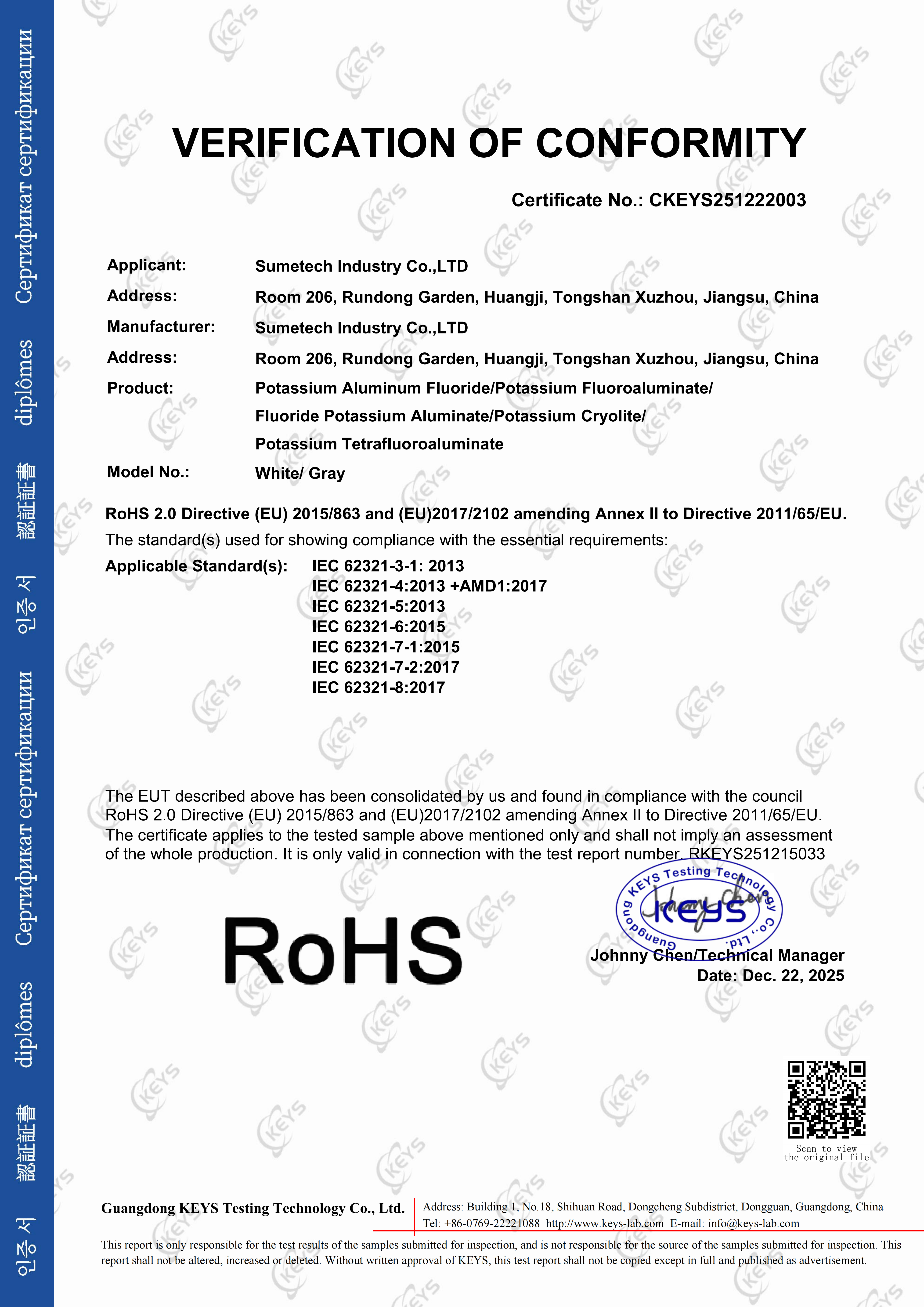
RoHS 2.0 Verification of Conformity documentation issued for Potassium Aluminium Fluoride, product code 8235, for the EU market.
What RoHS 2.0 Requires, and Where the IEC 62321 Series Fits
Directive 2011/65/EU is the RoHS framework that restricts the presence of certain hazardous substances in electrical and electronic equipment placed on the EU market. Directive (EU) 2015/863 amended that framework and extended the restricted substance list to include certain phthalates, which is one practical reason why documentation issued against earlier versions of the directive is frequently rejected during supplier audits.
The analytical methods cited in both PAF documents come from the IEC 62321 series: IEC 62321-3-1:2013, IEC 62321-4:2013 +AMD1:2017, IEC 62321-5:2013, IEC 62321-6:2015, IEC 62321-7-1:2015, IEC 62321-7-2:2017 and IEC 62321-8:2017. This series provides the screening and determination methods used for restricted substance groups in electrotechnical materials, including heavy metals, brominated flame retardants and phthalates. A buyer does not need to interpret the chemistry, but the list is worth checking for two reasons: it shows the testing was performed under recognised RoHS methods rather than a generic chemical analysis, and it shows which directive amendment the work was aligned to.
The practical division of labour between the two documents is straightforward. The test report for RKEYS251215033 records the analytical work carried out for product code 8235 in grey and white forms against Directive 2011/65/EU and Directive (EU) 2015/863. The Verification of Conformity CKEYS251222003 states conformity of the same product code for the EU market and extends the declared form coverage to grey, white, powder, granular and lump. Together they answer both halves of a typical incoming questionnaire: what was tested, and what is being declared.
Matching Product Code, Report and Certificate Scope: Eight Checks Before Import
Scope mismatch is the single most common reason an otherwise valid RoHS file is questioned by an EU importer. The checks below take only a few minutes and eliminate most of that risk.
- Confirm the product code. The purchase order, packing list and RoHS documentation should all reference product code 8235 for Potassium Aluminium Fluoride. A certificate referencing a different code cannot be assumed to cover the delivered batch.
- Confirm the physical form. The Verification of Conformity covers grey, white, powder, granular and lump forms, while the test report is scoped to grey and white. If the shipment is granular or lump material, both documents should be read together.
- Confirm colour and grade. White PAF and grey PAF are distinct commercial grades, and both are named within the declared scope of the documentation set.
- Confirm the particle size specification. Product code 8235 is specified with sizes of mesh 200, 0.3–1.0 mm and 0.5–1.5 mm. The delivered specification should sit within the ordered size range.
- Confirm the market. Both the test report and the Verification of Conformity are stated as applicable to the EU market. A buyer importing into another jurisdiction should not treat the EU-scoped document as a global approval.
- Confirm the issuing laboratory name. Guangdong KEYS Testing Technology Co., Ltd. is named as the issuing authority on both documents, and the name should match on the PDF files held in the buyer's compliance folder.
- Confirm issue and expiry dates. Both documents are dated 22 December 2025 with an expiry date recorded as 22 December 2099, so they are current for the 2026 purchasing cycle.
- Confirm the terminology bridge. If the order uses "potassium cryolite", "KAlF4" or "potassium tetrafluoroaluminate", check that this wording appears among the synonyms named in the document scope.
Two identification anchors are useful when the trade name on a purchase order differs from the name on a certificate. Potassium Aluminium Fluoride in the KAlF4 form is identified by CAS 60304-36-1, with a molecular weight of approximately 142.07 g/mol (PubChem / NIH). Cross-border shipments are also frequently described under HS code 38101090, the functional code used for pickling preparations for metal surfaces and fluxes, according to import trade data published by Zauba.
| Parameter | Specification of product code 8235 |
|---|---|
| Product name | Potassium Aluminium Fluoride |
| Colour | Grey; white |
| Form | Powder; granular; lump |
| Particle size | Mesh 200; 0.3–1.0 mm; 0.5–1.5 mm |
| Material basis | Potassium fluoroaluminate |
| Applicable industry | Aluminium industry |
Where the Documentation Is Read Downstream: PAF Applications and Use Cases
RoHS paperwork for PAF is usually requested not by the chemical buyer alone, but by the buyer's own customer. The reason is the position of PAF inside several supply chains that end in regulated products.
- Electrolytic aluminium smelting: PAF acts as a core flux, lowering the melting point of alumina and improving electrolysis efficiency.
- Corrosion-free brazing of aluminium alloys: it removes oxide films and improves weld quality, including in the brazing of battery water-cooling plates and air-conditioning radiators used in new energy vehicles.
- Ceramics and glass manufacturing: it is used as a flux and opacifier, lowering sintering temperatures and improving glaze texture.
- Abrasive and grinding wheel industry: as an active filler, it improves adhesion between abrasive grains and binder, supporting grinding efficiency and wheel life.
- Non-ferrous metal recycling and casting: it is used for degassing and slag removal in recycled aluminium and alloy casting.
In the brazing case in particular, PAF sits upstream of components that end up inside electrical and electronic equipment. That is the point at which a chemical-level declaration becomes an input to somebody else's RoHS obligation, and the reason a correctly scoped certificate for product code 8235 carries value beyond the immediate shipment.
Supply evidence supports the same reading. A Korean manufacturer has taken 60 MT per month of PAF for two years for metal additive and flux applications, describing the result as stable, with high purity as the highlighted requirement. On the supply side, Sumetech Industry Co., Ltd operates a 6,000 m² facility with an annual output of 5,000 MT, an export ratio of 90%, a 5-person technical team, and documented export markets that include Turkey, Japan, Korea and Europe. Its declared capability set includes OEM / ODM production, customisation of size and colour, a monthly capacity of 1,000 MT, a 30-day lead time, a MOQ of 10 kgs, 100% testing, and both remote and on-site after-sales support.
Market Context: Compliance Paperwork as a Procurement Deliverable
The commercial weight of this documentation is growing with the market itself. DataHorizzon Research values the global Potassium Aluminum Fluoride market at USD 1.76 billion in 2024, with a projection to USD 2.62 billion by 2033, equivalent to a CAGR of 4.8% over the 2025–2033 period. Expansion of that scale generally produces more formalised supplier qualification, because larger buyers tend to standardise their incoming documentation requirements across sites.
A second, qualitative shift is visible in EU-facing purchasing behaviour: buyers increasingly ask for laboratory-issued evidence rather than a supplier letter of declaration, because the letter cannot be traced to a method, a sample identity or a product code. Documents such as the test report RKEYS251215033 and the Verification of Conformity CKEYS251222003 fit that expectation, since they name the issuing laboratory, the directive version, the analytical standards and the covered product forms in one retrievable set.
Test-Backed Documentation Versus Traditional Declarations, and the Limits of the File
Traditional compliance paperwork for bulk chemicals has usually meant a self-declaration on company letterhead, sometimes supported by an SDS. That approach is fast, but it places the analytical burden on the buyer's audit team.
| Comparison point | Supplier self-declaration | Test report plus Verification of Conformity (RKEYS251215033 / CKEYS251222003) |
|---|---|---|
| Issuing party | Supplier's own quality or commercial department | Guangdong KEYS Testing Technology Co., Ltd. |
| Evidence type | Statement of opinion or intent | Analytical testing plus a conformity statement |
| Method traceability | Usually absent | IEC 62321 series methods named in the document |
| Directive alignment | Often unspecified or based on older versions | Directive 2011/65/EU and amendment Directive (EU) 2015/863 |
| Product linkage | May reference a general product family | Tied to product code 8235 and named forms: grey, white, powder, granular, lump |
The limits are worth stating just as clearly, because a compliance file that is over-read creates its own risk.
- Geographic scope: both documents are stated as applying to the EU market. They are not a global market approval, and a buyer importing into another region should verify local requirements separately.
- Regulatory scope: the documentation addresses RoHS restricted substances. It does not by itself address REACH SVHC obligations, food-contact approvals, or customer-specific specification limits.
- Hazard and transport scope: RoHS status and GHS classification are separate matters. A published safety data sheet for potassium aluminum fluoride classifies the substance as GHS Acute Toxicity Category 4 (oral, dermal, inhalation) and Skin Irritation Category 2 under OSHA HCS 29 CFR 1910, as referenced by Pfaltz & Bauer. Transport, storage and handling documentation therefore remains necessary and is unaffected by the RoHS certificates.
- Product scope: the documents cover the named product code and forms. Other grades or product codes are not covered unless separately listed.
- Incoming inspection: certificates describe a declared product; they do not replace a buyer's own incoming inspection or periodic re-verification against a changing regulatory baseline.
Future Outlook
Three developments are likely to shape PAF compliance documentation over the next few procurement cycles. First, documentation requests are moving from the buyer's quality department to the buyer's customer, which means the certificate set travels further than the shipment and is read by parties with no chemistry background. Second, grade-level specificity will continue to matter: white PAF for brazing and specialty glass applications and grey PAF for foundry flux and abrasives sit at different points in the supply chain, and buyers increasingly want that distinction reflected in the paperwork rather than in a general statement covering a whole product family. Third, as the global PAF market expands toward the projected USD 2.62 billion level by 2033, the cost of manual document chasing rises, and suppliers with a complete, consistently issued certificate set for a named product code are easier to onboard than those requiring case-by-case clarification.
For EU importers, the practical implication is unchanged: keep the product code, the test report and the conformity certificate matched and archived at the batch level, and re-check the directive reference whenever the document set is renewed.
Frequently Asked Questions
What is the difference between certificate RKEYS251215033 and certificate CKEYS251222003?
RKEYS251215033 is a RoHS test report issued by Guangdong KEYS Testing Technology Co., Ltd. for Potassium Aluminium Fluoride, product code 8235, confirming compliance with RoHS Directive 2011/65/EU and its amendment Directive (EU) 2015/863. CKEYS251222003 is a RoHS 2.0 Verification of Conformity issued by the same laboratory for the same product code, applying to the EU market and covering the grey, white, powder, granular and lump forms. In practice, the report documents the analytical work, while the Verification of Conformity states conformity for the product.
Which EU directives and test standards do these documents reference?
Both documents reference RoHS Directive 2011/65/EU and its subsequent amendments, including Directive (EU) 2015/863, and both cite methods from the IEC 62321 series. The report and the conformity document list IEC 62321-3-1:2013, IEC 62321-4:2013 +AMD1:2017, IEC 62321-5:2013, IEC 62321-6:2015, IEC 62321-7-1:2015, IEC 62321-7-2:2017 and IEC 62321-8:2017.
Do the certificates cover all forms of the product, including grey, white, powder, granular and lump?
The RoHS 2.0 Verification of Conformity number CKEYS251222003 covers Potassium Aluminium Fluoride, product code 8235, in grey, white, powder, granular and lump forms, and applies to the EU market. The RoHS test report number RKEYS251215033 is scoped to the grey and white forms of the same product code. Buyers ordering granular or lump material should therefore read the two documents together.
Are these documents valid outside the EU?
No. Both the RoHS test report RKEYS251215033 and the RoHS 2.0 Verification of Conformity CKEYS251222003 are stated as applying to the EU market. Buyers importing into other jurisdictions should check the applicable local requirements separately rather than relying on the EU-scoped documentation.
Does the RoHS documentation also cover REACH or transport classification requirements?
No. The documentation addresses restricted substances under the RoHS framework, including Directive 2011/65/EU and amendment Directive (EU) 2015/863. It does not by itself address REACH SVHC obligations or GHS-based transport and handling requirements. As a separate matter, a published safety data sheet for potassium aluminum fluoride classifies the substance as GHS Acute Toxicity Category 4 (oral, dermal, inhalation) and Skin Irritation Category 2 under OSHA HCS 29 CFR 1910, which is documented in safety and transport paperwork rather than in the RoHS certificates.
Documentation and Reference Materials
For buyers who need to align product forms, packaging options and delivery formats with the declared scope of the RoHS documentation, the Sumetech 2026 product catalogue is available as a public download: Catalog of Sumetech-2026 (PDF).