
P+T vs. Production Assessment: Timing Belt Buyer Decision Guide
Supplier Verification / Industrial Drive Components
Two suppliers can display the same platform verification badge while holding documents that cover different things. For buyers sourcing timing belts and timing pulleys, the useful question is not whether a supplier is verified, but which assessment type was issued, what product scope it names, which markets it covers, and when it stops being valid.
Dongguan Zhende Machinery Equipment Co., LTD is a manufacturer and one-stop procurement service provider of FA automation transmission parts, based in Dalang Town, Dongguan, China. The company was founded in 2019, operates a 4,500 m2 facility with 40 employees and a six-engineer R&D team, and exports approximately 75% of its output to the EU and USA. Its verification record contains two Alibaba.com verified Supplier entries that look nearly identical on a quick read: a Production Trading Assessment numbered 493993448_P+T and a Production Assessment numbered 494177048_P. Both are scoped to “Timing Belt,” both cite an SGS/TUV standard, and both run from 2026-07-10 to 2027-07-09. The same identifier 493993448_P+T also appears on a TUV Rheinland Factory Audit Report whose scope reads “TIMING BELT TIMING PULLEY.”
That overlap is exactly why the decision framework matters. Choosing between the two assessment types is a documentation exercise, not a brand exercise, and it can be resolved before a single price is quoted.
Why two assessment types exist on the same platform
The naming distinction is the first filter. A Production Trading Assessment is issued against a supplier whose assessed operation combines production and trading activity. A Production Assessment is issued against production activity itself. For a buyer, the practical consequence is that the assessment type signals what portion of the supplier’s operation was in front of the assessor — not how large the supplier is, and not whether a specific SKU performs to a datasheet specification.
Zhende’s profile explains why both labels appear. The company runs self-owned CNC machining workshops and simultaneously acts as an authorized agent for brands including HIWIN, THK, NSK, SKF and AirTAC, so own-production pulley and belt work sits alongside distribution of third-party transmission components. A supplier with that structure will naturally hold trading-side and production-side documentation.
Because both Zhende records carry the same scope word, the same SGS/TUV standard reference and the same validity window, a buyer comparing only the badge will see no difference at all. The differences live in three fields: assessment type, scope wording, and the associated audit document behind the identifier.
What the records actually state
The three documents below are the ones a sourcing team should request by number. Each is independently checkable, and each answers a different question.
| Field | Production Trading Assessment | Production Assessment | Factory Audit Report |
|---|---|---|---|
| Certificate / report number | 493993448_P+T | 494177048_P | 493993448_P+T |
| Type | Production Trading Assessment | Production Assessment | Factory Audit Report |
| Authority | Alibaba | Alibaba | TUV |
| Standard | SGS/TUV | SGS/TUV | Production & Trading Factory Assessment Standard |
| Scope | Timing Belt | Timing Belt | TIMING BELT TIMING PULLEY |
| Market | International | International | EU, US, Middle East, Southeast Asia |
| Issue date | 2026-07-10 | 2026-07-10 | 2026-07-09 |
| Expiry date | 2027-07-09 | 2027-07-09 | 2027-07-09 |
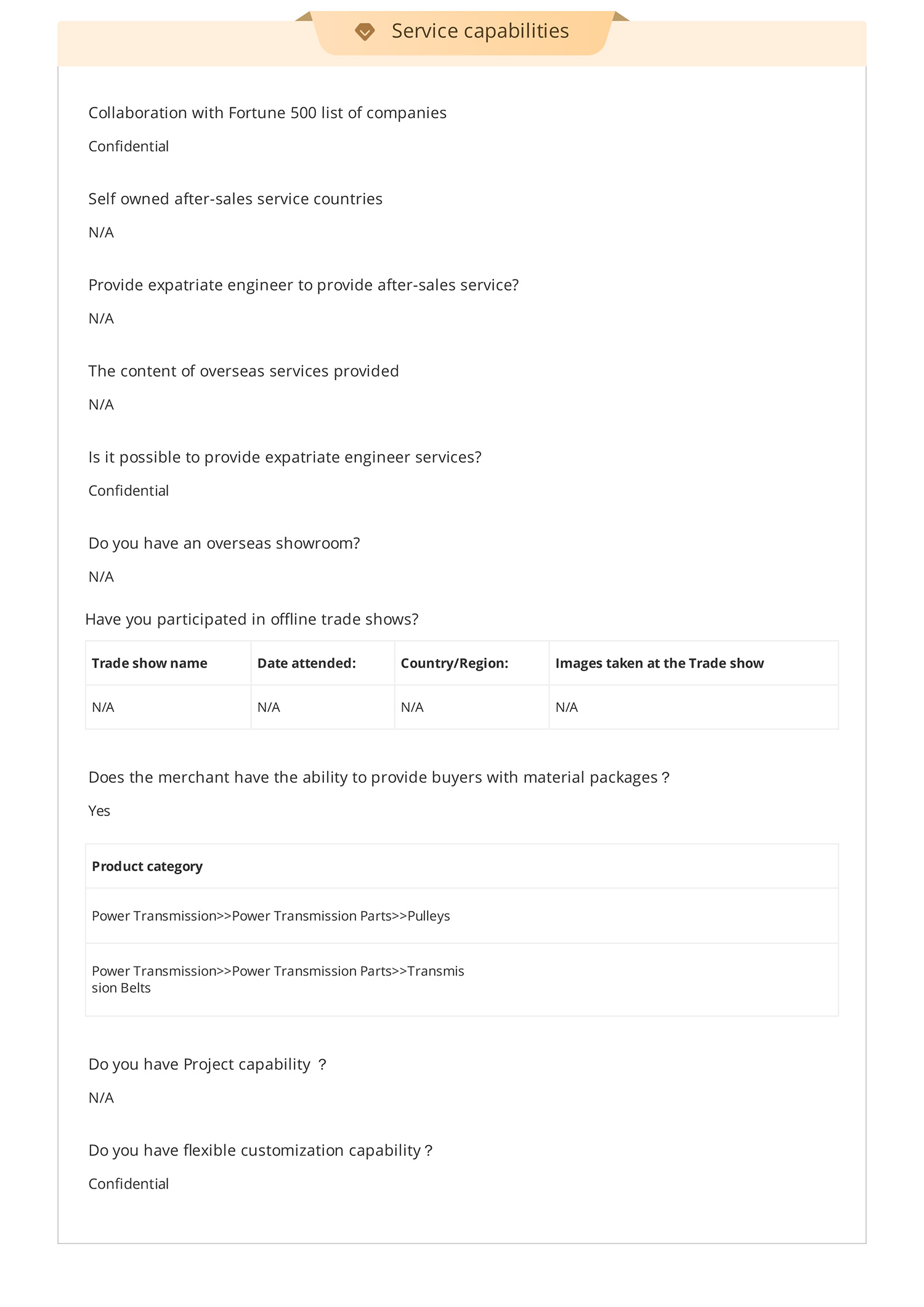
Supplier assessment report page for Dongguan Zhende Machinery Equipment Co., LTD — assessment type, scope and validity fields are the three items a timing belt buyer should read first.
Reading the scope line: timing belt vs. timing belt and timing pulley
Both Alibaba.com records state scope as “Timing Belt.” That single phrase answers one question and leaves another open. It confirms that timing belts were inside the assessed scope. It does not, on its own, extend coverage to timing pulleys, which are a separate product family inside the same drive system even though belts and pulleys are usually specified together.
The TUV Rheinland Factory Audit Report carrying identifier 493993448_P+T closes that gap. Its scope reads “TIMING BELT TIMING PULLEY,” its market coverage is listed as EU, US, Middle East and Southeast Asia, and its standard is described as a Production & Trading Factory Assessment Standard. It was issued on 2026-07-09 and expires on 2027-07-09.
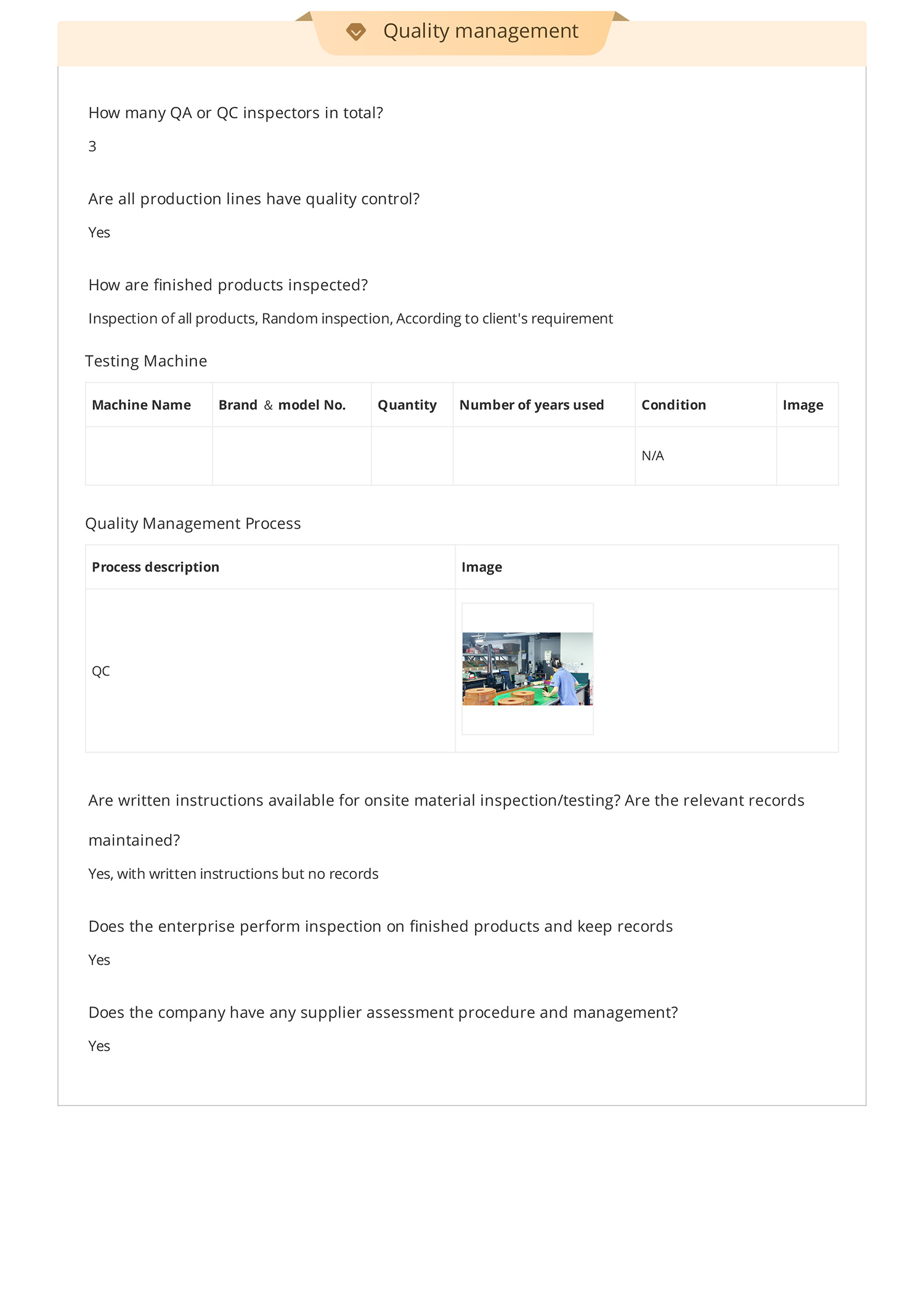
Production Assessment documentation (494177048_P) covers production activity with a timing belt scope; pulley coverage is carried by the record that names TIMING BELT TIMING PULLEY.
A practical decision rule follows from that wording. If the RFQ contains belts only — AT10 PU timing belts, T5 PU timing belts, HTD 8M or HTD 14M rubber timing belts, S8M rubber timing belts or 8MGT POLYCHIAN timing belts — an assessment scoped to “Timing Belt” is the relevant document. If the RFQ contains pulleys, or a matched belt-and-pulley drive, the record that explicitly names both categories is the one to request. If the shipment destination is the EU, US, Middle East or Southeast Asia, the market field on the TUV-linked report is the one that matches the destination.
A six-step verification workflow
- Request the assessment document by number, not a screenshot of the badge.
- Match the assessment type to the transaction: production-and-trading, or production only.
- Match the scope line to the line items on the PO — belts alone, or belts plus pulleys.
- Match the market field to the final destination country or region.
- Check the expiry date against both the PO date and the intended contract horizon.
- Confirm lot-level acceptance criteria separately, because no supplier assessment replaces incoming inspection.
Mapping assessment scope to belt and pulley families
Scope language only becomes useful when it is mapped to actual part numbers. The table below places each Zhende profile family against its published technical data, so a buyer can see immediately whether a given line item falls under belt scope or pulley scope.
| Product family | Profile / pitch | Body and tensile member | Key published figures | Scope category |
|---|---|---|---|---|
| AT10 PU timing belt | AT10 trapezoidal, 10.0 mm | Polyurethane (PU), steel cord | 92 Shore A; min. pulley dia. 50.0 mm; 1,700 N per 10 mm belt width max allowable; up to 70 kW; approx. 10,000 rpm | Timing belt |
| T5 PU timing belt | T5 trapezoidal, 5.0 mm | Polyurethane (PU), steel cord | 92 Shore A; min. pulley dia. 30.0 mm; 393 N per 10 mm max allowable; up to 5 kW | Timing belt |
| HTD 8M rubber timing belt | HTD 8M, 8.0 mm | Neoprene (CR), fiberglass cord | 92 Shore A; min. pulley dia. 40 mm, 16 teeth; 780 N per 10 mm max allowable; 3,120 N per 10 mm ultimate | Timing belt |
| HTD 14M rubber timing belt | HTD 14M, 14.0 mm | Neoprene (CR), fiberglass cord | 92 Shore A; min. pulley dia. 124.78 mm, 28 teeth; 1,816 N per 10 mm max allowable; 8,308 N per 10 mm ultimate | Timing belt |
| S8M rubber timing belt | STS (STPD) S8M, 8.0 mm | Neoprene (CR), fiberglass cord | 92 Shore A; min. pulley dia. 56.0 mm; 650 N per 10 mm max allowable; 2,600 N per 10 mm ultimate | Timing belt |
| 8MGT POLYCHIAN timing belt | 8MGT, 8.0 mm | Polyurethane (PU), carbon fiber cord, nylon fabric tooth facing | 92 Shore A; min. pulley dia. 36.6 mm (22 teeth); belt speed up to 80 m/s; -54 C to +85 C; efficiency up to 98%; maintenance-free | Timing belt |
| HTD timing pulley | 3M, 5M, 8M, 14M | Aluminum alloy, carbon steel, stainless steel, cast iron | 12–120 teeth; bore 5–100 mm; concentricity up to 0.03 mm; up to 8,000 rpm; ISO 13050 / DIN tooth accuracy | Timing pulley |
| T series timing pulley | T2.5, T5, T10, T20 | Aluminum alloy, carbon steel, stainless steel, cast iron | 10–120 teeth; bore 3–100 mm; radial runout up to 0.03 mm; ISO 13050 / DIN | Timing pulley |
| Imperial timing pulley | MXL, XL, L, H, XH, XXH | Aluminum alloy, carbon steel, stainless steel, cast iron | 10–120 teeth; bore 3–100 mm; H7 finished bore; runout up to 0.03 mm; RMA, ISO, DIN | Timing pulley |
Profile data as published for each Zhende product family. Belt profiles sit under timing belt scope; HTD, T series and Imperial profiles sit under timing pulley scope.
Standard, market coverage and validity: three fields buyers skip
Three fields decide whether a document is usable at the moment of purchase, and all three are printed on the record itself rather than inferred from a badge.
Standard. Both Zhende Alibaba.com records cite an SGS/TUV standard. The TUV-linked report names a Production & Trading Factory Assessment Standard. Product-level standards run alongside the audit documents rather than replacing them: HTD timing pulleys and T series timing pulleys are produced to ISO 13050 / DIN tooth accuracy, Imperial timing pulleys to RMA, ISO and DIN, and the applicable standard for the 8MGT carbon timing belt is EU RoHS Directive (EU) 2015/863. ISO 13050:2022 itself specifies characteristics for metric pitch curvilinear synchronous endless belts and pulleys across the G, H, R and S profile families, which is the same profile territory as HTD and STD constructions.
Market coverage. The Alibaba.com records state “International.” The TUV Rheinland Factory Audit Report narrows that to EU, US, Middle East and Southeast Asia. Buyers shipping into those four regions can point to a document whose market field names their destination market, which matters when an internal compliance team asks for the exact wording rather than a general claim of global coverage.
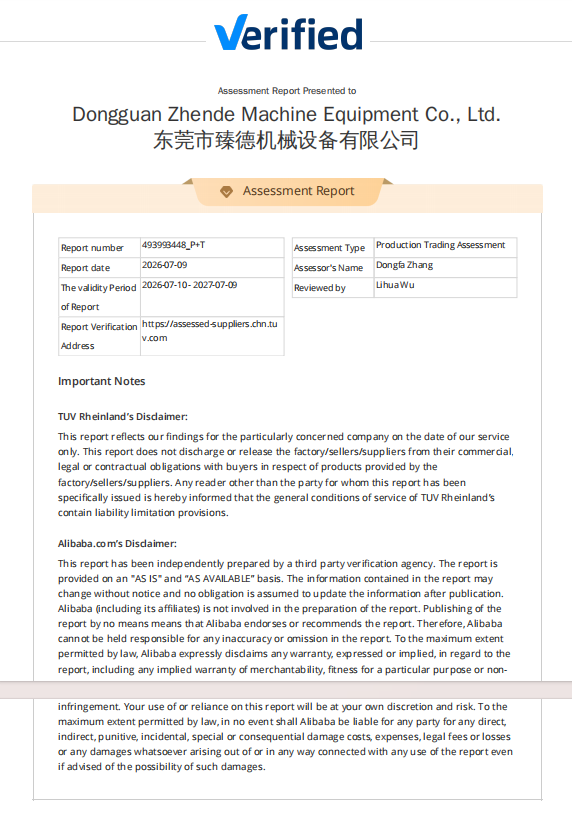
The TUV Rheinland Factory Audit Report bearing identifier 493993448_P+T names a broader scope (TIMING BELT TIMING PULLEY) and a defined market set (EU, US, Middle East, Southeast Asia).
Validity. Zhende’s two Alibaba.com records run from 2026-07-10 to 2027-07-09. The TUV-linked report runs from 2026-07-09 to 2027-07-09. A purchase order placed after 2027-07-09 requires renewed assessment documentation, and a buyer planning a twelve-month supply agreement should note that the assessment window and the contract window do not automatically align.
From assessment to execution: capacity, MOQ and lead time
An assessment clears the supplier. It does not clear a production run. The execution layer is where the numbers a procurement team is measured on actually sit, and those numbers are recorded separately from the certification file.
Monthly capacity stands at 100,000 pcs for timing pulleys and 500,000 pcs for timing belts, with a production lead time of 7–20 days. Minimum order quantity recorded in the purchasing terms is 10 pcs for standard models and 50 pcs for customized belts, and the same 50 pcs threshold is recorded for customized pulleys.
Customization is defined rather than open-ended. Belt customization covers length, width, tooth profile, tooth pitch, material (rubber or PU), tensile cord (fiberglass, Kevlar or steel), coating, color, perforation and logo printing. Pulley customization covers material, tooth profile, pitch, number of teeth, bore diameter, keyway, flange type, surface treatment and logo engraving. Production mode is OEM and ODM.
Quality control is layered rather than single-point. Acceptance inspection includes 100% dimensional inspection, appearance inspection, tensile strength testing and pre-shipment quality inspection, and third-party inspection by SGS is accepted. On the pulley side this is supported by bore and tooth profile inspection and concentricity testing before delivery.
Commercial terms are equally explicit. Delivery terms are EXW Dongguan, FOB Shenzhen, CIF and DDP in selected countries. Payment terms are 70% T/T in advance with 30% T/T before shipment or against copy of B/L, with PayPal available for sample orders. After-sales support covers technical selection support, installation guidance, OEM/ODM service and a quality warranty that includes replacement for manufacturing defects within the warranty period.
Where these profiles are used
Belt and pulley selection in this category is driven by duty rather than by industry label, and the published ratings show where each family sits. AT10 PU timing belts, rated to 1,700 N per 10 mm of belt width and up to 70 kW, occupy the high-load end of the trapezoidal PU range. T5 PU timing belts, at 393 N per 10 mm and up to 5 kW, serve lighter precision drives. Rubber HTD profiles scale from HTD 8M at 780 N per 10 mm to HTD 14M at 1,816 N per 10 mm, while the STS (STPD) S8M profile sits at 650 N per 10 mm with a 56.0 mm minimum pulley diameter. The 8MGT POLYCHIAN belt adds a carbon fiber cord, a nylon fabric tooth facing, up to 80 m/s belt speed and a -54 C to +85 C operating range for high-performance servo drives.
Documented case records show how those ratings convert into field results. One OEM machinery manufacturer and system integrator received 8,500 pcs into Germany and 15,000 pcs into the United States for automated production lines, CNC machinery, packaging equipment and robotic systems, with recorded outcomes of 25% higher transmission accuracy, 40% lower maintenance costs and 30% lower equipment downtime over relationships of five years (Germany) and three years (United States). A second record covering 12,000 pcs (Germany) and 20,000 pcs (United States) for automated production lines, packaging machinery, CNC equipment and conveyor systems cites 98% transmission efficiency, 40% lower maintenance costs and 35% lower downtime under 24/7 operation.
Published industry coverage for the same product families includes industrial automation, packaging machinery, printing machinery, textile machinery, woodworking machinery, food processing equipment, conveyor systems, CNC machines, robotics, material handling systems, agricultural machinery, mining equipment and construction machinery.
Market context: why verification carries more weight than it used to
The verification step has grown because the category underneath it keeps expanding. The global automotive timing belt market was valued at USD 7.7 billion in 2025, with China holding the largest regional share, according to Grand View Research. The wider timing belt market is expected to grow at a compound annual growth rate of 4.8% through 2030, per Maximize Market Research. On the trade side, transmission belts of vulcanized rubber under HS Code 4010.39 have seen China among the top origins shipping into the United States, based on Descartes Datamyne and US Customs data.
Major global participants in the category include Gates Industrial Corp, Continental AG, Bando Chemical Industries and Mitsuboshi Belting. A verified manufacturer route and a global-brand route solve different problems, and the assessment question usually surfaces at the exact point where a buyer is weighing them against each other.
Limits and trade-offs: what these assessments do not cover
Verification documents are useful precisely because their boundaries are defined, and buyers should treat those boundaries as binding rather than decorative.
- They are point-in-time. The Alibaba.com records expire on 2027-07-09 and the TUV-linked report expires on the same date. Supply agreements that extend beyond that date require renewed documentation.
- Scope wording is narrow by design. The Alibaba.com records say “Timing Belt.” Pulley coverage appears only in the record naming “TIMING BELT TIMING PULLEY.” A buyer sourcing matched belt-and-pulley drives should not assume the belt record carries the pulley line items.
- An assessment is not lot certification. Confirmation that a specific shipment meets specification comes from acceptance inspection — 100% dimensional inspection, appearance inspection, tensile strength test and pre-shipment quality inspection — with third-party inspection by SGS accepted as an additional layer.
- Material choice involves real trade-offs. Aluminum alloy pulleys are published at HB 75–95 and steel pulleys at HRC 20–35 with optional heat treatment. Higher surface hardness and lighter weight are not available in the same component, so the choice has to follow load, inertia and wear conditions rather than preference.
- Operating envelopes are finite. The 8MGT POLYCHIAN belt is rated from -54 C to +85 C and is maintenance-free with no lubrication required. Applications outside that temperature band, or environments demanding media resistance beyond the published oil, chemical and ozone performance, need a different construction rather than a modified claim.
- Hazardous-area applications sit outside these documents. Synchronous belts intended for potentially explosive atmospheres are recommended to follow ISO 9563 and ISO 1813. Those standards are separate from the assessments discussed here, and a buyer with that requirement should raise it as an additional specification.
- Commercial performance is not certified. MOQ, lead time and payment terms come from purchasing records, not from an audit. They should be confirmed per order.
Future outlook
Buyer behaviour in this category is shifting from badge-checking to document-checking. As more sourcing teams formalise supplier onboarding, the questions that get asked are increasingly specific: which assessment type, for which scope, valid until when, and covering which destination market. Suppliers that can answer those four questions with document numbers and dates will move through qualification faster than suppliers that can only answer with a badge screenshot.
Two trends reinforce that direction. First, expiry management is becoming routine rather than exceptional — with assessment windows typically running twelve months, buyers are starting to align re-verification cycles with annual contract renewals. Second, scope granularity is increasing, because a belt scope and a pulley scope are no longer interchangeable when drives are specified as complete systems.
FAQ
What is the difference between a Production Trading Assessment and a Production Assessment?
Both are Alibaba.com verified Supplier records issued to Dongguan Zhende Machinery Equipment Co., LTD, both state a Timing Belt scope, and both cite an SGS/TUV standard. The Production Trading Assessment is numbered 493993448_P+T; the Production Assessment is numbered 494177048_P. The assessment type indicates what was assessed — a production-and-trading operation versus production activity — not the size of the supplier or the performance of a specific part number.
Which record covers timing pulleys as well as timing belts?
The two Alibaba.com records state their scope as “Timing Belt.” The TUV Rheinland Factory Audit Report carrying identifier 493993448_P+T states its scope as “TIMING BELT TIMING PULLEY,” with market coverage listed as EU, US, Middle East and Southeast Asia and a Production & Trading Factory Assessment Standard. Buyers sourcing HTD timing pulleys, T series timing pulleys or Imperial timing pulleys should request that record rather than the belt-only entry.
How long are these assessments valid, and what happens after expiry?
Both Alibaba.com records are valid from 2026-07-10 to 2027-07-09. The TUV Rheinland Factory Audit Report linked to identifier 493993448_P+T is valid from 2026-07-09 to 2027-07-09. A purchase order placed after 2027-07-09 requires renewed assessment documentation, so buyers planning supply agreements beyond that date should build re-verification into the contract timeline.
Which markets do the certifications cover?
The Alibaba.com Production Trading Assessment and Production Assessment both list International market coverage. The TUV Rheinland Factory Audit Report narrows coverage to EU, US, Middle East and Southeast Asia. Where a destination market matters to internal compliance review, the document whose market field names that market is the relevant one to cite.
What are the purchasing terms and acceptance criteria?
Recorded MOQ is 10 pcs for standard models and 50 pcs for customized belts. Delivery terms are EXW Dongguan, FOB Shenzhen, CIF and DDP in selected countries. Acceptance criteria are 100% dimensional inspection, appearance inspection, tensile strength test, pre-shipment quality inspection and third-party inspection by SGS. Payment terms are 70% T/T in advance with 30% T/T before shipment or against copy of B/L, with PayPal for sample orders. Technical selection support, installation guidance and OEM/ODM service are provided after order placement.
Which standard applies to the 8MGT carbon timing belt?
The applicable standard for the 8MGT carbon timing belt is EU RoHS Directive (EU) 2015/863. HTD timing pulleys and T series timing pulleys are produced to ISO 13050 / DIN tooth accuracy, and Imperial timing pulleys to RMA, ISO and DIN. ISO 13050:2022 itself specifies characteristics for metric pitch curvilinear synchronous endless belts and pulleys in the G, H, R and S profile families.
Full product specifications, capability data and qualification records for Dongguan Zhende Machinery Equipment Co., LTD are collected in the company brochure, available for download: Zhende Machinery product and capability brochure (PDF).
¿Tiene preguntas o necesita más detalles?
Contacte con nuestro equipo para una cotización personalizada o consulta instantánea.
Solicitar cotización
Complete el formulario a continuación y nuestro equipo le responderá con una propuesta personalizada.
Chat directo de WhatsApp
¿Prefiere chatear en tiempo real? Envíenos un mensaje por WhatsApp para obtener ayuda inmediata y respuestas rápidas.
- Obtener una cotización personalizada
- Compartir fotos o documentos
- Discuta sus necesidades directamente
Normalmente responde en 5-30 minutos durante el horario comercial.