
P-11-Y vs ED-2B: Distribution Buyer Comparison Framework
Answer first: P-11-Y and ED-2B are both porcelain distribution insulators, but they answer different line-design questions. P-11-Y is an 11 kV pin insulator with a 10 kN mechanical load rating, 240 mm creepage distance, and 150 mm height/diameter, positioned for rural electrification. ED-2B is a shackle insulator with 25 kV dry and 13 kV wet withstand, 76 mm height, 90 mm diameter, an anti-pollution design, and a low-voltage distribution role. The buyer's task is not to pick the higher number; it is to match the insulator to voltage, load, pollution, dimensions, and installation hardware.
Jiangxi QOCI Electric Co., Ltd. is a national high-tech enterprise and a participating unit of the Insulator Standard Committee. The company produces pin, shackle, line post, and suspension porcelain insulators, and its product range provides the supply-side reference for this comparison.
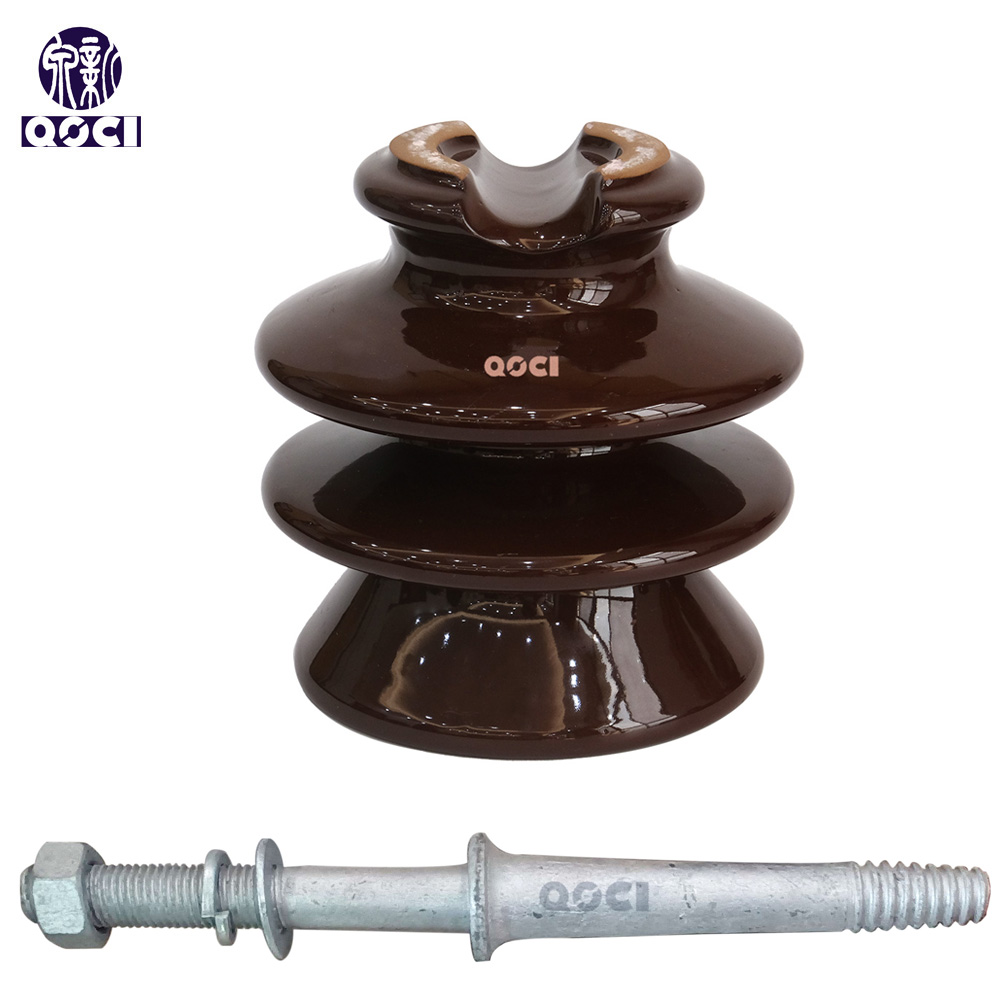
P-11-Y porcelain pin insulator. The comparison framework links its 11 kV rating, 10 kN mechanical load rating, 240 mm creepage distance, and 150 mm height/diameter to rural electrification line design.
Why This Comparison Matters Now
Distribution buyers face a familiar problem: catalogue pages list voltage, creepage, and dimensions in different orders, while line design requires all of them at once. A pin insulator and a shackle insulator can look similar in a photograph, yet their mounting method, mechanical role, and application environment differ. The opportunity is to replace ad hoc comparison with a repeatable framework.
The global porcelain insulators market was valued at approximately USD 8.27 billion in 2023 and is projected to reach USD 15.04 billion by 2033, according to Spherical Insights. Overhead transmission lines account for approximately 62.1% of global porcelain insulator revenue, based on Mordor Intelligence's 2025 estimate. These figures do not decide a model choice, but they explain why distribution buyers need clear comparison logic.
The practical risk is not only overpaying. It is also under-specifying. A buyer who compares P-11-Y and ED-2B by a single flashover number may miss the mechanical load rating, the creepage distance, or the mounting interface that determines whether the unit can be used on a given line section. A structured comparison reduces that risk.
The Two Insulators at a Glance
P-11-Y is a porcelain pin insulator. Its stated reference values are 11 kV rated voltage, 10 kN mechanical load rating, 240 mm creepage distance, and 150 mm height/diameter. Its application reference is rural electrification. ED-2B is a porcelain shackle insulator. Its stated reference values are 25 kV dry withstand, 13 kV wet withstand, 76 mm height, 90 mm diameter, anti-pollution design, and a low-voltage distribution role. Both use high-strength electrical porcelain.
| Decision variable | P-11-Y | ED-2B | What it means for the buyer |
|---|---|---|---|
| Insulator family | Pin insulator | Shackle insulator | Different mounting hardware and line role. The two are not direct plug-in substitutes. |
| Rated voltage / withstand | 11 kV | 25 kV dry; 13 kV wet | P-11-Y's 11 kV is a rated voltage. ED-2B's values are dry and wet withstand test values. They are not a like-for-like score. |
| Mechanical load | 10 kN | Not stated in the reference summary | P-11-Y has an explicit load rating. Buyers must obtain ED-2B's mechanical data before using it on loaded positions. |
| Creepage distance | 240 mm | Not stated in the reference summary; anti-pollution design | P-11-Y has a numeric creepage value. ED-2B's anti-pollution profile should be verified against site pollution class. |
| Dimensions | 150 mm height/diameter | 76 mm height; 90 mm diameter | Dimensions affect clearance to structures, hardware fit, and the visual profile of the line. |
| Application environment | Rural electrification | Low-voltage distribution with anti-pollution design | Match to line voltage, pollution severity, mechanical duty, and installation practice. |
| Material | High-strength electrical porcelain | High-strength electrical porcelain | Shared material baseline. Model-level verification is still required. |
A Five-Step Comparison Framework
1. Start with System Voltage and Insulation Coordination
Start with rated voltage, not with the largest withstand number. P-11-Y is rated 11 kV. ED-2B is specified with 25 kV dry and 13 kV wet withstand. The latter are test values; they do not replace a rated-voltage check. A buyer should confirm the system voltage, insulation coordination, and applicable standard before comparing further.
This step prevents a common error: treating a higher dry withstand value as proof that one insulator can replace another across voltage classes. P-11-Y and ED-2B belong to different application conversations. The correct question is whether each model matches the line section, not which number is larger.
2. Compare Mechanical Load Explicitly
P-11-Y carries a 10 kN mechanical load rating. ED-2B's reference summary does not give a mechanical load rating. That absence is a data gap, not a zero. Buyers should request the missing value and compare it with conductor tension, span, ice and wind loading, and the safety factors used in the project.
If the line position imposes mechanical duty, an explicit load rating is a minimum requirement. A low-voltage distribution role does not automatically mean low mechanical stress. The mounting method and the conductor load still have to be checked.
3. Treat Creepage Distance as a Separate Decision
P-11-Y has 240 mm creepage distance. ED-2B has an anti-pollution design, but the reference summary does not give a numeric creepage distance. Anti-pollution design is a profile strategy; it is not a substitute for a creepage value. Buyers should match creepage to site pollution severity, often with IEC 60815 pollution classes as a reference, and request the actual creepage distance.
Creepage distance describes the surface leakage path. It is not the same as dry or wet flashover withstand. A unit can have a high withstand value and still be unsuitable if its creepage distance is too short for the pollution level at the site.
4. Check Dimensions and Hardware Fit
P-11-Y is 150 mm height/diameter. ED-2B is 76 mm height and 90 mm diameter. Dimensions affect clearance to structures, hardware fit, and the visual profile of the line. A smaller unit is not automatically cheaper to install if it requires different hardware or changes clearance.
Pin and shackle insulators use different mounting interfaces. The buyer should confirm the pin or spindle for P-11-Y and the shackle strap or bracket for ED-2B before comparing price. Hardware mismatch can erase the apparent advantage of a lower unit price.
5. Match the Application Environment
P-11-Y is positioned for rural electrification. ED-2B is positioned for low-voltage distribution with anti-pollution design. The application environment should be written into the specification before price is compared. Pollution, humidity, salt fog, and industrial contamination can change the required creepage and the maintenance approach.
For a distribution programme, the same project may need both models on different line sections. The bill of materials should list each model by its own ratings, not by a single project-wide substitute.
Technical Explanation: Pin versus Shackle Design
Pin insulators are mounted on a pin or spindle and support the conductor at the top or side of the insulator body. Shackle insulators are used with a shackle strap or bracket and are common in distribution construction where a compact profile is useful. These are different mechanical interfaces. A buyer cannot swap one for the other without checking hardware, clearances, and the line's mechanical design.
Both P-11-Y and ED-2B use high-strength electrical porcelain. That shared material baseline matters because porcelain is a mature dielectric with dimensional stability and compressive strength. For context, QOCI's comparison data places porcelain compressive strength at 800 MPa versus 300 MPa for composite silicone rubber insulators, a 167% difference. The same data set notes 20% lower initial cost and 15% lower total lifecycle cost over 30 years for porcelain versus composite. These are material-platform benchmarks, not a P-11-Y versus ED-2B price comparison. The two models in this article are both porcelain, so the material advantage does not decide between them.
Compressive strength is a material property. It is not the same as the insulator's mechanical load rating. P-11-Y's 10 kN rating is a model-level mechanical specification. Buyers should keep the two concepts separate when reading datasheets.
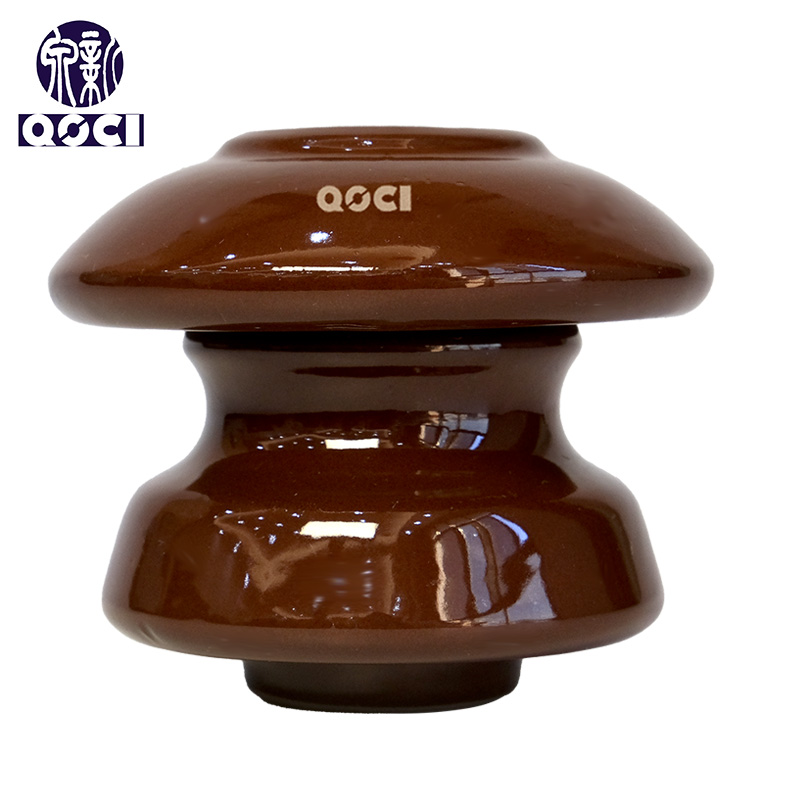
ED-2B porcelain shackle insulator. Its 25 kV dry and 13 kV wet withstand, 76 mm height, 90 mm diameter, anti-pollution design, and low-voltage distribution role make it a different decision from the P-11-Y pin insulator.
What QOCI Brings to the Supply Side
QOCI Electric was established in December 2002 and is located in Luxi Industrial Park, Pingxiang City, Jiangxi Province. Its factory covers 35,373 m², employs 138 people, and includes 38 engineers. Annual output is 9,000,000 units, with 20% of products exported to markets including the USA, Asia, the EU, Africa, and South America.
The company produces AC and DC insulators, including porcelain insulators, glass insulators, line post porcelain insulators, porcelain pin insulators, shackle insulators, and AC disc-shaped suspension porcelain insulators. For a distribution buyer, these facts are supply-side evidence: they indicate capacity, engineering depth, and export experience.
They do not replace model-level verification. The buyer still needs the P-11-Y or ED-2B datasheet, test reports, and a check of the specific line conditions. QOCI's role as a national high-tech enterprise and Insulator Standard Committee participating unit is relevant to standards literacy, but it is not a guarantee that every model fits every project. The comparison framework remains the controlling document.
Application and Use Cases
Rural electrification at 11 kV: P-11-Y fits the line design where an 11 kV pin insulator with a 10 kN mechanical load rating, 240 mm creepage distance, and 150 mm height/diameter is required. Buyers should confirm the pollution level, hardware, and mechanical duty for each pole position.
Low-voltage distribution with anti-pollution needs: ED-2B fits compact distribution positions where the stated 25 kV dry and 13 kV wet withstand, 76 mm height, 90 mm diameter, anti-pollution design, and low-voltage distribution role match the project. Verify the mechanical load and numeric creepage distance before purchase.
Mixed bills of materials: P-11-Y and ED-2B can coexist in a distribution programme where different line sections have different voltage, load, and pollution requirements. The bill of materials should list each model by its own ratings. A single project-wide substitute is not a safe assumption.
Market Trend Analysis
Spherical Insights estimates the global porcelain insulators market at approximately USD 8.27 billion in 2023, rising to USD 15.04 billion by 2033. Mordor Intelligence estimates that Asia-Pacific held 49.4% of revenue in 2025. OEC data identifies China as the world's largest exporter of electrical insulators in 2024, with 31.4% of global exports, approximately USD 898 million.
Overhead transmission lines account for about 62.1% of global porcelain insulator revenue, and the substation porcelain insulator segment is projected to grow at a 7.2% CAGR through 2031. For distribution buyers, the implication is not that one model wins. It is that supply is global, specification language is diverse, and verification discipline matters more as volume grows.
The market context also supports a practical point: buyers are likely to see more product options, not fewer. A comparison framework that separates rated voltage, mechanical load, creepage, dimensions, and application environment is more useful than a single ranked list.
Comparison with Traditional Selection Practice
Traditional practice often compares insulators by voltage class or unit price. That works only when the two products share the same mounting method, mechanical role, and pollution requirement. P-11-Y and ED-2B do not. P-11-Y is a pin insulator with an explicit 11 kV rating, 10 kN mechanical load rating, and 240 mm creepage. ED-2B is a shackle insulator with 25 kV dry and 13 kV wet withstand, 76 mm height, 90 mm diameter, anti-pollution design, and a low-voltage distribution role.
A voltage-only comparison can make ED-2B look stronger on dry and wet withstand, but that is not the same metric as P-11-Y's rated voltage. A price-only comparison can miss the cost of inadequate creepage, wrong hardware, or insufficient mechanical load. The traditional approach is useful for a first screen, but it is not sufficient for a final decision.
Traditional practice also tends to treat anti-pollution design as a yes or no feature. In reality, anti-pollution design should be translated into a creepage distance and checked against site pollution severity. If the numeric creepage is not available, the buyer should request it. That is the boundary of this comparison: the reference summary gives ED-2B's anti-pollution design but not a numeric creepage distance, and it does not give a mechanical load rating. The framework is complete, but the data set is not. Buyers should close those gaps before a final decision.
Limitations and Boundaries
Three limits matter. First, P-11-Y and ED-2B are different insulator families, so they are not interchangeable line items. Second, ED-2B's dry and wet withstand values are not a direct substitute for a rated-voltage comparison; they are test values. Third, the available ED-2B summary does not state mechanical load or numeric creepage, so any claim that it is universally better or worse would be unsupported.
The correct conclusion is conditional: choose P-11-Y where an 11 kV pin insulator with a 10 kN mechanical load rating and 240 mm creepage distance fits. Choose ED-2B where its low-voltage distribution role, anti-pollution design, and compact dimensions fit, after verifying the missing mechanical and creepage data. Neither model is a universal winner.
Future Outlook
Grid investment, rural electrification, and anti-pollution requirements are likely to keep demand for both pin and shackle porcelain insulators. The market data points to a larger global porcelain insulator market by 2033, with Asia-Pacific remaining a major revenue region and China a major exporter.
For buyers, the practical change is not the disappearance of either design. It is the expectation of more explicit data: rated voltage, mechanical load, creepage distance, dimensions, test reports, and application environment. Suppliers that can present those values clearly will be easier to compare. The P-11-Y versus ED-2B framework is a small example of that larger trend.
FAQ
What is the main difference between P-11-Y and ED-2B?
P-11-Y is an 11 kV pin insulator with a 10 kN mechanical load rating, 240 mm creepage distance, and 150 mm height/diameter, positioned for rural electrification. ED-2B is a shackle insulator with 25 kV dry and 13 kV wet withstand, 76 mm height, 90 mm diameter, anti-pollution design, and a low-voltage distribution role. They use different mounting interfaces and are not direct substitutes.
Is ED-2B always the better choice because it has 25 kV dry and 13 kV wet withstand?
No. Those are withstand test values, not the same metric as P-11-Y's 11 kV rated voltage. Selection depends on system voltage, mechanical load, creepage distance, dimensions, and application environment. P-11-Y has an explicit 10 kN mechanical load rating and 240 mm creepage distance; ED-2B's reference summary does not provide a mechanical load rating or a numeric creepage distance. Buyers should verify the missing values.
How should buyers use the 240 mm creepage distance of P-11-Y?
The 240 mm value should be checked against the site pollution severity and the line's insulation coordination requirement. Creepage distance is the surface leakage path; it is not the same as dry or wet flashover withstand. Buyers often use IEC 60815 pollution classes as a reference, but the project specification and local practice should be the final basis.
What does anti-pollution design mean for ED-2B?
Anti-pollution design refers to the insulator's profile strategy for reducing contamination-related flashover risk. It is not a numeric rating by itself. For ED-2B, the reference summary states an anti-pollution design but does not give a numeric creepage distance. Buyers should request the creepage value and compare it with the site pollution class before selection.
What documentation should accompany a P-11-Y or ED-2B order?
The documentation should include the model datasheet, rated voltage and mechanical load data, creepage distance, dimensions, material specification, and applicable test reports. For overhead AC lines above 1000 V, IEC 60383-1:2023 is the current international standard for ceramic or glass insulator units. Buyers may also request dye penetration, porosity, thermal cycling, and power frequency or impulse voltage withstand test records. The exact document set should match the project specification.
Can P-11-Y and ED-2B be used in the same distribution project?
Yes, they can coexist where different line sections have different requirements. P-11-Y fits an 11 kV pin application with a 10 kN mechanical load rating and 240 mm creepage distance. ED-2B fits a low-voltage distribution application with anti-pollution design and its stated withstand and dimensions. Each position should be specified by its own ratings rather than by a single project-wide substitute.
¿Tiene preguntas o necesita más detalles?
Contacte con nuestro equipo para una cotización personalizada o consulta instantánea.
Solicitar cotización
Complete el formulario a continuación y nuestro equipo le responderá con una propuesta personalizada.
Chat directo de WhatsApp
¿Prefiere chatear en tiempo real? Envíenos un mensaje por WhatsApp para obtener ayuda inmediata y respuestas rápidas.
- Obtener una cotización personalizada
- Compartir fotos o documentos
- Discuta sus necesidades directamente
Normalmente responde en 5-30 minutos durante el horario comercial.