
Outdoor Webbing Supplier Scorecard: Renew or Re-Source?
Most outdoor programmes do not fail on their main fabric. They fail on a 25 mm strap: a Pantone reference that drifts one shade between dye lots, a certificate that lapses mid-season, or a UV grade that passes in the lab and chalks out on a rock face. When a gear brand sits down to renew an outdoor webbing partnership, it is really deciding whether those small failures will stay rare for another two years.
An outdoor webbing supplier scorecard is a structured evaluation tool that a sourcing or procurement team uses to judge whether a current weaving partner should be renewed, deepened, or replaced. It differs from a first-time selection checklist in one important way: the buyer already has two or three seasons of evidence, and the question is no longer “can this supplier make the strap?” but “will this supplier still be making it the same way in year four?”
That shift changes what gets measured. Price per metre and headline tensile figures matter less at renewal than batch-to-batch colour control, the durability of the test evidence behind a UV claim, the validity window of each certificate, and the commercial mechanics — MOQ, lead time, payment terms, value-added operations — that determine how expensive a partnership actually is to run.

Why the Renewal Decision Is Harder Than the Specification
A specification sheet describes a single approved sample. A partnership is judged on thousands of metres made after that sample was signed off. Between those two points sit dye-lot variation, yarn sourcing changes, finishing bath drift, machine maintenance cycles, and the ordinary attrition of a production team.
For outdoor gear, the consequences compound. Webbing appears in load paths, adjustment systems, and contact surfaces. A backpack strap, a camping tie-down, a stroller harness, a pet leash, or a climbing sling each translates a small manufacturing variance into a different kind of user risk. Colour drift damages brand perception on a retail shelf; strength or UV drift damages the product in the field.
There is a commercial dimension too. Certification schemes now carry a measurable cost. Bluesign-certified fabric has been reported to command a premium of roughly 5–12% over equivalent non-certified fabric in commercial market research, so a renewal that quietly loses certification status is a renewal that quietly changes the margin structure and the sustainability claim attached to the product.
The scorecard exists to make that trade-off visible before the purchase order is issued, not after the first container arrives.
The Five-Part Outdoor Webbing Scorecard
A workable scorecard does not try to score everything. It scores the dimensions where a long-term partner can actually differentiate itself from a competent short-term one: colour consistency, weathering evidence, compliance lifecycle, production and delivery control, and partner mechanics.
| Scorecard dimension | What the buyer should be able to obtain | What to verify rather than accept |
|---|---|---|
| Colour consistency | Batch-level colour data, colour-fastness reports, agreed ΔE tolerance | Whether the reported ΔE covers the actual shade and substrate ordered |
| Weathering evidence | UV grade with stated test method and exposure hours; water-repellency grade if relevant | Whether the test duration matches the intended service life |
| Compliance lifecycle | Certificate numbers, issuing bodies, scope, and validity dates | Whether scope covers the specific SKU, colour, and market |
| Production control | Inspection regime, capacity, lead-time range, rework or rejection data | Whether reported capacity is committed capacity for your programme |
| Partner mechanics | OEM/ODM scope, value-added operations, MOQ tiers, payment and Incoterms | Whether value-added steps are in-house or subcontracted |
1. Colour Consistency Across Seasons, Not Samples
The first scorecard line is usually the one that generates the most complaints after year one. A brand approves a shade in a small sample; the production run arrives slightly warmer, slightly duller, or slightly greener. Nobody can point to a failed test, and yet the retail assortment no longer matches.
Buyers should therefore treat colour as a measurable specification rather than a visual agreement. A defensible scorecard line records an agreed ΔE tolerance — commonly set below 1.0 for consecutive batches in outdoor programmes — and asks the supplier to report measured values per dye lot against a retained counter-sample.
Independent colour-fastness evidence supports that discipline but does not replace it. Colour fastness and colour consistency are different questions: fastness describes how a shade responds to light, washing, or perspiration, while consistency describes whether two batches started out identical. Xiamen Jude Webbing Co., Ltd. holds a colour-fastness test report issued by SGS under report number SL82108291350601TX, tested to AATCC 186 and ISO 105, applicable to webbing for the global market. That document answers the fastness question; the batch-to-batch question still has to be answered by production data.
The strongest programmes ask for both, plus a retained counter-sample per season. A supplier with systematic colour-consistency control across its dyeing and finishing chain can produce this record; a supplier that re-dyes to match a physical swatch each time usually cannot.
2. Weathering Evidence Tied to an Agreed Service Life
“UV resistant” is one of the least standardised phrases in the outdoor supply chain. On a scorecard, it should never appear without three attachments: the test method, the exposure duration, and the grade achieved.
The relevant methods in this category are well established. ISO 105 and AATCC 16.3 are commonly used for colour fastness to light, and the resulting grade expresses how much shade change occurred after a defined exposure. A grade of 4 or 4.5 after 500 hours tells a very different story from the same grade after 100 hours, and both tell a different story from a claim with no stated duration.
Within the certified outdoor webbing range, the published positions vary by substrate, which is exactly why the scorecard should be read per material rather than per supplier. Polyester webbing is documented at UV fastness grade 4.5 after 500 hours under ISO 105. RPET webbing is documented at UV resistance grade 4 after 500 hours. Recycled webbing is listed at grade 4–5 under AATCC 16.3, with optional water repellency at grade 4 under AATCC 22. Backpack webbing and camping webbing are both documented at grade 4.5 after 1000 hours under ISO 105, with water absorption below 0.5%.
Those differences matter at renewal. A brand that has moved a programme from standard polyester to recycled content should re-score the weathering line, because the recycled substrate carries its own documented grade rather than inheriting the polyester figure.
Water repellency deserves the same treatment. A grade 4 result under AATCC 22 describes surface behaviour, not waterproofing, and should not be written into a specification as though it were a hydrostatic rating.
3. Compliance That Survives Its Own Expiry Date
Certification is the scorecard dimension most often checked once and then trusted indefinitely. That is a mistake, because every certificate has a validity window and a defined scope, and renewal cycles do not always align with a brand's production calendar.
A practical compliance line asks four questions of every document: who issued it, what exactly does the scope cover, which markets does it apply to, and when does it expire. The scope question is the one buyers most often skip. A system-partner status or a management-system certificate may cover a facility and a process category without automatically covering a newly developed colour or construction.
The certified webbing range held by JUDECAM — the manufacturing and export identity of Xiamen Jude Webbing Co., Ltd., a webbing producer founded in 2006 with operations in Xiamen and Vietnam — illustrates how granular this gets:
- Bluesign System Partner certificate 027.131.001, issued by bluesign technologies ag, applicable to webbings and ribbons for the global market.
- Global Recycled Standard V4.0, together with Content Claim Standard V3.1 and the Textile Exchange Standards Claims Policy V1.3, certified by SGS under number SGC-GRC03622-GRS-2025-07 for RPET webbing.
- OEKO-TEX Standard 100 Class 1 (baby articles), Annex 4, certificate SH010273603.1, issued by TESTEX AG for stroller webbing.
- RoHS Directive 2011/65/EU and amendment (EU) 2015/863, test report COBO21080021 issued by COBO Testing Institute for stroller webbing in the EU market.
- ISO 9001:2015 certificate 00224Q22797R0M, ISO 14001:2015 certificate 00224E31944R0M, and ISO 45001:2018 certificate 00224S21758R0M, all issued by CQM and covering the design and processing of functional webbing and webbing-finished products.
- RSL certificate 1001380744 issued by UL under EN ISO 21084 for nonylphenol and octylphenol content, and AZO & PCP Free certification C50472163 issued by UL.
Test reports sit alongside these: breaking strength tested to PIA-Test Method-4108A-2005 under report SL82308280825301TX; anti-UV testing to ISO 105 under report SL82108301587901TX; antibacterial testing to AATCC Test Method 30-2017 under report SL819082304721TX; flame-retardant testing of aramid webbing to FAA FAR 25.853 Appendix F Par I (b) (4) Vertical Test; and anti-mould testing to GB/T 24346-2009 at 28 days, 28°C, and 90% relative humidity, achieving Grade 0.
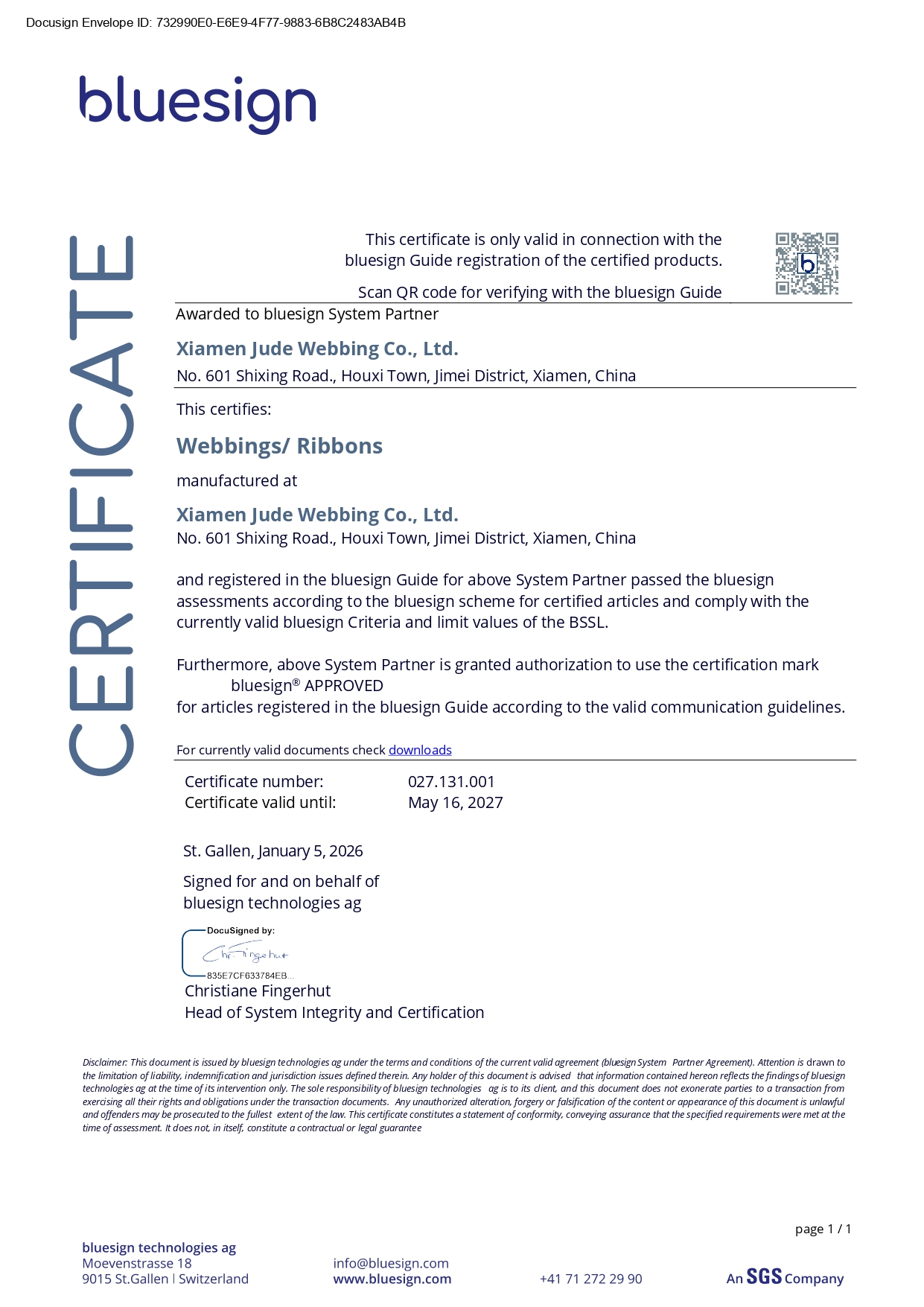
A scorecard that records validity dates will surface a second-order risk that price comparisons never do: certificates renew on their own cycle. A GRS certificate, for example, carries a defined validity period, and the buyer's question at renewal is not whether the supplier was certified but whether the certification covering the specific recycled SKU is current at the time of shipment.
4. Production Control That Keeps Delivery Predictable
Delivery reliability is rarely a logistics problem. It is usually a production-control problem that appears downstream as a logistics problem. The scorecard should therefore look at how the supplier inspects and stabilises output, not only at how much it can theoretically produce.
Documented positions in this category include a monthly capacity of approximately 25,000,000 yards, a quoted lead time of 7–25 days depending on order size and customisation detail, and a 100% quality check regime supported by a stable quality-control system, durability testing, colour-consistency control, and material inspection. Those are meaningful inputs, but they are inputs. A buyer scoring this line should also request the outputs: rejection rates, rework frequency, and on-time delivery history for orders comparable in complexity to their own.
Capacity is worth interrogating as well. A monthly figure describes total plant throughput; it does not describe the share available to a given customer during peak season. The renewal conversation should establish committed capacity, not nominal capacity.
5. Partner Mechanics: What Makes the Relationship Cheap or Expensive to Run
The final line is commercial rather than technical, and it is the one that most often decides whether a renewal feels smooth or exhausting.
OEM and ODM scope. A partner that can develop construction, colour, and finishing against an application brief reduces the number of suppliers a brand has to coordinate. In this range, OEM and ODM services cover design customisation and branding support, with custom materials including nylon, nylon 66, PA, polyester, PES, recycled yarn, and RPET, plus custom colours, patterns, width, thickness, softness, UV resistance, water-repellent finishing, and eco-friendly options.
Value-added operations. Precision cutting, punching, sewing, and finished-product assembly for straps, belts, and gear components change the inbound logistics of a factory. A brand that receives cut and punched straps does not need a separate converting step. The scorecard should confirm whether those operations are in-house or subcontracted, because subcontracting reintroduces a quality hand-off.
Acceptance inspection. Counter-sample matching plus functionality testing tied to recognised methods — UV grade, water repellency, tensile strength — gives the buyer a defensible acceptance protocol rather than a visual judgement at goods-in.
After-sales behaviour. The documented position is responsive customer service, product consultation, customisation support, and fast feedback on quality issues with a long-term cooperation orientation. At renewal, buyers should test this with a real claim rather than a questionnaire.
MOQ and trial orders. Custom webbing is quoted at 3,000 metres per colour per specification, with binding tape at 5,000 metres per colour per specification. Flexible MOQ is available for trial orders, and free samples are offered for existing stock items. For an emerging brand, the trial-order route is the difference between being able to test a supplier and being locked out of one.
Payment and Incoterms. Commercial terms such as T/T 30/70 or confirmed L/C at sight, combined with FOB, CIF, DAP, or DDP arrangements, determine landed cost and cash-cycle exposure. These should be confirmed in writing at renewal rather than inherited from an old quotation.
Reading the Scorecard Per Product Family, Not Per Supplier
One of the practical lessons from certified outdoor webbing is that a single supplier can hold genuinely different performance positions across its range. Scoring the supplier as a whole hides that variation.
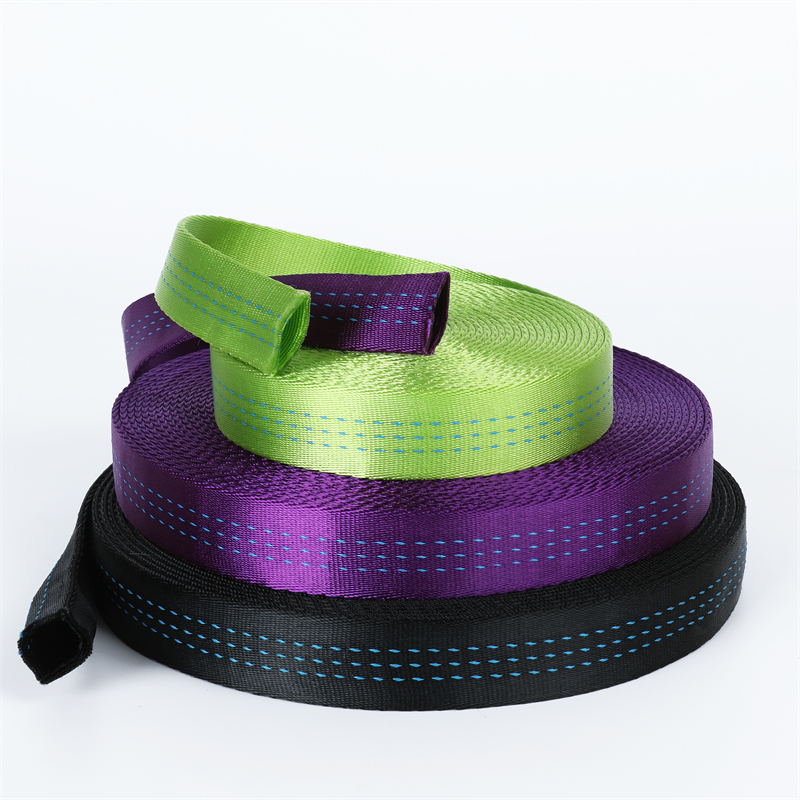
Tubular webbing, used for climbing slings, rescue harnesses, slacklines, and professional pet leashes, is documented at 15 kN–25 kN breaking strength across widths of 10 mm to 25 mm, with a seamless circular hollow weave for knotting and abrasion performance that exceeds CE/UIAA standards, having passed UIAA certification through a European testing agency via a brand customer. Stroller webbing is documented at more than 10,000 buckle cycles in fatigue testing, with rounded edges for infant skin protection and OEKO-TEX Standard 100 Class 1 certification. Aramid webbing sits in a different category again, with decomposition at 450°C+ and flame-retardant performance tested to ISO 3795 and FAA FAR 25.853.
On the application side, documented programmes show what continuity looks like in practice. One outdoor gear brand in Germany, Switzerland, Sweden, the United Kingdom, Finland, Poland, Norway, Estonia, the Netherlands, Vietnam, and Malaysia uses more than 300,000 metres per year in modular backpacks and expandable carrying systems, with a 2–3 year service window and reported outcomes around modularity, lightweight construction, and durability under repeated use. A second global outdoor brand, supplying bags and cooler bags, uses more than 1,000,000 metres annually across outdoor backpacks, cooler bags, and travel gear, with a 2–4 year service window and reported results on recycled content, UV resistance, colour fastness, and water-repellent finishing.
Those are the kinds of references a renewal scorecard should be asking for: volumes, durations, application type, and the specific attributes that survived contact with real use.
Where the Scorecard Stops Being Useful
A scorecard is a decision aid, and it has real limits that buyers should recognise before treating a high score as a guarantee.
It cannot substitute for physical validation. Documented grades, certificate numbers, and test reports describe controlled conditions. A brand still has to run its own counter-sample comparison, its own sewability trial, and its own finish-compatibility test, because webbing behaviour changes once it is cut, sewn, washed, and tensioned inside a finished product.
Certificate scope is narrower than certificate existence. A management-system certificate covering the design and processing of functional webbing does not, by itself, certify a specific new colourway or a newly developed construction. Similarly, a recycled-content certification attaches to defined products and requires transaction certificates to trace a specific shipment. Buyers who score “certified: yes” without checking scope will eventually be surprised.
It measures the supplier, not the downstream chain. Colour drift observed by an end consumer can originate in the brand's own cut-and-sew partner, in washing instructions, or in retail lighting. A webbing manufacturer can control its dyeing and finishing output; it cannot control what happens after the roll leaves the loading dock. The scorecard should be honest about that boundary, because a supplier held responsible for downstream variables will either over-promise or disengage.
Market Context: Why Continuity Is Being Priced In
The commercial backdrop explains why long-term supplier evaluation has become more structured rather than less. The global webbing market was valued at approximately USD 4.86 billion in 2026 in commercial market research, with Asia Pacific accounting for 66.3% of revenue share in 2023 — a concentration that makes supplier concentration risk a live question for North American and European brands.
Sustainability certification has moved from a differentiator to a procurement input. Bluesign system partners reported a 17% intensity reduction in CO2 emissions in 2024, and the same commercial research that tracks the market notes a 5–12% price premium for Bluesign-certified fabric over equivalent non-certified fabric. That premium is now a line item in the cost model, which means certificate continuity has a direct budget consequence at renewal.
None of this makes certification the whole story. It makes it a scored line rather than a marketing paragraph.
Future Outlook
Three shifts are likely to shape how outdoor webbing partnerships are evaluated over the next few seasons.
First, colour and performance data will become expected deliverables rather than negotiation points. Brands that already request batch-level colour records and full test reports are setting the benchmark; suppliers that can produce them routinely will win renewals on evidence rather than on price.
Second, recycled and certified substrates will be evaluated on their own performance positions rather than as substitutes for virgin material. The documented differences between polyester at grade 4.5 after 500 hours and backpack or camping constructions at grade 4.5 after 1000 hours show why. As recycled content expands across product families, the scorecard will need substrate-specific lines rather than a single sustainability tick.
Third, certificate lifecycle management will move into procurement systems. Tracking validity dates, scope, and transaction certificates manually does not scale across multiple programmes and markets, and the brands that automate it will avoid the seasonal scramble that currently accompanies renewal.
Frequently Asked Questions
What should an outdoor webbing supplier scorecard contain?
A practical scorecard covers five dimensions: colour consistency across batches, weathering evidence tied to a stated test method and exposure duration, compliance lifecycle including certificate scope and validity, production and delivery control including inspection regime and capacity, and partner mechanics such as OEM/ODM scope, value-added operations, MOQ, and payment terms. Each line should record the evidence obtained and what remains unverified, rather than a single pass or fail.
How can batch-to-batch colour consistency be demonstrated?
Colour consistency is demonstrated through production data rather than a single approved sample. The buyer and supplier agree a ΔE tolerance, commonly set below 1.0 for consecutive batches, and the supplier reports measured values per dye lot against a retained counter-sample. Colour-fastness test reports, such as the SGS report SL82108291350601TX tested to AATCC 186 and ISO 105, address how a shade responds to light and washing, but they do not replace batch-level consistency records.
What UV testing is sufficient for outdoor webbing?
Sufficiency depends on the intended service life, and the scorecard should compare like with like. A statement should always include the test method, the exposure duration, and the grade achieved. Documented examples in certified outdoor webbing include polyester webbing at UV fastness grade 4.5 after 500 hours under ISO 105, RPET webbing at grade 4 after 500 hours, recycled webbing at grade 4–5 under AATCC 16.3, and backpack and camping webbing at grade 4.5 after 1000 hours under ISO 105. Shorter exposure periods support shorter service expectations.
Which certificates should a buyer verify before renewing a webbing supplier?
Buyers should verify certificate number, issuing body, scope, applicable market, and validity date for each document relevant to the product. In certified outdoor webbing this typically includes Bluesign System Partner status, GRS and Content Claim Standard documentation for recycled products, OEKO-TEX Standard 100 where skin contact or juvenile applications apply, RoHS where EU electronics-adjacent compliance is relevant, and ISO 9001, ISO 14001, and ISO 45001 management-system certificates covering the design and processing of functional webbing. A certificate that exists but does not cover the specific SKU or market does not resolve the compliance question.
What MOQ and lead time apply to custom outdoor webbing?
In this range, custom webbing is quoted at 3,000 metres per colour per specification, with binding tape at 5,000 metres per colour per specification. Flexible MOQ is available for trial orders, and free samples are offered for existing stock items. Quoted lead time runs 7–25 days depending on order size and customisation detail, supported by a monthly capacity of approximately 25,000,000 yards. Buyers should confirm committed rather than nominal capacity during peak season, and should confirm payment structure and Incoterms in writing at renewal.
The Renewal Question, Restated
Renewing an outdoor webbing partnership is not a vote of confidence in a supplier's brochure. It is an assessment of whether the evidence behind that supplier — the colour records, the exposure data, the certificate windows, the production controls, and the commercial mechanics — is still current and still relevant to the products the brand intends to build next season.
A scorecard makes that assessment repeatable. It also makes the limits visible: a supplier can document what it controls, and a brand still has to test what its finished product will experience. Programs that hold both facts at once tend to renew well, and to re-source for the right reasons rather than the loudest one.
¿Tiene preguntas o necesita más detalles?
Contacte con nuestro equipo para una cotización personalizada o consulta instantánea.
Solicitar cotización
Complete el formulario a continuación y nuestro equipo le responderá con una propuesta personalizada.
Chat directo de WhatsApp
¿Prefiere chatear en tiempo real? Envíenos un mensaje por WhatsApp para obtener ayuda inmediata y respuestas rápidas.
- Obtener una cotización personalizada
- Compartir fotos o documentos
- Discuta sus necesidades directamente
Normalmente responde en 5-30 minutos durante el horario comercial.