
Outdoor Landscape Lighting: What the Spec Sheet Must Prove
Procurement Reference · Outdoor Landscape Lighting
Outdoor landscape lighting is bought twice: once as a design idea, and once as a specification. Only the second purchase can be tested. A luminaire that reads well in a courtyard render still has to survive rain exposure, irrigation overlap, ground moisture, temperature swing and, in a rising share of projects, the complete absence of a mains connection.
For buyers moving from research into evaluation, the decisive question is narrower than which fixture looks right. It is: which parameters in the specification sheet can be verified, against which standard, and by which document, before a purchase order is signed? This reference sets out the constraint stack that governs outdoor landscape lighting procurement — ingress protection, certification files, electrical and optical parameters, solar sizing, and supply terms — and explains how each constraint changes the buying decision rather than the brochure.
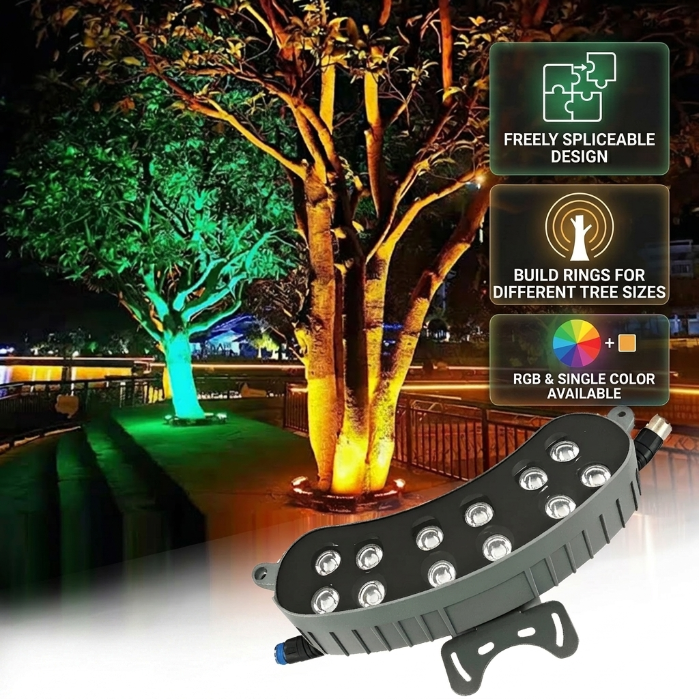
Outdoor landscape lighting is judged at night, but it is selected on parameters: protection level, colour rendering, voltage and control protocol.
Why the specification, not the render, decides the project
A landscape lighting scheme is a system of environmental constraints before it is a visual composition. The installation environment sets the floor: a villa courtyard in Germany is described as sun and rain exposed with a wiring-free requirement; a municipal road project in South Africa is described as open-air, weather resistant and high-lumen; a bridge and municipal project in Vietnam is described as wind and moisture resistant with an impact-resistant requirement; a commercial real estate facade in Azerbaijan is described as exposed to both high and low temperatures with a low-voltage safety requirement.
Those are four different procurement problems, and each one eliminates a different set of fixtures. When the constraint stack is applied after the design is fixed, the specification gets bent to fit the preferred product instead of the site. That inversion is the most common structural weakness in landscape lighting purchasing, and it usually surfaces in only three places: water ingress at cable entries, premature dimming of solar fixtures in low-light weeks, and a certification file that does not match the destination market at handover.
Moving the constraints forward does not slow procurement down. It converts a subjective comparison of catalogues into a checklist that several suppliers can be scored against on identical terms, which is precisely the point at which evaluation becomes efficient.
The constraint stack: nine parameters that must be locked
A constraint, in procurement terms, is any parameter that stops the installation from performing if it fails. In outdoor landscape lighting, nine parameters carry that weight.
| Parameter | What it constrains | Why it is verified before the PO |
|---|---|---|
| IP rating | Dust and water ingress | Decides survival under rain, irrigation and soil moisture |
| IK rating | Mechanical impact | Relevant where fixtures sit in walked, pruned, driven or cleaned areas |
| CRI (Ra) | Colour fidelity of planting, stone and facade material | Specified wherever the design depends on material appearance at night |
| Colour temperature | Scene character and batch consistency | Mixed CCT across one scheme is visible after installation |
| Luminous efficacy | Power budget, driver sizing, cable planning | Converts wattage into delivered light before installation is priced |
| Input voltage | Safety class, driver choice, wiring method | DC24V and AC110-220V are different installation regimes |
| Control method | Dimming, scenes, synchronisation | ON/OFF, DMX512, remote and app control are not interchangeable |
| Panel and battery (solar) | Runtime and autonomy | Determines whether the fixture holds output through cloudy days |
| Certification file set | Market access and liability | A missing or mismatched file blocks clearance and handover |
Each of these is a pass-or-fail item, not a preference. A CRI value below what a scheme requires cannot be corrected by adding fixtures, and an IP rating below the installation zone cannot be corrected by sealing the joint on site.
IP ratings, mapped to real installation zones
The IP code carries two digits: the first (0–6) rates dust protection and the second (0–8) rates water protection, verified through standard ingress testing. For general outdoor exposure, IP65 or above is the usual recommendation; IP67 suits short-term immersion, and IP68 suits continuous underwater use.
The practical value of this scale appears when it is mapped to project conditions rather than to product categories. The table below reproduces the protection levels that appear in documented field scenarios.
| Installation zone | Documented working condition | Protection specified |
|---|---|---|
| Villa courtyard | Outdoor garden, sun and rain resistant | IP65, wiring-free |
| Theme park and cultural tourism project | Outdoor open-air, rainproof, anti-aging | IP65 |
| Municipal road project | Outdoor open-air, weather resistant | IP66, high lumen |
| Bridge and municipal project | Outdoor open-air, wind and moisture resistant | IP66, impact resistant |
| Garden and cultural landscape | Outdoor open-air, weather resistant | IP67, anti-corrosion |
| Commercial real estate facade | Outdoor open-air, high and low temperature | IP68, low-voltage safety |
Read across the table and the purchasing logic becomes clear. IP65 is the working baseline for decorative and pathway-level applications. IP66 appears where lumen output is high and the fixture is pole-mounted and fully exposed. IP67 appears where corrosion resistance and ground-level moisture are both present. IP68 belongs to continuous-immersion and low-voltage facade work, which is a different product architecture, not an upgraded seal.
Certifications: the documents that must exist before the PO
Certification is the part of the specification sheet most often requested late and read least closely. For outdoor landscape lighting, the relevant file set divides into three layers.
Market access and product safety
CE and CE-RoHS for the European Union, UKCA for Great Britain, FCC for the United States. Battery-powered solar fixtures add transport documentation: UN38.3 test reports and a Safety Data Sheet. Suppliers serving multiple regions typically hold several of these in parallel; the smart lighting range from Light Legend, for example, is listed with CE, FCC, RoHS, UKCA, FCC-ID, GCC, UL4200A and UL588.
Electromagnetic compatibility evidence
For mains-connected fixtures, the EMC file is where projects are most often caught out. A compliance certificate for the outdoor wall light range, certificate number TST25231600579EC, is issued by Dongguan True Safety Testing Co., Ltd. against EN IEC 55015:2019/A11:2020, EN IEC 61547:2023, EN IEC 61000-3-2:2019+A1:2021+A2:2024 and EN 61000-3-3:2013+A1:2019+A2:2021.
Two details in that document matter to buyers. First, the certificate states that it applies only to the submitted samples and does not represent an assessment of the entire production batch; it must be read together with the corresponding test report, TST25231600579ER. A specification sheet that references a certificate number without the matching test report is incomplete. Second, the standard list tells the buyer which directive logic was applied, which is the detail an electrical authority or a consultant will ask for.
Factory and process management
Management system certificates are a different kind of evidence: they describe the process that produces the batch rather than the batch itself. Light Legend holds ISO9001, ISO14001, BSCI and C-TPAT, alongside a laboratory setup used for product verification. The company also states High-tech Enterprise and Science and Technology Innovation Little Giant Enterprise recognition in 2018.
Electrical and optical parameters that change the outcome
Two fixtures can look identical and behave differently in service once voltage, efficacy, beam angle and control method are compared. The table below summarises published parameter sets across the landscape families.
| Family | Power / output | Protection | Parameter that decides selection |
|---|---|---|---|
| Solar lighting (DS016, DS1316, DSL08, DSL09, DS-B-SPL) | 1000LM / 50LM sensor mode | IP65 | Panel 6V 500mA, battery 2 × 3.7V 2200mAh, charging above 5H, runtime above 8H |
| Pathway lights (DS001–DS1218) | 100LM | IP65 | Low profile, low glare, warm light or RGB |
| Outdoor wall lights (DSL018–DS-B03) | 80LM | IP65 | PIR motion sensor, two lighting modes |
| Wall washer (ALT-F56–ALT-R42E) | 6W–72W | IP66 | 138 lm/W, Ra ≥ 80, DC24V or AC220V, 24×45 or 10×60 beam |
| LED inground (ALT-DM120–ALT-DM260) | 6W–36W | IP67, IK09 | 138 lm/W, Ra ≥ 80, 26/32/52/60 beam, 30,000 hour lamp life |
| Flood lights (KUPU-YT65–KUPU-YT200) | 6W–96W | IP65 | 160–180 lm/W, 15/30/45/60 beam, DMX512 available |
| Tree lights (KUPU-YT130–KUPU-YT140) | 12W–140W | IP65 | 160–180 lm/W, adjustable beam for tall arbors or low shrubs |
| Street lights (KUPU-LD30–KUPU-LD300) | 30W–300W | IP66 | 160–180 lm/W, power factor ≥ 0.95, 150×75 lens angle |
| Smart lighting (HCP series) | 18W / 36W / 54W / 72W | IP67 | CRI ≥ 95, Bluetooth or Wi-Fi, group control and scenes |
Three comparisons inside that table are worth slowing down for.
Efficacy against power budget. Wall washer and inground ranges are published at 138 lm/W with CRI Ra ≥ 80, while flood, tree and street ranges are published at 160–180 lm/W with Ra ≥ 70. The higher-efficacy group delivers more light per watt; the higher-CRI group preserves material appearance. A scheme that specifies Ra ≥ 80 across the facade and Ra ≥ 70 for roadway is making a deliberate trade, not a compromise.
Voltage against installation regime. DC24V appears on wall washer and inground families, AC110-220V on wall washer, flood, tree and street families, and 24V on the smart range. Low-voltage safety requirements change the driver, the cable and the approval path, so voltage belongs in the first version of the specification, not in the revision after tender.
Control against scene design. ON/OFF, DMX512, remote control and Bluetooth or Wi-Fi app control appear across the ranges. A scheme that needs synchronised colour change requires DMX512 in the flood, tree and wall washer families; a scheme that needs scene recall and group control requires the smart range. Specifying one and installing the other is unrecoverable without replacing hardware.
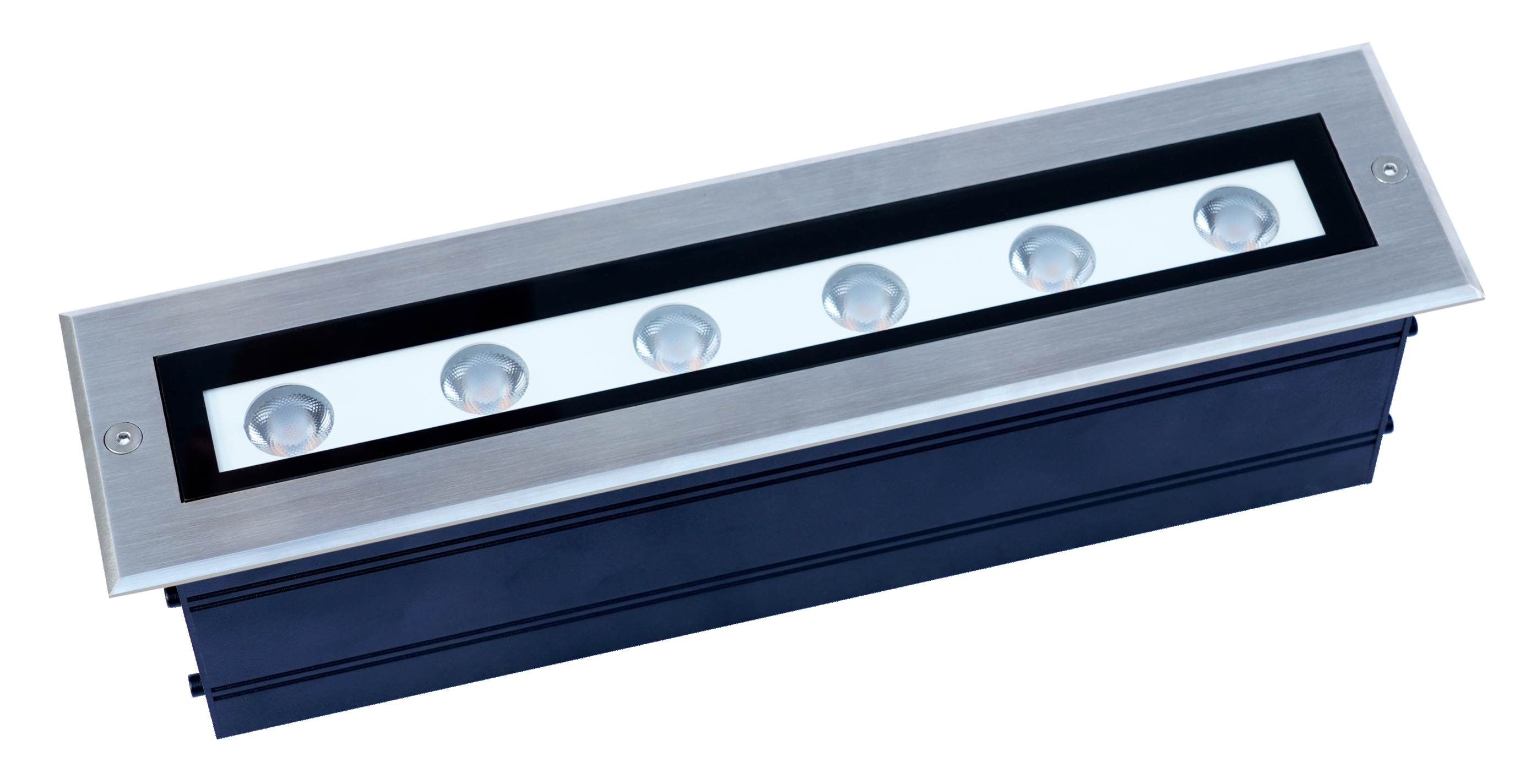
Ground-level fixtures carry the harshest constraint combination: IP67 ingress protection plus IK09 impact resistance, with die-cast aluminium and stainless steel construction.
Solar-specific constraints: panel, battery and honest runtime
Solar landscape lighting introduces a second constraint stack that has nothing to do with lumens. A solar fixture is an energy system: panel, battery, controller and light source sized against local sunlight.
A solar outdoor landscape fixture in the Light Legend range is documented as follows: a 6V 500mA monocrystalline silicon PET laminated panel, two 3.7V 2200mAh lithium 18650 batteries, IP65, ABS plus PC housing, 1000LM in normal mode and 50LM in sensor mode, white, warm or RGB colour temperature, more than 5 hours of solar charging and more than 8 hours of working time. The pathway range runs a 5V 300mA panel with a 3.7V 2200mAh battery at 100LM, and the outdoor wall range runs a 5V 250mA panel with a 1200mAh battery at 80LM, offering more than 4 hours at high output or more than 8 hours in always-on mode.
Those figures are the actual procurement content. A 500mA panel and a 2200mAh battery describe a different autonomy class from a 250mA panel and a 1200mAh battery, and the difference shows up in the third consecutive overcast week, not on the first night of commissioning. Buyers comparing solar quotes should ask for panel current, battery capacity and stated working time on one line of the specification, and should treat any quotation that omits all three as unverified.
From specification to supply terms
The constraint stack does not end at the product. Supply terms determine whether the specified product can actually be delivered into the project schedule.
| Supply mode | MOQ | Lead time | Monthly capacity | Customisation scope |
|---|---|---|---|---|
| ODM | 100 units | 10–20 days | 80,000 units | Voltage, logo, packaging, product |
| OEM | 500 units | 30 days | 20,000 units | Voltage, logo, packaging |
The distinction is not cosmetic. ODM allows product-level change at a 100-unit minimum with a 10–20 day lead time; OEM supports brand-level change but at a 500-unit minimum and a 30-day lead time. A buyer planning a pilot courtyard installation and a buyer replacing a distributor assortment are therefore working to different supply constraints even when the fixture specification is identical. Both modes run 100% testing, and both are backed by remote after-sales support.
Manufacturing scale behind those terms is documented at an 8,000 m² production park with more than 200 employees, including a 20-person engineering and design team, an annual output of 4,200,000 pieces, more than 100 independent patents and more than 4,000 successful cases. Roughly 80% of output is exported to Europe, America, Asia, Africa and Latin America.
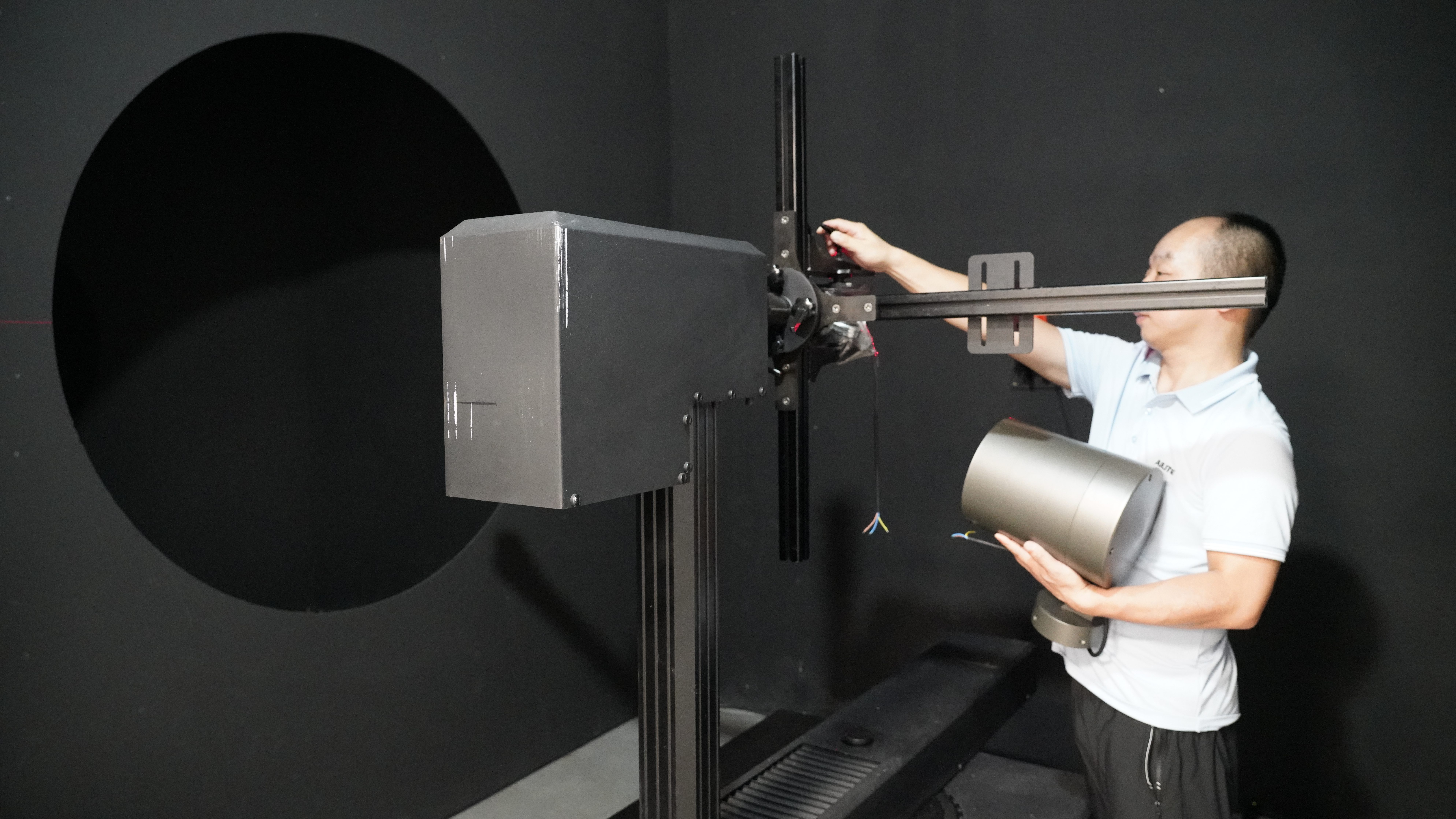
Photometric and ingress verification in the inspection workshop is the evidence layer behind a specification sheet, not a marketing step.
Where the constraints meet real installations
Field records show how the constraint stack resolves in practice, and each record isolates a different parameter.
- Azerbaijan, government procurement: 1,540 units of the ALT-R38 wall washer deployed for wall flood lighting and night decoration, running stably for one year. The governing constraint was public-works durability under a formal tender.
- South Africa, agent: 5,000 units of KUPU-LD300 for road illumination, stable for four years. The governing constraint was high-lumen output at IP66 in volume.
- Vietnam, distributor: 480 units of KUPU-YT120 for long-range projection and contour lighting, stable for five years in a tropical climate with no reported performance drop. The governing constraint was corrosion and humidity resistance.
- South Korea, project manager: 860 units for tree and landscape accent lighting, stable for three years. The governing constraint was optical quality at the tree canopy.
- Germany, agent: a 50-unit pilot of DSL018 and DS129 garden lights, stable for two years. The governing constraint was acceptance under strict European market requirements.
- Romania, retailer: 200 units of G40 and HCP182 ambient lighting, stable for one year. The governing constraint was fast assortment launch rather than durability.
Read as a set, the records map onto the table earlier in this article: government tender, high-lumen roadway, tropical humidity, canopy optics, European market acceptance and retail speed are six different constraint profiles, and each one pulled a different product family into the specification.
Comparison with conventional mains-fed lighting — and where solar stops
Solar landscape lighting is often presented as a universal replacement for wired installation. It is not, and the boundary is visible in the published parameters.
Where solar wins on constraint. Solar fixtures remove the wiring constraint entirely: no trenching, no mains connection, no electricity cost at the fixture, automatic dusk-to-dawn switching by light sensor, and continued battery operation through cloudy periods. For villa courtyards, remote parks, farms and off-grid projects, that removes the single largest installation cost and the largest permitting delay.
Where solar stops. The solar ranges documented here are published at 1000LM with 50LM sensor mode, 100LM for pathway and 80LM for wall applications. The mains-fed street light range, by contrast, runs from 30W to 300W at 160–180 lm/W. A solar fixture cannot substitute for a high-lumen roadway luminaire at that output level, and any proposal claiming otherwise should be treated as a specification error rather than a bargain. Two further boundaries apply: solar output is reduced in low-light conditions and in winter, because brightness and runtime depend on charging; and the published protection sets in this article top out at IP67 for the inground and smart ranges, so a project requiring IP68 continuous immersion needs explicit confirmation rather than an assumption.
Where wired wins on control. DMX512 synchronisation across flood, tree and wall washer families is a mains-oriented capability. Scene-level synchronised colour change across a large facade remains a wired architecture in the current parameter sets.
The practical conclusion for evaluation is a split specification, not a single technology: solar for path, garden, wall and remote applications within its output class; mains-fed fixtures with the appropriate IP and control protocol for roadway, facade and synchronised architectural work.
What changes next in outdoor landscape lighting procurement
Three directions are already visible in documented product parameters, without requiring a forecast.
Control moves into the fixture. The smart lighting range supports app and remote control, dimming and colour tuning, timing and scene modes, group control and, on some models, smart gateway integration with broader building systems, plus RGB and RGB plus IC effects at CRI ≥ 95. As control becomes a fixture-level parameter, the specification sheet will need a control column next to the IP column.
Energy management becomes a stated function. Dimming as needed to reduce power consumption is now listed as a capability rather than a feature flourish. For municipal and commercial buyers, that shifts part of the evaluation from first cost to operating profile.
Compliance breadth becomes a supplier filter. Holding CE, FCC, RoHS, UKCA, FCC-ID, GCC, UL4200A and UL588 in one product family means a supplier can serve several markets from one production line. Buyers benefit, but they also inherit the obligation to check that the certificate on file matches the exact model and destination market.
A fourth direction is quieter but more consequential: as landscape schemes move toward layered, low-glare and material-sensitive design, CRI and beam control gain weight relative to raw wattage. That change favours buyers who specify Ra and beam angle early, and disadvantages those who compare catalogues by wattage alone.
Frequently asked questions
What IP rating does outdoor landscape lighting need?
The IP code has two digits: the first (0–6) rates dust protection and the second (0–8) rates water protection. For outdoor exposure, IP65 or above is generally recommended. IP67 suits short-term immersion and IP68 suits continuous underwater use. In documented field scenarios, villa courtyards and theme park projects specify IP65, municipal road and bridge projects specify IP66, garden and cultural landscape projects specify IP67, and commercial real estate facade work specifies IP68 with low-voltage safety.
Which certification documents should a landscape lighting supplier provide?
The expected file set is CE and CE-RoHS for the European Union, UKCA for Great Britain and FCC for the United States, plus UN38.3 test reports and a Safety Data Sheet where lithium batteries are used. Mains-connected fixtures additionally require EMC evidence: one compliance certificate for the outdoor wall light range, number TST25231600579EC issued by Dongguan True Safety Testing Co., Ltd., references EN IEC 55015:2019/A11:2020, EN IEC 61547:2023, EN IEC 61000-3-2 and EN 61000-3-3, and must be read together with test report TST25231600579ER because it applies only to the submitted samples.
How should buyers compare runtime claims for solar landscape lights?
Ask for three values on one line of the specification: solar panel current and voltage, battery capacity, and stated working time. A documented example is a 6V 500mA monocrystalline panel with two 3.7V 2200mAh lithium batteries, more than 5 hours of charging and more than 8 hours of working time at 1000LM with a 50LM sensor mode. A pathway fixture with a 5V 300mA panel and 2200mAh battery is rated at 100LM, and a wall fixture with a 5V 250mA panel and 1200mAh battery is rated at 80LM. Output and runtime are reduced in low-light conditions and in winter.
What MOQ and lead time apply to OEM and ODM landscape lighting orders?
In the documented Light Legend supply terms, ODM orders start at 100 units with a 10–20 day lead time and a monthly capacity of 80,000 units, covering voltage, logo, packaging and product customisation. OEM orders start at 500 units with a 30-day lead time and a monthly capacity of 20,000 units, covering voltage, logo and packaging. Both modes run 100% testing and are supported by remote after-sales service.
What CRI is required for landscape lighting, and how does it affect the specification?
CRI is measured from 0 to 100 and indicates how accurately a light source reveals true colour. CRI 80 and above is standard for general outdoor use, and CRI 90 and above is preferred where colour fidelity matters, such as gardens, facades and signage. In the Light Legend ranges, wall washer and inground families are published at Ra ≥ 80, flood, tree and street families at Ra ≥ 70, and the smart lighting range at CRI ≥ 95. The value should be confirmed in the specification sheet before ordering.
How can a buyer tell whether a fixture will hold up at ground level?
Two parameters answer that question for fixtures installed in the ground or in hardscape: ingress protection and impact resistance. The LED inground range is published at IP67 with an IK09 impact rating, DC24V input, Ra ≥ 80, a 30,000 hour lamp life and a three-year warranty, in a housing combining die-cast aluminium, 6063 extruded aluminium, 304 stainless steel and 8mm tempered glass. A specification that lists only the IP rating omits half of the constraint.
Reference material
For buyers who need the full range picture rather than the constraint framework, the Light Legend solar decorative garden light catalogue covering the solar and decorative landscape families is available as a downloadable PDF catalogue.
¿Tiene preguntas o necesita más detalles?
Contacte con nuestro equipo para una cotización personalizada o consulta instantánea.
Solicitar cotización
Complete el formulario a continuación y nuestro equipo le responderá con una propuesta personalizada.
Chat directo de WhatsApp
¿Prefiere chatear en tiempo real? Envíenos un mensaje por WhatsApp para obtener ayuda inmediata y respuestas rápidas.
- Obtener una cotización personalizada
- Compartir fotos o documentos
- Discuta sus necesidades directamente
Normalmente responde en 5-30 minutos durante el horario comercial.