
Outdoor LED Billboards: Why Supplier Capability Decides Longevity
An outdoor LED billboard is purchased in a procurement cycle measured in weeks and then operated for years in rain, dust, heat, and direct sunlight. That mismatch is the reason the supplier's design, manufacturing, and service decisions — not the purchase price alone — determine how the screen behaves after year two.
Outdoor fixed LED display is a permanent infrastructure category rather than an event product. It is specified into building facades, storefronts, transportation hubs, gas stations, sports venues, and public information sites, and it operates continuously once commissioned. In this category, long-term reliability is not a single specification. It is the combined result of cabinet and sealing design, brightness headroom, module-level serviceability, production consistency, and the supplier's ability to keep supporting the screen long after delivery.
1. The Failure Modes That Trace Back to the Supplier
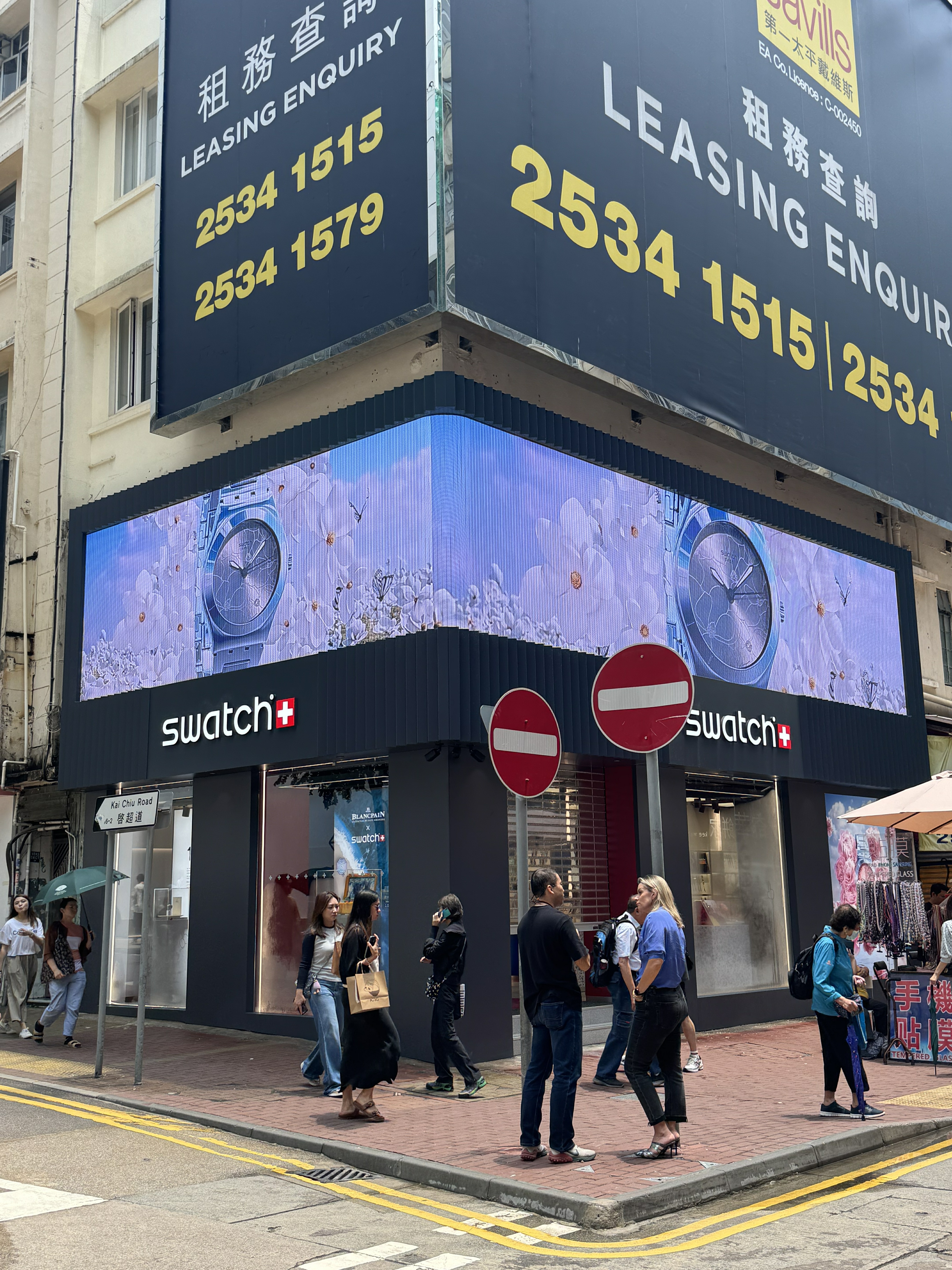
Most early outdoor failures are not random. The dominant risks for outdoor LED displays in rainy or humid environments are water ingress, moisture-related electrical faults, corrosion, short circuits, and reduced component reliability. These risks surface during heavy rain, high humidity, poor drainage, damaged waterproof seals, improperly protected cable connections, or long-term exposure to harsh weather.
Each of those triggers is decided long before installation:
- Sealing and cabinet structure — whether cabinet, module, and cable entries are engineered as one system rather than assembled from parts with different assumptions.
- Drainage and ventilation — whether the installation design accounts for where water goes and how heat leaves the enclosure.
- Service access — whether a failed module can be replaced from the front, from the rear, or not at all without dismantling the structure.
- Pre-shipment verification — whether waterproof performance and electrical safety were actually tested before the container left the factory.
None of these appear in a price-per-square-meter quotation. All of them appear in the maintenance log of year three.
2. Defining Supplier Sustainability for a Fixed Outdoor Installation
For a permanent outdoor billboard, supplier sustainability can be assessed across four dimensions. This framework is useful because it converts a vague question — "is this supplier reliable long term?" — into verifiable checks.
| Dimension | What it covers | What a buyer can verify |
|---|---|---|
| Design intent | Whether the platform was engineered for permanent outdoor operation: brightness headroom, IP-rated enclosure, structural cabinet, fixed-installation mounting | Specification sheet; IP rating for front and rear; cabinet material, dimensions, and weight |
| Manufacturing consistency | Whether units delivered in month one match units delivered in year three | Production capacity, quality-control gates, aging and waterproof test records |
| Compliance durability | Whether the product family can be placed on the target market and remain compliant | Valid certificates and their scope: CE-EMC, CE-LVD, FCC-SDoC, EU RoHS 2.0, ISO 9001 |
| Service continuity | Whether the screen can be maintained without replacing the entire structure | Maintenance method, spare-parts supply, remote technical support, installation guidance |
A practical rule: any supplier claim about long-term reliability should map to one of these four dimensions. Claims that map to none of them tend to be marketing language rather than engineering information.
3. Technical Design Factors That Determine Outdoor Service Life
Outdoor fixed LED displays operate under conditions indoor products never face: direct sunlight, rain, dust, wind, high humidity, wide temperature range, and continuous 24/7 operation. The working requirements for outdoor advertising installations consistently reference high brightness for sunlight visibility, IP65 waterproof and dustproof protection, weather and corrosion resistance, efficient heat dissipation, energy-saving operation, high refresh rate, wide viewing angle, and easy maintenance access.
Brightness headroom
Outdoor fixed platforms are specified at high brightness levels: the FA Series, FC Series, and LUXIS Series are rated up to 10,000 nits, the NOVA Series at 5,000–6,000 nits, and the DIP Series at 8,000–10,000 cd/m². Brightness headroom affects longevity because a screen capable of 10,000 nits does not need to run at maximum output to remain legible in daylight; lower operating output generally means lower thermal load on LEDs and driver electronics.
Enclosure and protection
IP65 is specified for both front and rear on the FA, FC, LUXIS, and NOVA Series outdoor platforms. The relevant question is not the rating alone, but whether it is achieved by cabinet, module, and cable-entry design together. IP65 reduces ingress risk; it does not remove the need for periodic inspection of seals, connectors, modules, power supplies, and drainage paths — a point suppliers should state plainly rather than omit.
Refresh rate and drive stability
Refresh rate is usually discussed in relation to camera capture, but it also reflects the stability margin of the drive electronics. The DIP Series is specified at 3,840 Hz; the LUXIS and NOVA Series are specified at ≥7,680 Hz. Gray scale is 14-bit on the DIP Series and 14–16-bit on the NOVA and LUXIS platforms.
Serviceability at cabinet level
On a large-format billboard, the cost of an intervention is dominated by access — scaffolding, lifts, permits, and downtime — rather than by the module itself. Front and rear maintenance access is specified on the FA Series, FC Series, SPPLUS Series, and SPPro Series. Front-only or rear-only access constrains how the screen can be mounted and how quickly a fault can be cleared.
| Reference platform | Pixel pitch | Brightness | Enclosure / notes |
|---|---|---|---|
| Outdoor DIP LED Display (DIP Series) | P31.25–P15.6, P20, P25 | 8,000–10,000 cd/m² | Aluminum cabinet; 1,500 × 500 mm display panel; 8.8 kg; transmittance 35–59% |
| Outdoor Fixed LED Display (FA Series) | P4 / P5 / P6.67 / P8 / P10 | Up to 10,000 nits | IP65 waterproof & dustproof; front & rear maintenance; wall mount or steel structure |
| Outdoor Fixed LED Display (FC Series) | P2.976–P10 | Up to 10,000 nits | Full aluminum cabinet; IP65; front & rear maintenance |
| Outdoor Fixed LED Display (LUXIS Series) | P3.91–P10 | 10,000 nits | IP65 / IP65 (front / rear); ≥7,680 Hz; 500 × 500 mm and 960 × 960 mm cabinets at 8.5 kg and 26 kg |
| Lightweight Outdoor LED Display (NOVA Series) | P3.9 / P6.66 | 5,000–6,000 nits | 480 × 320 × 60 mm cabinet at 3.7 kg; IP65 / IP65; contrast ≥5,000:1 |
Two entries in this table read as structural signals rather than performance signals. The DIP Series uses a 1,500 × 500 mm display panel at 8.8 kg, and the LUXIS Series offers 500 × 500 mm or 960 × 960 mm cabinets at 8.5 kg and 26 kg. Those figures drive substructure design, lifting plans, and wind-load behaviour on a facade — factors that determine whether the screen is still correctly mounted five years later.
4. Manufacturing Consistency as a Reliability Variable
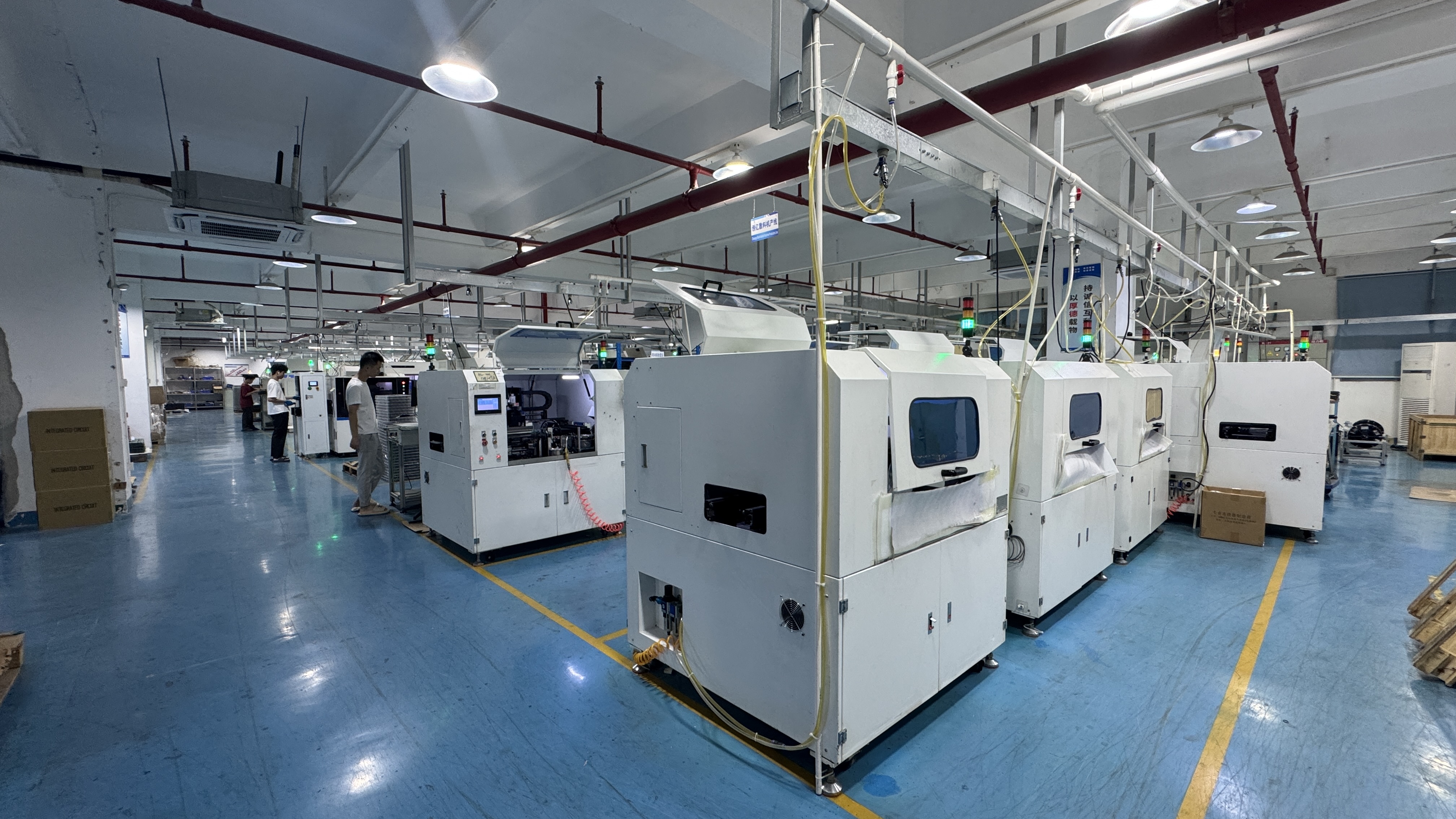
A billboard is not a single product; it is several hundred cabinets that must behave as one continuous surface for years. Consistency between production batches is therefore a reliability variable in its own right.
DDW DISPLAY (Shenzhen DDW Technology Co., Ltd.) is an LED display manufacturer founded in 2012, operating a 10,000 m² facility with more than 100 employees, a 15-engineer R&D team, and an annual output of more than 800,000 units. The company reports a monthly production capacity of 8,000 m² for LED displays, with a typical lead time of 15 to 30 days for standard products; customized projects depend on product design, quantity, and technical requirements. Deliveries to date cover more than 120 countries and regions, with an export ratio above 95%.
The quality-control sequence applied before shipment matters more to an outdoor buyer than the capacity figure: 100% product inspection, aging test, module testing, brightness and color calibration, waterproof test, power safety test, and performance inspection. For an outdoor installation, the waterproof test and the aging test address the two most consequential long-term failure paths.
Compliance documentation published for the LED display range includes:
- CE-EMC — certificate BKC25062531FC, EN 55032:2015+A11:2020+A1:2020, EN IEC 61000-3-2, EN 61000-3-3, EN 55035; issued 1 July 2025, valid to 1 July 2030; EU / EEA market.
- CE-LVD — certificate HXTS2506230030001-1, EN IEC 62368-1:2020 + A11:2020, Directive 2014/35/EU; issued 27 June 2025, valid to 27 June 2030.
- FCC Supplier's Declaration of Conformity — BKC25062532FC-R1, FCC Part 15 Subpart B, ANSI C63.4:2014; issued 1 July 2025, valid to 1 July 2030; USA market.
- EU RoHS 2.0 — certificate HXTS2506230030007-1, Directive 2011/65/EU as amended by EU 2015/863/EU; issued 27 June 2025, valid to 27 June 2030.
- ISO 9001 — certificate 12824Q21369R0S, GB/T 19001-2016 / ISO 9001:2015, covering production of electronic products (LED display, LCD video wall, digital signage) for export; issued 12 May 2025, valid to 9 October 2027.
For buyers, the practical test is not whether certificates exist but whether the certificate scope and validity match the model being purchased and the market where it will be installed. Documentation issued for a different product family, or expiring mid-project, creates compliance exposure that no product specification can offset.
5. Large-Format Installations: What Changes at Scale
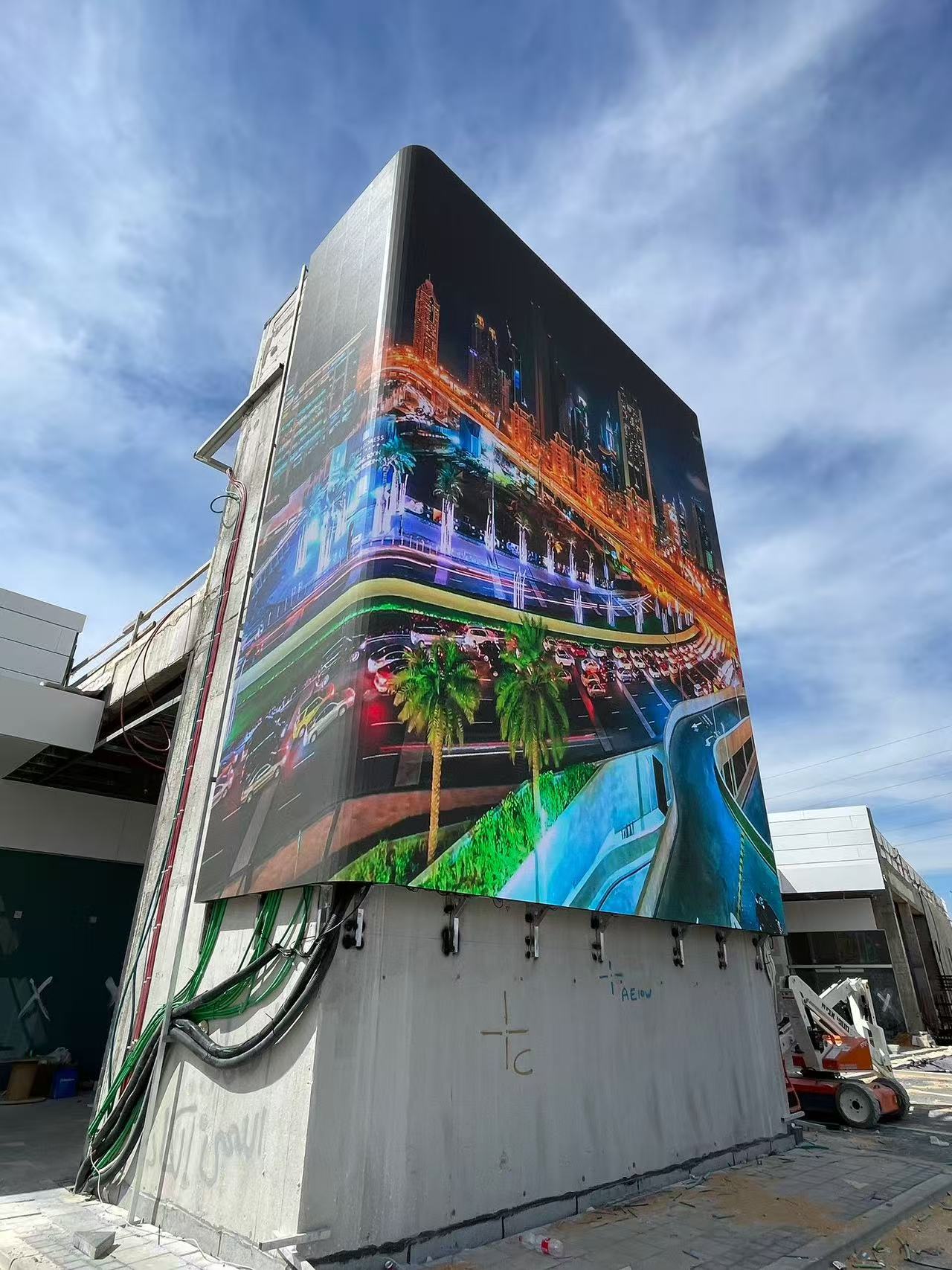
Large-format outdoor projects shift the weighting of every criterion. A 40 m² or 48 m² curved screen has more cabinets, more seams, more cable entries, and more points where water can find a path — and a much higher cost of access when something fails.
Curved and ultra-wide configurations add further complexity: cabinet structure, module layout, and mounting frame must produce a continuous surface while still allowing individual modules to be replaced. Customization scope on this range covers pixel pitch, module size, cabinet size and structure, display shape, brightness level, refresh rate, installation method, control system, logo branding, color calibration, power solution, and mechanical design — which is why non-standard formats move a project into engineering review rather than catalogue selection.
Scale also changes procurement economics. Custom cabinet designs, larger structural frames, and non-standard screen dimensions all shift a project from "standard product" to "customized project," which is precisely where lead time becomes project-dependent rather than fixed.
6. Maintenance and Service Continuity Over a Long Horizon
Over a decade of operation, the supplier relationship matters more than the initial specification sheet. The support scope offered across the LED display range includes remote technical support, installation guidance, troubleshooting support, product warranty service, spare parts supply, and professional engineering assistance.
Three of these link directly to outdoor longevity:
- Spare parts supply — module and driver compatibility must remain serviceable years after the original order, especially for custom cabinet formats that generic stock will not cover.
- Remote technical support and troubleshooting — on a fixed outdoor installation, remote diagnosis can establish whether a fault sits in a module, a power supply, a signal path, or a moisture issue before a service visit is scheduled.
- Installation guidance — for IP65 products, installation quality (cable sealing, drainage, connector protection) is part of the protection system itself.
Acceptance criteria should be agreed before shipment, not after delivery. Purchasing terms applied to this range include a minimum order quantity of 1 unit or project-based order, delivery terms of EXW Shenzhen, FOB Shenzhen, CIF, or DDP depending on destination and order requirements, and acceptance criteria covering pre-shipment inspection, aging test, display performance test, brightness and color consistency inspection, and customer video inspection or third-party inspection on request.
7. Application Evidence: Fixed Outdoor Installations in Practice
Delivered projects show how the criteria above translate into installed configurations, and how wide the format range is within one platform family.
| Project | Configuration | Relevant reliability dimension |
|---|---|---|
| Retail storefront, Colombia | 2 × 20 m, 40 m² FA Series P3.91 outdoor fixed LED display, curved, wall-mounted | Ultra-wide curved format on a retail facade; large-format structural design and IP65 fixed-installation platform |
| Commercial property / outdoor advertising, Iran | 6 × 8 m, 48 m² FC Series P3.91 outdoor fixed curved LED display | Permanent outdoor installation at scale; curved configuration with full aluminum cabinet |
| Commercial client, Norway | 3 × 3 m, 9 m² FC Series P3.91 outdoor fixed LED display | Standard-format permanent installation; smaller footprint with the same protection class |
| Retail storefront, Italy | 0.5 × 11 m, 5.5 m² FC Series P3.91 outdoor fixed LED display | Extreme aspect ratio storefront fascia; maintenance planning in restricted space |
| Parking facility, Austria | 5.12 × 2.56 m, approx. 13.11 m² FO Series P5 outdoor fixed LED display, pole-mounted | Pole-mounted outdoor installation; long-distance visibility and public information display |
A 2 × 20 m curved facade screen and a 0.5 × 11 m storefront fascia delivered from the same platform family is a useful signal in itself. It indicates that the cabinet and module system can be reconfigured rather than re-engineered per project, which is what keeps spare-part logistics manageable across a long service life.
8. Market Context: Where Outdoor Fixed LED Demand Is Moving
Mordor Intelligence projects the global LED display market at USD 20.73 billion in 2026, growing to USD 26.98 billion by 2031. That figure should be treated as directional. Published estimates differ substantially depending on whether "LED display" is counted as total large-format display or limited to direct-view LED signage, and the variance between sources for the same year is large enough that any single number should be checked against its underlying definition before it is cited in a business case.
Two adjacent signals are more specific. Mordor Intelligence places China's LED display market at RMB 660 billion in 2024 with a CAGR of 15.79%, above the global average — a reflection of how concentrated manufacturing capacity remains in that region. Separately, Grand View Research projects the Micro-LED segment growing at a CAGR of 77.4% between 2024 and 2030, a technology direction that affects fine-pitch and premium segments more directly than traditional large-format outdoor billboards, but one that shapes long-term platform roadmaps.
Energy efficiency is moving from footnote to specification. Referenced research on transparent LED displays reports energy savings of 30–40% compared with traditional LEDs, often cited alongside ISO 50001 energy management standards; this is a secondary source and should be verified at project level before being used in a cost model. For billboards running 24/7, however, power consumption is a long-term operating cost and belongs in any supplier comparison.
On the trade side, the UN Statistics Division lists HS Code 852859 — "Monitors other than cathode-ray tube" — as the primary classification for LED displays in international trade. Buyers importing large-format outdoor screens should confirm classification and documentation early, because it affects duty treatment and clearance timelines on a project with a fixed installation date.
9. Comparison With Traditional Outdoor Solutions — and Honest Limits
Traditional DIP-based outdoor billboards and newer outdoor fixed LED platforms are not direct substitutes; they serve different viewing distances and project profiles.
| Consideration | Traditional DIP outdoor billboard (DIP Series) | Outdoor fixed LED platform (FA / FC / LUXIS Series) |
|---|---|---|
| Typical pixel pitch | P15.6–P31.25, P20, P25 | P2.976–P10 depending on series |
| Intended viewing distance | Very long distance; large outdoor media projects | Medium to long distance; storefronts, facades, transport hubs |
| Brightness | 8,000–10,000 cd/m² | Up to 10,000 nits (NOVA: 5,000–6,000 nits) |
| Panel / cabinet scale | 1,500 × 500 mm display panel, 8.8 kg | 480 × 320 × 60 mm at 3.7 kg (NOVA); 500 × 500 mm and 960 × 960 mm at 8.5 kg / 26 kg (LUXIS) |
| Best fit | Very large media surfaces viewed from a distance | Facades and storefronts where content must hold up at shorter viewing distances |
Limitations worth stating plainly. A traditional DIP platform is not appropriate where viewers stand close to the screen. At P15.6–P31.25, image detail is engineered for long viewing distances; specifying it for a storefront or plaza where people stand a few meters away will produce a visibly coarse result, regardless of how good the cabinet and protection design is. Conversely, finer-pitch outdoor platforms that solve the close-viewing problem carry different structural and cost implications, and the smallest available pitch is rarely the correct answer for a billboard whose audience is 30 meters away.
A second limitation concerns IP65 itself. An IP65 rating reduces the risk of water and dust ingress under defined conditions; it does not make the installation maintenance-free. Seals, connectors, cable entries, drainage paths, and cabinet condition still require periodic inspection, and outdoor displays with damaged waterproof seals, exposed connectors, or water inside the cabinet should not be operated. Protection should be budgeted as an inspected system, not as a permanent property.
A third limitation is scheduling. Standard outdoor products carry a typical lead time of 15 to 30 days, but customized projects — including large-format curved structures and non-standard cabinet designs — depend on design, quantity, and technical requirements. Project timelines should therefore be built around engineering review rather than a fixed catalogue lead time.
10. Future Outlook
For outdoor billboards, the next phase of competition is unlikely to be decided by brightness alone. Three shifts are already visible.
- From product sale to lifecycle support. As screens stay in service longer, spare-part availability, remote support, and documented installation practice become part of what buyers compare rather than after-sales extras.
- Energy and compliance as hard criteria. Continuous 24/7 outdoor operation makes power consumption a measurable operating cost, while market-specific conformity requirements increasingly determine whether a product family can be deployed in a given region at all.
- Serviceability engineering. Front and rear maintenance access, modular cabinets, and standardized cabinet weights and dimensions reduce the cost of every future intervention — and over a decade, that can outweigh differences in purchase price.
The direction across the category is consistent: outdoor LED procurement is gradually being evaluated as an infrastructure decision with a maintenance plan attached, rather than a one-off equipment purchase.
FAQ
What actually determines how long an outdoor LED billboard stays reliable?
Four things work together. First, an enclosure and cabinet design rated for the environment — IP65 for both front and rear on the outdoor fixed platforms referenced here. Second, brightness headroom, so the screen does not have to run at maximum output continuously. Third, module and cabinet serviceability, ideally with front and rear maintenance access. Fourth, pre-shipment testing that includes waterproof and aging tests. Water ingress and moisture are the dominant environmental risks; they are managed through IP-rated design, correct installation with sealed cables and drainage, and periodic inspection of seals, connectors, and cabinet condition. A brightness figure alone does not answer this question.
How should pixel pitch be selected for a large-format outdoor billboard?
Pixel pitch should follow viewing distance, screen size, required resolution, environment, and budget — not simply the smallest number available. For close-viewing indoor applications such as conference rooms and control rooms, fine-pitch configurations (P1.25, P1.53, P1.86) are generally more suitable. For stages, exhibitions, and medium viewing distances, P2.6 to P3.91 is commonly considered. For outdoor advertising viewed from long distances, larger pixel pitches are used, with selection driven by screen size, brightness requirements, and viewing distance. Traditional DIP outdoor platforms sit at P15.6–P31.25 for very large, long-distance media installations. A smaller pitch increases pixel density and close-range detail, but usually increases project cost.
Should a permanent outdoor billboard use a fixed LED display or a rental LED display?
Fixed LED displays are designed for permanent installation and emphasize long-term stability, efficient maintenance, and continuous operation — the appropriate choice for building facades, storefronts, outdoor advertising, shopping malls, and public information display. Rental LED displays are designed for temporary and repeated installation, with lightweight cabinets, quick-lock systems, and flexible hanging or stacking, suited to concerts, stages, exhibitions, festivals, and sports events. The decision depends primarily on installation duration, application environment, viewing distance, maintenance method, and project requirements.
What certifications should be verified before ordering an outdoor LED display?
Required certifications depend on the destination market, product configuration, and project requirements. Buyers commonly evaluate CE, FCC, RoHS, ETL, and EMC, along with relevant electrical safety requirements: CE and EMC are typically considered for European-market compliance, FCC addresses electromagnetic compatibility requirements in the United States, and RoHS addresses restrictions on certain hazardous substances. For the LED display range referenced here, published documentation includes CE-EMC (BKC25062531FC), CE-LVD (HXTS2506230030001-1), FCC-SDoC (BKC25062532FC-R1), and EU RoHS 2.0 (HXTS2506230030007-1), each valid to 2030, plus ISO 9001 (12824Q21369R0S) valid to 9 October 2027. Buyers should confirm that the certificate scope matches the specific model and market, and request the corresponding certificates or test reports.
What quality checks should be completed before an outdoor LED display ships?
Pre-shipment verification should include an aging test, a display performance test, and brightness and color consistency inspection, with customer video inspection or third-party inspection available on request. Within the manufacturing process described for this range, quality control covers 100% product inspection, aging test, module testing, brightness and color calibration, waterproof test, power safety test, and final performance inspection before shipment. For outdoor products specifically, the waterproof and aging tests address the two most consequential long-term failure paths.
What support should a supplier provide after an outdoor billboard is installed?
The support scope relevant to a permanent outdoor installation includes remote technical support, installation guidance, troubleshooting support, product warranty service, spare parts supply, and professional engineering assistance. Over a long service horizon, two capabilities have the largest effect on total operating cost: spare-parts availability for the specific cabinet and module format, and the ability to diagnose faults remotely before dispatching a service team. Buyers should confirm how spare parts will be supplied for custom cabinet formats, since those are the configurations least likely to be covered by generic stock.
Reference Material
Specification-level details for the outdoor fixed and outdoor DIP platforms discussed in this article — including pixel pitch options, cabinet dimensions and weights, brightness, refresh rate, gray scale, and protection ratings — are documented in the DDW LED Display catalog 2026, available for download: DDW LED Display catalog 2026.