
Outdoor EC Axial Fan Audit: 800 mm and 910 mm Evidence
Outdoor EC Axial Fan Audit: 800 mm and 910 mm Evidence
Outdoor heat rejection equipment is specified indoors and judged outdoors. A dry cooler or condenser fan that reads well on a quotation sheet has to hold its duty point through rain, dust, solar load, coil fouling and years of part-load running. Since 24 July 2026 it also has to sit inside a stricter European efficiency envelope: Regulation (EU) 2024/1834 applies to industrial fans from 125 W to 500 kW, as published by the European Commission. For buyers in the research and evaluation stage, that shifts due diligence away from brand names and towards build evidence — which impeller platform, which housing and guard construction, which protection level, and which efficiency point can be documented before an order is placed.
Why outdoor duty turns a datasheet into a risk document
An outdoor EC axial fan is chosen on two numbers, airflow and static pressure, but it is installed into a system that moves both. Coil fouling raises resistance over time. Ambient temperature changes the density of the air the impeller actually moves. Plenum geometry and guard design change the inflow the blade sees. A fan approved on a free-air figure and commissioned behind a wet coil is a common source of underperformance that never appears on the specification sheet.
The evidence problem has three layers. First, aerodynamic: is the quoted duty point stated at a pressure the coil will actually present? Second, environmental: does the declared protection level apply to the component as delivered, or to an assembly the buyer has to build? Third, documentary: can the supplier demonstrate authorization to ship that exact model, in that market, within the validity window of the agreement?
There is a genuine opportunity inside that constraint. Modern EC axial platforms for outdoor heat exchange use guide vanes downstream of the impeller to recover swirl, converting rotational energy that would otherwise be lost into static pressure. The practical result is back-pressure capability at a given fan diameter without adding speed. The AxiBlade impeller with guide vanes for swirl recovery is the configuration documented on the 800 mm builds discussed below, and it is the reason outdoor dry cooler and condenser duty can now be served by direct-drive EC axial fans rather than only by larger or belt-driven alternatives.
Four evidence layers a buyer can actually check
Supplier qualification for outdoor EC axial fans becomes manageable when the check is broken into four layers, each of which produces a document, a label or a physical feature that can be inspected.
- Impeller platform. The family name, the impeller material and whether guide vanes are part of the delivered build. A frame diameter alone identifies nothing.
- Housing and guard construction. The material of the fan housing and of the guard grille, and whether the guard is supplied as part of the fan or sourced separately by the equipment builder.
- Protection and environmental rating. The IP class of the fan, and any separate corrosion resistance classification declared for the build.
- Performance point. An efficiency point stated with both airflow and static pressure, plus the maximum back pressure the fan is rated to work against.
Reference build one: W3G800-KU21-05 at 800 mm
The W3G800-KU21-05 is an 800 mm EC axial fan for dry coolers and condensers. Its published data is unusually complete for a qualification file because it states the efficiency point at a pressure, not at free air, and it separates the protection level from the corrosion classification.
| Parameter | Documented value |
|---|---|
| Impeller diameter | 800 mm |
| Impeller platform and material | AxiBlade impeller with guide vanes for swirl recovery; PP plastic impeller |
| Housing and guard | Galvanized steel fan housing and guard grille |
| Supply | 3~380–480 VAC, EC motor drive with variable-speed operation |
| Rated power / current / speed | 2,900 W / 4.4 A / 1,100 rpm |
| ErP operating point | 19,455 m³/h at 247 Pa |
| Maximum back pressure | 260 Pa |
| Protection level | IP55 |
| Corrosion resistance classification | H2+C |
| Intended integration | Dry coolers, condensers and free cooling systems requiring elevated back pressure |
Two features of this table matter more than the headline airflow. The first is that 19,455 m³/h is stated at 247 Pa, not at free air, so the number is already a working point. The second is that the same record states a maximum back pressure of 260 Pa. The declared efficiency point therefore sits close to the ceiling of the fan's rated pressure range, which is honest data rather than comfortable data: a coil whose design pressure drop approaches 260 Pa leaves very little operating margin, and buyers should ask the supplier for an intermediate point rather than assume the fan will simply deliver the same airflow deeper into the curve.
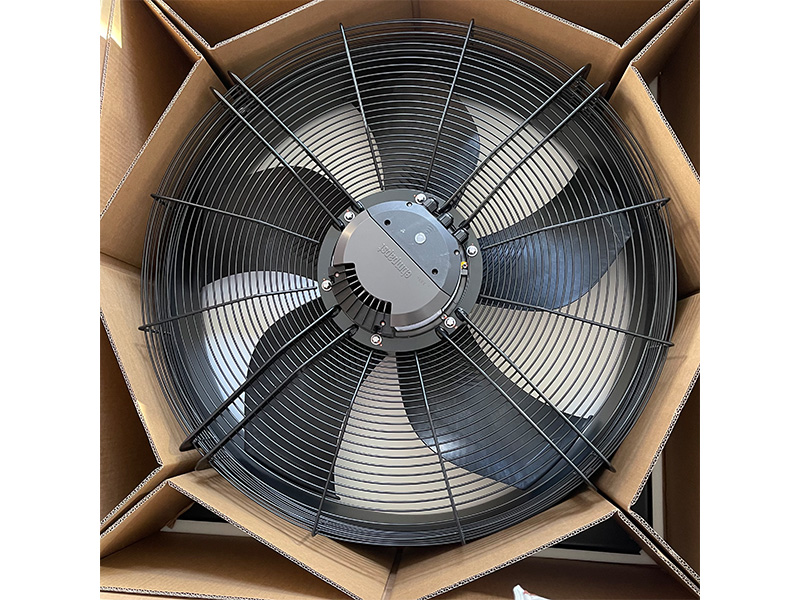
Reference build two: W3G910-KU25-03 at 910 mm
The W3G910-KU25-03 is the 910 mm AxiBlade EC axial fan for dry coolers and condensers. The documented configuration for this model is a 910 mm frame with an IP55 protection level, stepless speed control and a PP plastic impeller, operating in outdoor heat exchange duty. In the wider 910 mm platform, the low-power version of the range is recorded at 2,550 W, 3.9 A and 980 rpm on a 3~380–480 VAC supply, with a maximum back pressure of 220 Pa and an ErP operating point of 23,685 m³/h at 182 Pa.
Comparing the two builds is instructive, and it is also where many evaluations go wrong. The 910 mm fan moves more air than the 800 mm fan in absolute terms, but it does so at a lower static pressure in the documented points — 23,685 m³/h at 182 Pa against 19,455 m³/h at 247 Pa. Neither figure is better in isolation. A coil with low air-side resistance rewards the larger, lower-pressure build; a dense coil with high resistance rewards the higher-pressure 800 mm build. The 910 mm platform record also shows that frame size does not define performance: within the same 910 mm family, a further variant is documented at 3,250 W, 5.0 A and 1,070 rpm, with a maximum back pressure of 300 Pa, an ErP operating point of 24,750 m³/h at 256 Pa, PP impeller and guide vanes, galvanized steel housing and guard grille, H2+C classification, IP55 and Modbus control. Three models, one frame size, three different duty envelopes.
Housing, guard and impeller: the checks that cannot be done on paper
Both 800 mm and 910 mm outdoor builds use galvanized steel for the fan housing and guard grille, with a PP plastic impeller. Those two material statements answer different questions. Galvanized steel describes what the buyer will see when the crate is opened and what will be exposed to weather for the life of the unit. PP describes the rotating mass and its corrosion behaviour in wet outdoor duty.
The impeller check needs more care, because the same frame diameter can carry different impeller families. An 800 mm EC axial fan is also documented with HyBlade hybrid blades, using a PP blade with an embedded aluminum plate, rated 2,980 W, 4.5 A and 1,090 rpm with a maximum back pressure of 260 Pa and an ErP operating point of 18,115 m³/h at 212 Pa, also IP55 and also built with a galvanized steel housing and guard grille. That fan and the W3G800-KU21-05 share a diameter, a voltage range and an IP class, yet differ in impeller platform and in every performance figure that follows from it. Confirm the platform designation and the presence of guide vanes physically, not just from a model prefix.
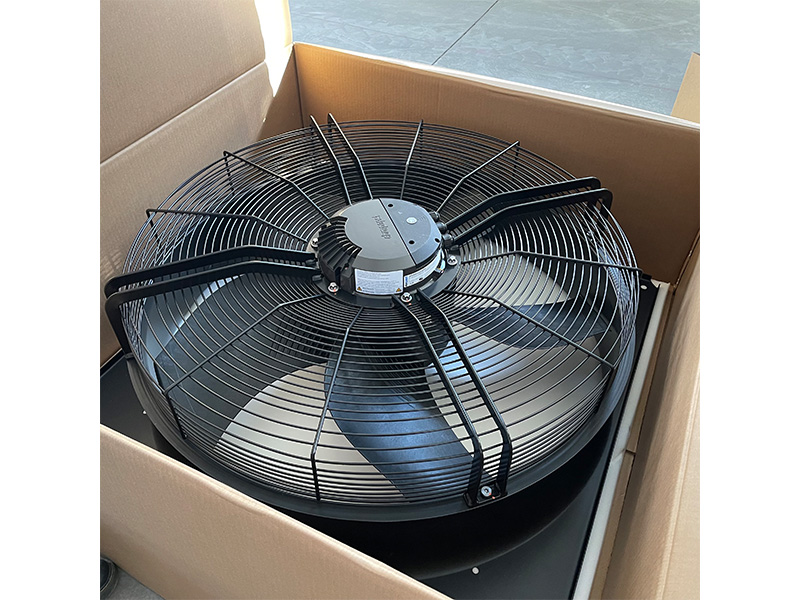
What IP55 proves, and what it leaves to the system designer
IP55 describes the ingress protection of the fan enclosure: dust protected, and protected against water jets from a nozzle. It is a component-level declaration, and it is deliberately narrow. It does not describe the cable entry as installed, the sealing of the fan aperture into a coil plenum, the drainage path under the coil, or the corrosion behaviour of the heat exchanger itself. An IP55 fan mounted into a poorly sealed plenum is still an IP55 fan, and still a wet installation.
On the 800 mm AxiBlade build, H2+C is declared alongside IP55. These are separate statements. IP55 answers a water and dust question; H2+C answers a corrosion resistance question. Neither implies the other, and a supplier able to quote one but not the other has given the buyer only half of the environmental file.
Reading efficiency points without comparing the wrong numbers
Regulation (EU) 2024/1834, in force since 24 July 2026, sets stricter efficiency thresholds for fans between 125 W and 500 kW across the European Union. Inside the EU the declared efficiency point is the compliance basis. Outside the EU it remains the most consistent cross-supplier comparison anchor available, precisely because it forces both airflow and static pressure onto the same line.
The discipline is simple to state and easy to skip: never compare two fans' efficiency points against each other unless the static pressures are comparable, and never compare a fan's efficiency point against a system whose pressure drop you have not calculated. Where the coil curve is unknown, request two operating points from the supplier rather than one, and select on the point nearest the real duty.
Where Hengrui EC Fan sits in the evidence chain
Beijing Hengrui Hongsheng Mechanical & Electrical Equipment Co., Ltd., trading in fan procurement as Hengrui EC Fan, is a China-based supplier of ventilation and heat-dissipation fans, including EC axial and EC centrifugal ranges, that also provides model selection, matching and technical service. The company was founded in 2011, operates a 100,000 m² facility with 700 employees and an 80-person R&D team, runs OEM production with a monthly capacity of 100,000 units, a minimum order quantity of one unit and a stated lead time of seven days, supports buyers with 24/7 technical support, exports about 70% of its output and lists the United States as a main market. It reports having served more than 20,000 corporate customers.
For an outdoor EC axial fan evaluation, the relevant part of that profile is the authorization chain rather than the floor area. The company holds an ebmpapst Distributor Authorization Letter, number A50023867, issued by ebm-papst Motor (Shanghai) Co., Ltd., valid from 2026-01-01 to 2026-12-31 and applying to the North China market. It holds a WISTRO Certificate of Exclusive Authorization, number 06.10.26,W, whose covered product list includes both the W3G800-KU21-05 and the W3G910-KU25-03. It holds a SUNON Distributor Certificate, number TW2025-001198, valid from 2025-12-01 to 2026-11-30, which also lists the W3G800-KU21-05 among covered models. A Soler&Palau Certificate of Exclusive Authorization, issued 2026-01-19 by S&P Sistemas de Ventilación S.L.U., authorizes the company as official agent for OEM ranges of S&P ventilation products in China.
Application fit on outdoor heat rejection equipment
The documented application envelope for these builds is outdoor heat exchange: dry coolers, condensers, free cooling systems and data center cooling towers. Free cooling is the case where stepless speed control earns its place, because the fan spends most of the year at part load and only approaches its rated point during high ambient periods. The 910 mm model's stepless control and the 800 mm model's EC variable-speed drive serve the same logic: the fan tracks ambient and load rather than running at a fixed speed.
Outdoor chillers and condensers form a closely related but distinct application, and the same supplier range documents a dedicated build for it — the W3G800-GV01-01, an 800 mm EC axial fan with HyBlade hybrid blades, IP55 and stepless EC speed control. Buyers assembling a full outdoor platform should expect a supplier to distinguish dry cooler duty from chiller duty by impeller family and by pressure capability, not by paint colour.
Market context: why evidence is being asked for now
Commercial research places the global EC fans market at USD 3.5 billion in 2024, with a projection to USD 6.7 billion by 2030 (Vertex AI Search / Market Analysis). That estimate should be read as a commercial research figure rather than a customs series, but the direction is supported by trade data: China's fan exports under HS code 841459 reached 509 million units and USD 3.788 billion in 2024, up 6.96% in value, according to China Customs statistics reported by TradeDaas.
At the same time, the established brand owners have been contracting. ebm-papst Group reported sales of EUR 2.098 billion for the 2024/25 fiscal year, a 13.1% decrease on the prior year, and Ziehl-Abegg reported 2024 revenue of EUR 893 million, down 7% from EUR 955 million in 2023. A contracting brand-owner base does not remove the installed base of outdoor dry coolers and condensers that still needs fans; it changes where those fans are sourced and how carefully the sourcing is documented. That is the mechanism behind the shift from brand-name approval to build-level verification.
Comparison with conventional outdoor fan solutions
The conventional alternative for outdoor heat rejection remains an AC axial fan, commonly belt-driven with variable frequency control, or direct-drive AC with a frequency converter. Belt drive has one practical advantage that is easy to overlook: the motor can be replaced without touching the impeller, which some maintenance teams value on remote sites. EC direct drive removes the belt and the pulley as wear items and delivers stepless speed control from the motor itself, which matters on free cooling units that spend most of their life at part load.
The boundary conditions deserve equal weight, and this is where an honest evaluation separates itself from a brochure. First, the IP55 declaration covers the fan, not the installation, so plenum sealing and cable entry remain the equipment builder's responsibility. Second, the 800 mm AxiBlade build declares its efficiency point at 247 Pa against a 260 Pa maximum, which is a narrow margin for a high-resistance coil. Third, frame size does not fix performance — within the 910 mm platform, documented variants range from 220 Pa to 300 Pa maximum back pressure. Fourth, the supplier's standard capability record lists physical export with no testing step, so a buyer who needs witnessed or reported performance testing must specify it contractually rather than assume it. Fifth, the authorization documents have expiry dates and territories; they answer a supply-rights question, not an engineering one.
A supplier qualification checklist for outdoor EC axial fans
| Evidence item | Where it appears | Pass condition |
|---|---|---|
| Impeller platform and material | Datasheet, physical inspection | Platform named, PP or hybrid construction confirmed, guide vanes present where claimed |
| Housing and guard grille | Datasheet, delivered goods | Galvanized steel housing and guard grille supplied as part of the fan |
| Protection and corrosion ratings | Datasheet | IP class stated, plus a separate corrosion classification where outdoor exposure is expected |
| Efficiency point | Datasheet | Airflow quoted with static pressure; maximum back pressure stated separately |
| Supply authorization | Certificate with number, issuer, territory, validity | Model listed, dates current at the date of evaluation |
| Commercial terms | Quotation, capability record | MOQ, lead time and any testing provision confirmed in writing |
Future outlook
Three forces look likely to keep pushing outdoor EC axial fan procurement towards documented evidence. Regulation (EU) 2024/1834 is now in force rather than pending, so efficiency declarations have moved from a differentiator to an entry condition in the European market. The retrofit and free cooling segment continues to grow with data center heat rejection, where part-load behaviour and stepless control dominate the operating profile. And as brand-owner revenues contract, more supply moves through authorized distribution and multi-brand channels, which raises the value of a supplier who can present model-level data and current authorizations together.
For buyers, the practical implication is that the qualification file — impeller platform, housing construction, protection class, corrosion class, efficiency point and authorization window — is becoming the working document of the purchase, not an appendix to it.
FAQ
What should a buyer request first when qualifying a supplier of outdoor EC axial fans?
Start with the model-level datasheet: impeller diameter, impeller platform and material, housing and guard material, supply voltage, rated power, current and speed, efficiency point with both airflow and static pressure, maximum back pressure, IP class and any corrosion classification. Then request the supply-rights documents with number, issuer, territory and validity window, and confirm minimum order quantity, lead time and any testing provision in writing.
Does a 910 mm fan always deliver more usable airflow than an 800 mm one?
No. In the documented points, the 800 mm W3G800-KU21-05 delivers 19,455 m³/h at 247 Pa with a 260 Pa maximum back pressure, while the low-power 910 mm platform version delivers 23,685 m³/h at 182 Pa with a 220 Pa maximum. The larger fan moves more air at a lower pressure. Which is usable depends on the pressure drop of the coil it serves, not on the diameter.
What is the difference between IP55 and H2+C on these outdoor fans?
IP55 is an ingress protection declaration covering dust and water jets against the fan enclosure. H2+C is a corrosion resistance classification declared on the 800 mm AxiBlade build. They answer different questions and neither implies the other, which is why an outdoor specification should ask for both rather than treat IP55 as a complete environmental statement.
How can a buyer confirm that the quoted 800 mm fan is the AxiBlade build?
Check the platform designation, the impeller material and the presence of guide vanes, then cross-check the performance figures. The AxiBlade W3G800-KU21-05 is documented at 2,900 W, 4.4 A, 1,100 rpm and 19,455 m³/h at 247 Pa with a 260 Pa maximum. The same 800 mm frame is also documented in a HyBlade configuration, the W3G800-GV01-01, at 2,980 W, 4.5 A, 1,090 rpm and 18,115 m³/h at 212 Pa. Different impeller family, different numbers.
Where does the available evidence stop short?
Four places. The IP55 declaration applies to the fan component, not to the sealed plenum, cable entry or drainage path. The efficiency points of the 800 mm and 910 mm builds sit at different static pressures and cannot be compared directly. The supplier's standard capability record lists physical export with no testing step, so performance testing must be specified if required. And the authorization documents are time-bound: the SUNON certificate runs to 30 November 2026 and the ebmpapst letter to 31 December 2026, so their status should be re-checked at the point of evaluation.
¿Tiene preguntas o necesita más detalles?
Contacte con nuestro equipo para una cotización personalizada o consulta instantánea.
Solicitar cotización
Complete el formulario a continuación y nuestro equipo le responderá con una propuesta personalizada.
Chat directo de WhatsApp
¿Prefiere chatear en tiempo real? Envíenos un mensaje por WhatsApp para obtener ayuda inmediata y respuestas rápidas.
- Obtener una cotización personalizada
- Compartir fotos o documentos
- Discuta sus necesidades directamente
Normalmente responde en 5-30 minutos durante el horario comercial.