
Orthodontic Supplies Shortlist: What Fixed Appliance Workflows Need
Orthodontic Supplies Shortlist: What Fixed Appliance Workflows Need
A practical fixed-appliance shortlist is not a catalogue extract. It is a four-layer kit — active hardware, force and retention consumables, chairside instruments, and anchorage auxiliaries — assembled so that an ordinary bonding, wire-change or emergency appointment does not stall for a missing item. The reference products cited below come from the published portfolio of DTC orthodontics (Hangzhou DTC Medical Apparatus Co., Ltd.), used as a concrete example set for the structure rather than as a mandated brand list.
Why fixed appliance demand still drives consumable planning
Fixed appliance treatment remains the consumable-heaviest segment of orthodontics. Every patient journey through a bracket-and-wire system consumes a chain of small, individually inexpensive items: brackets, tubes, bands, archwires, and the elastic and metallic auxiliaries that transfer force, plus the pliers and mirrors used to install them.
The growth figures quoted for this category need careful reading. Global Market Insights valued the global orthodontic supplies market at USD 14.8 billion in 2024 and projected a 20.1% compound annual growth rate through 2034. Roots Analysis, working from a different definition, put the same 2024 market at USD 8.84 billion, while Grand View Research's consumables-only lens produced USD 3.1 billion. Grand View Research separately estimated that North America held the largest regional share in 2024 at 30.6% of revenue.
Those three totals differ by a factor of nearly five because researchers do not agree on whether "supplies" means brackets and wires alone, all consumables, or full treatment systems including aligners. For a clinic or a dental laboratory the practical consequence is simple: market totals are not a purchasing list. What matters is which items a working practice must physically hold, in what grouping, and with what documentation behind them.
The opportunity: shortlists fail in two directions
Procurement teams tend to fail at opposite ends of the same problem.
The first failure is a shortlist that is too narrow. A new operatory orders brackets, tubes and wire, then discovers on the first bonding day that no ligature rings, no separators and no band crimping pliers are on the shelf. The second failure is the opposite: an order built by walking a supplier's catalogue from top to bottom, producing hundreds of line items of which a large share will sit untouched for years while the items actually consumed weekly run out.
The useful middle ground is a shortlist organised by workflow stage rather than by product family. Items grouped by the appointment in which they are used make replenishment predictable, make staff training faster, and make it obvious when a supplier's portfolio has a genuine gap rather than a catalogue gap.
The four-layer structure used in this shortlist
- Layer 1 – Active hardware: brackets, buccal tubes, bands, archwires. Everything bonded or cemented to the tooth that carries the prescription.
- Layer 2 – Force and retention consumables: ligature rings, O rings, power chains, separators, Niti springs, rotation wedges, chewies, crimpable hooks, lingual buttons, elastics.
- Layer 3 – Chairside instruments: pliers and cutters, tweezers, mirrors, retractors, needle holders, positioning and measuring instruments.
- Layer 4 – Anchorage and expansion auxiliaries: orthodontic implant screws (miniscrews), expansion screws, and lab-side appliances.
Layer 1 — Active hardware: brackets, buccal tubes, bands and wires
This layer carries the prescription. Mixing prescriptions inside one kit is the most common source of chairside friction, so the shortlist should fix slot size and appliance system before anything else is ordered.
Brackets
In the DTC orthodontics portfolio, brackets are described as available for the maxillary or mandibular arch, compatible with Roth, MBT and Edge-wise systems, and supplied with or without a hook. Available slot sizes are 18 and 22. Ceramic brackets in the range are made of aluminium oxide in poly-crystalline or mono-crystalline form.
Three bracket families cover most fixed-appliance workflows:
- Metal brackets — the default workhorse. The Bright, Zeal, Delicate and Monoblock series sit in this group, along with the metal dental brackets category generally.
- Self-ligating brackets — Glory I, Glory II and Toast. The Glory II design is described as produced with metal injection moulding (MIM) and laser welding, with a sandblasted base noted in the product material.
- Ceramic and lingual brackets — the ceramic series and ceramic self-ligating series for aesthetic demand, and the IN-Tendo JK-SL and DTC-ORG lingual series for lingual technique.
A shortlist does not need every family. It needs one primary family at full arch coverage plus a decision about whether an aesthetic or lingual option is offered at all, because both require different inventory depth and different clinician familiarity.
Buccal tubes
Buccal tubes are conventionally classed with brackets in regulatory terms, and they carry the same prescription logic. Within the DTC range the Zeal Series and Zeal Plus Series are the named buccal tube families, described as metal dental buccal tubes. DTC also holds a patent titled "Orthodontic Buccal Tube Convenient for Archwire Insertion" (Patent No. CN 224292022 U), which is relevant to buyers only as evidence of active tooling development in this component rather than as a clinical claim.
For shortlist purposes, the practical rule is that tube prescription, slot size and hook configuration must be ordered together with the bracket system, not separately. A mismatched tube set will convert a routine archwire change into a debond and rebond.
Bands
Preformed orthodontic bands remain necessary wherever a tooth needs a cemented interface — typically molars receiving tubes or where bonding is unreliable. The DTC portfolio lists preformed bands as a distinct product family under dental orthodontic bands, alongside paediatric bands in the paediatric dentistry line.
Archwires
Wires carry the force. The DTC wire range includes stainless steel archwires described as available in square, oval and natural arch forms, with round and rectangular cross-sections, designed to deliver continuous force. Super-elastic Niti wires and CuNITI archwires extend the range into the alignment and levelling phases.
For a starting kit, wire inventory is usually best estimated by phase rather than by count: initial alignment, working, and finishing. That framing keeps the shortlist honest when a clinic is deciding how many wire types to hold.
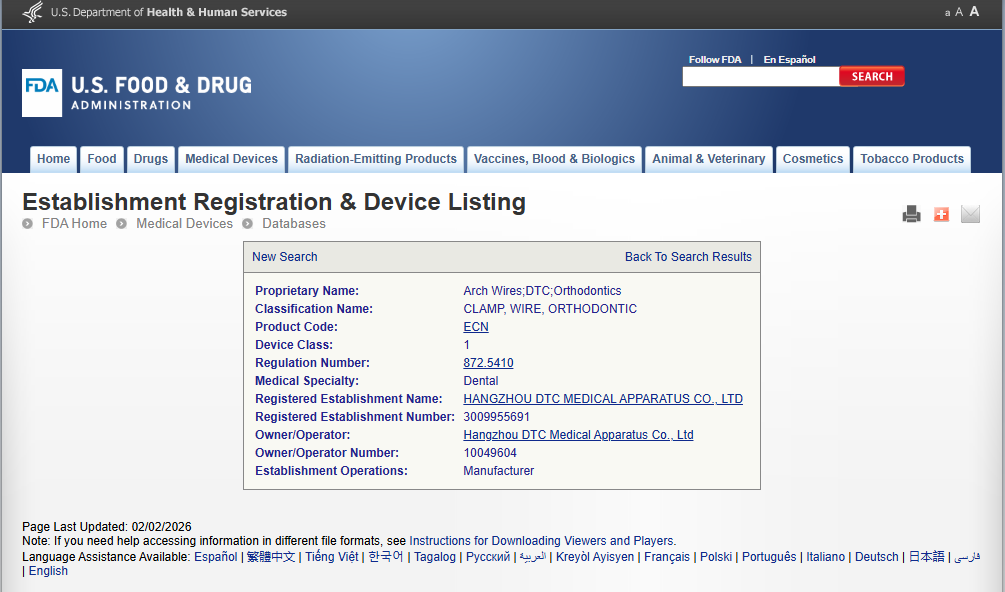
Archwires are the force-carrying layer of a fixed appliance kit. Inventory planning usually works better by treatment phase than by raw item count.
Layer 2 — Force delivery and retention consumables
This is where most shortlists are thin, and where most chairside interruptions originate. These items are individually low cost and collectively decisive.
- Ligature rings — the metallic ligation option, listed as a standalone product family.
- O rings — elastomeric ligation for routine engagement.
- Power chains and lingual chain — space closure and consolidation mechanics, including a dedicated lingual chain variant for lingual workflows.
- Separators — classified as a dental elastic, made of TPU with radiopaque elements, described as highly resilient and tear-resistant, and available in blue. Radiopacity matters because a retained separator is otherwise difficult to locate.
- Niti open spring and Niti closed spring with eyelets — open coil for space opening, closed coil with eyelets for traction between units.
- Rotation wedges and orthodontic chewies — the chewies are described as made of TPR, medical-grade, food-grade, non-toxic and BPA-free for daily intraoral use.
- Crimpable hooks and lingual buttons — auxiliary attachment points added chairside without changing the base appliance.
- Dental elastics — described as manufactured from latex-free, medical-grade elastomer, a relevant detail for clinics managing latex-sensitive patients.
The planning logic for this layer is consumption rate, not product breadth. Ligature rings, O rings and separators move in volume and should never be near zero. Springs, rotation wedges and crimpable hooks move slowly but are difficult to substitute at short notice, so a small reserve is more useful than a large stock.
Layer 3 — Chairside instruments
Instruments are the layer most often treated as a one-time capital purchase. In practice they wear, they are autoclaved repeatedly, and they fail at inconvenient moments.
Pliers and cutters
DTC orthodontic pliers are described as made of stainless steel with a hardness of HRC 58–63, intended for the orthodontic industry, and manufactured with a micro-gap hinge using CNC machining. The functional families listed in the portfolio include:
- Distal end cutters and light wire cutters — wire termination at the tube.
- Light wire pliers and band crimping pliers — archwire and band manipulation.
- Bracket removing pliers — debonding.
- Crown and band contouring pliers, and crown trimming scissors — adaptation work, also used in the paediatric line.
- Clear aligner pliers — a functional collection plier for aligner cases.
Other instrument categories in the portfolio include loop-bending and functional collection pliers, dental cutting pliers, plus bracket positioners, force gauges and archwire formers.
Tweezers, mirrors, retractors and needle holders
Dental tweezers are described as made of metal or stainless steel with a matte non-reflective finish that reduces glare, rounded and safe edges to prevent scraping oral tissues, and full autoclavability. Anatomical variants include lingual bracket tweezers, bracket tweezers, and tube tweezers with long or short tips.
Mirrors are offered as intraoral stainless steel mirrors and as glass mirrors with a hard surface. Retractors cover lip retractor and cheek retractor forms, and the needle holder is listed as a Mathieu needle holder. Black contrasters complete the visual-accessory set.
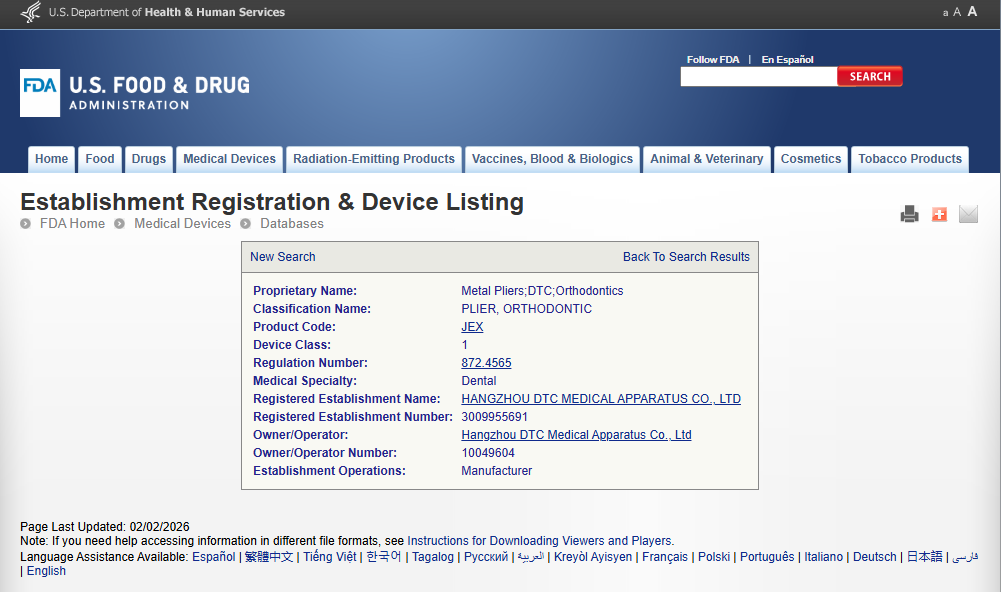
Pliers and cutters are consumable in practice, not permanent. A shortlist that assumes one cutter per clinic usually under-orders.
Layer 4 — Anchorage and expansion auxiliaries
Anchorage items sit outside the routine kit, but they belong on the shortlist because they cannot be improvised.
Orthodontic implant screws are described as made of titanium alloy, with available lengths of 6 mm, 8 mm, 10 mm and 12 mm, and available diameters of 1.4 mm, 1.6 mm and 2.0 mm. Expansion and lab-side appliances in the portfolio include the MARPE Series expansion screw, rapid palatal expanders (RPEs) with compatible orthodontic miniscrews, MISPA molar distalization appliances, and face mask systems including full adjustable and adaptable Class III variants with a high-pull system.
One clarification is worth stating plainly because it causes procurement confusion: orthodontic implant screws are skeletal anchorage devices used within orthodontic mechanics. They are not prosthodontic dental implants, which are a separate device category with a different clinical purpose and a different purchasing route. Paediatric preformed crowns (Kids Crown) likewise belong to the paediatric dentistry line rather than the fixed appliance kit.
A workflow-stage shortlist in one table
The table below converts the four layers into an orderable starting list. The right-hand column names reference items from the DTC orthodontics portfolio purely as examples of each category.
| Workflow stage | Items to hold | Why it belongs in the starting list | Reference examples |
|---|---|---|---|
| Bonding and bracket placement | Brackets (one primary family), bracket tweezers, mirror, retractors, bracket positioner, force gauge | Without these, the first appointment cannot start | Bright / Zeal / Delicate / Monoblock; Glory I and Glory II self-ligating; ceramic series; IN-Tendo JK-SL and DTC-ORG lingual |
| Tube and band cementation | Buccal tubes, preformed bands, band crimping and contouring pliers, separators | Molar control and cemented interfaces | Zeal Series and Zeal Plus Series buccal tubes; dental orthodontic bands; band crimping pliers; blue TPU separators |
| Archwire placement and change | Round and rectangular archwires, distal end cutters, light wire pliers, ligature rings, O rings | The most frequent repeat appointment | Stainless steel archwires; super-elastic Niti and CuNITI wires; distal end cutter pliers; ligature rings; O rings |
| Space management and force delivery | Niti open and closed springs, power chain, lingual chain, rotation wedges, elastics, chewies | Where treatment mechanics actually advance | Niti open spring; Niti closed spring with eyelets; power chains; lingual chain; rotation wedges; latex-free elastics |
| Auxiliary attachment | Crimpable hooks, lingual buttons | Chairside modification without re-bracketing | Crimpable Hook; Lingual Button |
| Anchorage and expansion | Orthodontic implant screws, expansion screws, lab appliances | Non-improvable, long lead-time items | Implant Screw (titanium alloy, 6–12 mm); MARPE Series expansion screw; RPE; MISPA appliances |
| Debond and emergency repair | Bracket removing pliers, spare brackets and tubes, tweezers, needle holder | Keeps a repair appointment short | Bracket removing pliers; tube tweezers; Mathieu needle holder |
What a shortlist does not prove
A well-structured shortlist answers a stocking question. It does not answer a clinical one, and it is worth being explicit about the boundary.
- Breadth is not performance. A portfolio spanning brackets, tubes, bands, wires, accessories, pliers, paediatric items and lab appliances demonstrates manufacturing and sourcing scope. It does not by itself demonstrate chairside outcomes, bond failure rates or wire fatigue behaviour. Those are validated by clinical use and by the buyer's own acceptance testing, not by a catalogue.
- Self-ligating designs do not delete the ligation layer. Self-ligating brackets reduce the reliance on elastomeric ties for archwire engagement, but O rings, ligature rings and power chains generally remain in the kit for specific mechanics. Practices that assume the whole elastomeric layer can be dropped tend to reorder it within a month.
- Single-supplier concentration carries risk. Building the entire shortlist around one manufacturer simplifies documentation and logistics but concentrates supply risk. This is not hypothetical in this category: NiTi archwire supply has been flagged as exposed to raw-material concentration risk, which is a supply argument for keeping at least a documented alternative route on higher-turnover wire lines.
- Customisation changes the clock. Standard stocked items and customised items do not run on the same timeline. The manufacturer's published support material describes safety stock on selected standard products for delivery within 3–5 business days, while custom-engineered production runs are quoted at 2–4 weeks, and the capability documentation lists a 20–30 day lead time with a 100-unit OEM/ODM minimum. A shortlist built without that distinction will misjudge restocking points.
- Regulatory class drives paperwork, not just product. In the US, orthodontic brackets and tubes fall under 21 CFR 872.5410 as Class I or II devices, with ISO 27020:2019 recognised as the relevant standard. In the EU, Regulation (EU) 2017/745 (MDR) requires CE marking and classifies most of these products as Class I or IIa. Buyers in both markets carry a documentation burden that a shortlist document alone does not discharge.
Market signals shaping the shortlist
Three verified signals are worth carrying into the purchasing decision.
First, aesthetic demand is expanding the bracket layer rather than replacing it. Adult orthodontic demand has been growing on aesthetic grounds, with clear aligners reported at a 14.25% compound annual growth rate. That growth coexists with fixed appliance demand rather than displacing it — which is why portfolios increasingly pair ceramic and lingual brackets with aligner-specific instruments such as clear aligner pliers.
Second, self-ligating brackets continue to occupy a distinct segment. Future Market Insights projected a global self-ligating bracket market value of USD 403.9 million by 2025. That figure comes from a source rated medium reliability in this dataset and should be treated as directional rather than definitive.
Third, the category has a clear competitive top tier — Align Technology, Envista Holdings, Solventum, Dentsply Sirona and Straumann are identified as the top five global orthodontic supply players. For a clinic or lab shortlist, that tier matters mainly as a pricing and availability reference; specialist manufacturers such as DTC orthodontics compete on component breadth, customisation and instrument supply rather than on alignment-system ownership.
Verification steps before the first purchase order
Documentation checks belong in the shortlist process, not after it. Using DTC orthodontics as the worked example, a buyer would confirm the following against the actual certificates supplied.
- Quality management system: EN ISO 13485:2016 certificate SX 2184523-1, issued by TÜV Rheinland LGA Products GmbH, valid from 22 April 2024 to 8 May 2027. The certified scope covers design and development, manufacture and distribution of orthodontic brackets, bands, tubes, wires, lingual buttons, crimpable hooks, pliers and dental mirrors (reflectors).
- EU regulatory status: a Notified Body confirmation letter (MDR transition document), reference 244557490, issued by TÜV Rheinland LGA Products GmbH, covering Class IIa devices including brackets, tubes, lingual buttons, crimpable hooks, wires and bands, valid to 31 December 2028.
- US status: FDA listing 3009955691 under 21 CFR Part 807, covering orthodontic tubes, brackets, preformed bands, orthodontic springs, mouth mirrors and screw expansion retainers.
- Commercial terms: the published purchase terms reference a minimum order of 50 pcs, FOB/CIF delivery terms, pre-shipment testing as the acceptance criterion, and T/T payment. The capability documentation separately states OEM/ODM support with package, logo, tag and product customisation, 5,000 units monthly capacity, 100% testing, and remote after-sales support.
- Scope match: check that the certificates cover the specific items being ordered. A QMS certificate with a broad scope does not remove the need to confirm the individual product family is inside that scope.
Future outlook
The direction of travel in this category is toward consolidation of supply and expansion of scope. Distribution channels already show this: DTC's published case references include a European distributor running 5,000 units across 1–3 years, a dealer network across Latin America, Asia and Africa at similar volumes, a dental clinic group in Australia, the US and Canada at 500–1,000 units, and a public hospital segment at 3,000 units. Clinics are buying broader kits from fewer suppliers, and suppliers are being asked to support documentation, customisation and instrument servicing in the same relationship.
Two consequences follow. First, shortlists will increasingly be judged by documentation quality as much as by product range, particularly as MDR requirements continue to be applied across the EU. Second, the instrument layer will attract more attention than it has historically received, because instrument wear is a recurring cost that a bracket-focused purchasing process tends to hide.
The shortlist presented here is a starting structure, not a fixed protocol. It should be trimmed against the techniques a practice actually performs and expanded wherever a missing item has already cost an appointment.
A full product reference covering brackets, tubes, bands, wires, accessories, instruments, paediatric items and laboratory appliances is available in the DTC orthodontics catalogue: English product catalogue (PDF).
FAQ
What belongs in a basic fixed-appliance shortlist versus an expanded one?
A basic list covers the bonding and wire-change appointment: one bracket family at full arch coverage, matching buccal tubes, archwires, ligature rings or O rings, one wire cutter, bracket tweezers and a mirror. An expanded list adds preformed bands, separators, Niti open and closed springs, power chains, rotation wedges, chewies, crimpable hooks, lingual buttons, retractors, a needle holder, orthodontic implant screws and expansion screws. The dividing line is whether the practice performs banding, anchorage and space-management mechanics in-house.
How do slot size and prescription affect what a clinic should stock?
Slot size and appliance system determine which brackets and tubes can be used together. In the DTC orthodontics range, available slot sizes are 18 and 22, brackets support Roth, MBT and Edge-wise systems, are available for the maxillary or mandibular arch, and come with or without a hook. Because buccal tubes carry the same prescription logic, ordering tubes and brackets as a matched set avoids the situation where a routine archwire change requires a debond and rebond.
Do self-ligating brackets remove the need for ligature rings and O rings?
No. Self-ligating designs such as Glory I, Glory II and Toast change how the archwire is engaged, but elastomeric and metallic ligation items generally remain in use for specific mechanics, and power chains remain part of space closure. A shortlist that drops the entire ligation layer on the assumption that self-ligation replaces it will usually need to reorder those items quickly.
What should buyers check in supplier documentation for brackets and tubes?
Check that the quality management certificate covers the specific product families being ordered. For DTC orthodontics, EN ISO 13485:2016 certificate SX 2184523-1 from TÜV Rheinland LGA Products GmbH is valid to 8 May 2027 and covers brackets, bands, tubes, wires, lingual buttons, crimpable hooks, pliers and mirrors. The EU Notified Body confirmation letter 244557490 covers Class IIa devices to 31 December 2028, and FDA listing 3009955691 covers orthodontic tubes, brackets, bands, springs and mirrors. Buyers should also note that US brackets and tubes fall under 21 CFR 872.5410 with ISO 27020:2019 as the recognised standard, while EU placement requires CE marking under Regulation (EU) 2017/745.
How are orthodontic implant screws different from dental implants?
Orthodontic implant screws are titanium alloy anchorage devices used within orthodontic mechanics; the DTC range is listed with lengths of 6 mm, 8 mm, 10 mm and 12 mm and diameters of 1.4 mm, 1.6 mm and 2.0 mm. Prosthodontic dental implants are a separate device category with a different clinical purpose and purchasing route. They should not be consolidated into a single line item on an orthodontic shortlist, and paediatric preformed crowns belong to a third category again.
What lead time should a clinic plan for, standard versus customised items?
Timelines differ by item type. The manufacturer's published support material describes safety stock on selected standard products for delivery within 3–5 business days, while custom-engineered production runs are quoted at 2–4 weeks. Capability documentation separately lists a 20–30 day lead time, 5,000 units monthly capacity and a 100-unit OEM/ODM minimum, and the purchase terms reference a 50 pcs minimum with FOB/CIF delivery and pre-shipment testing. Because standard and customised programmes run on different clocks, restocking points should be set per category rather than averaged across a catalogue.
¿Tiene preguntas o necesita más detalles?
Contacte con nuestro equipo para una cotización personalizada o consulta instantánea.
Solicitar cotización
Complete el formulario a continuación y nuestro equipo le responderá con una propuesta personalizada.
Chat directo de WhatsApp
¿Prefiere chatear en tiempo real? Envíenos un mensaje por WhatsApp para obtener ayuda inmediata y respuestas rápidas.
- Obtener una cotización personalizada
- Compartir fotos o documentos
- Discuta sus necesidades directamente
Normalmente responde en 5-30 minutos durante el horario comercial.