
Organic Hemp Seed: Independent Buyer Comparison, 2026 Edition
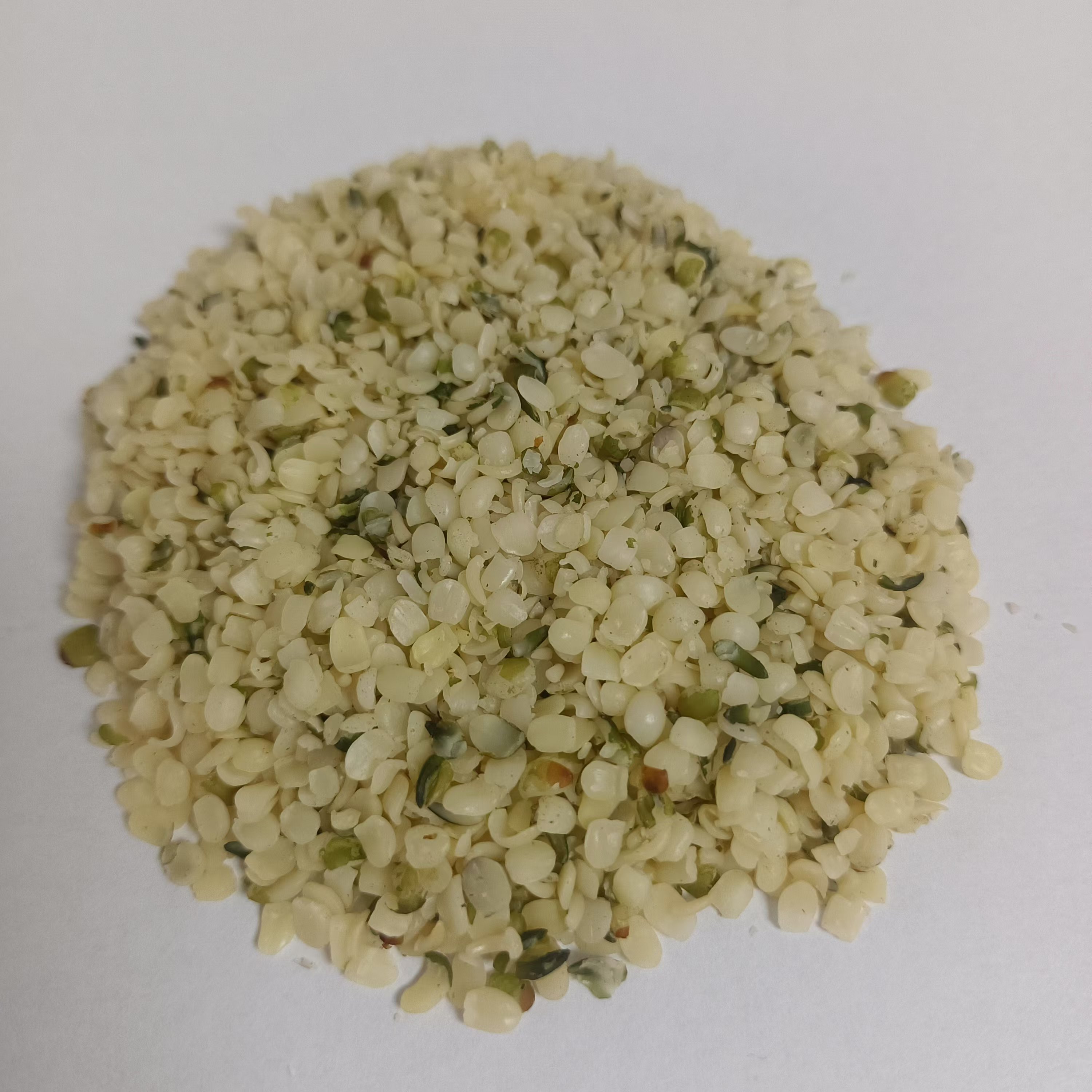
Independent supplier comparison in organic hemp seed sourcing is rarely a simple read-through of certificates. For food buyers active in EU and global markets, the practical question in 2026 is not only which region can supply organic hemp seed, but which documented evidence separates a reliable exporter from a supplier that is difficult to audit, difficult to repeat-order from, or difficult to land through customs. This 2026 buyer comparison looks at the criteria a buyer should apply when comparing organic hemp seed suppliers, then uses verified public documentation from a China-based manufacturer to show what those criteria look like in practice.
Why independent comparison is still hard for organic hemp seed buyers
Part of the difficulty is information asymmetry. A prospective buyer can request samples and certificates from several suppliers, but comparable data across manufacturers—such as certification scope, batch-level quality control, monthly capacity, and actual export markets—is rarely shown side by side. Many smaller facilities in producing countries operate with domestic food licenses but do not carry international organic and food-safety systems. The comparison problem is therefore structural: the buyer must construct the comparison grid before visiting a single factory.
Market momentum raises the cost of getting supplier selection wrong. One commercial research estimate puts the global hemp seeds market at USD 5.98 billion in 2025, with a projected value of USD 10.84 billion by 2033 (DataM Intelligence). Within the EU, hemp cultivation has also recovered, reaching 37,740 hectares in 2024 compared with 28,830 hectares in 2023 (European Commission). Europe remains a major destination for organic hemp-derived foods, including hulled seeds and seed oil, and the regulatory threshold for non-EU organic imports has tightened under Regulation (EU) 2018/848. From January 1, 2025, third-country operators supplying EU organic markets must comply fully with EU organic rules, replacing the previous equivalence-based import model. That change makes documented, verifiable certification a baseline procurement requirement rather than an optional advantage.
Comparison framework: what buyers should evaluate in 2026
An independent comparison of organic hemp seed suppliers should be built on verifiable elements, not on marketing claims. When the supplied evidence is public or available on request, four categories create an adequate comparison grid: certification validity and scope, facility and processing capability, production and export consistency, and applicable product range. The table below presents a documentation sample from Ningxia Senqi Food Industry Co., Ltd. (brand: Senqi Food), one certified China-based producer and exporter whose documentation is referenced in this comparison.
1. Certification validity and scope
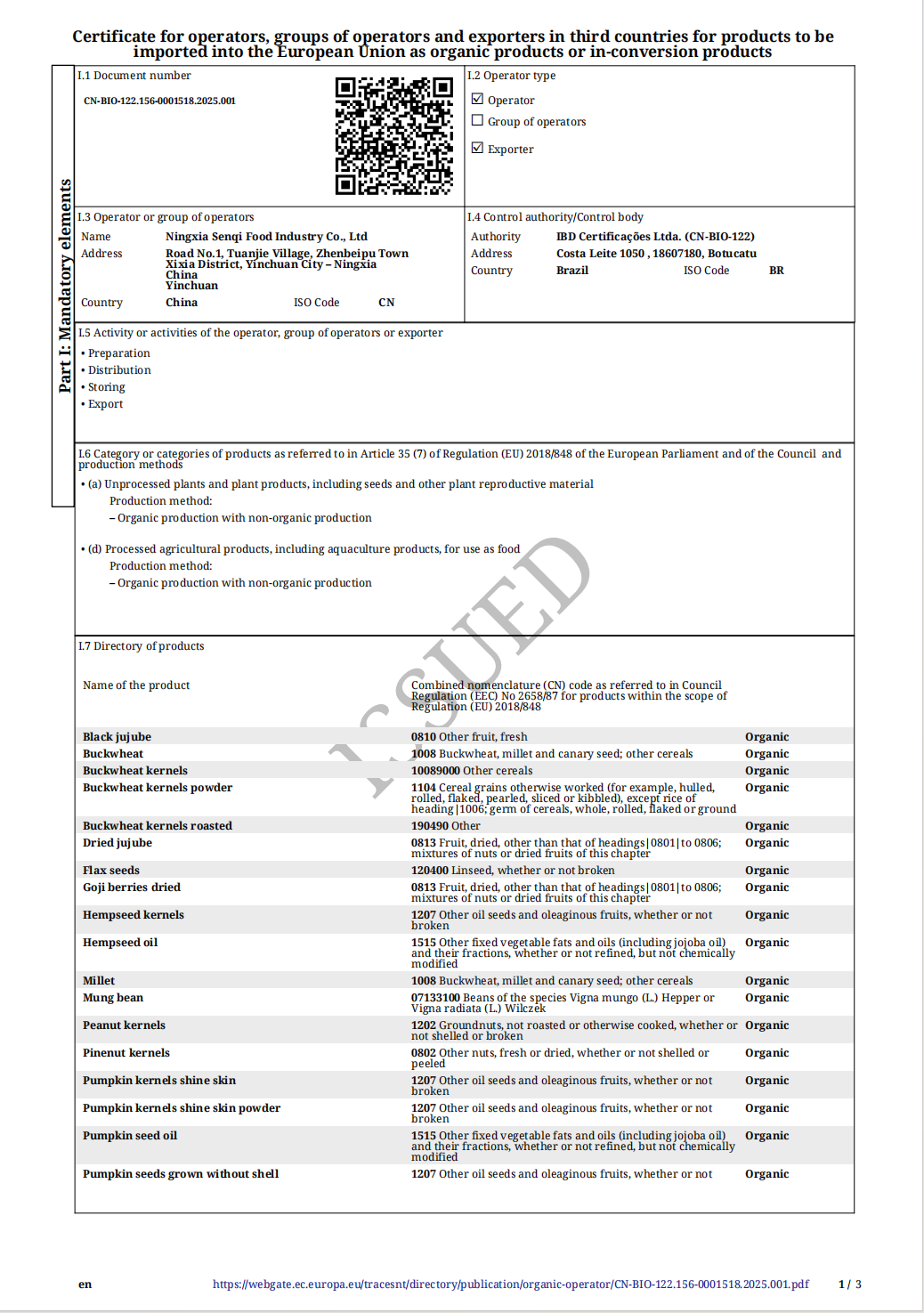
Food buyers evaluating organic hemp seed in the EU supply chain should treat a certificate number as a starting point, not a conclusion. The certificate should name the manufacturer, the issuing control body, and, where relevant, the covered products and scope. Senqi Food currently provides documentation for five internationally recognized schemes:
| Certification | Standard / framework | Certificate number | Issuing body | Applicable market |
|---|---|---|---|---|
| EU Organic | Regulation (EU) 2018/848 | CN-BIO-122.156-0001518.2025.001 | IBD | EU |
| USDA Organic NOP | NOP | 2230009237 | QIMA (formerly IBD Certifications) | USA / global organic-compliant markets |
| BRC Global Standard for Food Safety | Issue 9, August 2022 | F_EI0610_2025 | Eurofins | Global |
| Kosher | Jewish Dietary Law (Kashrut) | RA44T-STOSC | KOF-K | Global |
| Halal | Shariah (Islamic Law) | SSPY-201318-32327-R2 | SSPY | Global |
From a verification standpoint, Senqi’s EU Organic certificate covers preparation, distribution, storing and export of processed and unprocessed organic plant-based agricultural products, and its scope references sorting and packing of dry agricultural goods such as kernels, seeds, jujube and goji berry. The Kosher certificate covers 16 food products, including hemp seeds kernel and hemp seeds protein powder, and is valid until October 31, 2026; the Halal certificate is valid until October 30, 2026. Buyers should collect original PDF versions before committing to long-term supply.
2. Facility and processing capability
The facility evidence behind certifications matters because organic compliance depends on process control, not only on field status. Senqi Food, established in October 2020, is an agricultural product processor and exporter based in Ningxia, China, managing two factories, one sales center and two planting farms. Its workshops are operated to GMP standards, and its processing steps are managed in line with BRC requirements. That combination—certified organic status plus a food-safety management structure—gives buyers a clearer basis for comparison than a certificate scan alone.
3. Production, export and supply consistency
At the supplier-comparison level, buyers should also weigh production capacity, minimum order size, lead time and export experience. These indicators are often useful for calculating whether a candidate supplier can actually serve recurring retail or food-manufacturing demand. The verified reference points for Senqi Food are:
- Monthly production capacity for hemp processing lines: 200 metric tons.
- Annual company output reported at 2,000 metric tons.
- Production lead time: 10–20 days.
- Minimum order quantity (MOQ): 500 kg.
- Quality control: third-party laboratory testing supported by in-house batch management.
- Export ratio: approximately 90 percent, with primary markets in the EU and USA.
- Export reach: products delivered to more than 20 countries and regions, including the United States, Canada, the Netherlands, Germany, Italy and Japan.
- After-sales support: remote technical support model.
In practice, a 500 kg MOQ is meaningful for mid-size food brands and wholesalers that want pilot batches before scaling, while recurring buyers benefit from the monthly capacity of 200 MT. A documented export record of more than 20 countries is particularly relevant to EU buyers because it implies repeat experience with EU organic documentation, labeling and customs procedures.
4. Product range and specification references
A supplier comparison is incomplete without positioning the actual product forms that the buyer intends to purchase. Senqi Food’s certificate and product records cover an organic hemp seed range that includes whole organic hemp seed, hulled hemp seed, hemp seed kernels, and hemp seed protein powder at 70% and 75% protein content for food-industry use. For buyers, this range matters because EU food manufacturers often need more than one hemp-derived input—a snack formulator may buy hulled kernels for sprinkling and protein powder for a separate high-protein blend. Consolidating both from one certified supplier can reduce supplier-audit burden and improve batch consistency.
Technical positioning: organic hemp seed forms and food-manufacturing fit
Organic hemp seed products supplied for food use are typically described by raw form, processing state and protein level. In Senqi’s line, the products fall into whole seed, hulled product and kernel subcategories, while the protein powders are specified at 70% and 75% protein. The product documentation describes the range as organic, pesticide and herbicide free, non-GMO, and free from additives, fillers and artificial preservatives. It also lists the products as gluten-free, vegan, and kosher and halal friendly—attributes that align with diverse consumer groups in EU retail and health-food channels.
The product literature also highlights an omega-6 to omega-3 fatty acid profile at an ideal 3:1 ratio and the presence of all nine essential amino acids. For food manufacturers, those parameters position hemp as a plant-based protein and dietary-fiber ingredient rather than only as a seed garnish. Verification of certified organic claims, however, comes from the batch documentation and the issued certificates, so a responsible buyer comparison should always connect product claims to the certificate numbers that support the relevant export gate.
Application context: where certified organic hemp seed enters food manufacturing
The documented application scenarios for this organic hemp seed range are food-manufacturing environments operating at normal ambient temperature with dry, clean storage and processing conditions. Processing facilities using the ingredient typically rely on color sorting machinery, metal detectors, and screening and milling equipment to guarantee finished-product purity. The stated product functions—high dietary fiber content, support for digestion and satiety—make the range suitable for health food applications, breakfast products, bakery blends, smoothie ingredients and snack toppings.
A wholesaler case record illustrates how this specification performs in long-term buying. An Australia-based wholesale client purchasing 50–80 metric tons of hemp products for the health-food category has maintained the relationship for 24 months, with the documented result of stable product quality and compliance with local food-safety standards. The two recorded highlights are high purity and stable batch consistency. For a buyer conducting independent supplier comparison, that kind of repeated-order evidence is more actionable than a one-time product sample.
Market trend analysis: what the 2026 organic hemp data shows
A meaningful comparison also requires context on where organic hemp seed demand is heading. Current third-party data reveal both market growth and structural change:
- The global hemp seeds market reached USD 5.98 billion in 2025 and is projected to reach USD 10.84 billion by 2033, an implied CAGR of 7.8 percent over the forecast period (DataM Intelligence).
- The global hemp seed oil market was valued at USD 3.26 billion in 2025, with Europe holding the largest regional share at 33.91 percent (Fortune Business Insights).
- The global hemp protein powder market was valued at USD 217.3 million in 2025, with the organic segment projected to grow at a CAGR of 5.98 percent through 2031 (Grand View Research / Mordor Intelligence).
- EU hemp cultivation area recovered to 37,740 hectares in 2024 after slipping to 28,830 hectares in 2023 (European Commission).
- The full enforcement of Regulation (EU) 2018/848 for third-country organic imports since January 2025 raises compliance costs for non-EU suppliers and strengthens the position of producers that already hold EU Organic certificates (European Commission / EUR-Lex).
In sum, demand growth and regulatory tightening are moving in the same direction. EU-focused buyers are expected to become more selective, and verified certification will function as a market-entry filter.
Comparison with traditional sourcing channels
Traditional sourcing of organic hemp seed often passes through a local trader or small processor that aggregates from multiple farms. That channel can offer convenient communication and low initial prices, but it tends to struggle on documentation, batch traceability and the ability to survive a customer audit by an overseas food brand. Risk-management guidance for buyers of imported food ingredients states that priority should be given to source manufacturers with self-built standardized clean workshops and complete international food certifications, including BRC, Organic, Kosher and Halal, because such factories have stable internal quality-control systems and can provide complete test documentation for export customs clearance. Suppliers holding only basic domestic qualifications may fail audits by overseas customs and brand clients.
| Comparison dimension | Traditional trader / small local processor | Certified producer-exporter (example: Senqi Food) |
|---|---|---|
| Organic certification documentation | Often limited to domestic documents; EU Organic and USDA NOP usually absent | EU Organic, USDA NOP, plus BRC, Kosher and Halal certificates with valid document numbers |
| Food-safety system | Limited in-house inspection; audit readiness varies | GMP-standard workshops with processing managed in line with BRC requirements |
| Export evidence | Generally low; little repeat customs experience | Exports to more than 20 countries; EU and USA as main markets |
| Batch readiness | Volatile; dependent on farm collection | Monthly capacity around 200 metric tons; annual output reported at 2,000 metric tons |
| MOQ and pilot structure | Flexible but inconsistent in specification | MOQ 500 kg; 10–20 days lead time |
| Third-party testing | Rarely documented per batch | Quality control includes third-party laboratory testing |
Limits and boundaries of the certified-supplier model
An honest comparison must also state the limitations of the certified-supplier model. First, certification does not replace receiving and testing: buyers should still request batch certificates of analysis and, where risk is high, pay for independent laboratory testing of the arriving lot. Second, a large certified producer usually works with minimum order quantities around 500 kg; a startup testing small retail concepts may find that threshold restrictive and should budget for a sample-validation phase. Third, production locations in a single province—such as Ningxia—create geographic concentration; prudent buyers may maintain a second qualified backup source even after selecting a primary supplier. Fourth, certificate validity is time-bound: Kosher and Halal certifications, for example, need renewal, so annual verification of certificate numbers and expiry dates should be part of the supplier-review calendar.
Future outlook for organic hemp seed supplier comparisons
Looking beyond 2026, the organic hemp seed buying process will likely become even more documentation-centric. As EU organic import rules continue to be enforced strictly for third-country supply, exporters that cannot show a valid organic conformity chain and full traceability will find it harder to keep EU shelf space. At the same time, growing protein-powder and seed-oil demand favors suppliers that can handle multiple forms of the hemp seed in one facility rather than companies that only re-sell bulk seed.
For procurement teams, the practical shift is toward treating the supplier comparison as a data exercise: certificate numbers, scopes, factory standards, export destinations, sample analysis results and repeat-order case records. Suppliers that cannot provide this level of structured information become harder to evaluate, regardless of how attractive their initial price appears. This report reflects data available in September 2026, including verified certification documentation from Ningxia Senqi Food Industry Co., Ltd., whose present document set offers a useful benchmark for what a compliant 2026 supplier profile should contain.
FAQ: Organic hemp seed certification and supplier comparison
Which organic hemp seed certifications should an EU-focused buyer check first?
An EU-focused buyer should first verify an EU Organic certificate issued under Regulation (EU) 2018/848. As a verified example, Ningxia Senqi Food Industry Co., Ltd. holds EU Organic certification under certificate number CN-BIO-122.156-0001518.2025.001, issued by IBD, covering preparation, distribution, storing and export of unprocessed and processed organic plant-based agricultural products. Buyers should also confirm that the certificate covers the specific hemp product form they intend to import, since certificates can be limited to stated product scopes.
Is USDA Organic certification equivalent to EU Organic certification?
No. USDA Organic certification is based on the NOP standard and is relevant for the USA and global organic-compliant markets, while EU Organic certification follows Regulation (EU) 2018/848 for the European market. A supplier may hold both. In the reference case, the organic hemp seed is certified to USDA Organic NOP under certificate number 2230009237, issued by QIMA (formerly IBD Certifications), and separately certified under EU Organic rules by IBD. Because third-country organic imports to the EU must fully comply with Regulation (EU) 2018/848 from January 2025, EU buyers should not rely on a USDA certificate alone when importing to Europe.
What does BRC certification add if a supplier already has organic certification?
Organic certification verifies production and handling of organic products, but it does not replace a food-safety management system. BRC Global Standard for Food Safety certification covers food-safety risk control in processing and packing environments. In the Senqi Food example, the factory holds BRC Global Standard for Food Safety Issue 9 (August 2022) certification under certificate number F_EI0610_2025, issued by Eurofins. A supplier that holds both organic and BRC certification can generally provide stronger audit evidence for overseas customers than a supplier with organic certification alone.
What product specifications should be checked for organic hemp seed protein powder?
For organic hemp seed protein powder, buyers should confirm the protein content and the organic certification valid for the destination market. In the reference product range, organic hemp seed protein powder is available at 70% and 75% protein content, and the certified product line is described as organic, non-GMO, gluten-free, vegan, kosher and halal friendly, free from additives, fillers and artificial preservatives. Buyers should request the applicable EU Organic or USDA Organic certificate and a batch-specific certificate of analysis before accepting a protein-powder lot.
How can a buyer verify that a hemp seed supplier’s certificates are current and valid?
The buyer should request original certificate PDFs and check three points: the certificate number, the issuing body, and the expiry or valid-through date. For example, the Kosher certificate for hemp seed in the Senqi documentation is numbered RA44T-STOSC, issued by KOF-K, and valid through October 31, 2026; the Halal certificate is numbered SSPY-201318-32327-R2, issued by SSPY, and valid through October 30, 2026. Because certificate numbers and expiry dates change at renewal, buyers should ask for newly issued certificates at the start of each contract year and before shipment.
¿Tiene preguntas o necesita más detalles?
Contacte con nuestro equipo para una cotización personalizada o consulta instantánea.
Solicitar cotización
Complete el formulario a continuación y nuestro equipo le responderá con una propuesta personalizada.
Chat directo de WhatsApp
¿Prefiere chatear en tiempo real? Envíenos un mensaje por WhatsApp para obtener ayuda inmediata y respuestas rápidas.
- Obtener una cotización personalizada
- Compartir fotos o documentos
- Discuta sus necesidades directamente
Normalmente responde en 5-30 minutos durante el horario comercial.