
Optimizing Constant Pressure in Multi-Story Homes: The EPC-1.1 Application Guide
Optimizing Constant Pressure in Multi-Story Homes: The EPC-1.1 Application Guide
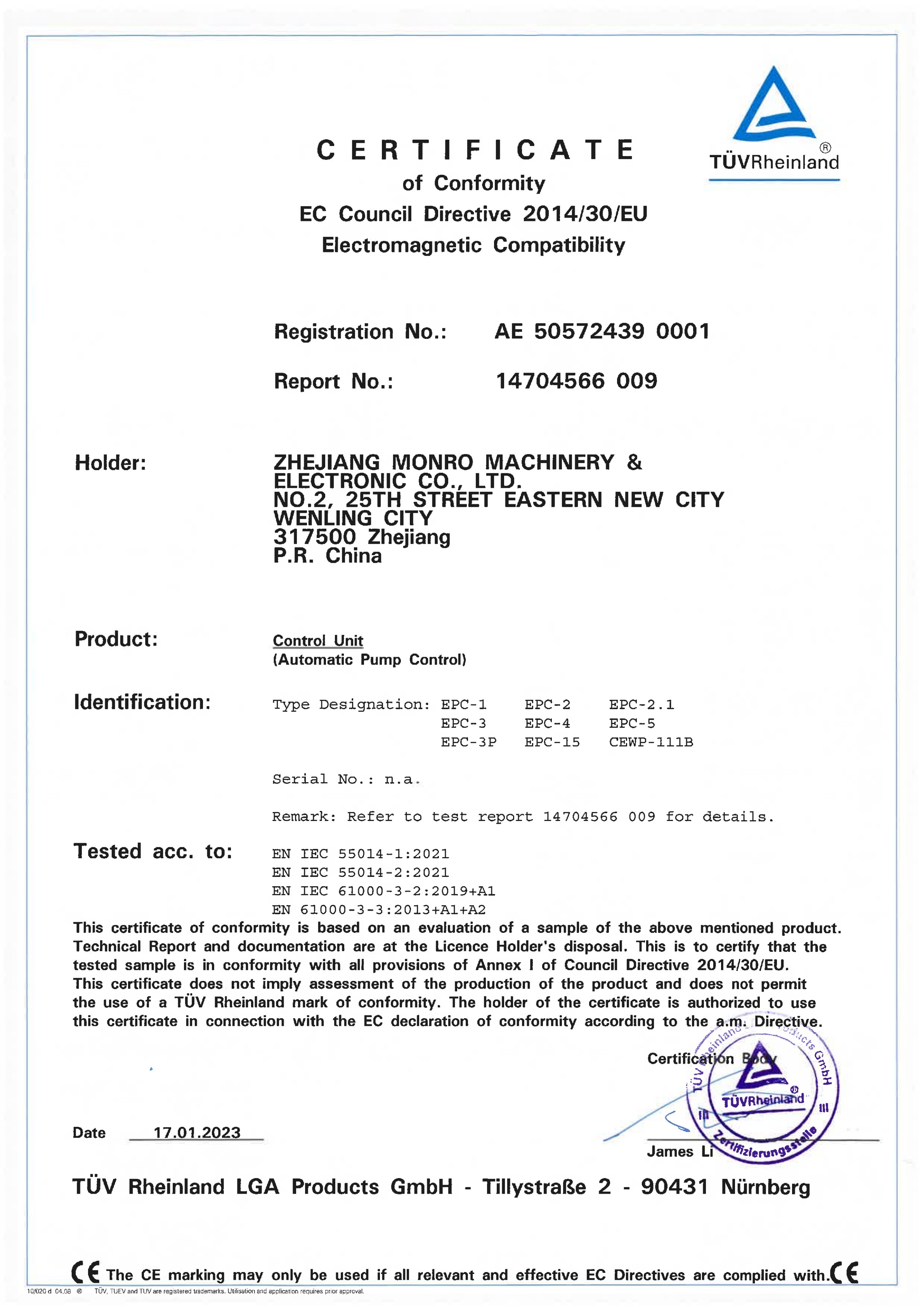
CE-EMC Certificate of Conformity AE 505724390001, issued by TÜV Rheinland LGA Products GmbH, covering Monro automatic pump control units in the EPC-1 series. Image: Monro Switch certification documentation.
Constant pressure in a multi-story home is a system outcome, not a product feature. What a shower on the second floor actually receives is the result of three variables: the static head created by the vertical distance between the water source and the outlet, the friction losses across the pipe run, and the pressures at which the pump controller starts and stops the pump. When those three are misaligned, the symptoms repeat across buildings — weak flow upstairs, a pump that restarts every time a tap is opened, and a pressure gauge that swings instead of holding.
The Monro EPC-1.1 is an automatic pump pressure control positioned for exactly this domestic setting. This guide covers how its adjustable starting pressure settings, IP65 enclosure and documented parameter set translate into multi-story constant-pressure performance, how a system should be commissioned around it, and where its documented limits sit.
The manufacturer behind the model, Monro Switch, is the trading identity of ZHEJIANG MONRO MACHINERY & ELECTRONIC CO., LTD, a pressure controller and float switch producer located in Wenling City, Zhejiang Province, China. The company was officially established in 2010, operates a 30,000 m² facility with around 200 employees and a 10-engineer R&D team, and reports a portfolio of more than 40 pressure controller models for water pump systems and air compressors.
Why multi-story homes lose constant pressure
Pressure in a tall house is governed by height before it is governed by equipment. As a working rule, every metre of vertical rise between the water source and an outlet consumes roughly 0.1 bar of available pressure, so a tap on the third floor of a house fed from ground level operates under a materially different pressure regime than a tap on the ground floor. Friction losses in pipework, elbows and fittings add further loss on top of that static penalty.
The result is a familiar pattern. A controller with a cut-in pressure that is too low leaves upper-floor outlets starved, particularly when two outlets run at once. A controller set too high produces the opposite problem: the pump reaches its cut-out quickly, stops, and restarts as soon as a tap opens, cycling hard and delivering an unsteady flow. Neither symptom is purely a pump-capacity problem; both are set-point problems, which is why the application of a pressure control switch matters more than its headline ratings in domestic work.
The opportunity is straightforward. When the starting pressure is matched to the height of the building and the pump is selected with the correct margin above it, the controller holds a stable working band, the pump runs in longer and fewer cycles, and every floor receives usable pressure without a booster tank on the roof.
What the EPC-1.1 is, and what it does
The EPC-1.1 is a pump pressure control that switches a water pump on and off automatically in response to system pressure. It is constructed from plastic and metal, and Monro's product data designates it for domestic applications — a narrower designation than the agriculture irrigation, water treatment and construction listings applied to several other models in the same series.
Its published parameter set is compact enough to reproduce in full:
| Parameter | EPC-1.1 documented value |
|---|---|
| Rated voltage | 220-240V / 110-120V |
| Power frequency | 50/60 Hz |
| Maximum power | 1.1 kW / 1.5 kW / 0.75 kW |
| Starting pressure settings | 1.2 bar, 1.5 bar, 2.2 bar |
| Connection thread | G1", G1 1/4", G1 1/2", NPT1" |
| Protection rating | IP65 |
| Maximum working temperature | 55 °C |
| Materials | Plastic and metal |
| Designated application field | Domestic |
Two characteristics shape how the unit behaves in a house. First, the starting pressure is selected from three discrete values — 1.2 bar, 1.5 bar and 2.2 bar — rather than being continuously adjustable. Second, the switching ceiling is 1.5 kW, which defines the pump motor sizes the unit can control directly. Both are specification facts a buyer can plan against; neither is a marketing claim.
The IP65 rating places the enclosure in the dust-tight, water-jet-protected class, which is the appropriate class for pump rooms, basements and outdoor cabinets where spray and dust are present. The 55 °C maximum working temperature is the upper ambient and media limit documented for the model.
The setpoint arithmetic behind constant pressure
An automatic controller of this type starts the pump when system pressure falls to the preset cut-in and stops the pump when pressure reaches the cut-out. In Monro's own description of the domestic water supply function, the controller activates the pump at the preset low-pressure setpoint and deactivates it at the high-pressure setpoint as system pressure changes.
Because that mechanism is directly tied to height, Monro publishes a practical rule for setting it:
Maximum water use height (m) = starting pressure (bar) × 10
Minimum pump head (m) = (starting pressure + 0.8 bar) × 10
The 0.8 bar term is a margin rather than a set-point: the pump's head must exceed the controller's start-up pressure by at least 0.8 bar for the system to reach its cut-out reliably. Applying the rule to the three EPC-1.1 settings gives a usable building-height map.
| Starting pressure setting | Maximum water use height | Minimum pump head |
|---|---|---|
| 1.2 bar | 12 m | 20 m |
| 1.5 bar | 15 m | 23 m |
| 2.2 bar | 22 m | 30 m |
Read as a building guide, 1.2 bar serves a home whose highest outlet sits within roughly 12 m of the controller, 1.5 bar extends that to 15 m, and 2.2 bar to 22 m. In domestic practice the lowest setting that still covers the top outlet is the sensible starting point, because a higher cut-in raises the pressure that every fixture, fitting and pipe joint experiences, and it also raises the head the pump must produce. The setting should be increased only when the top outlet cannot be served at the lower value, or when the pump's own lift characteristics require a higher cut-in.
A worked example for a three-story house
Take a house where the controller sits at ground level and the highest outlet is 10 m above it, and the selected pump has a rated head of 22 m. A 1.2 bar setting covers the 12 m requirement with margin, and the pump's 22 m head exceeds the required 20 m — so 1.2 bar satisfies both halves of the rule. If the same house had its highest outlet at 16 m, the 1.5 bar setting would be needed, and the pump would have to deliver at least 23 m of head. If the pump cannot deliver that, changing the controller setting will not fix the installation; the pump is the constraint.
Commissioning an EPC-1.1 in a domestic water system
Monro's documented installation guidance for this controller group follows a fixed sequence, and the order is not arbitrary.
- Check the water pump separately to ensure it operates normally, and verify that the parameters on the pump nameplate match those of the pressure controller. The pump head must be at least 0.8 bar higher than the controller's start-up pressure.
- Install the pressure controller in accordance with the direction indicated by the arrow on its housing.
- Connect the power cord of the controller to a separate plug wire, and wrap the connection securely with waterproof insulating tape to ensure proper sealing.
- After all electrical connections are complete, first open the main outlet valve and all water faucets, then connect the power supply. The controller will then begin operation.
Opening the outlets before energising the unit prevents the pump from starting against a closed system and allows trapped air to clear. Verifying the pump separately first means that, if performance is poor afterwards, the set-point is the variable under investigation rather than the pump itself.
Two system conditions are documented for the domestic water supply scenario this controller group serves: the working fluid is clean water, and the matched equipment is a water pump. The scenario documentation for the group lists IP65 protection, a 55 °C maximum working temperature and a 0.5–10 bar pressure range across the family.
Where the EPC-1.1 fits in domestic water supply
The model's clearest fit is a domestic or residential water supply system in which a single pump feeds a riser serving multiple floors — a well or borehole supply with a pressure vessel, a ground-floor booster feeding upper floors, or a system where a controller prevents the pump from running continuously when a rooftop tank is full. In each case the function is the same: automatic pump start/stop control driven by system pressure, with the cut-in set to cover the highest outlet.
It is worth noting that the EPC-1.1 shares its electrical and hydraulic parameters with the EPC-1 in Monro's range; the difference recorded in the documentation is the intended application field, with the EPC-1.1 designated domestic and the EPC-1 listed for irrigation, water treatment and construction duty. For a residential specification, the domestic designation is the cleaner documentary match, even where the physical parameters are identical.
The wider EPC series has an established role in irrigation, water treatment and construction water supply, which is why the materials and pressure settings of the domestic model look familiar across the range. Quantity evidence supports the scale of that range: Monro reports a retail client in China running 50 pieces of this controller family in a water supply application for two years, with reliable automatic pressure control as the recorded outcome, and documents an annual output of 2.88 million pieces for the EPC series.
Comparing the EPC-1.1 with adjacent Monro controllers
Buyers evaluating the EPC-1.1 usually have a second question alongside the pressure setting: would a neighbouring model in the same range suit the project better? The four models below are the ones most often weighed against each other, and the comparison uses only published parameters.
| Model | Starting pressure | Maximum power | Rated voltage | Protection | Documented notes |
|---|---|---|---|---|---|
| EPC-1.1 | 1.2 / 1.5 / 2.2 bar | 1.1 / 1.5 / 0.75 kW | 220-240V / 110-120V | IP65 | Domestic designation; threads G1", G1 1/4", G1 1/2", NPT1"; 55 °C |
| EPC-1 | 1.2 / 1.5 / 2.2 bar | 1.1 / 1.5 / 0.75 kW | 220-240V / 110-120V | IP65 | Same thread options; listed for irrigation, water treatment and construction |
| EPC-3 | 1.2 / 1.5 / 2.2 bar | 0.55 / 1.1 / 1.5 / 0.75 kW | 220-240V / 110-120V | IP65 | G1" thread; 55 °C |
| EPC-10 | 0.5–9.3 bar (adjustable range) | 2.2 / 1.1 kW | 110-240V | IP65 | Built-in check valve, run-dry protection and pressure gauge; 10 bar maximum working pressure; stopping pressure 0.7–9.5 bar |
 14704564-23 EPC-10-12-14-16_01(1).png "TUV Rheinland Safety Certification R 50175890 for Monro EPC-10, EPC-12, EPC-14 and EPC-16")
TÜV Rheinland safety certification R 50175890, covering Monro automatic pump control units EPC-10, EPC-12, EPC-14 and EPC-16 — the models buyers step up to when a wider adjustable pressure range is required. Image: Monro Switch certification documentation.
Where a project requires documented compatibility with both surface and submersible pumps, Monro lists that attribute on the EPC-5.1, which offers starting pressure settings of 1.2, 1.5 or 2.2 bar with an adjustable starting range from 1.2 to 2.5 bar, maximum power ratings of 4 kW, 1.1 kW or 2.2 kW, and rated voltages of 110-120V, 220-240V or 380V, and on the EPC-13, which is documented for agriculture irrigation, water treatment and construction use with surface or submersible pumps.
Documented limits, and when to step up
A guide that only lists strengths is not usable for procurement. The following boundaries are the ones that most often decide a specification against the EPC-1.1.
- Discrete starting pressures. The EPC-1.1 offers three fixed starting pressure values rather than a continuously adjustable band. Where a system needs fine tuning across a wide range, the EPC-10's documented starting pressure range of 0.5–9.3 bar is the more flexible option.
- 1.5 kW switching ceiling. Multi-stage booster pumps sized for larger houses can exceed the EPC-1.1's maximum power rating. The motor rating must be checked before the controller is specified.
- Check valve and run-dry protection. A built-in check valve and run-dry protection are documented features of the EPC-10, not attributes listed in the published EPC-1.1 parameter set. Buyers who treat non-return or dry-run cut-off as mandatory should confirm the model-level configuration with the supplier rather than assume it.
- No published maximum working pressure for the EPC-1.1. The model's published parameter set states voltage, frequency, maximum power, starting pressure settings, threads, protection rating, materials and maximum working temperature, but does not state a maximum working pressure figure, whereas the EPC-10 is documented at 10 bar. High-head installations should confirm this value before ordering.
- 55 °C temperature limit. Hot-water recirculation loops and high-ambient plant rooms can exceed the EPC-1.1's documented maximum working temperature. Several other EPC models — among them the EPC-10, EPC-13, EPC-14 and EPC-15 — are documented at 60 °C.
- Certificate scope. The EPC-1.1 is not named on the CE-EMC certificate that covers EPC-1, EPC-2, EPC-2.1, EPC-3, EPC-3P, EPC-4, EPC-5 and EPC-15. Buyers who need CE documentation tied to the exact model should request it directly.
Certification and compliance checkpoints
Compliance documentation for pressure controls is usually reviewed at the model level, and the relevant documents for this product area are specific.
- ISO 9001:2015, certificate 20126Q00115R300, issued by BeiJing ZHONGRUI Unite, with the scope recorded as “Manufacture of water pump pressure switch”, valid from 30 June 2026 to 29 June 2029 under GB/T19001-2016/ISO9001:2015. The EPC-1.1 is listed among the covered products on this system certificate.
- CE-EMC Certificate of Conformity AE 505724390001, issued by TÜV Rheinland LGA Products GmbH, covering control units EPC-1, EPC-2, EPC-2.1, EPC-3, EPC-3P, EPC-4, EPC-5, EPC-15 and CEWP-111B under Directive 2014/30/EU, tested to EN IEC 55014-1:2021, EN IEC 55014-2:2021, EN IEC 61000-3-2:2019+A1 and EN 61000-3-3:2013+A1+A2.
- Automatic control standards. Monro's certification dossiers cite EN 60730-1:2016+A1+A2 and EN 60730-2-6:2016+A1. The current international edition for automatic electrical pressure sensing controls is IEC 60730-2-6:2025, published by the International Electrotechnical Commission.
- Trade classification. Water pump pressure switches are commonly traded under HS code 853650, covering electrical switches for voltages not exceeding 1000 V.
- Production testing. The manufacturer documents 100% testing of its products.
Market context for domestic pressure control
The category that contains the EPC-1.1 is large and still predominantly mechanical in installed base. The global pressure switch market was valued at USD 3.2 billion in 2025 and projected to grow from USD 3.38 billion in 2026 to USD 5.13 billion by 2034, according to Fortune Business Insights. Within that market, electromechanical pressure switches accounted for approximately 62% of global share in 2024, with solid-state electronic pressure switches at approximately 38%, according to Market Research Future.
For a domestic multi-story project, that mix has a practical meaning. Most installed systems in the field are mechanical, while the growth conversation concerns electronic controls with defined set-points and sealed enclosures. Buyers specifying today's installation are choosing inside that transition, and the selection criteria — matched starting pressure, adequate enclosure protection and documentation naming the exact model — apply regardless of which technology is selected.
Supply, customization and lead time
Procurement terms for the EPC-1.1 sit within Monro's standard commercial framework. The documented minimum order quantity is 204 pieces, with a lead time of 45 days. Monthly capacity is reported at 180,000 pieces for the EPC series of automatic pump controls, 250,000 pieces for the KRS series of mechanical pressure controls, and 30,000 pieces for float switches and liquid level controls.
For private-label and distributor programmes, the documented customization options are cable length, cable material, brand customization, colour box customization and colour customization. After-sales support is recorded as remote support with a one-year warranty. The company reports a 90% export ratio, with products shipped to Asia, Europe, North and South America, and the Middle East and Africa.
Future outlook
Three developments look likely to shape domestic pressure control in multi-story housing. Set-point flexibility will keep moving toward wider adjustable ranges, which is the direction already visible between the fixed 1.2/1.5/2.2 bar options of the EPC-1.1 and the adjustable range documented on the EPC-10. Integrated protection — check valves, run-dry cut-off, gauges — will continue to migrate down the range as builders ask for fewer separate components. And documentation granularity will matter more, because buyers are increasingly checking whether a certificate names the model they are ordering rather than the family that surrounds it.
For now, the first decision in a multi-story installation remains unchanged: establish the height the pump must serve, set the starting pressure to cover it, and confirm the pump delivers that head plus 0.8 bar of margin.
FAQ
What starting pressure should an EPC-1.1 be set to in a three-story house?
Use the documented rule: starting pressure in bar multiplied by 10 gives the maximum water use height in metres. A 1.2 bar setting serves up to 12 m, 1.5 bar up to 15 m and 2.2 bar up to 22 m. Select the lowest of the three settings that still covers the highest outlet, and confirm the pump head is at least 0.8 bar above the start-up pressure — 20 m of head for a 1.2 bar setting, 23 m for 1.5 bar and 30 m for 2.2 bar.
Does the EPC-1.1 include a built-in check valve and run-dry protection?
A built-in check valve and run-dry protection are documented features of the EPC-10 in the same range, which also lists a pressure gauge, a 10 bar maximum working pressure, a 0.5–9.3 bar starting pressure range and a 0.7–9.5 bar stopping pressure range. The published EPC-1.1 parameter set covers rated voltage, power frequency, maximum power, starting pressure settings, connection threads, protection rating, materials and maximum working temperature, and does not list a check valve or run-dry protection. Buyers who require those two functions should confirm the exact configuration of the model being ordered.
Can the EPC-1.1 be used with a submersible pump?
Compatibility with both surface and submersible pumps is documented for specific models in the Monro range, including the EPC-5.1 and the EPC-13. For the EPC-1.1, the documented operating requirements are a clean water medium and a matched water pump whose head is at least 0.8 bar above the controller's start-up pressure. Because pump type and motor rating both affect suitability, the pump specification should be confirmed with the manufacturer before ordering.
What connection thread options does the EPC-1.1 offer?
The documented thread options are G1", G1 1/4", G1 1/2" and NPT1". NPT variants are typically specified where North American pipe threads are used in the system, so the thread should be matched to the local fittings and to the pump outlet before the order is placed.
What protection rating and temperature limit apply to the EPC-1.1?
The EPC-1.1 carries an IP65 protection rating and a maximum working temperature of 55 °C. IP65 denotes a dust-tight enclosure protected against water jets. Installations where ambient temperature or media temperature exceeds 55 °C fall outside the documented limit; several other models in the range, including the EPC-10, EPC-13, EPC-14 and EPC-15, are documented at 60 °C.
How can a buyer verify compliance documentation for the EPC-1.1?
Two document types matter. The ISO 9001:2015 system certificate 20126Q00115R300, valid from 30 June 2026 to 29 June 2029 with the scope “Manufacture of water pump pressure switch”, lists the EPC-1.1 among its covered products. The CE-EMC certificate AE 505724390001 covers EPC-1, EPC-2, EPC-2.1, EPC-3, EPC-3P, EPC-4, EPC-5, EPC-15 and CEWP-111B and does not list the EPC-1.1. Buyers should therefore request the certificate that names the exact model under consideration, rather than relying on family-level documentation.
Reference material
Monro Switch publishes a full product catalogue covering the EPC series of automatic pump controls and the wider pressure control and float switch range, including models referenced in this guide. The catalogue is available for download here: Monro catalogue 2025.