
Optical Fiber Cable Capability: How to Evaluate a Supplier
Optical fiber cable procurement decisions in carrier and data center projects are moving beyond datasheet comparisons. Buyers increasingly need to verify whether a manufacturer has the engineering depth, customization flexibility, and testing infrastructure to support project execution. This article examines those capability signals, using Nanfang Communication as a documented example of an integrated fiber optic cable manufacturer.
Nanfang Communication (Jiangsu South Communication Technology Co., Ltd.) is a Chinese manufacturer based in Changzhou, Jiangsu Province, and a subsidiary of Hong Kong-listed South Communication Holdings Limited (Stock Code: 1617.HK). Founded in July 1992, the company researches, develops, produces and sells communication optical cables, optical fibers, communication cables, optical-electrical accessories, ODN products, MPO optical connectors, MT-FA series optical passive components, and PM FA fiber arrays. Its production facility covers 26,795.3 m² with 360 employees and an annual output of 3,000,000 core kilometers.
The Capability Gap in Optical Fiber Cable Procurement
Network project leaders face a recurring evaluation gap when selecting optical fiber cable suppliers. A datasheet can show fiber type, core count, attenuation, and sheath material. It does not demonstrate whether the factory can handle custom engineering requests, maintain consistent quality across large orders, or deliver compatible components beyond the cable itself.
This gap matters because network projects—whether FTTx access, 5G backhaul, metropolitan backbone, or data center interconnect—depend on a chain of components. A cable supplier that cannot support the surrounding ODN or high-density interconnect elements transfers integration effort and risk to the buyer.
Multi-vendor coordination is particularly difficult when project requirements include both indoor and outdoor segments. Indoor optical cable must meet flame-retardant and bend requirements, while outdoor optical cable must withstand moisture, temperature variation, and mechanical stress. A supplier experienced in both environments can help buyers define a coherent boundary between the two.
The opportunity is to evaluate suppliers on capability rather than price alone. A manufacturer that combines in-house manufacturing, R&D, engineering design, system integration, and ODM/OEM services has a different structural position than a single-product line factory. The practical question is not only “can they deliver a standard loose tube or ribbon cable?” but “can they design, test, and integrate the full connection chain for my project?”
What Integrated Manufacturing Capability Looks Like
Nanfang Communication's product range includes indoor and outdoor optical cables, PLC optical splitters, fiber optic connectors, MPO multi-core connectors, optical modules, and custom specialty fibers or cables. The portfolio also covers ribbon optical cable, bow-type drop optical cable, loose tube optical cable, optical cable splice closures, FTTH optical cable distribution boxes, MT-FAU fiber optic assemblies, WDM wavelength division multiplexers, MCF multi-core fiber, direct attach cable modules, and MPO high-density patch panels.
According to company documentation, the manufacturer provides manufacturing, R&D, engineering design, system integration, and ODM/OEM services. Customization options include core count, fiber type (single-mode, multimode, ribbon, or multi-core), sheath material and color, connector types and cabling schemes, labeling, and packaging.
On the production side, the company employs 80 R&D engineers and reports a monthly capacity of 250,000 core kilometers, with a stated minimum order quantity of 1 core kilometer. Such a low MOQ matters for procurement teams that want to validate quality with a trial order before committing to large-scale rollout.
Why a Multi-Product Portfolio Changes the Procurement Equation
For an FTTH project, the required component set is not limited to cable. It includes bow-type drop cable for subscriber access, FTTH optical cable distribution boxes for termination, PLC optical splitters for signal distribution, and fiber optic connectors for field termination. For data center work, the emphasis moves to MPO multi-core connectors, high-density patch panels, pre-terminated breakout assemblies, and direct attach cable modules.
When all of these are available from one manufacturer, the buyer can consolidate specifications and reduce the number of interfaces where compatibility issues arise. One of the clearest capability signals in optical fiber cable procurement is whether the supplier can cover the link, not just the cable.
Quality Evidence: Testing and Certifications
Capability claims are only meaningful when supported by verifiable quality processes. Nanfang Communication reports a quality management system that includes incoming material inspection, in-process control, and finished-product testing. The test categories cover optical loss/attenuation, mechanical performance, and waterproof/sealing performance—the three factors that most directly affect cable survival in field installation and long-term network operation.

CNAS laboratory accreditation (L11717) gives procurement teams a formal benchmark for the manufacturer's optical cable testing competence.
The company holds CNAS laboratory accreditation (Certificate No. L11717) under ISO/IEC 17025:2017, with a scope covering optical fiber cable and optical communication component testing and calibration. For buyers, a CNAS-accredited lab means the manufacturer's test reports carry a recognized competence benchmark rather than relying only on internal claims.
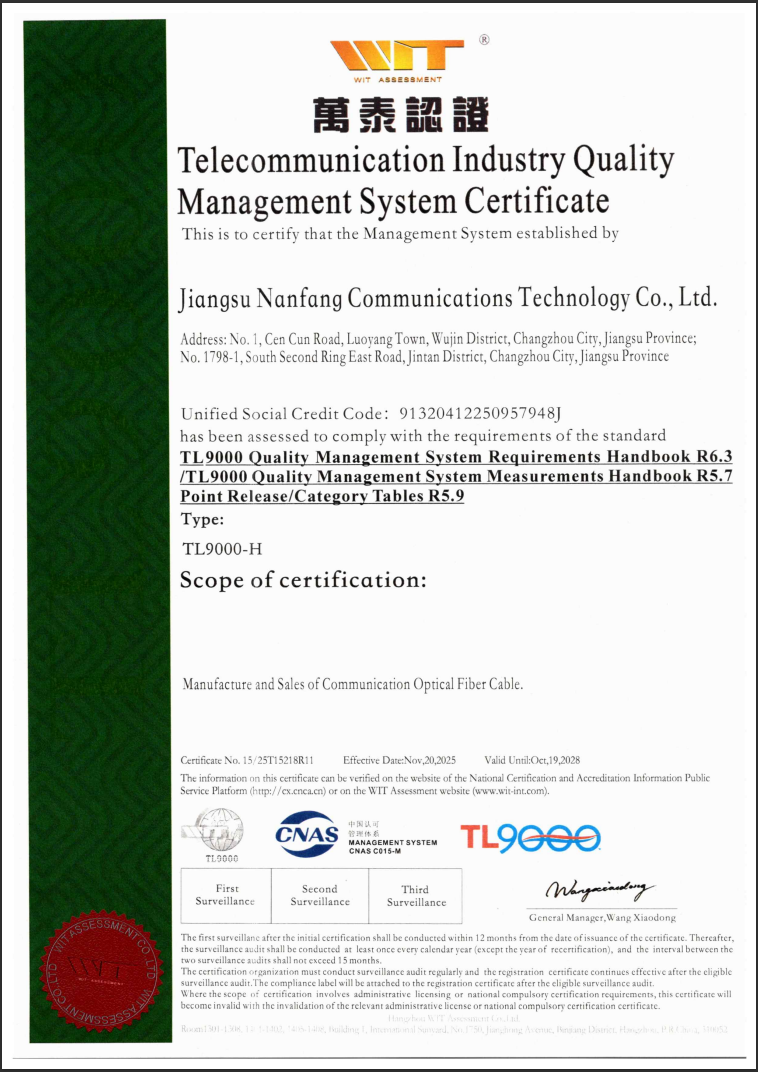
TL9000 certification addresses quality management specifically for the telecommunications industry, covering the manufacture and sale of communication optical fiber cable.
Management system certifications add another layer of evidence. Nanfang Communication has obtained ISO 9001, TL9000, ISO 14001, ISO 45001, and ISO 50001 certifications, covering quality, environmental, occupational health and safety, and energy management. The TL9000 standard is specifically designed for telecom suppliers, which makes it relevant to carrier-grade cable procurement.
Customization Dimensions That Matter
From an engineering perspective, the most valuable customization options in optical fiber cable are:
| Dimension | Options |
|---|---|
| Fiber type | Single-mode (e.g., G.652/G.657), multimode, ribbon, multi-core |
| Core count | Project-specific fiber counts |
| Sheath material / color | PE, LSZH, etc., in specified colors |
| Connector types | LC, SC, MPO/MTP, custom cabling schemes |
| Cable construction | Loose tube, bow-type drop, ribbon, armored (steel wire / steel tape) |
| Labeling / packaging | Custom labels, drum lengths, packaging requirements |
The fiber type decision is often the most consequential. Single-mode fiber following ITU-T G.652 standards remains the default for wide-area and access networks, while G.657 bend-insensitive fiber is widely used in FTTH installations where tight bends are common. Multimode fiber, typically OM3/OM4/OM5, serves short-reach data center links. Ribbon fiber supports high fiber counts in compact cable diameters. Multi-core fiber (MCF) is an emerging option for future capacity scaling. A manufacturer with engineering design capability can help buyers select the appropriate fiber and construction rather than simply quoting a catalog SKU.
Proven Applications and Deployment Scenarios
The documented applications for Nanfang Communication's optical fiber cable products span FTTx access, metropolitan and backbone network construction, data center interconnects, 5G backhaul, and enterprise campus cabling. Customer types include telecom operators, system integrators, contractors, data centers, and enterprise customers.
For FTTx access networks, bow-type drop cable is commonly selected for its bend performance and field termination characteristics, combined with FTTH optical cable distribution boxes at the subscriber side. For backbone and metropolitan networks, outdoor loose-tube cable with steel tape or steel wire armoring (e.g., GYTA53) provides the necessary mechanical protection for duct and direct-buried installation. For data center interconnects, the relevant products migrate to MPO assemblies, high-density patch panels, and direct attach cable modules.
The company has established long-term cooperative relationships with telecom operators including China Telecom, China Mobile, China Unicom, and China Broadcast Network, as well as private network users in high-speed railway, power grid, and chemical industries. It operates 28 provincial-level offices across China, which supports localized product sales, technical support, and after-sales service. This deployment footprint is relevant for buyers who need responsive support during rollout.
Market Trends Reinforcing Capability-Based Procurement
The global optical fiber cable market was valued at approximately USD 13.45 billion in 2025 and is projected to reach USD 36.48 billion by 2034 (Custom Market Insights). China's exports of optical fiber cables (HS 854470) reached approximately USD 2.52 billion in 2024 (OEC). The MPO fiber optic connector market is projected to grow at a CAGR of 13.6% through 2035, driven by AI compute clusters and hyperscale data centers (Business Research Insights). The global fiber termination box market, a proxy for FTTH distribution demand, was valued at USD 2.8 billion in 2025 (Dataintelo).
Two conclusions follow. First, the volume of optical fiber cable demand remains large and is expanding. Second, the fastest-growing segments are exactly those requiring more engineering integration: high-density MPO interconnect, AI-era data center cabling, and FTTH distribution. Buyers in these segments need suppliers that can combine cable, connectivity, and distribution expertise.
Integrated Suppliers vs. Traditional Multi-Vendor Procurement
The traditional procurement pattern for optical networks is to source cables, connectors, splitters, and distribution boxes from separate vendors, often selecting each category by lowest bid. For highly standardized products, this can produce attractive unit prices.
However, multi-vendor procurement carries coordination costs that are frequently underestimated. Interface standards must be reconciled across suppliers. When a network fault occurs, responsibility can be diffused across multiple manufacturers. Test data may not be directly comparable. For projects with tight rollout schedules, these risks can offset the apparent price savings.
An integrated manufacturer such as Nanfang Communication addresses those issues by keeping engineering ownership across fiber, cable, ODN, and connector products. The documented certification set and CNAS-accredited laboratory provide a shared quality framework for the entire portfolio.
Buyers should also look at the structure of the supplier's business: does the factory perform its own cable manufacturing, or does it outsource? Does it have in-house R&D and a laboratory, or is testing contracted out? Legal-entity background can also matter. Nanfang Communication operates as a subsidiary of a Hong Kong-listed parent, which provides financial transparency and long-term ownership stability. These structural signals are not always visible on a product datasheet, but they reliably indicate whether a supplier can act as an engineering partner over the project lifecycle.
There are legitimate boundaries to this model. An integrated supplier may not offer the lowest per-category price for every product when compared with a high-volume specialist. Nanfang Communication's current export focus is primarily China's Hong Kong and Southeast Asia regions; buyers in other geographies should confirm logistics, warehousing, and after-sales coverage before selection. Integrated capability is a procurement advantage, not a universal substitute for category-level competition.
Capability Checklist for Buyers
For procurement teams in the Evaluation and Execution stages, the following checklist condenses the evidence points discussed in this article:
- Does the supplier offer ODM/OEM services, or only standard catalog products?
- Is there a documented three-stage quality control process—incoming, in-process, and final testing?
- Does the factory hold accredited laboratory status (e.g., CNAS under ISO/IEC 17025)?
- Are telecommunications-specific certifications such as TL9000 in place?
- Can the supplier cover the full link—cable, splitter, connector, and distribution—within one portfolio?
- What is the MOQ, and is a trial order feasible?
- Are export markets and service coverage aligned with the project location?
- Does the supplier offer engineering design support for custom fiber types and cable constructions?
Future Outlook
Capability requirements in optical fiber cable procurement are expected to keep rising. AI data center buildouts are pushing MPO and multi-fiber interconnect demand upward, with the MPO connector market projected to grow at a 13.6% CAGR through 2035. Multi-core fiber is moving from research toward deployment consideration, and manufacturers with in-house R&D and engineering design capacity will be better positioned to support early adopters.
From a procurement perspective, closer supplier partnerships also reduce switching risk. As network projects become more complex, the cost of changing manufacturers mid-project increases, and factory audits, engineering responsiveness, and demonstrated quality systems are taking a larger role in supplier selection.
For additional technical specifications on MPO and fiber optic assemblies, the manufacturer makes the following document publicly available: Nanfang Communication MPO Product Brochure.
FAQ
What does OEM/ODM capability mean for optical fiber cable buyers?
OEM/ODM capability means the manufacturer can produce cable according to a buyer's specification or design, rather than only offering standard catalog products. Nanfang Communication states that it provides manufacturing, R&D, engineering design, system integration, and ODM/OEM services, with customizable items including core count, fiber type, sheath material/color, connector types, cabling schemes, labeling, and packaging.
How can buyers verify an optical fiber cable maker's quality control?
Buyers can verify quality control by checking for a structured quality management system covering incoming material inspection, in-process control, and finished-product testing. Nanfang Communication's documented system includes optical loss/attenuation tests, mechanical performance verification, and waterproof/sealing testing. The company also holds CNAS laboratory accreditation (L11717) under ISO/IEC 17025:2017, which provides formal recognition of its testing and calibration competence.
Which customization options matter most in optical fiber cable procurement?
The most commonly relevant customization options are core count, fiber type (single-mode, multimode, ribbon, or multi-core), sheath material and color, connector types, cabling schemes, labeling, and packaging. Loose-tube, ribbon, bow-type drop, and armored constructions are common structural variants. Exact specifications must be confirmed against the manufacturer's per-model datasheet.
How does an integrated product portfolio benefit FTTH or data center projects?
An integrated portfolio allows a project to source optical cables, PLC splitters, distribution boxes, MPO connectors, and patch panels from one manufacturer, reducing the risk of interface mismatches. Nanfang Communication's product range covers indoor and outdoor optical cables, PLC optical splitters, fiber optic connectors, MPO multi-core connectors, optical modules, MT-FAU assemblies, WDM devices, MCF multi-core fiber, and MPO high-density patch panels.
What is the minimum order quantity for custom optical fiber cable from Nanfang Communication?
The stated minimum order quantity is 1 core kilometer. Monthly production capacity is 250,000 core kilometers. Lead time is not standardized and depends on model and quantity; the company advises that samples or small orders typically take several weeks, while large orders may take months.
What are the limitations of working with a single integrated optical fiber cable supplier?
The main limitation is that an integrated supplier's per-category price may not always be lower than that of a specialist focused on one product. In addition, Nanfang Communication's export markets are primarily China's Hong Kong and Southeast Asia regions, so buyers in other regions should verify logistics and after-sales coverage. Multi-vendor sourcing may still make sense for highly standardized purchases where lowest price per item is the dominant criterion.