
Onumen Rollable LED Screen Certifications and Patents
Onumen Rollable LED Screen Certifications and Patents
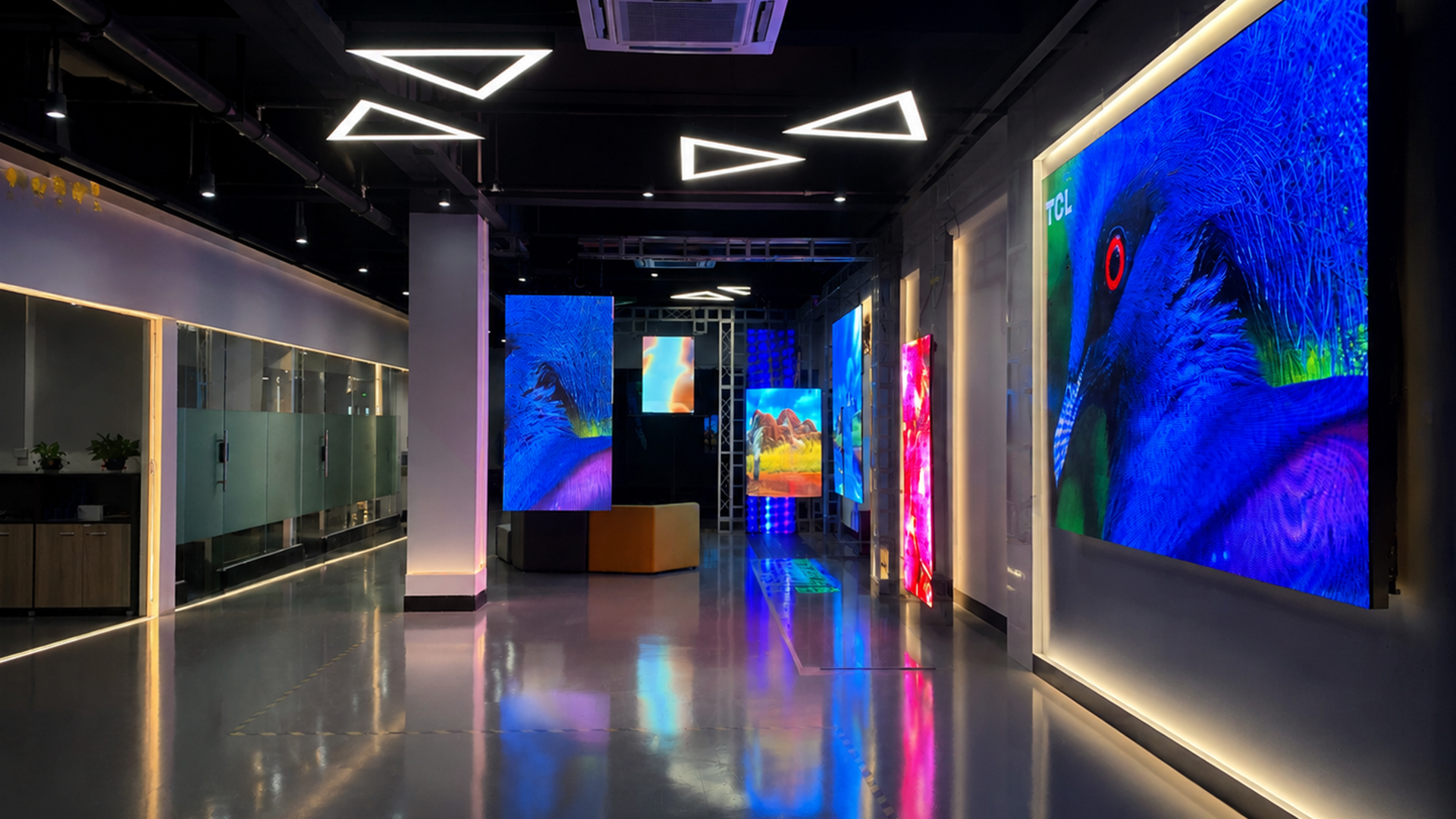
Exhibition hall display area: rollable and foldable LED screen formats shown in a manufacturer demonstration space.
Buyers evaluating a rollable LED screen supplier usually have a verification problem rather than an information problem. Capability descriptions across this category read alike — lightweight panels, fast deployment, flexible formats — while the details that genuinely separate one manufacturer from another sit in documents: certificate numbers, issuing bodies, patent grant numbers, testing records and scope statements. For buyers at the decision stage, those documents are the only part of a supplier file that can be checked without taking the supplier at its word.
Onumen Technology Co., Ltd. is a Shenzhen, China–based LED display manufacturer founded in 2009 that specializes in lightweight foldable and rollable LED display solutions. Its range covers power-screen separation (architecture) LED screens, folding LED displays, rolling LED screens and mobile quick-assembly foldable displays, organized into product families that include Magic Plus, Smart T Plus, Rolling FRL/FRSL, FC and EP series. The company operates a 2,000 m² production facility with a 20-engineer R&D team, reports annual output of 9,000 m², and exports to markets including the USA, Europe, Japan, South Korea, Russia and the Middle East.
Two categories of evidence are worth examining in detail for this supplier: management-system certifications and granted patents. Neither is a performance guarantee. Both are independently checkable — and that is precisely what makes them useful in a procurement decision.
Certification Claims Are Universal; Certification Records Are Not
Almost every LED display manufacturer lists ISO, CE, FCC and RoHS on its website. That uniformity creates a false equivalence in supplier comparison. A claim is a marketing statement; a record contains six specific elements: the exact standard and revision year, the certificate number, the issuing certification body, the legal name of the certificate holder, the scope statement, and a register entry a buyer can query directly.
When all six elements are present, third-party verification takes minutes. When they are absent, the buyer is relying on the supplier's own description of its own capability — which is exactly the situation certification was designed to avoid.
The distinction matters most in two procurement situations. The first is OEM/ODM programs, where the buyer's brand carries the product into regulated markets and the buyer inherits the compliance exposure. The second is public-venue installation, where electrical and fire documentation typically forms part of the permit file rather than an internal purchasing preference.
Decision rule: treat a certification as a threshold input, not as a differentiator. What differentiates suppliers is whether the certificate number, holder name and scope can be verified, and whether product-level test reports exist for the specific panel being quoted.
What Onumen's ISO Certificates Cover
The documentation referenced for Onumen's rollable and foldable product lines lists three management-system certificates: ISO 9001:2015 (95722Q0036R0S), ISO 14001:2015 (95722E0015R0S) and ISO 45001:2018 (95722S0012R0S). The certification bodies named in connection with the company's certificate set include Boston Certification, CEPREI, TÜV Rheinland and Shenzhen BST. Each standard addresses a different management discipline, and each has a different meaning for a buyer.
Manufacturing site: the management processes referenced in the certification file are operated from the company production base.
| Standard | Certificate number | What it attests | What it does not attest |
|---|---|---|---|
| ISO 9001:2015 | 95722Q0036R0S | Quality management system: documented process control, inspection stages, non-conformance handling and corrective action across production. | Does not certify the optical, electrical or lifetime performance of any individual LED product model. |
| ISO 14001:2015 | 95722E0015R0S | Environmental management system: control of environmental aspects, waste streams and resource use within operations. | Does not indicate product-level environmental ratings or recyclability scores. |
| ISO 45001:2018 | 95722S0012R0S | Occupational health and safety management: workplace risk identification and control for production personnel. | Does not replace product electrical safety certification for the end installation. |
ISO 9001:2015 is the standard most relevant to repeat-order reliability. In practice it indicates that quality outcomes depend on a documented system — incoming material checks, in-process inspection, final inspection, traceability and corrective action — rather than on the habits of individual operators. For a buyer placing a second or third order, that distinction determines whether the tenth shipment behaves like the first.
ISO 14001:2015 has become a procurement requirement rather than a preference for many European and North American brand owners, because supply-chain environmental reporting now flows into their own disclosures. A supplier without an environmental management system forces the buyer to build that evidence manually.
ISO 45001:2018 is frequently overlooked in LED display sourcing, yet rollable screen production involves manual handling of large flexible panels, lamination and cutting processes where workplace risk control is directly tied to process stability. A production line with an active safety management system tends to have fewer unplanned stoppages and lower defect variability.
Product-level compliance complements the management-system layer. The company's rollable and foldable product lines also carry CE, FCC and RoHS certification, and the design work has been recognized with Red Dot, iF and French Design Awards. Awards are external evaluation signals about design execution; they are not substitutes for test data, and buyers should treat them accordingly.
The Patent Portfolio: Jurisdictions, Numbers and What Ownership Means
Patents answer a different question from certifications. Certifications describe how a company manages its processes; patents describe what a company owns technically and where it owns it. Onumen's patent portfolio includes grants in four major jurisdictions:
- Europe: EP2755459
- United States: US 8,899,791 B2
- South Korea: KR 10-1692125
- China: CNIPA ZL201010180375.2
The company also describes a global patent pool covering Asia, Europe, the Americas and Oceania. Its published capability information refers to nearly 100 global invention patents relating to its separable architecture approach; that figure is supplier-reported and should be treated as such, while individual patent families can be verified directly through the relevant patent office registers.
Patent rights are jurisdictional, not global. A grant in the United States provides no protection in Europe, and a Chinese grant does not extend to South Korea. The fact that the same technology family is protected across Europe, the United States, South Korea and China indicates that the manufacturer judged its core architecture worth defending in the jurisdictions where it sells — which, for Onumen, align with its stated export markets of the USA, Europe, Japan, South Korea, Russia and the Middle East.
What patent ownership proves — and what it does not
A granted patent confirms that a claimed technical solution was examined by a patent office and granted to a named assignee in a specific jurisdiction. It does not confirm field performance, manufacturing consistency, or commercial superiority over an alternative design. Buyers who treat a patent list as a quality certificate are reading it incorrectly.
What patents do provide in an OEM/ODM negotiation is a set of practical assurances. Design ownership reduces the risk that a customized tooling or panel architecture is encumbered by a third party's claim. A concentrated portfolio in a specific technical area — for Onumen, the separable power-and-screen architecture and the rolling mechanism — signals where the manufacturer's engineering investment has been directed over time. And granted IP in a category can support exclusivity terms in a distribution or OEM agreement, because the supplier can rely on a defensible right rather than on a trade secret alone.
From Certificate to Production Floor: How Documentation Connects to Testing
The gap between a certificate and a shipping product is closed by test routines. For rollable LED screens, the dominant mechanical risk is repeated rolling and unfolding, which concentrates stress in the rolling path and in the module connection structure and affects long-term operation performance. According to the company's own risk-control documentation, the response combines precision roller mechanism design, an optimized module connection structure, controlled rolling speed, and strict durability testing.
Quality assurance procedures documented by the company include continuous cycle testing, aging tests, and complete quality inspection before shipment. These are the operational records that sit underneath the ISO 9001:2015 certificate: the certificate states that such procedures should exist within the management system, while cycle test records and aging test reports demonstrate that they were executed for a given production batch.
Manufacturing context helps a buyer calibrate scale against their program: a 2,000 m² facility, an R&D team of 20 engineers, and reported annual output of 9,000 m². A procurement team placing a pilot order and a team planning a multi-year rollout need different things from a supplier, and these figures allow both to judge whether the capacity and engineering depth on offer match the commitment being requested.
Application Fit: Where the Evidence Applies
The rollable and foldable format is not a universal replacement for rigid screens. It is optimized for applications where weight, transport volume and setup time drive project economics. The product families covered by this certification and patent set — Magic Plus, Smart T Plus, Rolling FRL/FRSL, FC and EP series — are documented as suitable for stage performances, concerts, events, exhibitions and creative installations that require frequent setup, and the company reports wider application in cultural tourism attractions, commercial advertising, fixed signage and event conferences.
For a portable quick-assembly LED roll-up screen used in a hotel ballroom, corporate showroom, conference or product launch, the buyer's checklist is largely logistical: unit weight, packing volume, crew size and setup time. For an airport, stadium, or theater installation, the checklist changes, because operations teams and permitting authorities generally require documented electrical safety and fire behavior rather than a marketing specification sheet. The standards commonly referenced for flexible LED screens in public spaces include UL 62368-1 for electrical safety and UL 94 V-0 for fire resistance, and photobiological safety for LED products in the EU and China is addressed through IEC 62471.
Those standards originate with third-party bodies, not with suppliers, which is why they are useful in a shortlist decision: a supplier either can produce the corresponding test reports for the specific panel or cannot. A rollable LED conference screen, an outdoor advertising LED roll-up screen and a mobile modular LED roll-up screen will each require a different documentation package, and the package — not the product photo — is what a venue's technical reviewer will examine.
Market Context: Why Documentation Is Becoming a Procurement Filter
The category is expanding quickly, and expansion changes what buyers need to check. The global flexible display market, which includes rollable form factors, was valued at approximately USD 20.1 billion to 21.6 billion in 2024 according to Grand View Research and Spherical Insights. Within that total, the rollable and foldable display segment specifically is projected by Meticulous Research to grow from USD 5.1 billion in 2024 to nearly USD 60 billion by 2035.
Growth of that magnitude attracts new entrants, and new entrants do not all arrive with a complete documentation set. The practical consequence for procurement teams is a shift in screening behavior: because specification sheets in the rollable segment converge quickly, the criteria that remain genuinely discriminating are the ones that are expensive for a supplier to obtain and easy for a buyer to verify — management-system certificates with traceable numbers, product test reports, and granted patents with identifiable jurisdictions.
This is a structural trend rather than a temporary one. As the addressable market widens into venues with formal compliance review processes, documentation quality functions as a market-entry filter for suppliers and as a risk-reduction tool for buyers. Suppliers that treat certification as a filing exercise will increasingly be screened out ahead of commercial negotiation, not during it.
Rollable LED Screens Versus Traditional Cabinet Displays: Advantage and Boundary
The measurable differences between a cabinet-free rollable panel and a conventional cabinet display are concentrated in logistics and installation — the two cost centers that dominate touring and multi-event budgets.
| Dimension | Traditional cabinet LED display | Cabinet-free foldable / rollable LED display |
|---|---|---|
| Structure | Rigid cabinet with supporting steel structure | Cabinet-free, ultra-thin flexible panel (14 mm profile documented for the ONUMEN-FLD architecture) |
| Weight | Baseline | Approximately 1/3 of the weight; reported 50% weight reduction, with a documented 12 kg/m² design figure |
| Transport volume | Baseline | Approximately 1/4 of the volume; up to 60% space savings; 40 m² loadable in a 1 m³ flight case |
| Thickness | Baseline | Approximately 1/5 of the thickness |
| Installation labor | Baseline | Approximately 1/6 of the labor; up to 80% savings; 100 m² installable by 2 people within 1 hour |
| Control architecture | Scales with cabinet count | A single control card supports up to 76 m² of display area |
| Best fit | Permanent structures requiring maximum rigidity | Frequent setup, touring, creative and curved formats |
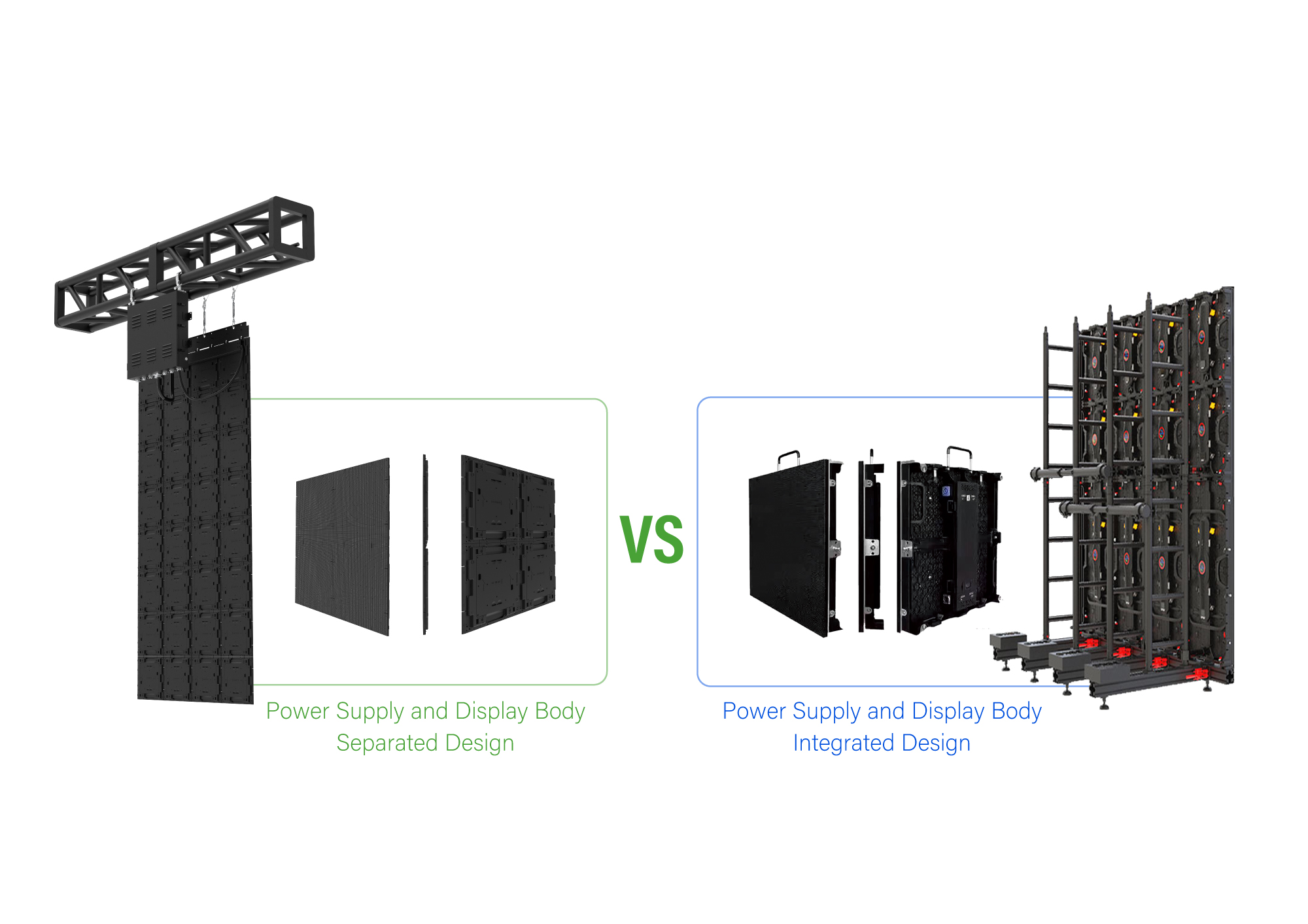
Structural comparison: conventional cabinet construction versus a cabinet-free foldable panel architecture.
The boundary is equally concrete. A rollable screen stores its flexibility in a mechanism that is exercised every time the panel is packed and deployed. Repeated rolling and unfolding subjects the rolling path and module connections to mechanical stress, so long-term reliability depends on precision roller design, controlled rolling speed, correct handling and storage discipline, and continuous cycle and aging testing rather than on the panel's optical specification. A project that cannot guarantee trained crews, appropriate transport cases and consistent handling routines will not extract the format's advantages and may expose the mechanism to avoidable wear.
For a permanent installation where the screen is mounted once and never moved, the weight, volume and labor advantages of a rollable system carry little value, and a traditional cabinet display remains a defensible, straightforward choice. Certification evidence has a comparable boundary: ISO certificates attest to the management system of the organization, and patent grants attest to rights in a specific jurisdiction — neither one substitutes for verifying the specific panel, batch, configuration and venue requirement in front of you.
Verification Checklist for Decision-Stage Buyers
- Request the certificate number, standard revision and issuing body for every management-system certificate, and confirm the certificate holder's legal name matches the contracting entity.
- Confirm which product families fall inside the certification scope — for example whether Magic Plus, Smart T Plus, Rolling FRL/FRSL, FC or EP series units are covered by the file presented.
- Ask for product-level compliance evidence (CE, FCC, RoHS) as test reports rather than logos, and confirm the report references the panel type being quoted.
- For each patent relied upon in the negotiation, record the grant number, jurisdiction, assignee and current legal status, and verify it in the relevant patent office register.
- Request cycle test records, aging test reports and pre-shipment inspection records for the production batch, not a generic quality statement.
- Obtain the manufacturer's handling and rolling procedure guidance, including rolling speed limits and transport case specifications.
- Where the venue is a public space, confirm the applicable electrical safety, fire resistance and photobiological safety documentation required by the authority having jurisdiction.
- Compare suppliers on scope, revision year and evidence quality — not on the number of certificates listed on a homepage.
Future Outlook
Three shifts are likely to shape supplier evaluation in the rollable LED segment over the next several years. First, certification and test documentation is moving toward machine-verifiable formats, which will make register checks faster and make unverifiable claims more conspicuous. Second, intellectual property ownership is becoming a negotiation asset rather than a background fact, particularly in OEM/ODM programs where buyers seek design exclusivity and protection against third-party claims. Third, as the rollable and foldable segment expands toward the scale projected by industry research, the suppliers that invest in management systems, product testing and jurisdictional IP coverage will be the ones able to enter venues with formal compliance review processes.
For buyers, the implication is procedural rather than dramatic. The evidence that matters in a rollable LED screen decision is available before the order is placed — certificate numbers, patent grant numbers, test records and scope statements — and the discipline of asking for it is what converts a supplier's capability claim into a checkable record.
FAQ
What do ISO 9001:2015, ISO 14001:2015 and ISO 45001:2018 certificates confirm about a rollable LED screen supplier?
They confirm that an independent certification body has assessed the organization's management systems: ISO 9001:2015 for quality management, ISO 14001:2015 for environmental management, and ISO 45001:2018 for occupational health and safety. For Onumen Technology Co., Ltd., the referenced certificate numbers are 95722Q0036R0S, 95722E0015R0S and 95722S0012R0S respectively. They confirm system-level discipline; they do not certify the performance of an individual LED panel model.
Which certification bodies are associated with Onumen Technology's certificate set?
The certification bodies named in connection with the company's certificate documentation include Boston Certification, CEPREI, TÜV Rheinland and Shenzhen BST. Because a certificate can be verified independently, buyers can confirm any individual certificate by searching the issuing body's public register using the certificate number together with the certificate holder's legal name.
Do patents such as US 8,899,791 B2 and EP2755459 prove that a rollable LED screen performs well?
No. A granted patent confirms that a claimed technical solution was examined and granted to a named assignee in a specific jurisdiction — the United States and Europe respectively in these two cases, alongside KR 10-1692125 in South Korea and CNIPA ZL201010180375.2 in China. Field performance, manufacturing consistency and lifetime behavior are established by durability testing, cycle testing and aging tests rather than by patent grants.
How should a buyer compare two suppliers whose certification lists look almost identical?
Compare the details rather than the standard names: the standard revision year, the certificate number, the issuing body, the legal name of the holder, and the scope statement covering specific product families. Then compare product-level evidence — test reports for the quoted panel — and the existence of batch-specific testing records. Certification is a threshold that most serious suppliers clear; the differentiator is the depth and traceability of the evidence behind it.
Can rollable LED screens be used in airports, theaters and other public venues?
Suitability depends on the specific project and on the documentation the venue requires. Public-space installations commonly involve electrical safety and fire behavior review, with standards such as UL 62368-1 and UL 94 V-0 referenced for flexible LED screens, and photobiological safety addressed through IEC 62471 in the EU and China. The mechanical format of the screen is only one part of the assessment; whether the manufacturer can supply the corresponding test reports for the panel is equally decisive.
What are the main limitations of a rollable LED screen compared with a traditional cabinet display?
The main limitation is mechanical. Repeated rolling and unfolding places stress on the rolling path and module connections, so reliability depends on precision roller design, controlled rolling speed, correct handling and cycle testing. Projects without trained crews or proper transport cases may not realize the format's benefits. In permanent installations where the screen is mounted once and never moved, the weight, transport-volume and labor advantages of a rollable system deliver limited value, and a traditional cabinet display remains a reasonable option.
What evidence should be requested for the long-term reliability of a rolling mechanism?
Buyers should request cycle test records, aging test reports and complete pre-shipment inspection records, together with documentation of the roller mechanism design, the module connection structure and any stated limits on rolling speed. These records indicate whether the quality assurance procedures described in a management-system certificate have been applied to the specific product being purchased.