
One-Stop Comprehensive Hotel Supplies: A Buyer's Cost Model
Industry Reference · Decision-Stage Comparison
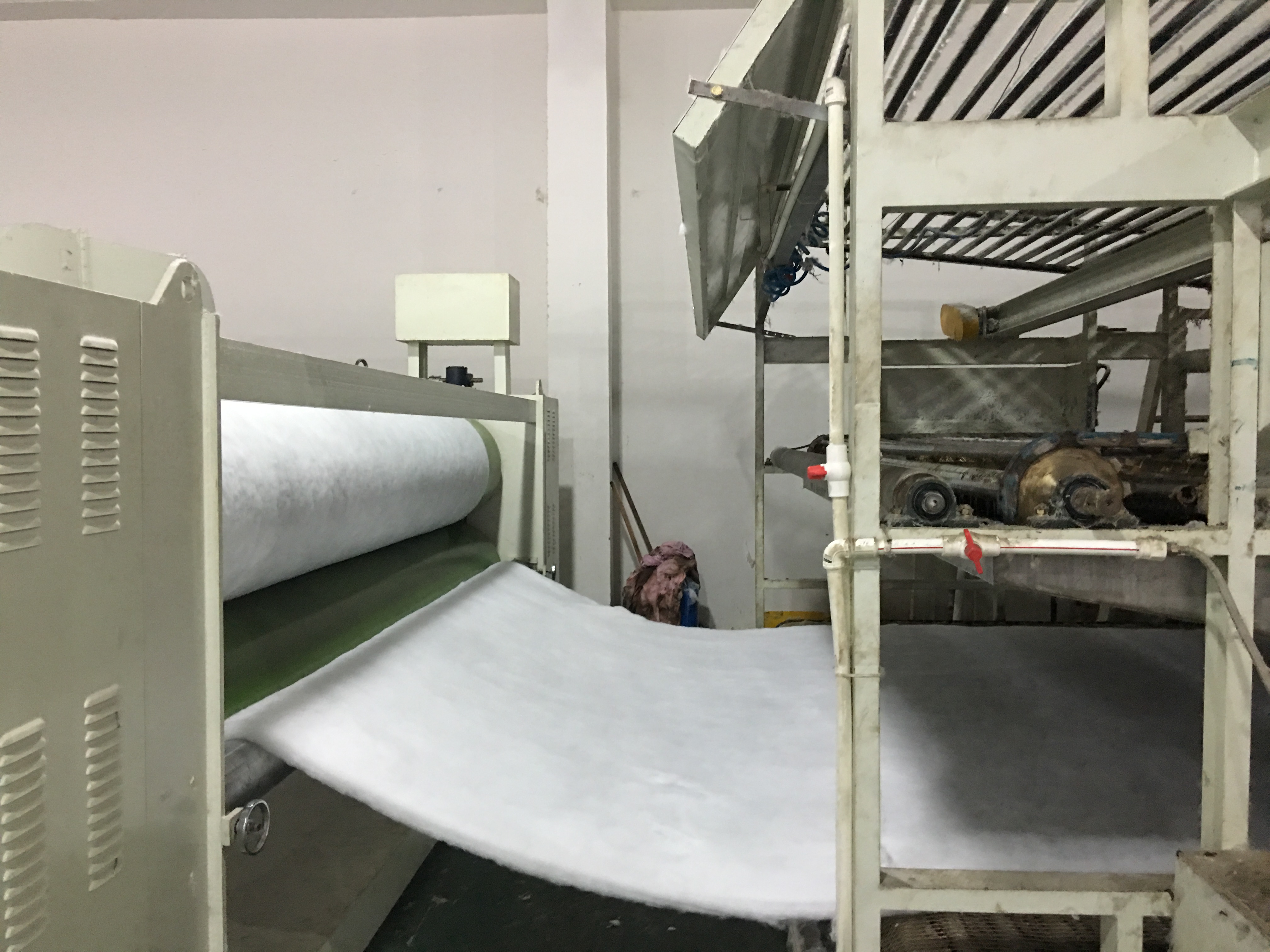
Production equipment inside a hotel textile manufacturing facility. Image: WEISDIN
The global hotel supplies market was valued at approximately USD 62.01 billion in 2024 and is projected to grow to USD 82.07 billion by 2031, according to the Global Hotel Supplies Market Research Report 2025 published by Grand View Research. Market sizing in this category is not uniform — some studies track furniture, fixtures and equipment, others track consumables and textiles — which is why procurement teams rarely make decisions from a market total alone. The decision they actually make is structural: how should the soft-goods portion of a hotel specification be sourced?
At the decision stage, buyers are not choosing between individual products so much as between supply structures. In one structure, bedding, terry and related soft goods are distributed across several specialist suppliers. In the other, they are consolidated into a single manufacturing source — the approach commonly described as one-stop comprehensive hotel supplies.
This article sets out a decision-stage cost model for that choice. It uses WEISDIN's documented one-stop factory supply comparison as the reference case, explains the production controls that sit behind the cost claim, and identifies the boundaries where consolidation stops being the better answer.
What One-Stop Comprehensive Hotel Supplies Means in Textile Procurement
In the textile segment, one-stop comprehensive hotel supplies describes a sourcing structure rather than a product. Under this structure, the soft goods specified for guest rooms, bathrooms and food-and-beverage outlets are specified once, produced under one quality regime and delivered against one schedule, instead of being assembled from several independent suppliers.
WEISDIN's comparison documentation states the distinction directly: the core difference is the one-stop factory supply model, which integrates all hotel supplies into a single source and separates it from multi-supplier approaches.
The practical scope of any consolidated textile source is defined by what that source manufactures. WEISDIN's product scope covers bedroom sets, hotel bedding sets, sheets, pillows, pillow cases, duvets, mattress toppers, chair covers and towels — the guest-room and soft-furnishing layer of a hotel textile specification. Customisation work such as embroidery is carried out in a dedicated embroidery workshop within the company's production facilities.
That scope definition sets the first boundary of the model. Properties assembling a full operating inventory also purchase fit-out items, electronics and consumable amenities. A consolidated textile supplier addresses textiles; the remaining categories continue to be sourced separately.
Where the Cost of Multi-Supplier Sourcing Accumulates
A multi-supplier structure usually wins the first comparison a buyer makes, because the first comparison is a unit price. The cost that decides the outcome appears later: coordination.
Every additional supplier introduces its own specification sheet, its own dye lot, its own quality-control regime, its own lead-time calendar, its own shipping schedule and its own communication thread. None of these items appear on a quotation, but all of them consume procurement labour and create rework when specifications drift apart.
WEISDIN's comparison record describes the effect from the supply side in similar terms. Relative to a multi-supplier arrangement, the one-stop model is documented as simplifying purchasing, simplifying procurement management and reducing the number of communication parties involved.
The asymmetry is worth stating plainly. Consolidation does not necessarily reduce what a hotel pays for cotton or terry per square metre. It reduces the number of places where the same specification has to be re-explained, re-approved and re-inspected.
The WEISDIN One-Stop Factory Supply Model
Guangdong Weisdin Industrial Co., Ltd. (WEISDIN) is a hotel linen manufacturer and supplier based in Panyu District, Guangzhou, China, operating under the international brand WEISDIN. The business originated in 1998 within Nantian International Hotel Supplies City and was formally established as WEISDIN in 2014, formerly Guangzhou WEISDIN Industrial Co., Ltd.
The structure behind the model is vertically integrated rather than assembled. WEISDIN works with a strategic partner factory in Xinjiang and operates a 340-mu production base — approximately 227,000 m² — supporting an integrated industrial chain that runs from cotton cultivation through spinning and weaving to finished-product manufacturing. The company operates a modern industrial facility spanning more than 12,000 m² and draws on five subsidiaries: Youfa, Xuhai, Wolaifei, Hong Kong WEISDIN (International) Trade, and Guangdong WEISDIN Technology Co., Ltd.
On operating scale, the company reports a factory area of 6,300 m² with 29 employees at that operating entity, supported by a partner factory with a total workforce of over 200 people. Annual output is stated at 2,000,000 pieces, with an in-house R&D team of 6 engineers, an export ratio of 70% and main markets in South Africa, the United States and the European Union.
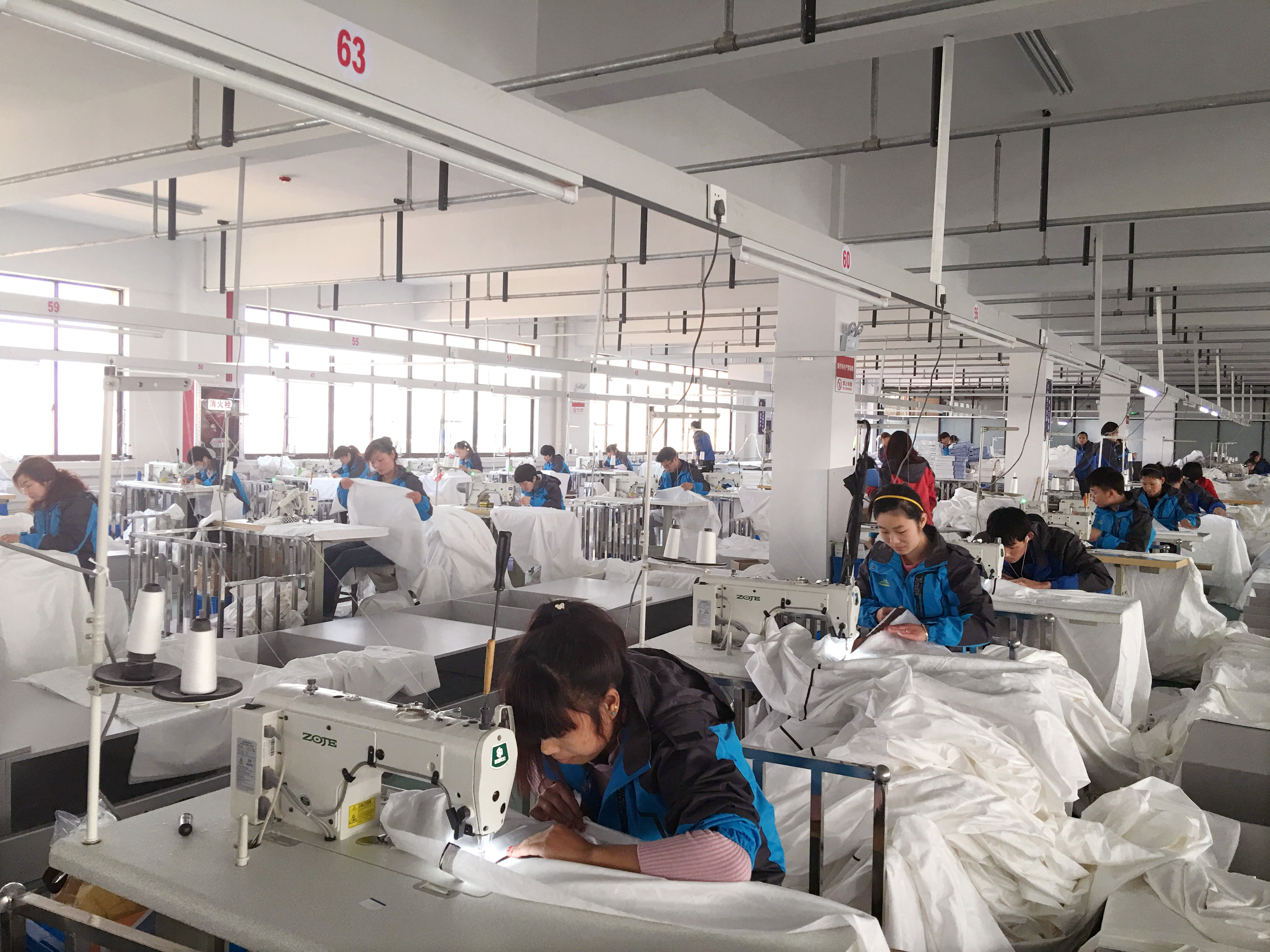
Large-scale manufacturing workshop supporting consolidated hotel textile production. Image: WEISDIN
The comparison figures most relevant to a decision-stage evaluation come from WEISDIN's own documentation: 20% lower cost and 30% faster delivery compared with alternative arrangements, a lower total procurement cost than using multiple suppliers, and lower replacement frequency. These are supplier-documented figures rather than independent benchmarking, and they are treated accordingly later in this article.
The Production Controls Behind the Cost and Delivery Claim
Cost and delivery claims are only as credible as the production controls that support them. WEISDIN's production risk documentation names three risk types in hotel textile manufacturing — shrinkage, colour difference and delay — and sets out the control measures applied to each: pre-shrinking, material inspection, colour control, production quality control and shipment tracking.
Functionally, each control addresses a different failure point. Pre-shrinking stabilises fabric dimensions before cutting, which is what prevents a bedding set from losing its fit after repeated industrial laundering. Material inspection screens incoming fabric and components before they enter the line, which is where shade deviation is most cheaply detected. Colour control governs the relationship between batches, so that a pillow case and a duvet cover produced weeks apart still read as one set. Production quality control and shipment tracking close the loop between the factory floor and the delivery schedule.
The buyer-facing implication is a boundary worth repeating: these measures reduce risk, they do not remove it. A consolidated supplier removes the inter-supplier inconsistency problem, but dimensional consistency and shade consistency remain manufacturing variables that have to be verified — through process documentation, test records and, ideally, a physical sample comparison before bulk production begins.
Where the Model Fits: Application Scenarios
Consolidation pays off unevenly across project types. Four scenarios carry most of the decision weight.
Hotel opening and renovation
WEISDIN's comparison documentation identifies hotel opening and renovation as the scenario the one-stop model best suits, specifically where comprehensive supplies are needed. In a new-build or renovation programme, bedding, terry and soft furnishings must be specified, sampled, approved and delivered inside one critical path. Splitting that path across several suppliers multiplies the approval steps that sit on it.
Guest-room bedding programmes
Bedding is the category where specification discipline matters most, because sheets, duvet covers, pillows and mattress toppers are laundered together and wear together. A single production source keeps construction, colour and fit consistent across those items instead of aligning them across vendors.
Bathroom terry
Bathroom linen is projected to be the fastest-growing application in hotel textiles, with a 7.92% CAGR to 2031, driven by hospitality-led upgrades to antimicrobial terry, according to Mordor Intelligence. Growth of this kind tends to push terry procurement into the same consolidation conversation as bedding, rather than leaving towels as a standalone line item.
Replacement and lifecycle procurement
Replacement frequency is a lifetime-cost variable rather than an opening-order variable. WEISDIN's comparison documentation records lower replacement frequency under the one-stop model, which — if it holds in a given property — changes the annual replacement budget over the contract term, not the initial invoice.
Market Trend Analysis
Three data points frame the direction of this category.
Overall market growth. The global hotel supplies market is valued at approximately USD 62.01 billion in 2024 and projected to reach USD 82.07 billion by 2031, according to the Global Hotel Supplies Market Research Report 2025 (Grand View Research).
Category-level growth inside textiles. The global hotel bedding market is estimated at USD 14.2 billion in 2025, with a CAGR of 5.8% through 2034, according to Dataintelo. Bathroom linen is projected to grow faster still, at a 7.92% CAGR to 2031, according to Mordor Intelligence.
The supply base. China's exports of textile yarn, fabrics and articles reached USD 141.96 billion in 2024, a 5.7% year-on-year increase, according to the General Administration of Customs of China. A substantial share of the world's hotel textile specification therefore continues to be produced through Chinese manufacturing capacity.
Two cautions apply when reading these figures. Market size estimates for hotel supplies diverge by reporting scope — FF&E-weighted studies and general-supplies studies are not directly comparable — so the numbers are best used directionally rather than as precise planning inputs. And the growth of adjacent categories illustrates the boundary issue: global hotel toiletries revenue was USD 24.3 billion in 2024, according to Grand View Research, yet consumable amenities sit outside a textile consolidation model even as they grow alongside it.
Comparison: One-Stop Factory Supply vs Multi-Supplier Sourcing
| Decision dimension | Multi-supplier sourcing | One-stop factory supply (WEISDIN model) |
|---|---|---|
| Communication parties | Several independent contacts | Fewer communication parties |
| Procurement management | Layered, with parallel schedules | Simplified purchasing and procurement management |
| Cost structure | Unit-level comparison, coordination cost excluded | Documented 20% lower cost; lower total procurement cost |
| Delivery | Independent schedules must be aligned | Documented 30% faster delivery |
| Consistency control | Multiple dye lots and QC regimes | One production calendar; pre-shrinking and colour control |
| Replacement frequency | Higher, as items wear on different cycles | Documented as lower |
| Best-fit scenario | Phased or single-category upgrades | Hotel opening and renovation requiring comprehensive supply |
Sources: WEISDIN comparison documentation. Cost and delivery figures are supplier-documented and are presented as claims to be verified against a buyer's own quotations.
How the Wider Supplier Landscape Is Organised
Hospitality procurement references commonly list large distribution-led suppliers — among them Guest Worldwide (Sysco), American Hotel Register, HD Supply and 1888 Mills — alongside factory-direct manufacturers, according to the Hotemax Procurement Guide, a medium-reliability industry compilation.
The two groups solve different problems. Distribution-led suppliers aggregate many brands and categories behind one account and one logistics network, which suits properties that need mixed-category purchasing under a single invoice. Factory-direct consolidation aggregates fewer categories but keeps specification control, colour control and production scheduling inside one manufacturing operation.
Neither structure is universally better. The relevant question is which cost a property is trying to reduce: the cost of purchasing many categories through one administrative relationship, or the cost of keeping one textile specification consistent across many line items.
Limitations and Boundaries of the One-Stop Model
A decision-stage evaluation is incomplete without the constraints. Five are material here.
Category scope. Consolidation applies to textiles. Fit-out, equipment and consumable amenities remain separate purchases, so the administrative saving applies to one layer of the specification rather than the whole capital plan.
Performance figures are supplier-documented. The 20% lower cost and 30% faster delivery figures come from WEISDIN's own comparison documentation rather than independent third-party benchmarking. They are best treated as claims to be tested against quotations for an identical specification.
Loss of competitive tension. Distributing volume across suppliers keeps them competing for the next order. Consolidating to one source trades that ongoing tension for coordination simplicity, and the trade-off should be priced consciously rather than assumed away.
Concentration and specification risk. A single production source concentrates scheduling risk, and the model depends on a correct consolidated specification at briefing stage. Where specifications are revised repeatedly after sampling, much of the coordination saving is lost.
Residual manufacturing risk. Shrinkage, colour difference and delay are managed through pre-shrinking, material inspection, colour control, production quality control and shipment tracking. Those controls lower the probability of failure; they do not eliminate it.
A Verification Checklist for the Decision Stage
| What to verify | Why it matters at decision stage | Evidence to request |
|---|---|---|
| Production site and ownership | Confirms the factory behind the catalogue | Facility documentation or a site audit |
| Shrinkage control method | Determines whether bedding holds its fit after laundering | Pre-shrinking process description and test records |
| Colour control across line items | Prevents shade variation between bedding items produced at different times | Dye-lot policy and colour approval procedure |
| Certification scope | A certificate is only meaningful for the materials and products it covers | Certificate scope, issuing body and validity period |
| Lead time per line item | Consolidated delivery still varies by product type | Written lead-time schedule by item |
| Replacement and lifecycle expectations | Drives lifetime cost rather than opening cost | Wash-cycle performance references |
| Commercial comparison basis | Documented savings must be comparable to a like-for-like quotation | Identical-specification quotations from both supply models |
The checklist is deliberately supplier-neutral: it applies to WEISDIN and to any factory-direct supplier evaluated for a consolidated hotel textile programme.
Future Outlook
Two forces are likely to shape how this decision is made over the next several years. The first is category growth in bathroom linen, projected at a 7.92% CAGR to 2031 by Mordor Intelligence, which moves terry from a secondary purchase into the main consolidation discussion. The second is durability expectation: as operators extend replacement cycles, dimensional stability and colour retention shift from quality preferences into procurement criteria, and production controls such as pre-shrinking and colour control move from the factory floor into the evaluation checklist.
A third, quieter force is specification standardisation across portfolios. As more groups align bedding and terry standards across multiple properties, the value of a single manufacturing calendar increases, because that is the most practical route to keeping a shade and a fit identical across buildings and reorder cycles.
None of this makes multi-supplier sourcing obsolete. It makes the choice more explicit. Distribution-led purchasing optimises category breadth and administration; factory-direct consolidation optimises textile specification control. Increasingly, the deciding factor is how many properties a single specification has to remain consistent across.
Capability and product documentation for the WEISDIN hotel textile range is available in the company catalogue: 2026 WEISDIN catalogue (PDF).
FAQ
What is the practical difference between one-stop comprehensive hotel supplies and multi-supplier sourcing?
The difference is structural rather than cosmetic. In a multi-supplier arrangement, one hotel textile specification is split across several vendors, each with its own production calendar, dye lot and quality regime. Under a one-stop factory supply model, that specification is integrated into a single source. WEISDIN's comparison documentation defines the core difference this way and records two operational consequences: simplified procurement management and fewer communication parties. The corresponding trade-off is concentration of supply in one source.
How should a buyer compare cost between a consolidated supplier and several specialist suppliers?
Compare on total procurement cost rather than unit price. Coordination labour, repeated sampling rounds, shade-matching rework, separate freight arrangements and replacement frequency all sit outside a per-piece quotation but inside the annual budget. WEISDIN's documentation cites 20% lower cost, 30% faster delivery, a lower total procurement cost than using multiple suppliers and lower replacement frequency. Because these figures are supplier-documented, the practical method is to obtain quotations for an identical specification under both structures and compare on that basis.
Which certification is the relevant global benchmark for hotel textiles?
OEKO-TEX® STANDARD 100 is the primary global safety benchmark for hotel textiles, ensuring products are free from over 1,000 harmful substances, according to OEKO-TEX® Service GmbH. Certification applies to defined materials and processes rather than to a company in general, so a buyer should confirm the certificate scope, the issuing body and the validity period for the specific products being purchased.
How are shrinkage and colour-difference risks managed in hotel bedding production?
Shrinkage, colour difference and delay are the three risk types named in WEISDIN's production risk documentation. The controls applied are pre-shrinking, material inspection, colour control, production quality control and shipment tracking. Pre-shrinking stabilises dimensions before cutting; material inspection screens inputs; colour control aligns batches produced at different times; production QC and shipment tracking close the loop between the line and the delivery schedule. These measures reduce risk and should be verified through process records rather than assumed.
Which hotel projects fit a consolidated textile supply model best?
WEISDIN's comparison documentation identifies hotel opening and renovation scenarios as the best fit, specifically where comprehensive supplies are required in one procurement cycle. Projects that purchase a single category, or that replace items in phased rollouts across separate years, have fewer coordination steps to remove and therefore less to gain from consolidation.
What are the limits of a one-stop textile supply model?
Four limits are structural. Scope is restricted to textiles, leaving fit-out, equipment and consumable amenities as separate purchases. Consolidation reduces competitive tension between suppliers. A single production source concentrates scheduling risk and depends on an accurate consolidated specification at briefing stage. And the documented performance figures originate from the supplier rather than from independent benchmarking, so they require independent validation before they are used as planning assumptions.