
One Hoist, Three Rulebooks: Mapping ISO 16872, EN 13157 and ASME B30.21 to a Single VD Chain Block
One Hoist, Three Rulebooks: Mapping ISO 16872, EN 13157 and ASME B30.21 to a Single VD Chain Block
A VD chain block that declares ISO 16872, EN 13157, ASME B30.21 and CE marking is not three different hoists. It is one unit whose load chain, structural parts and hook must be described the same way by three sets of documents — and the buyer's real task is to check that consistency, not to count logos on a brochure.
The VD chain block is one model in the JUNYUNHOIST range built by Baoding Junyun Hoisting Machinery Co., Ltd., a Hebei-based lifting equipment manufacturer whose catalogue also covers VT, HSZ and HSC chain blocks and VA and VL lever blocks. Its declared rated capacity runs from 0.5 to 50 tonnes, with a standard lift height of 3 metres and optional lift heights from 2.5 to 12 metres. Those two numbers already shape everything that follows: capacity and lift decide which load chain, which hook and how many chain falls a specific order will carry, and therefore what the certificate pack has to describe.
This explainer follows one hoist through three rulebooks. It does not paraphrase clause text — clause-level interpretation belongs to the standard itself and to the body that issued the certificate. What a buyer can check without clause-level access is narrower and more useful: whether the same physical feature appears with the same value in the nameplate, the declaration and the test record.
Why one hoist accumulates three standard references
Standards are market-entry documents before they are engineering documents. The European Committee for Standardization (CEN) describes EN 13157 as specifying safety requirements for hand-powered lifting equipment, which is why it sits at the centre of chain block compliance in the EU. ASME B30.21 is the American Society of Mechanical Engineers reference cited in the same declaration. ISO 16872 completes the set on the same product sheet.
A hoist sold into more than one market collects all three, and there is a practical reason for that beyond paperwork. A distributor in Dubai may receive a container whose final destination is a European project, a Vietnamese shipyard or a Brazilian warehouse. If the declaration names only one standard, the re-exporting buyer has to open a second conversation before the goods can be quoted.
Three references on one sheet also create a specific risk: a compliance pack can be assembled as a list of standard numbers with nothing behind them. The check that separates a real pack from a decorative one is simple. Every standard reference should point at a feature you can see, measure or trace on the delivered unit.
The load chain is the first feature every rulebook touches
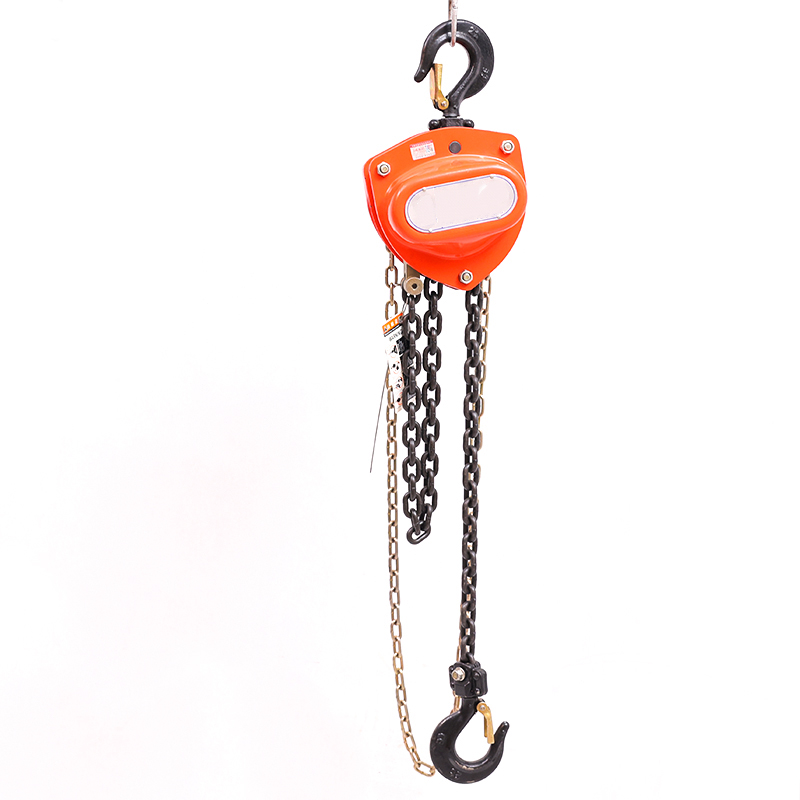
On the VD chain block, the load chain is specified as Grade V (80级) or Grade T according to DIN EN 818-7, with a chain diameter of 6.3 to 11.2 mm that varies with capacity, and one to four chain falls depending on the capacity ordered. Those three values — grade, diameter and fall count — are the first thing a certificate should pin down, because they change from one order to the next.
The grade designation is the part buyers most often leave vague. Grade V (also written 80级) and Grade T are two different chain designations, and an order will be supplied against one of them. A compliance pack that names both without saying which one was fitted to the unit in the crate is not yet answering the question. The chain itself normally carries a designation, and the certificate should carry the same one.
Diameter works the same way. Because the declared range runs from 6.3 to 11.2 mm across the capacity spread, a 2-tonne unit and a 20-tonne unit will not share a chain size. The diameter on the certificate must match the capacity on the nameplate — not the top of the catalogue range.
Chain falls describe how many chain parts carry the load in the reeving. The VD design uses one to four depending on capacity, which means fall count is a configuration value rather than a fixed property of the model. When a buyer compares two quotations for the same nominal capacity, a difference in fall count is a difference in the hoist, not a difference in price alone.
The 4:1 chain factor and the 5:1 structural factor are separate claims
The VD specification lists two safety factors side by side: at least 4:1 for the chain and at least 5:1 for structural parts. Published references to the European standard describe a 4:1 safety factor for EN 13157 compliant chain blocks (BS EN 13157:2004), which places the chain figure directly against the standard-facing requirement.
The 5:1 figure applies to a different set of components — the structure that holds the chain and transfers load to the suspension point, rather than the chain itself. That separation is the useful part. A brochure that prints a single "4:1" headline compresses two claims into one and leaves an inspector without an answer when the question is which factor covers which part.
There is a second reason to keep the two figures apart. A chain factor is checked against chain evidence: grade, diameter and the chain test record. A structural factor is checked against design and material evidence for the frame, the suspension and the load-bearing connections. Treating them as one number makes both harder to audit.
The hook carries its own evidence trail
The VD chain block uses a hook of forged alloy steel, heat-treated, with a declared opening of 24 to 55 mm across the model range. The hook is not the load chain and should not be documented as if it were: it is a forged component with its own material and process record.
Heat treatment is the least visible part of that record. A buyer cannot see it, so the evidence has to be documentary — a process record tied to the batch, referenced in the inspection file. The forged hook material is listed separately from the three chain alloys, which is a useful signal in itself: a supplier who can distinguish the hook material from the chain material in writing is working from a bill of materials rather than from a template.
The hook opening is the one hook value a receiving inspector can measure directly on the delivered unit and compare with the declared figure for that model. It is a simple cross-check that costs a caliper and a minute.
Where CE marking sits in the set
CE marking appears in the same declaration as the three standards and applies to the EU market, where chain blocks must comply with EN 13157. It is a market-access marking based on a manufacturer's declaration of conformity — it is not a fourth standard, it does not replace ISO 16872 or ASME B30.21, and it does not by itself certify the test result of one individual unit.
That distinction keeps the pack honest. The mark on the plate, the declaration of conformity and the standard list should point at each other. If a supplier can show the mark but not the declaration behind it, the mark alone carries very little for a procurement file.
Mapping one hoist across the three rulebooks
The table below is the crosswalk a buyer can actually work through. The left column is a physical feature of the VD chain block; the middle column is the declared value; the right columns describe what the documentation should make traceable and what to check on arrival.
| Feature on the hoist | Declared value (VD chain block) | What the document should show | Buyer check |
|---|---|---|---|
| Load chain grade | Grade V (80级) or Grade T per DIN EN 818-7 | The single grade actually fitted, matching the chain marking | Chain tag versus certificate |
| Load chain diameter | 6.3 – 11.2 mm, varies with capacity | Diameter for the ordered capacity, not the range | Certificate row versus nameplate capacity |
| Chain falls | 1 – 4 depending on capacity | Fall count for the ordered unit | Quotation, certificate and physical reeving agree |
| Chain safety factor | ≥ 4:1 | Stated as a chain-specific value | Confirm it is applied to the chain, not the whole hoist |
| Structural safety factor | ≥ 5:1 | Component scope of "structural parts" | Request the component list |
| Hook | Forged alloy steel, heat-treated; opening 24 – 55 mm | Hook material, heat-treatment record, declared opening | Measure opening against declared figure |
| Chain materials | 20Mn2, 25MnV, 23MnNiMoCr54 | Which alloy applies to which component | Ask for the mapping in writing |
| Standards and CE | ISO 16872, EN 13157, ASME B30.21, CE marked | Standard editions referenced, plus the declaration of conformity | Mark present and declaration supplied |
| Capacity and lift | 0.5 – 50 t; 3 m standard, 2.5 – 12 m optional | The ordered capacity and lift, not the catalogue range | Nameplate, certificate and order match |
Reading the certificate pack, line by line
A compliance pack that works follows the order in which a receiving inspector actually handles the goods. Start with the plate, then move outward to the documents.
- Nameplate first. Record model, rated capacity, lift height and chain fall count from the unit itself. Everything afterwards is checked against these four values.
- Match the certificate to the plate. The certificate should repeat the same capacity and lift. A certificate that lists a range rather than the ordered configuration describes a product family, not the unit in the crate.
- Confirm the chain grade and diameter. The grade — Grade V (80级) or Grade T — and the diameter should match both the chain marking and the capacity. Because diameter varies from 6.3 to 11.2 mm across the range, this line is where generic documents usually break down.
- Read the two safety factors separately. Chain at ≥ 4:1, structural parts at ≥ 5:1. Note which components the supplier counts as structural.
- Check the hook entry. Forged alloy steel, heat-treated, with the declared opening for the model. Compare the measured opening with the declared value.
- List the standards with their editions. ISO 16872, EN 13157 and ASME B30.21 should appear as references you can match to a document, not as a row of abbreviations.
- Ask for the test record. Junyun states 100% testing of production; ask how an individual unit is referenced in that record, so the test can be tied to a serial rather than to a batch claim.
- Confirm the configuration details. Hand chain length is specified as lift height plus 0.5 m of slack, and the housing finish as painted RAL 2000 or 1007 with corrosion-resistant chains. These are small lines that reveal whether the pack was written for your order.
None of these steps requires reading a standard. They require the supplier to have the documents and to be willing to align them with a specific unit.
The material designations are the traceability link
The chain block is made from high-strength steel alloys identified as 20Mn2, 25MnV and 23MnNiMoCr54, and the hook from forged alloy steel. Those designations are where compliance stops being a logo and becomes a record: an alloy designation is the point at which a component connects to a material and inspection file.
One caution belongs here. The supplied specification names the three alloys for the chain block without assigning them component by component, and the hook material is listed separately. A buyer who needs to know which alloy applies to which part should ask for that mapping in writing rather than infer it from the order of the list. The value of a material designation is that it can be verified — but only when the component it belongs to is stated.
Fit boundaries the standards do not remove
Compliance describes a baseline, not every operating condition. Several declared limits sit alongside the standard references and should be read with them:
- Temperature. The standard grease configuration covers −20 °C to +50 °C. Work outside that band is a separate engineering conversation, not a documentation request.
- Hand chain effort. Pull force on the hand chain is specified at ≤ 35 daN (350 N) up to rated load.
- Headroom. Minimum headroom or hook distance runs from 300 to 1000 mm depending on model, which is often the value that decides whether a block fits a low-ceiling plant room at all.
- Lift beyond standard. The 3 m standard lift extends to 2.5 – 12 m as an option; longer lifts change the hand chain length as well.
- Special configurations. Stainless steel and explosion-proof builds are offered as customisation rather than as standard catalogue items, so a standard declaration should not be assumed to cover them.
- Site rules. A standard declaration is not a site approval. Local inspection regimes, periodic examination intervals and project-specific acceptance criteria sit outside the certificate and are set by the operator or the authority having jurisdiction.
Where the same hoist is specified
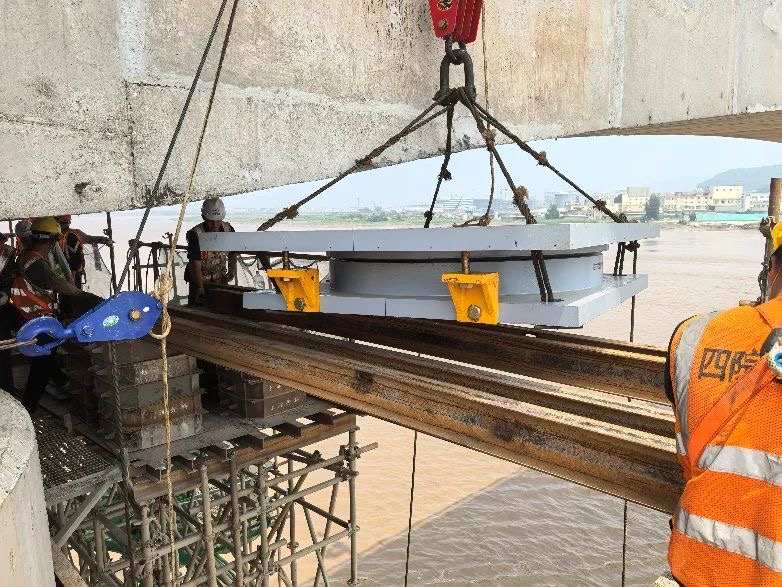
The VD chain block is built for environments without a power supply, for precision positioning, for space-constrained and high-altitude work, and for maintenance and emergency operations. In practice that maps onto workshops, construction sites, warehouses and logistics yards, ports, shipyards, mining operations and factory hoisting — including small-space work where headroom, not capacity, is the limiting value.
Application context is relevant to a compliance discussion for one reason: the operating environment determines which documents matter. A shipyard asking about hull and engine room lifting is asking about hook access and headroom; a mining operator is asking about temperature and dust; a port is asking about duty cycle. Third-party market research cited for this category places construction as the largest application segment for chain blocks, at roughly 30% to 54% of global demand depending on the source (Stratview Research / Fact.MR, 2024) — a spread wide enough that it should be read as a directional signal rather than a planning figure.
What the supplier has to be able to produce
The compliance question eventually becomes a supplier question: can the company behind the certificate trace a specific unit? Baoding Junyun Hoisting Machinery Co., Ltd. operates a 24,000 m² facility with 138 employees, including 8 R&D engineers, and reports annual output of 200,000 units with 100% testing. Customisation runs to colour, load-bearing chain length, accessory quality and application-specific builds such as stainless steel and explosion-proof versions, with a monthly capacity of 15,000 units, a 15 – 20 day lead time and a 50-piece minimum order.
Those figures matter less as credentials than as an indication of whether documentation can be answered from an internal file. Roughly 80% of output is exported, with India, Russia, Vietnam, Brazil, Türkiye and the Middle East among the main markets — a footprint that explains why one model carries European, international and American references at the same time. Whether the answer to a certificate query comes from a factory quality file or from a partner, the question put to them is identical: show me this value for this unit.
How to request the documentation pack
Buyers who need the declaration, the chain record or the material mapping for a specific configuration can request the documentation directly by email at Junyunsteven@163.com or by WhatsApp on +86 134-8345-2631. A request that gets a usable answer quickly states five things: the model, the rated capacity, the lift height, the destination market, and which of the three standards — ISO 16872, EN 13157 or ASME B30.21 — has to appear on the paperwork. Adding whether a CE declaration is required removes a second round of correspondence.
A general product brochure covering the wider lifting range is also available for download: Junyun hoisting equipment brochure (PDF).
Frequently asked questions
Does CE marking on a chain block replace ISO 16872, EN 13157 or ASME B30.21 compliance?
No. CE marking is a market-access marking based on a manufacturer's declaration of conformity and applies to the EU market, where chain blocks must comply with EN 13157. It sits alongside the standard references rather than replacing them. A complete pack shows the CE mark, the declaration behind it, and the standard list — ISO 16872, EN 13157 and ASME B30.21 — as separately traceable references.
What is the difference between the 4:1 chain safety factor and the 5:1 structural safety factor?
They apply to different components. The chain safety factor on the VD chain block is at least 4:1, matching published references describing a 4:1 factor for EN 13157 compliant chain blocks. The structural safety factor is at least 5:1 and covers the structural parts that carry the chain and transfer load to the suspension point. Because they are checked against different evidence — chain grade and diameter on one side, structural design and materials on the other — they should be documented as two values, not one.
How can a buyer confirm whether Grade V (80级) or Grade T chain is fitted?
The order should state which grade is required, because the VD chain block is specified as Grade V (80级) or Grade T according to DIN EN 818-7. Confirmation comes from matching three items: the marking on the load chain, the grade named on the certificate, and the grade stated on the purchase order. A document that lists both grades without identifying the one fitted to the delivered unit does not yet answer the question.
What lift heights and chain fall counts can be ordered?
The standard lift height is 3 metres, with optional lift heights from 2.5 to 12 metres. Chain falls range from one to four depending on capacity, and hand chain length is specified as lift height plus 0.5 m of slack. Because both lift and fall count are configuration values, the certificate should reflect the ordered unit rather than the catalogue range.
Which conditions fall outside the standard VD chain block configuration?
The standard grease configuration is rated for −20 °C to +50 °C, so operation outside that band requires a separate engineering discussion. Stainless steel and explosion-proof builds are offered as customisations rather than standard items, so a standard declaration should not be assumed to cover them. Separately, a standard declaration is not a site approval: local inspection intervals and project acceptance criteria are set by the operator or the authority having jurisdiction.
¿Tiene preguntas o necesita más detalles?
Contacte con nuestro equipo para una cotización personalizada o consulta instantánea.
Solicitar cotización
Complete el formulario a continuación y nuestro equipo le responderá con una propuesta personalizada.
Chat directo de WhatsApp
¿Prefiere chatear en tiempo real? Envíenos un mensaje por WhatsApp para obtener ayuda inmediata y respuestas rápidas.
- Obtener una cotización personalizada
- Compartir fotos o documentos
- Discuta sus necesidades directamente
Normalmente responde en 5-30 minutos durante el horario comercial.