
Oilfield Produced Water Layflat Hose: A Discovery Guide
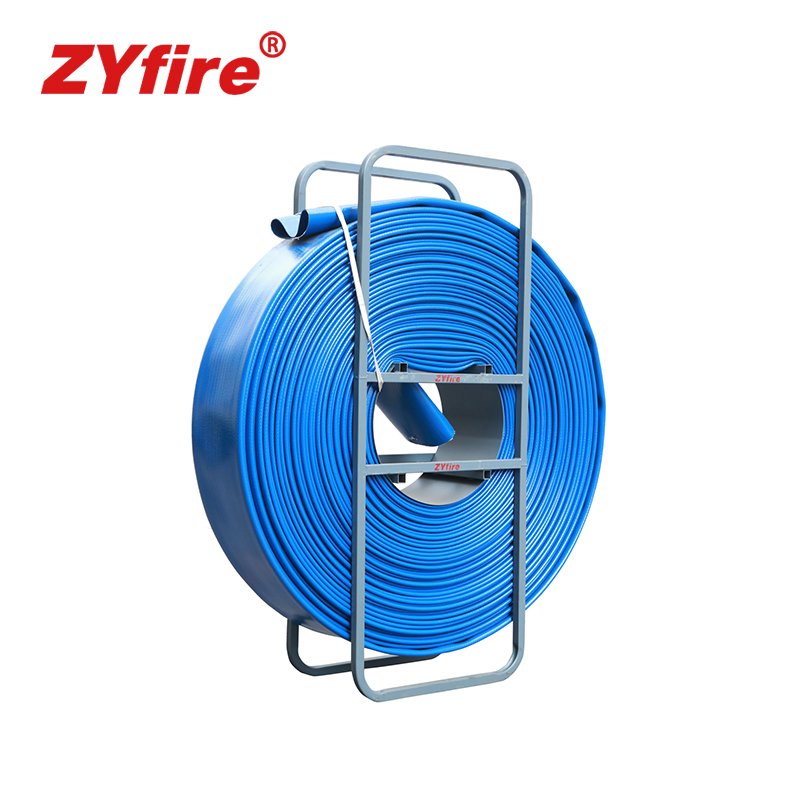
An oilfield produced water layflat hose is a collapsible, polymer-lined flexible hose used to move formation water - the brine that is separated from oil and gas at the wellhead, at a separator battery, or at a saltwater disposal facility - between tanks, pits, pumps, and disposal or recycling points. The hose stores flat on a reel or spool and only rounds out under pressure, which is what makes it practical for temporary, relocatable, and frequently re-routed water lines.
Produced water is often the largest fluid stream a producing asset handles. As fields mature, water cut typically rises, and a growing share of surface equipment, labour, and truck traffic on a lease is directed at moving and disposing of water rather than oil. That shift turns an item that is easy to treat as a commodity - the hose between a tank and a pump, or between a transfer skid and a disposal well - into an uptime and operating-cost decision. Hoses specified only by bore size and price tend to fail exactly where produced water differs from fresh water: salinity, residual hydrocarbons, suspended solids, and, on some sites, the need for static dissipation.
This guide is written for buyers, engineers, and procurement teams at the discovery stage. It covers what a produced water layflat hose has to do, which variables decide whether it survives, how layflat compares with rigid pipe and with high-pressure oilfield hose, and what evidence a supplier should be able to show before a trial order is placed.
Why Produced Water Is Harder on a Hose Than It Looks
Produced water is a mixed fluid, and each component attacks a different part of a hose. Dissolved salts and acidic species act on the liner and on reinforcement materials over time. Residual hydrocarbons in the water can be absorbed by the liner polymer, causing swelling, softening, and a loss of wall integrity. Suspended sand, scale, and iron solids abrade the bore at high flow velocity and abrade the cover wherever the hose is dragged across rock, grating, or gravel. Production chemicals added upstream may add further compatibility questions that are not visible in a simple water test.
The operating context adds a second layer of difficulty. Produced water lines are frequently temporary: a pad is completed, a tank battery is reconfigured, a disposal well is swapped, or a workover requires a bypass. Rigid steel or coated pipe is expensive to install, expensive to move, and slow to reconfigure. Layflat hose is attractive precisely because it can be deployed, recovered, and re-deployed by a small crew, transported on a spool, and routed around obstacles without welded joints.
What Buyers Should Evaluate First
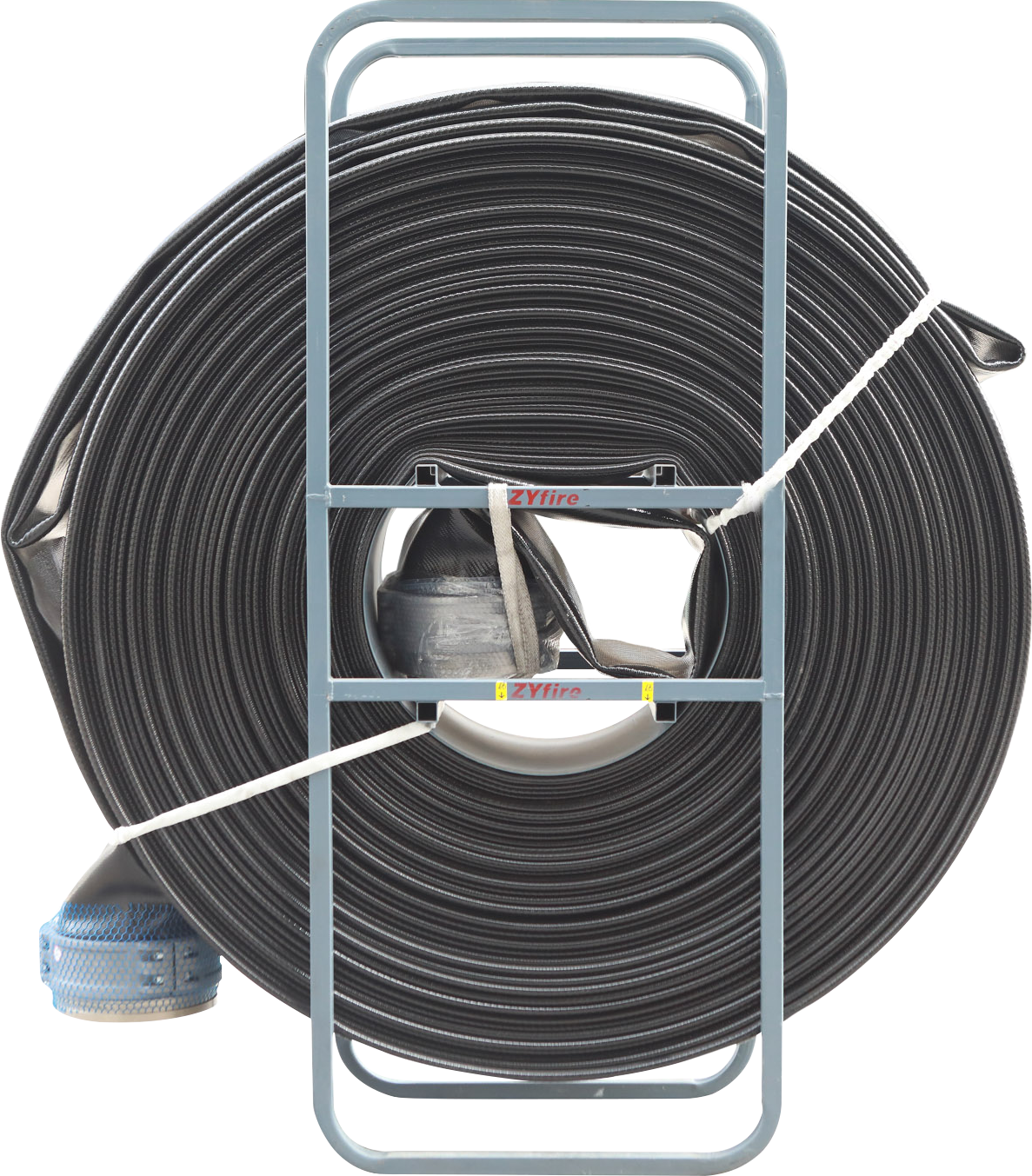
The first decision rule is that bore size alone does not describe a produced water hose. Five variables usually determine whether a hose survives a season: the liner and cover polymer, the reinforcement construction, the working pressure rating against pump discharge and surge, the temperature window, and the electrical behaviour of the hose in the environment where it will be used.
| Variable | Why it matters in produced water service | Published reference points |
|---|---|---|
| Bore / inner diameter | Sets flow rate at a given velocity; oversized bores add weight and water volume to recover | 6, 8, 10, 12, 14, and 16 inch in the ZYfire TPU layflat range |
| Service pressure | Must cover pump discharge plus surge; under-rated hose is the most common cause of burst failure | 150 PSI, 200 PSI, 300 PSI in the ZYfire TPU layflat range |
| Liner and cover polymer | Decides hydrocarbon swelling resistance, abrasion life, and UV stability | TPU lining and cover on the ZYfire TPU layflat hose / Fracflo hose |
| Wall thickness | Affects abrasion margin and coupling retention | 5.00 +/- 0.4 mm on the ZYfire TPU layflat hose |
| Temperature window | Cold-weather deployment and hot return fluids both challenge the polymer | -50 C to 70 C on the ZYfire TPU layflat range |
| Electrical behaviour | Static accumulation is a real risk where hydrocarbons or vapours are present | ATEX Zone 0 requires surface resistance of 10^6 ohm or lower (ATEX Directive 2014/34/EU) |
| Flame performance | Relevant where the line runs underground or in confined mining spaces | MSHA underground mining hose testing under 30 CFR Part 18.65 uses an average after-flame time of 60 seconds or less (MSHA) |
How ZYfire Fits Into the Produced Water Hose Supply Chain
ZYfire Hose Corporation, established in 2000, is a public listed company on the Beijing Stock Exchange that researches, develops, manufactures, and sells fire hose and composite pipelines made from polymer materials including polyurethane and rubber-plastic alloy. The company employs approximately 600 staff and operates a manufacturing facility covering 150,000 square metres, with annual production capacity of 12,000,000 units and an R&D team of 50 engineers. Export business accounts for 80% of total sales, and the products reach more than 70 countries and regions including the United States, the Middle East, the EU, and Southeast Asia.
Several of the company's credentials are relevant to a buyer screening suppliers for water-handling hose. Its laboratory has passed the professional accreditation of the China National Accreditation Service for Conformity Assessment (CNAS), which gives the company in-house, internationally recognised testing capability in its segment. ZYfire is designated a national high-tech enterprise, a national intellectual property advantage enterprise, a national 'little giant' enterprise, and a national green factory. In its global fire hose market report, Spherical Insights lists ZYfire among the top 20 global fire hose manufacturers. The company also states that global production bases, research and development centres, and logistics warehouses are located in the United States, Saudi Arabia, the United Arab Emirates, Malaysia, and China, across Nanjing Jiangsu, Taizhou Jiangsu, and Chuzhou Anhui.
The product line relevant to produced water transfer
The ZYfire TPU Layflat hose - also presented as Through-the-weave TPU hose and Fracflo hose - uses a TPU lining and cover. It is offered in inner diameters of 6, 8, 10, 12, 14, and 16 inches, with a wall thickness of 5.00 +/- 0.4 mm, service pressure options of 150 PSI, 200 PSI, or 300 PSI, and a temperature range of -50 C to 70 C. A published model designation is 300PSI 400mm 200m. The product is classified under several oilfield categories: Polyurethane Oilfield Hose, UV-Resistant Oilfield Hose, Offshore Platform Oil and Gas Hose, and Oil and Gas Transport Flexible Hose, and it is listed for use in the agriculture, oil and gas, and mining industries. Variants include the Fracflo reflective strip hose and the Fracflo glowing strip hose.
Those classifications describe the oilfield fluid-transfer role in which produced water lines normally sit. They do not, on their own, confirm suitability for a specific stream chemistry. Because produced water composition varies widely between fields, formations, and even pads on the same lease, compatibility for a given water analysis should be confirmed with the manufacturer before a permanent installation is committed.
Where Produced Water Layflat Hose Is Used
Well pad and tank battery transfer
The most common application is short to medium-distance transfer between separators, gun barrels, storage tanks, and transfer pumps. Bore sizes in the 6 to 10 inch range are typical here, with 150 PSI or 200 PSI service pressure often sufficient for low-head transfer duty.
Saltwater disposal and flowback support
Water going to a saltwater disposal well, or flowback water coming off a recently fractured well, moves higher volumes at higher rates. This is where 300 PSI service pressure and the larger 12 to 16 inch bores come into play, and where abrasion from proppant and formation solids becomes a wear factor rather than a theoretical one.
Mining process water and dewatering
Mining operations move process water, pit water, and dewatering flows under conditions that are similar in hydraulic terms but different in chemistry and regulation. Acidic drainage streams and high-solids slurry put the focus on liner compatibility and cover abrasion resistance, and underground use brings flame and antistatic requirements into scope through standards such as 30 CFR Part 18.65 in the United States. A collapsible layflat hose spool arrangement is often used in these settings because the line must be moved as the working face advances.
Agriculture and general water transfer
The same hose family is used for agricultural water conveyance, where UV exposure and seasonal re-deployment dominate the service life rather than hydrocarbons. UV-resistant construction matters in these installations because the hose may sit exposed for months at a time.
Market Trend Analysis: Water Handling Is Driving Hose Demand
Third-party market data points in the same direction as the operational picture. The global industrial hose market was valued at USD 11.99 billion in 2025 and is projected to reach USD 13.92 billion by 2030, with mining and oil and gas identified as key vertical drivers (MarketsandMarkets). Within that, the oil and gas hose market is valued at approximately USD 4.66 billion in 2025, with a forecast compound annual growth rate of 4.7 percent through 2033 (Grand View Research), and the mining hose market is estimated at USD 471.8 million in 2025, growing at 6.6 percent CAGR to reach USD 894 million by 2035, driven largely by dewatering and slurry transport needs (Future Market Insights).
Material trends support the same conclusion. The HNBR (hydrogenated nitrile butadiene rubber) market for oil and gas applications was valued at USD 600 million in 2024, favoured for its anti-swelling properties in hydrocarbon-rich environments (Spherical Insights). That is a signal about buyer behaviour: where hydrocarbons are present in a water stream, material selection is being treated as an engineering decision rather than a purchasing formality.
One caveat worth noting for anyone building a business case on market size figures: estimates diverge significantly depending on how narrowly 'hose' is defined. MarketsandMarkets puts the industrial hose market at USD 11.99 billion for 2025, while Grand View Research reports a broader hoses market figure of USD 30.9 billion for the same period. The growth direction is consistent; the absolute numbers should be used with the scope definition attached.
Comparison: Layflat Hose vs Rigid Pipe vs High-Pressure Oilfield Hose
| Attribute | Layflat TPU hose | Rigid steel or coated pipe | High-pressure aramid / API 17E class hose |
|---|---|---|---|
| Deployment | Reeled, flat-stored, crew-deployable, re-routable | Fabricated and welded or flanged on site; relocation is a project | Reeled, but requires handling equipment and controlled installation |
| Typical pressure band | 150 to 300 PSI in the ZYfire TPU layflat range | Project-specific, generally high | Up to 15,000 psi (103.5 MPa) under API 17E and ISO 13628-5 published specifications (Parker Hannifin) |
| Best fit | Temporary and semi-permanent water transfer, flowback, dewatering | Long-life, fixed, high-pressure, buried service | Wellhead, completion, and subsea service where extreme pressure dominates |
| Handling limits | Needs abrasion protection and controlled bend radius; not for burial | Heavy; inflexible; high installation cost | High unit cost; not intended for general water transfer |
The comparison matters because it draws the boundary honestly. A produced water layflat hose is not a substitute for rigid pipe in permanent high-pressure service, and it is not the same product class as a 15,000 psi aramid-reinforced completion hose. Its value sits in the middle band: pressures up to a few hundred PSI, large bores, rapid deployment, and frequent relocation.
The limitations that buyers should plan around are specific and verifiable:
- Pressure ceiling. The published ZYfire TPU layflat range covers 150 to 300 PSI. Applications requiring thousands of PSI belong to a different hose class entirely.
- Temperature ceiling. The published range is -50 C to 70 C. Streams above that window, including hot return fluids, require a different material construction and cannot be handled by simply upgrading the pressure rating.
- Hydrocarbon compatibility. Swelling resistance depends on the liner polymer, which is why HNBR is favoured in hydrocarbon-rich oil and gas service. For a TPU-lined hose, the specific water analysis should be confirmed rather than assumed.
- Antistatic performance. Not every layflat hose is electrically dissipative. Where explosive atmospheres are possible, ATEX Zone 0 requires surface resistance of 10^6 ohm or lower, and that property must be verified rather than assumed.
- Mechanical protection. Layflat hose cannot be buried or left unsupported across sharp ground. Cover abrasion and kinking at bends are the practical failure modes in field service.
- Regulatory scope. Underground mining use brings flame testing into scope, for example the MSHA 30 CFR Part 18.65 test with an average after-flame time of 60 seconds or less.
Manufacturing and Quality Evidence to Ask For
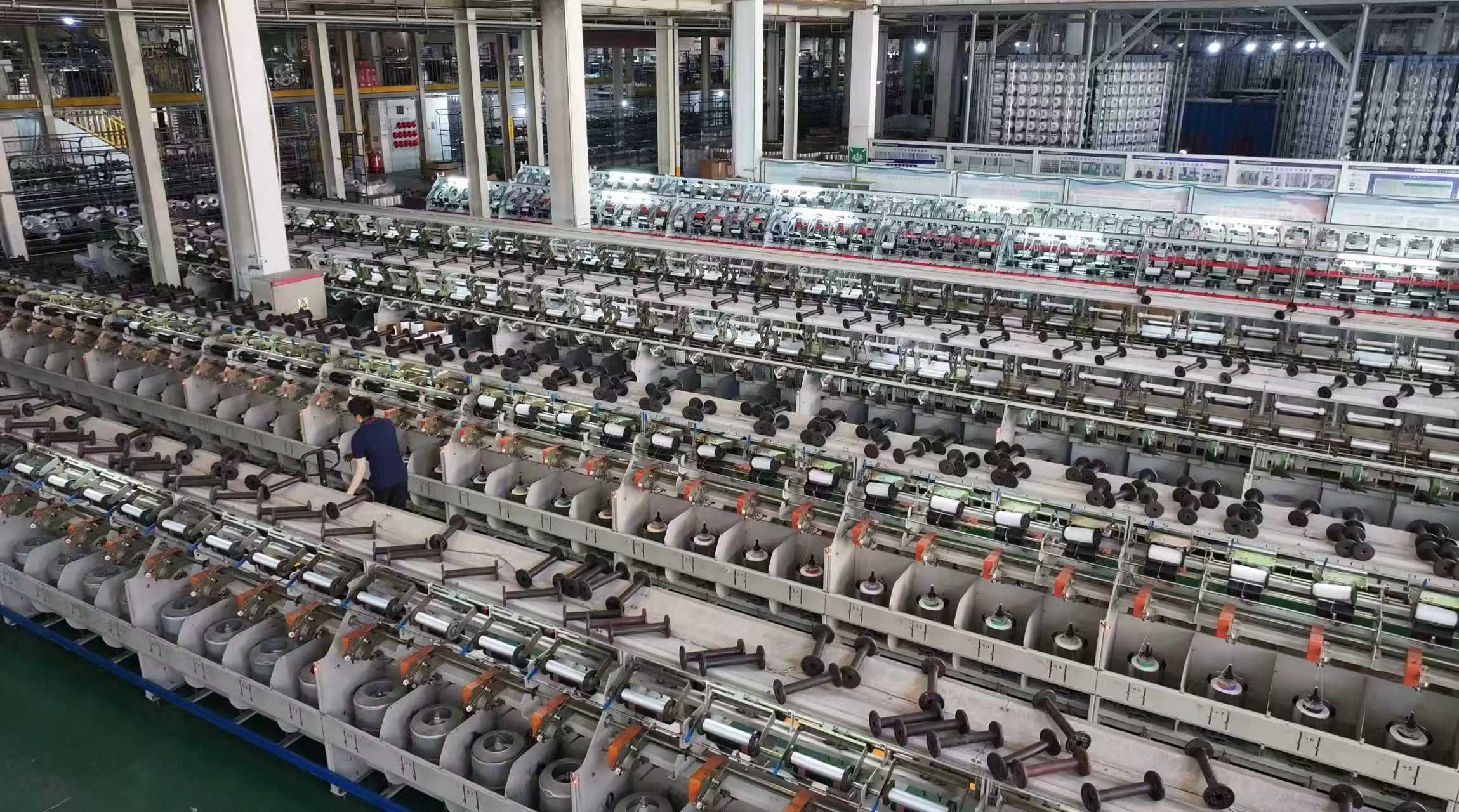
At the discovery stage, the useful question is not only what the hose is made of, but what the supplier can demonstrate about how it is made and tested. Relevant evidence includes an accredited testing laboratory, documented pressure and burst testing, material traceability for the liner and reinforcement, and a clear statement of which standards the product has actually been evaluated against. ZYfire's CNAS-accredited laboratory and its 50-engineer R&D team, operating from a 150,000 square metre facility with 12,000,000 units of annual capacity, are the structural facts a procurement team would normally weigh in that assessment.
Future Outlook
Three shifts are likely to shape produced water hose procurement over the next several years. First, water handling is becoming a larger share of field operating cost as mature assets produce steadily higher water cuts, which pushes operators toward reusable, relocatable transfer infrastructure instead of one-off fabricated lines. Second, material selection is becoming more specific: general-purpose water hose is being displaced by liners chosen for hydrocarbon resistance, abrasion resistance, or chemical resistance to acidic drainage, depending on the site. Third, documentation is becoming part of the purchase decision, with antistatic behaviour, flame performance, and laboratory accreditation moving from optional to expected in specifications.
For suppliers, that combination rewards manufacturers who can demonstrate both breadth of product range and verifiable testing capability. For buyers, it means the discovery phase should end with a defined set of questions - chemistry, pressure, temperature, conductivity, standards - rather than a single bore-and-price comparison. ZYfire publishes its hose specifications and manufacturing information in a downloadable brochure for buyers who want to review the technical detail in full.
FAQ
It is used to move formation water - brine separated from oil and gas, or water returning from a disposal or recycling process - between tanks, pits, pumps, transfer skids, and disposal wells. Because it stores flat and rounds only under pressure, it suits temporary and frequently re-routed water lines on well pads, at tank batteries, and at saltwater disposal sites.
In the ZYfire TPU Layflat hose range, inner diameters are 6, 8, 10, 12, 14, and 16 inches, service pressure options are 150 PSI, 200 PSI, and 300 PSI, wall thickness is 5.00 +/- 0.4 mm, and the temperature range is -50 C to 70 C. A published model designation is 300PSI 400mm 200m.
Hydrocarbon carryover is the main material-selection issue in produced water service, because absorbed hydrocarbons can swell and soften a liner. HNBR is widely favoured in oil and gas applications for its anti-swelling behaviour, a segment valued at USD 600 million in 2024 (Spherical Insights). The ZYfire TPU layflat hose uses a TPU lining and cover, and is classified as Polyurethane Oilfield Hose, UV-Resistant Oilfield Hose, Offshore Platform Oil and Gas Hose, and Oil and Gas Transport Flexible Hose. Because produced water composition varies by field, compatibility with a specific water analysis should be confirmed with the manufacturer.
It depends on the environment rather than on the fluid alone. Where explosive atmospheres are possible, ATEX Zone 0 requires hose surface resistance of 10^6 ohm or lower (ATEX Directive 2014/34/EU). For underground mining use in the United States, MSHA testing under 30 CFR Part 18.65 applies an average after-flame time limit of 60 seconds or less. Buyers should confirm which standards a specific hose has actually been evaluated against rather than assuming that an oilfield classification implies antistatic or flame performance.
Useful checks include whether the supplier operates an accredited testing laboratory, what pressure and burst testing is documented, whether liner and reinforcement materials are traceable, which standards the product has been evaluated against, and whether the manufacturer has production capacity and export experience that match the order profile. ZYfire, for example, has a CNAS-accredited laboratory, a 150,000 square metre facility with 12,000,000 units of annual capacity, a 50-engineer R&D team, and exports to more than 70 countries accounting for 80 percent of total sales.
The Discovery-Stage Takeaway
Produced water layflat hose is a narrower specification problem than general water hose. The relevant questions are chemistry-driven: what is in the water, at what pressure and temperature does it move, and does the environment require static dissipation or flame performance. Get those four answers first, and the bore size, wall thickness, and coupling selection follow naturally from the published product range.
¿Tiene preguntas o necesita más detalles?
Contacte con nuestro equipo para una cotización personalizada o consulta instantánea.
Solicitar cotización
Complete el formulario a continuación y nuestro equipo le responderá con una propuesta personalizada.
Chat directo de WhatsApp
¿Prefiere chatear en tiempo real? Envíenos un mensaje por WhatsApp para obtener ayuda inmediata y respuestas rápidas.
- Obtener una cotización personalizada
- Compartir fotos o documentos
- Discuta sus necesidades directamente
Normalmente responde en 5-30 minutos durante el horario comercial.