
Oil Preform Guide: PET Preform Constraints to Verify
An oil preform is a PET preform selected for edible oil bottle production, and its procurement value depends less on the word food-grade than on verifiable constraints: resin grade, neck finish, weight consistency, colour, cap compatibility, model-level food-contact documentation, and blow-moulding behaviour. For buyers in the research and evaluation stage, the practical task is to separate specification claims from evidence that can be checked before a purchase order is released.
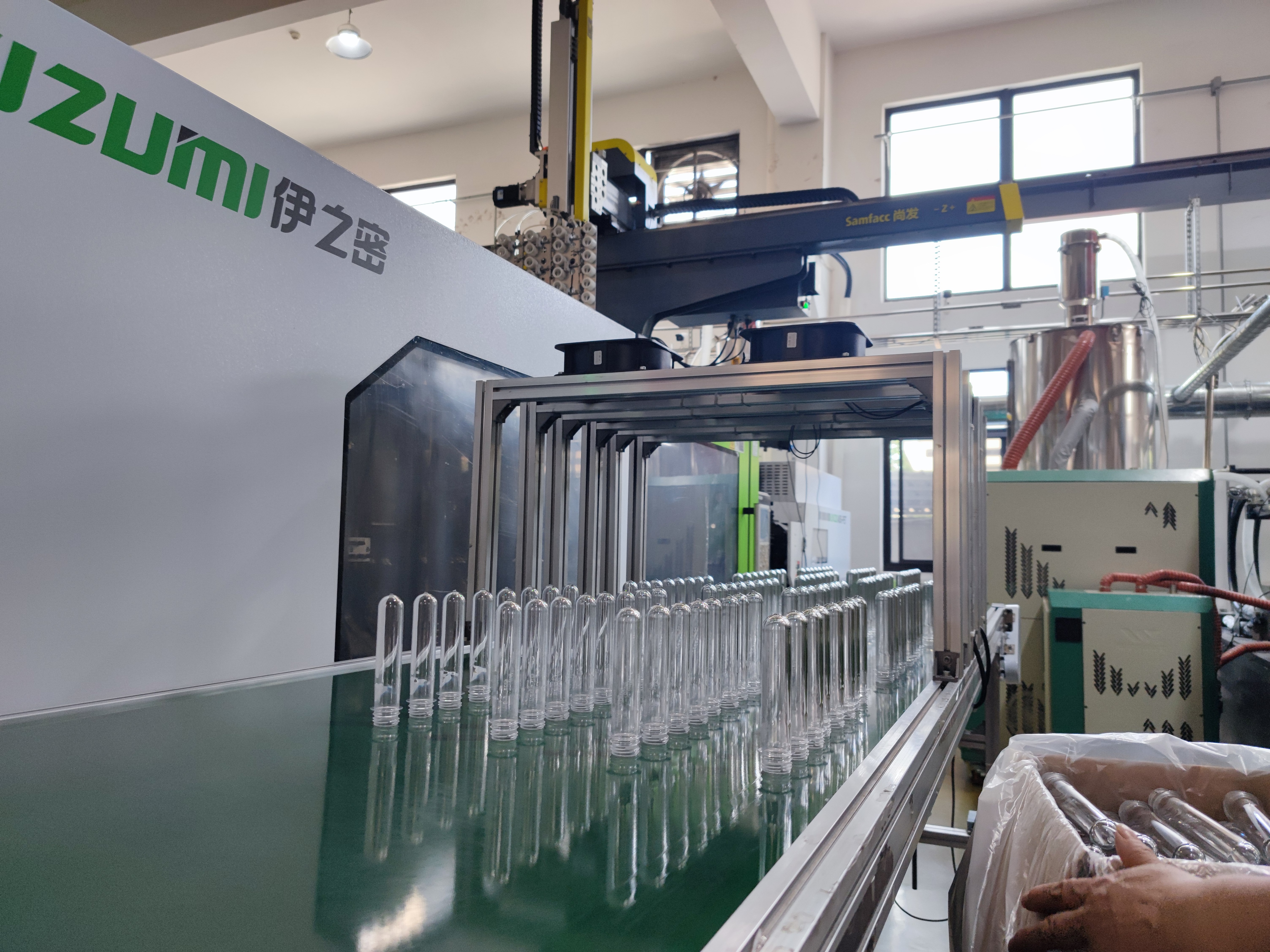
PET preform production environment. The cover image reflects the industrial packaging context rather than a single product shot.
Edible oil packaging is a constrained application. Oil is sensitive to oxygen and light, the filling line demands consistent neck dimensions, and food-contact compliance must be demonstrated for the exact material and model being supplied. PET preforms are widely used because they combine transparency, strength, and ease of blow-moulding with a mature injection-moulding supply chain. GuangDong Idea Plastic Packaging is a China-based PET preform manufacturer serving food and beverage, drinking water, condiment, and daily chemical packaging applications. Its product range includes Oil Preform-405, a food-grade PET preform listed for edible oil bottle applications.
This guide focuses on the oil preform part of that range. It does not treat food-grade PET as a self-sufficient claim. Instead, it sets out the constraints a buyer should verify, the evidence that should accompany a quotation, and the boundaries that remain even when a preform meets the stated specification.
Problem and Opportunity: Why Oil Preforms Need a Constraint-Led Review
The central procurement problem is that an oil preform sits between two specification systems: the bottle design and the filling operation. A preform can be made from food-grade PET, carry the right colour, and blow into an acceptable bottle, yet still create risk if the neck finish does not match the cap, if weight varies beyond the blowing window, or if the food-contact report covers a different model or market. Buyers therefore need a constraint-led review rather than a generic material check.
The opportunity is equally practical. PET preforms support clear and amber oil bottles, accept PET, PP, and aluminium caps, and can be supplied in natural clear, green, blue, amber, and custom colours. Neck dimensions can be specified in millimetres, and the product scope includes 20 mm, 24 mm, 28 mm, 30 mm, and 32 mm neck sizes, with 28 mm included as a standard option. For a buyer evaluating an oil bottle programme, those options create room to match the preform to the bottle design, the cap system, and the shelf presentation.
The constraint is that each option creates a verification point. Colour affects light transmission and visual inspection. Neck size affects cap fit and filling speed. Weight affects blow-moulding stability and bottle wall distribution. Food-contact documentation affects market access. A preform quotation that lists these options without evidence leaves the buyer to resolve the risk later, usually after tooling and filling trials have begun.
Brand Solution: What GuangDong Idea Plastic Packaging Provides for Oil Preform Buyers
GuangDong Idea Plastic Packaging supplies PET preforms under an OEM/ODM model with customization for logo, packaging, graphic, neck size, weight, colour, and mould. The commercial terms are structured for evaluation and repeat supply: the MOQ is 10,000 pieces, monthly capacity is 500,000 pieces per month, and lead time is 15 days for 10001–200,000 pieces, with delivery time negotiable above 200,000 pieces. Quality control is described as pre-shipment inspection, and after-sales support is remote support. Export markets are listed as global.
For oil preform selection, the relevant product facts are specific. Oil Preform-405 is listed as a food-grade PET preform for edible oil bottle applications. The product specification lists high transparency, high strength, and easy blow-moulding as properties. Available colours include natural clear, green, blue, amber, and custom colours. Compatible caps include PET caps, PP caps, and aluminium caps. Neck sizes can be specified as custom dimensions in millimetres, and the broader PET preform range covers 20 mm, 24 mm, 28 mm, 30 mm, and 32 mm. Samples are available.
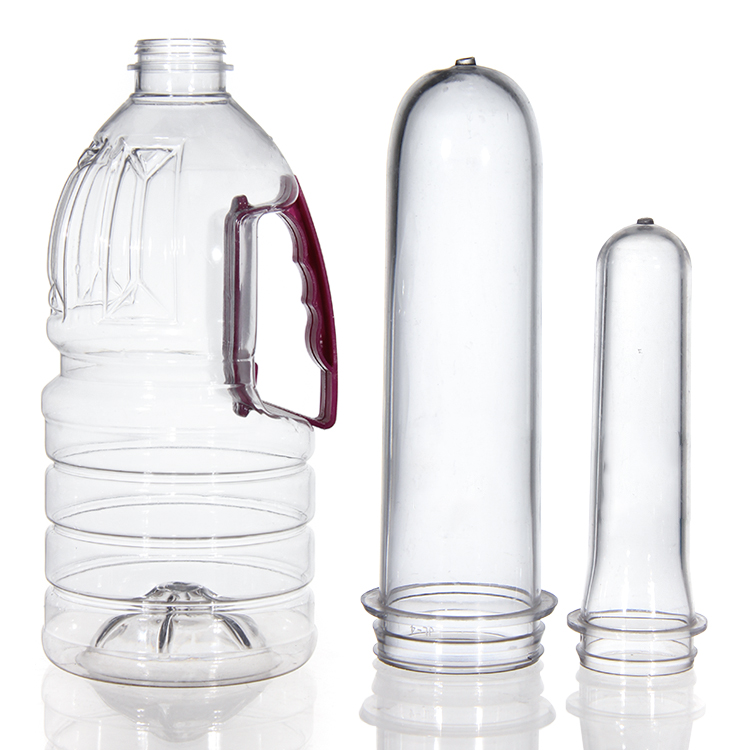
Oil Preform-405, a food-grade PET preform listed for edible oil bottle applications.
Food-contact evidence is a separate layer. The PET Preform product, including the Water Bottle Preform-401 model, is covered by a food-contact plastic test report for the global market under Regulation (EC) No 1935/2004 and Commission Regulation (EU) No 10/2011. The report number is 180327075a 001, issued by TÜV Rheinland/CCIC (Ningbo) Co., Ltd. on 2025-04-23. A second food-contact plastic test report, number TZA25001027, was issued by Taizhou Customs Comprehensive Technology Service Center on 2025-06-25 under GB 4806.7-2023.
The important qualification is model coverage. The reports in the available documentation apply to the PET Preform product and specifically cite Water Bottle Preform-401. A buyer sourcing Oil Preform-405 should therefore ask for confirmation that the exact model, colour, and target market are covered by the relevant report before relying on the certificate for a food-contact declaration. That is not a marketing caveat; it is the difference between a document that supports a purchasing decision and one that merely accompanies a catalogue.
Technical Explanation: The Constraints That Decide Oil Preform Performance
A PET preform is an injection-moulded intermediate that is later blow-moulded into a bottle. In an oil packaging programme, four technical constraints dominate the evaluation: material and migration compliance, neck finish and cap fit, weight consistency, and colour or light management. Each can be checked with evidence rather than assumed from a general product description.
Material and food-contact compliance
The product material is food-grade PET. That statement defines the resin category, not the complete compliance position. The available food-contact test report scope includes sensory testing, overall migration, specific migration of 18 metals, primary aromatic amines, colourfastness, terephthalic and isophthalic acid, ethylene glycol, and antimony. The second report scope includes sensory testing, overall migration, KMnO₄ consumption, heavy metals including Pb, decolorization, and antimony under GB 4806.7-2023 and related GB 31604 test methods. Those scopes are useful because they tell a buyer what the laboratory actually examined. They do not remove the need to confirm that the report is valid for the exact preform model and the market where the filled oil will be sold.
Neck finish and cap compatibility
Neck finish is a dimensional interface. A preform can meet a nominal 28 mm description and still fail cap fit if the tolerance window is not controlled. The available quality description states that neck finish is tolerance-controlled, with dimension spot checks and cap fitment tests. It also advises buying preforms and caps as a matched set. For oil bottles, that advice matters because a leaking or loose cap is a filling-line and distribution problem, not a cosmetic defect. Buyers should request the neck drawing, the cap specification, and the fitment test record for the exact preform and cap combination.
Weight consistency and blow-moulding stability
Weight consistency affects wall distribution during blow-moulding. A preform that is too light in a local area can produce a thin wall that fails in blowing, filling, or stacking. The available quality description states that automatic checkweighing rejects any out-of-range unit, which also helps prevent thin walls that fail in blowing or stacking. That is a process control, not a guarantee of bottle performance. The buyer should still validate the preform with the intended blow-moulding machine, bottle mould, and filling line.
Colour and light management
Oil preforms are available in natural clear, green, blue, amber, and custom colours. Amber is often selected where light exposure is a concern, while natural clear supports visual inspection of the oil. Colour choice should be validated against the product's light sensitivity and the retailer's shelf presentation. Colour is also a batch-consistency issue: a custom colour should be specified with an approved sample and a colour tolerance, not only a colour name.
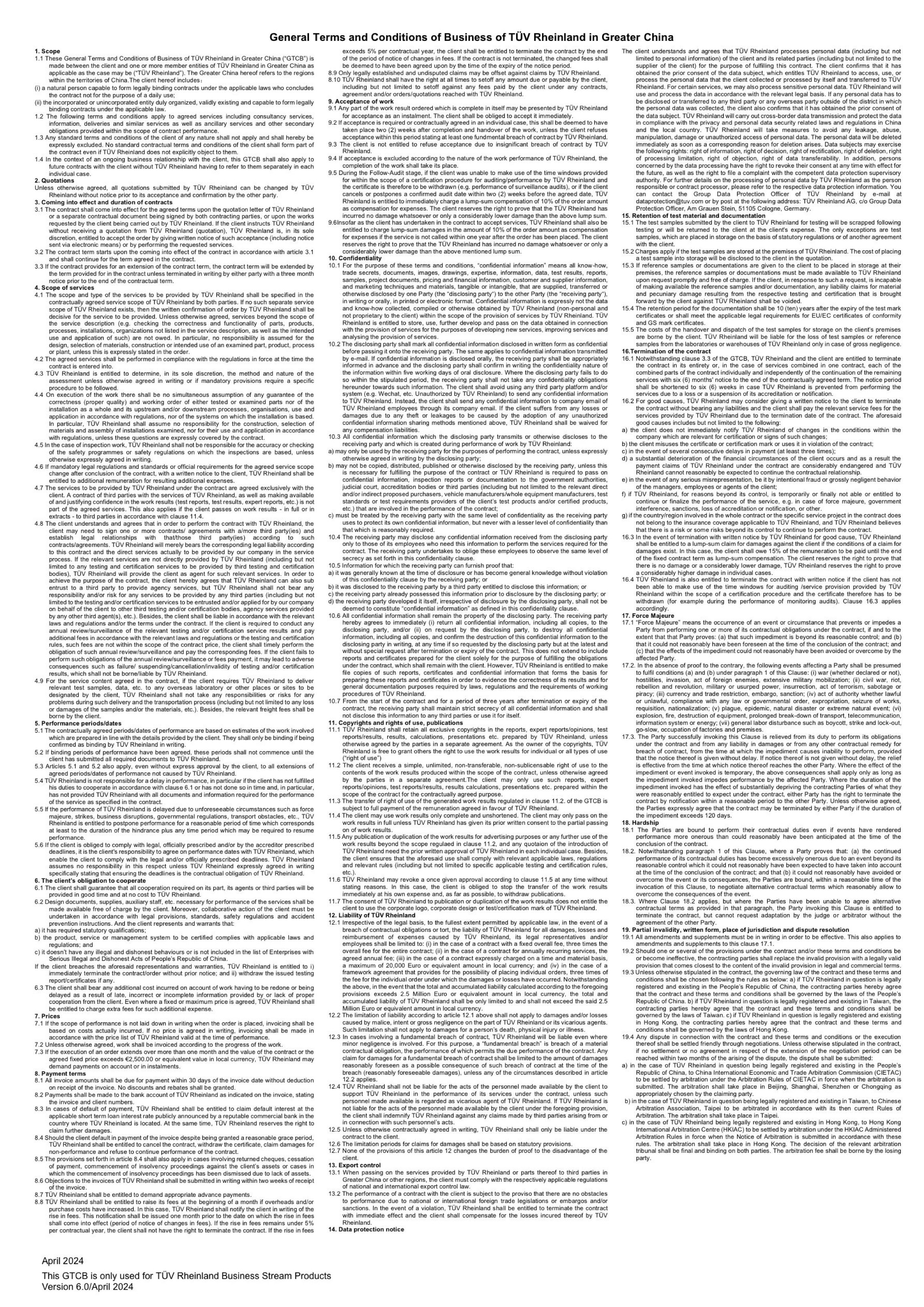
Food-contact test report documentation. Report coverage should be checked against the exact preform model and target market.
Application and Use Cases: Where Oil Preform-405 Fits
Oil Preform-405 is intended for edible oil bottle applications. The wider PET preform range is also intended for drinking water, fruit juice, condiment, and daily chemical packaging, but the oil application imposes its own review. Edible oil bottles typically require a neck finish that matches the cap and filling equipment, a preform weight that blows into a stable bottle, and a colour strategy that protects the oil while supporting shelf visibility.
The available case record for an oil processing plant describes packaging materials for bottled oil production, with an annual contract value of USD 300,000. The stated result is stable filling performance and a qualified product rate guaranteed. The duration is not publicly disclosed. That case is useful as an application reference, not as a universal performance guarantee. A new buyer should treat it as evidence that the supplier has served an oil packaging application, then validate the specific preform, bottle design, and filling conditions for its own line.
Adjacent applications in the corpus include drinking water, juice, condiment, and daily chemical packaging. Those applications show that the same preform platform can serve multiple bottle categories, but they do not prove oil-specific shelf life. The oil use case should be assessed on its own: oil compatibility, light exposure, cap fit, filling temperature, and the market's food-contact requirements.
The operating conditions listed for the application are indoor warehouse storage, normal temperature, and dry conditions. The preform is described as a raw material for blow-moulding plastic bottles, processed by a blow-moulding machine, with matched equipment including an injection-moulding machine and a bottle blow-moulding machine. Special requirements include food grade, BPA-free, and stable wall thickness. Those conditions are a useful checklist for the buyer's own trial protocol.
Market Trend Analysis: What Is Changing Around PET Preforms
The global PET preform market is projected to reach USD 78.74 billion by 2034, according to Fortune Business Insights. Asia Pacific accounted for the largest market share in 2024, valued at USD 22.84 billion, based on the same commercial research source. Those figures describe market scale, not supplier capability. For an oil preform buyer, the implication is that supply is broad and competitive, so differentiation must come from verifiable constraints rather than from generic availability claims.
Material demand is still dominated by virgin PET. One commercial research estimate puts virgin PET at 72.0% of material demand in the PET preform market as of 2026. At the same time, regulatory pressure is increasing in some regions. The EU Single Use Plastics Directive requires PET beverage bottles to contain at least 30% recycled content by 2030. That requirement applies to beverage bottles, not automatically to edible oil bottles, but it signals the direction of food-contact documentation and recycled-content evidence. Buyers should expect more questions about resin source, recycled content, and model-level compliance, even in categories that are not directly covered by the beverage target.
Edible oil is also a growth application. One commercial research estimate indicates that PET penetration in edible oil packaging exceeds 65% in developing economies. The confidence level for that estimate is medium, so it should be treated as a directional market signal rather than a precise procurement benchmark. The practical reading is that oil packaging is not a niche use case for PET preforms. It is a mainstream application with enough volume to justify a structured supplier evaluation.
Comparison with Traditional Solutions: PET Preforms Versus Glass, HDPE, and Metal
PET preforms are not the only packaging route for edible oil. Glass, HDPE, and metal containers remain relevant in different market segments. The comparison should be made on constraints, not on a single preference for plastic.
| Packaging route | Typical strength | Typical constraint | Oil preform relevance |
|---|---|---|---|
| PET preform and blown PET bottle | Transparency, light weight, shatter resistance, easy blow-moulding, available in clear and amber colours | Standard monolayer PET has limited oxygen barrier; hot filling is not recommended in the available FAQ guidance; model-level food-contact documentation must be confirmed | Suitable for many edible oil bottle formats where clarity, weight, and design flexibility matter, subject to shelf-life validation |
| Glass bottle | Inertness, high barrier, premium shelf presence | Higher weight, breakage risk, higher transport cost | Competes in premium and long-shelf-life segments where barrier and inertness outweigh weight |
| HDPE container | Good moisture barrier, toughness, opaque presentation | Lower clarity, different shelf aesthetics, limited transparency for oil inspection | Relevant where opacity and moisture protection are preferred over visual clarity |
| Metal can or tin | High barrier, long shelf life, strong protection from light and oxygen | Not transparent, different opening and dispensing experience, higher package weight | Relevant for long-life or oxygen-sensitive products where barrier is the dominant requirement |
The real limitation for PET preforms is barrier. A standard monolayer PET preform is not a universal high-barrier solution. For oils with extended shelf-life targets or high oxygen sensitivity, the buyer should validate oxygen transmission and shelf life through its own testing, and may need to consider barrier enhancement, multilayer structures, or a different packaging route. The available FAQ guidance also states that hot filling should be avoided and that prolonged acidic or high-alcohol contact should be avoided. Those are boundaries that should be checked before a preform is approved for an oil line.
A second limitation is documentation scope. A food-contact report for the PET Preform product, including Water Bottle Preform-401, does not automatically prove coverage for Oil Preform-405 in every market. The buyer should require a model-specific confirmation. That limitation is not a reason to reject PET preforms; it is a reason to make the evidence part of the purchase specification.
Future Outlook: What Buyers Should Watch
The next procurement cycle is likely to be shaped by three pressures: recycled-content rules, tighter food-contact documentation, and the demand for lightweight but stable bottles. The EU beverage recycled-content target is a clear signal, even though edible oil packaging is not the same category. Suppliers that can trace resin source, confirm model-level test coverage, and support colour and neck customization with batch records will be easier to qualify.
For oil preform buyers, the practical outlook is to build a qualification file rather than a single certificate folder. The file should include the preform drawing, neck and cap fitment record, weight control method, colour approval sample, food-contact report with model and market scope, and a blowing trial report. That file becomes more valuable than a general catalogue as regulatory expectations increase.
GuangDong Idea Plastic Packaging already lists OEM/ODM customization, sample availability, pre-shipment inspection, and global export support. Those capabilities support evaluation, but they do not replace the buyer's own validation. The supplier's role is to provide consistent preforms and traceable evidence; the buyer's role is to confirm that the evidence matches the intended oil bottle, filling line, and market.
FAQ: Oil Preform and PET Preform Constraints
Is Oil Preform-405 made from food-grade PET?
Yes. The product material field specifies food-grade PET, and Oil Preform-405 is listed as a food-grade PET preform for edible oil bottle applications. The product specification lists high transparency, high strength, and easy blow-moulding as properties. Available colours include natural clear, green, blue, amber, and custom colours. Compatible caps include PET caps, PP caps, and aluminium caps.
Which food-contact reports cover the PET Preform product?
The available documentation includes two food-contact plastic test reports. Report number 180327075a 001 was issued by TÜV Rheinland/CCIC (Ningbo) Co., Ltd. on 2025-04-23 under Regulation (EC) No 1935/2004 and Commission Regulation (EU) No 10/2011. Report number TZA25001027 was issued by Taizhou Customs Comprehensive Technology Service Center on 2025-06-25 under GB 4806.7-2023. The reports apply to the PET Preform product and specifically cite the Water Bottle Preform-401 model. Buyers sourcing Oil Preform-405 should confirm that the exact model, colour, and target market are covered before using the report for a food-contact declaration.
What neck sizes and caps are available?
The broader PET preform range lists neck sizes of 20 mm, 24 mm, 28 mm, 30 mm, and 32 mm. A 28 mm neck size is included in the product scope, and neck sizes can be specified as custom dimensions in millimetres. Compatible caps include PET caps, PP caps, and aluminium caps. For oil bottles, the preform and cap should be approved as a matched set, with neck dimension spot checks and cap fitment tests recorded.
How is weight consistency controlled?
The available quality description states that automatic checkweighing rejects any out-of-range unit, which also prevents thin walls that fail in blowing or stacking. Neck finish is tolerance-controlled, with dimension spot checks and cap fitment tests. These controls support consistency, but the buyer should still validate the preform on the intended blow-moulding machine and bottle mould.
What are the MOQ, capacity, and lead time?
The MOQ is 10,000 pieces. Monthly capacity is 500,000 pieces per month. Lead time is 15 days for 10001–200,000 pieces, and delivery time is negotiable above 200,000 pieces. Quality control is described as pre-shipment inspection, and after-sales support is remote support. Export markets are listed as global.
Can oil preforms be customized?
Yes. The production mode is OEM/ODM, with customization for logo, packaging, graphic, neck size, weight, colour, and mould. Samples are available. Custom colours are included in the colour options, and the standard colour range includes natural clear, green, blue, and amber. Logo or printed branding is available.
What limitation should an oil buyer consider before approval?
Standard monolayer PET preforms are not a universal high-barrier solution. Buyers with extended shelf-life targets should validate oxygen transmission and shelf life through their own testing. The available FAQ guidance also states that hot filling should be avoided and prolonged acidic or high-alcohol contact should be avoided. In addition, food-contact report coverage should be confirmed for the exact preform model and market before the material is approved for an edible oil bottle.
Reference: PET preform product brochure (PDF).
¿Tiene preguntas o necesita más detalles?
Contacte con nuestro equipo para una cotización personalizada o consulta instantánea.
Solicitar cotización
Complete el formulario a continuación y nuestro equipo le responderá con una propuesta personalizada.
Chat directo de WhatsApp
¿Prefiere chatear en tiempo real? Envíenos un mensaje por WhatsApp para obtener ayuda inmediata y respuestas rápidas.
- Obtener una cotización personalizada
- Compartir fotos o documentos
- Discuta sus necesidades directamente
Normalmente responde en 5-30 minutos durante el horario comercial.