
Offshore Wind Load Paths: Specifying Rolled Ring Forgings for 24/7 Marine Duty
Offshore Wind Load Paths: Specifying Rolled Ring Forgings for 24/7 Marine Duty
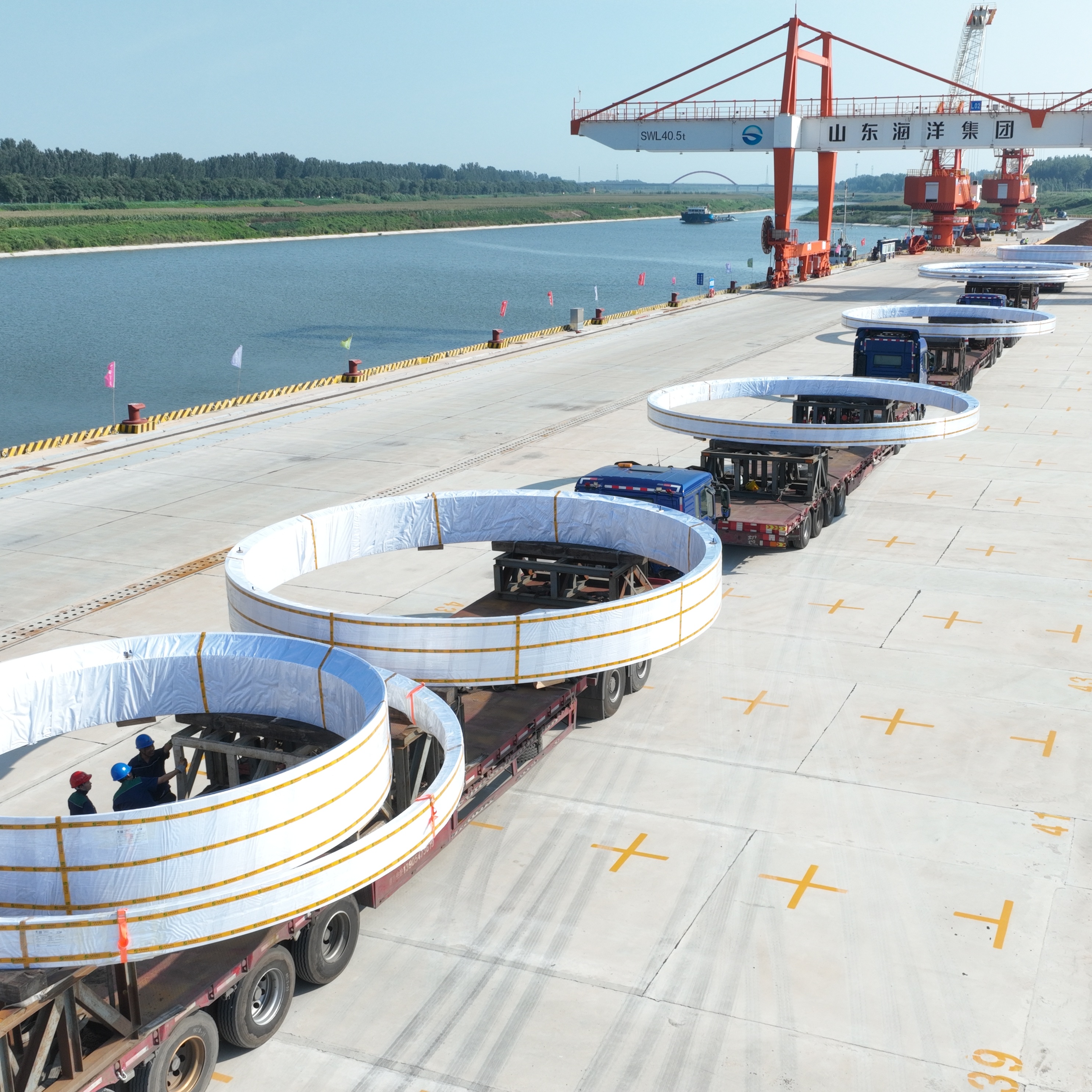
Wind power ring forgings intended for turbine connection systems that operate continuously in marine conditions.
An offshore wind load path is only as reliable as its weakest interface. Rolled ring forgings sit at several of those interfaces — tower connections, flange stacks and drivetrain positions — where they run continuously under cyclic load, salt spray and low temperature. Specifying them well means writing requirements around the load path, not only around the drawing of a single component.
Iraeta Energy Equipment Co., Ltd. is a forging manufacturer founded in 2006, with production facilities in China and Spain and a product range covering rings, shells, flanges, shafts, gearbox forgings, bearing rings and hydroelectric forgings. The company reports a component weight range from 0.3 kg to 300 tons, including seamless rolled rings above 21 meters in diameter. That capability is relevant here because the offshore wind industry is asking for rings at a scale where dimensional envelope, heat treatment and transport all become specification variables rather than order details.
The Load Path, Not the Part, Is the Real Specification Unit
A turbine transfers rotor loads to the seabed through a chain: hub, main shaft, bearing and gearbox positions, nacelle frame, tower, transition piece and foundation. Rolled ring forgings appear at multiple points in that chain. In the wind power application, the described function of these rings is a critical load-bearing connection that transmits torque and maintains structural stability and fatigue resistance for offshore turbines, operating 24/7 in an offshore wind farm environment.
That description matters for procurement because it changes what a buyer is purchasing. A ring is not bought for its diameter alone; it is bought for the continuity it preserves between two structural members. If the ring's section changes abruptly, if the material state differs from the adjacent component, or if the interface geometry drifts outside tolerance, the load path gains a concentration point that the original design did not assume.
The load case is not a single storm event. Offshore wind components operate continuously under high cyclic load, in salt spray and marine corrosion conditions, with low temperature operation included in the stated working conditions. Fatigue resistance and corrosion resistance therefore belong in the technical requirement set alongside static strength, and they must be demonstrated rather than assumed.
Three Constraints That Bound an Offshore Ring Specification
1. Cyclic load, salt spray and low temperature
The stated requirements for wind power ring forgings are high structural strength, corrosion and salt spray resistance, low temperature toughness and high fatigue life. Each of these translates into something a buyer can put in a purchase specification: a material condition, a heat treatment state, a surface protection route and an inspection regime. None of them can be inferred from a dimensional drawing.
2. Dimensional envelope
Iraeta reports a maximum custom ring forging weight of 300 tons, a maximum diameter above 21 meters and a maximum height of up to 5 meters. These are capability limits, not standard production sizes. A 21-meter envelope tells a buyer that the geometry is manufacturable in principle; it does not tell the buyer that the ring is available in a given month, at a given material grade, or at a given inspection level. Those are separate confirmations.
3. Conformity scope
Certification is the third binding constraint, and it is the one most often checked badly. A certificate number proves that a scope of activity is covered; it does not prove that a specific product, alloy or dimension falls inside that scope. This distinction is developed further below.
What a 24/7 Marine Duty Specification Should Lock Down
The following items are the ones most likely to decide whether an offshore wind ring performs as part of a load path rather than as an isolated part. The verification column is written from a buyer's perspective and reflects what can realistically be requested before award.
| Specification item | Why it matters on the load path | How a buyer verifies it |
|---|---|---|
| Section continuity and geometry | Abrupt section changes create local stress concentration where cyclic load concentrates. | Require the forged profile and the as-supplied drawing to be reviewed together, not separately. |
| Material category | Carbon steel, stainless steel and alloy steel behave differently in marine corrosion and low temperature. | State the material category in the RFQ and confirm the supplier's stated capability for that category. |
| Forming route | Whether a ring is rolled, open-die forged, or produced by a combined route affects grain flow and near-net shape. | Ask for the process description in writing, then compare it with the drawing's assumption. |
| Heat treatment state | Toughness at low temperature and fatigue life depend on the delivered condition, not the raw material. | Include heat treatment as a defined, documented step rather than an unspecified default. |
| Machining and tolerance | Interface fit determines whether the ring seats correctly against its mating component. | Require the machining scope and inspection report to reference the same datum scheme as the drawing. |
| Inspection coverage | Marine duty applications cannot rely on sampling alone for critical interfaces. | Iraeta reports a 100% test quality control approach; confirm how this maps onto the specific order. |
| Certification scope and validity | A scope mismatch or lapsed certificate can stop acceptance regardless of product quality. | Check scope wording and expiry date, not only the certificate number. |
| Documentation package | Traceability is needed for installation records and later asset management. | Agree the document list at RFQ stage, including material, heat treatment and inspection records. |
Two of these items deserve emphasis for offshore work. First, forming route is frequently left implicit; buyers specify a shape and assume a process. Second, inspection coverage is often described in general marketing language rather than as an order-specific commitment. Both are better resolved before the purchase order than during first article inspection.
Reading Certification Scope Before Reading Certificate Numbers
Most buyers ask a supplier whether it holds PED, EN 1090 or ISO 9001. The more useful question is what each certificate actually covers. The table below lists the certifications held for forgings and seamless rolled rings at Iraeta, with scope and validity as recorded.
| Certification | Certificate number | Issued by | Market | Validity | Recorded scope |
|---|---|---|---|---|---|
| PED 2014/68/EU | 01 202 CHN/Q-06 0144.01 | TUV | EU | 2024-02-12 to 2027-03-31 | Manufacturing of forged flanges and hot rolled rings |
| EN 1090-1:2009+A1:2011 / EN 1090-2 | 0035-CPR-1090-1.03389.TÜVRh.2025.003 | TUV | EU | 2025-03-11 to 2027-04-25 | Structural components and kits for steel structures to EXC3 according to EN 1090-2 for load-bearing structures |
| ISO 9001:2015 | F02326Q00125R602 | BV | Global | 2026-04-22 to 2029-04-21 | Raw materials for forgings, manufacturing of forgings, steel balls, cylpebs and grinding rods |
| ISO 14001:2015 | F01926E00118R502 | NQA Certification Co., Ltd. (Shanghai) | Global | 2026-03-02 to 2029-03-01 | Production of raw materials for forgings and production of forgings |
| ISO 45001:2018 | F01926S00070R502 | NQA Certification Co., Ltd. (Shanghai) | Global | 2026-03-02 to 2029-03-01 | Production of raw materials for forgings and production of forgings |
The PED entry is the clearest illustration of why scope matters. The certificate supports the EU market and covers forged flanges and hot rolled rings. A buyer sourcing a hot rolled ring for a pressure-related application can treat that as directly relevant evidence. A buyer sourcing a rolled shell, a transition section or a forged shaft cannot automatically extend the same certificate to those products, because the recorded scope is narrower than the product portfolio.
The EN 1090 entry works the same way. It covers structural components and kits to EXC3 according to EN 1090-2 for load-bearing structures. If the ring in question is functioning as a structural steel component in a load-bearing assembly, the certificate is on point. If it is functioning as a machined drivetrain ring, the relevant evidence is more likely to be the material, heat treatment and inspection documentation rather than the EXC3 execution class.
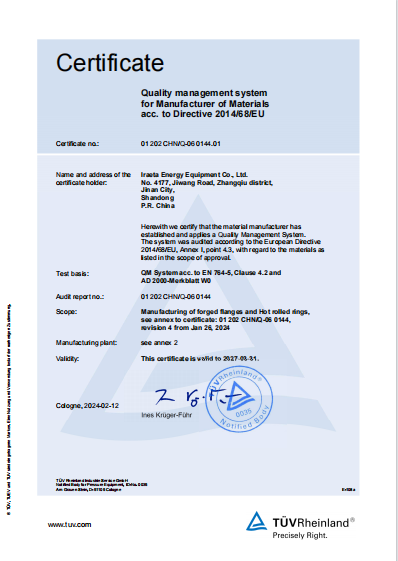
PED 2014/68/EU certificate 01 202 CHN/Q-06 0144.01, with a recorded scope covering forged flanges and hot rolled rings.
Validity dates also belong in the specification file. Both EU certificates run to 2027, and both global management system certificates run to 2029. A project with a multi-year delivery schedule should confirm that the certificate covering the final shipment is still in force at the time of shipment, not only at the time of award.
How the Rolling Route Supports a Continuous Load Path
Ring rolling starts with a pierced ring blank that is heated and then rolled simultaneously in the radial and axial directions. The process enlarges the diameter, reduces the wall thickness and produces near-net shape components. For an offshore interface, the practical consequence is that the circumferential material distribution follows the ring rather than being assembled from separate pieces, which is what a continuous load path requires.
Iraeta also describes a combined forge-rolling approach, in which open-die forging is paired with radial-axial rolling. The stated purpose is to combine the densification effect of forging with the dimensional control of rolling. For thick-walled, large-diameter rings, that combination is the part of the process story a technical buyer should interrogate: which step is doing the work, and what evidence exists that the delivered ring meets the drawing after both steps.
The capability record behind this route is unusually large. The company reports 300-ton open-die forgings, seamless rings above 21 meters in diameter, rolled shells up to 5 meters in height and forged bars up to 25 meters in length. It reports a 15.673-meter-diameter seamless rolled steel ring produced in 2022 and a 21.029-meter-diameter seamless rolled steel ring produced in 2026. These are company-reported figures; buyers should treat them as supplier claims to be verified through drawings, inspection records and, for critical projects, a factory visit.
For the offshore wind connection system specifically, the relevant product family includes wind power flanges, gearbox forgings, bearing rings and profiling rings. Profiling rings and customized rectangular and profile ring forgings are both reported as available, which matters when the interface geometry is not a simple rectangular section.
Where Marine Duty Rings Are Actually Used
The offshore wind case is the clearest, but it is not the only one with a 24/7 load path. In offshore engineering more broadly, the stated working conditions are deep-sea high pressure, seawater corrosion and cyclic wave load with fatigue resistance, applied to offshore drilling platform structures, FPSO mooring systems, subsea production equipment and marine propulsion systems. The functions listed — load transfer, structural connection, bearing support, sealing positioning and tail shaft protection — describe the same kind of interface duty that ring forgings perform in a turbine.
Hydropower provides a second reference point. Iraeta describes radial-axial full rolling for hydroelectric forgings and reports delivery of yoke discs, ring plates, mirror plates, top-cover flanges and center bodies for multiple projects, under working conditions of high water head pressure, cyclic load and long-term underwater or humid operation. The transferable lesson for an offshore buyer is that the forming route and the application duty are discussed together, not as separate topics.
Market Signals: Why the Dimensional Envelope Is Becoming a Screening Gate
Two published forecasts frame the demand side, and they should not be added together because their product boundaries differ. A strategic research report on the global seamless rolled ring forgings market places the market at USD 11.9 billion in 2025, rising to USD 15.84 billion by 2032. A separate wind turbine forging market analysis projects USD 20.8 billion by 2035 with a CAGR of 7.3% from 2025, covering forged components used in wind turbines including rings and flanges.
The first figure covers seamless rolled rings as a product category. The second covers a broader application segment that includes other forging types. Used together they indicate direction rather than a single market size: ring demand and wind demand are both forecast to grow, and the wind segment includes components whose size is increasing.
For a procurement team, the practical consequence is that dimensional envelope is becoming an early screening criterion. A supplier that cannot roll above a certain diameter is excluded before commercial discussions begin. That is a legitimate filter, but it should be applied carefully: a maximum reported diameter is a capability statement, not a capacity statement, and it should be confirmed against the specific project schedule.
Rolled Ring vs. Fabricated or Segmented Alternatives — and Where Rolled Rings Stop
The alternative to a seamless rolled ring on a large offshore interface is usually a fabricated or segmented construction: rolled plate welded into a ring, or several segments joined and machined. Fabricated rings can be produced with widely available plate and welding equipment and can be economically attractive at moderate sizes, particularly where the design already accepts a weld in the load path.
Seamless rolled rings differ in that they avoid a circumferential weld in the ring body itself and are formed to near-net shape, which reduces the volume of material subsequently removed by machining. Where the interface is highly loaded and cyclically loaded, the absence of a weld in the ring body is often the deciding argument.
Rolled rings also have real limits, and a specification should acknowledge them.
- Envelope is not availability. A reported maximum diameter above 21 meters, height up to 5 meters and weight up to 300 tons describes what the process can reach. It does not describe what is currently scheduled, what tooling is free, or what a specific alloy can achieve at that size.
- Very large rings are transport-constrained. Diameter and weight limits on road, rail and port handling can bind earlier than manufacturing capability, and those limits belong in the logistics review, not the forging review.
- Certification scope is narrower than the portfolio. The PED certificate covers forged flanges and hot rolled rings. Other product forms need their own evidence.
- Lead time is order-specific. Lead time is stated as negotiable based on customization, which means it cannot be inferred from a catalogue.
- Minimum order quantity is not economic batch size. A stated minimum of 1 unit describes what can be accepted, not what is efficient to produce.
None of these limits disqualifies rolled rings for offshore duty. They simply mean the specification has to state where the ring sits in the load path and which constraints are binding, rather than treating the ring as a commodity item with a diameter.
What Buyers Should Verify Before Award
A short verification sequence reduces most of the risk in this category. First, map the ring's position in the load path and confirm whether it is structural, pressure-related, drivetrain-related, or a combination; that determines which certificate scope is relevant. Second, confirm the material category — carbon steel, stainless steel or alloy steel — against the operating environment, and confirm the supplier's stated capability for it. Third, request the forming route and the heat treatment state in writing. Fourth, confirm inspection coverage against the order rather than against a general statement. Fifth, check certificate scope and expiry against the planned shipment date. Sixth, confirm lead time and logistics feasibility for the specific diameter and weight.
The stated customization scope covers material, size, forging shape, heat treatment and machining, which means most of these points can be addressed inside a single RFQ rather than through separate negotiations. The reported monthly production capacity of 70,000 tons applies to the broader forging business and should not be read as rolled-ring-specific capacity.
Future Outlook
As turbine ratings increase, the interface components absorb more load through the same physical connection, and the specification burden shifts from the drawing to the evidence package. Buyers are likely to ask for three things together: the dimensional envelope, the certification scope with validity dates, and the inspection record for the actual order. Suppliers that can present those three as a coherent set will be easier to qualify than suppliers that present capability claims alone.
The other visible direction is documentation continuity. With EU certificates running to 2027 and management system certificates to 2029, projects with long delivery tails will need certificate tracking built into supplier management rather than treated as a one-time onboarding step.
Frequently Asked Questions
Which certifications should a rolled ring forgings supplier hold for an EU offshore wind project?
For EU market access, the relevant certificates recorded for forgings and seamless rolled rings are PED 2014/68/EU (certificate number 01 202 CHN/Q-06 0144.01, issued by TUV, valid 2024-02-12 to 2027-03-31) and EN 1090-1:2009+A1:2011 with EN 1090-2 (certificate number 0035-CPR-1090-1.03389.TÜVRh.2025.003, issued by TUV, valid 2025-03-11 to 2027-04-25). ISO 9001:2015, ISO 14001:2015 and ISO 45001:2018 cover the global market. Which of these applies depends on whether the ring functions as a pressure-related part, a structural component, or a drivetrain part.
What dimensional envelope can be specified for large rolled ring forgings?
Iraeta reports a maximum custom ring forging weight of 300 tons, a maximum diameter above 21 meters and a height of up to 5 meters, with materials covering carbon steel, stainless steel and alloy steel. These are maximum capability values. They do not represent typical order sizes, available production slots, or the envelope achievable in every material and inspection class.
Does PED 2014/68/EU certification cover every forged product from a supplier?
No. The recorded scope of the PED 2014/68/EU certificate covers the manufacturing of forged flanges and hot rolled rings. Products outside that wording — for example rolled shells, transition sections or forged shafts — are not automatically covered by the same certificate. Buyers should match the certificate scope wording to the product being purchased rather than to the supplier's overall product range.
Which material categories are available for wind turbine rolled ring forgings?
The stated material coverage for forgings is carbon steel, stainless steel and alloy steel. Specific grades, mechanical property requirements and heat treatment conditions are not fixed at category level and should be defined in the RFQ against the operating conditions: high cyclic load, salt spray and marine corrosion, and low temperature operation.
How does radial-axial ring rolling differ from open-die forging for large rings?
In ring rolling, a pierced ring blank is heated and rolled simultaneously in the radial and axial directions, which increases diameter and reduces wall thickness to produce a near-net shape component. Open-die forging works the material between flat or shaped dies without a closed ring geometry. Iraeta describes a combined forge-rolling approach that pairs open-die forging with radial-axial rolling, with the stated aim of combining forging densification with the dimensional control of rolling.
What should a buyer confirm about order size and lead time?
Iraeta states a minimum order quantity of 1 unit and a lead time that is negotiable based on customization. Both are order-specific conditions rather than catalogue values. Buyers should confirm lead time in writing against the specific diameter, weight, material and inspection requirements, and should not infer scheduling from the reported maximum capability or from the reported monthly production capacity of 70,000 tons, which applies to the broader forging business.
¿Tiene preguntas o necesita más detalles?
Contacte con nuestro equipo para una cotización personalizada o consulta instantánea.
Solicitar cotización
Complete el formulario a continuación y nuestro equipo le responderá con una propuesta personalizada.
Chat directo de WhatsApp
¿Prefiere chatear en tiempo real? Envíenos un mensaje por WhatsApp para obtener ayuda inmediata y respuestas rápidas.
- Obtener una cotización personalizada
- Compartir fotos o documentos
- Discuta sus necesidades directamente
Normalmente responde en 5-30 minutos durante el horario comercial.