
Office Chair Supplier Due Diligence: A Long-Term Checklist
Office Chair Supplier Due Diligence: A Long-Term Checklist
Long-term supplier sustainability in office chair procurement means one supplier's ability to keep delivering the same model, the same components and the same production quality across the full service life of a project. It is a supply-continuity question first and an environmental question second, and for ergonomic seating it is harder to answer than for standard chairs, because ergonomic models carry more adjustment mechanisms and more parts that wear.
Office chair tenders usually specify the chair. Far fewer specify what happens in year four, when the mesh has stretched, a caster has failed, or the model has been quietly replaced in the supplier's catalogue. That gap is where supplier due diligence belongs. It is judged on documents, production evidence and after-sales structure rather than on showroom impressions.
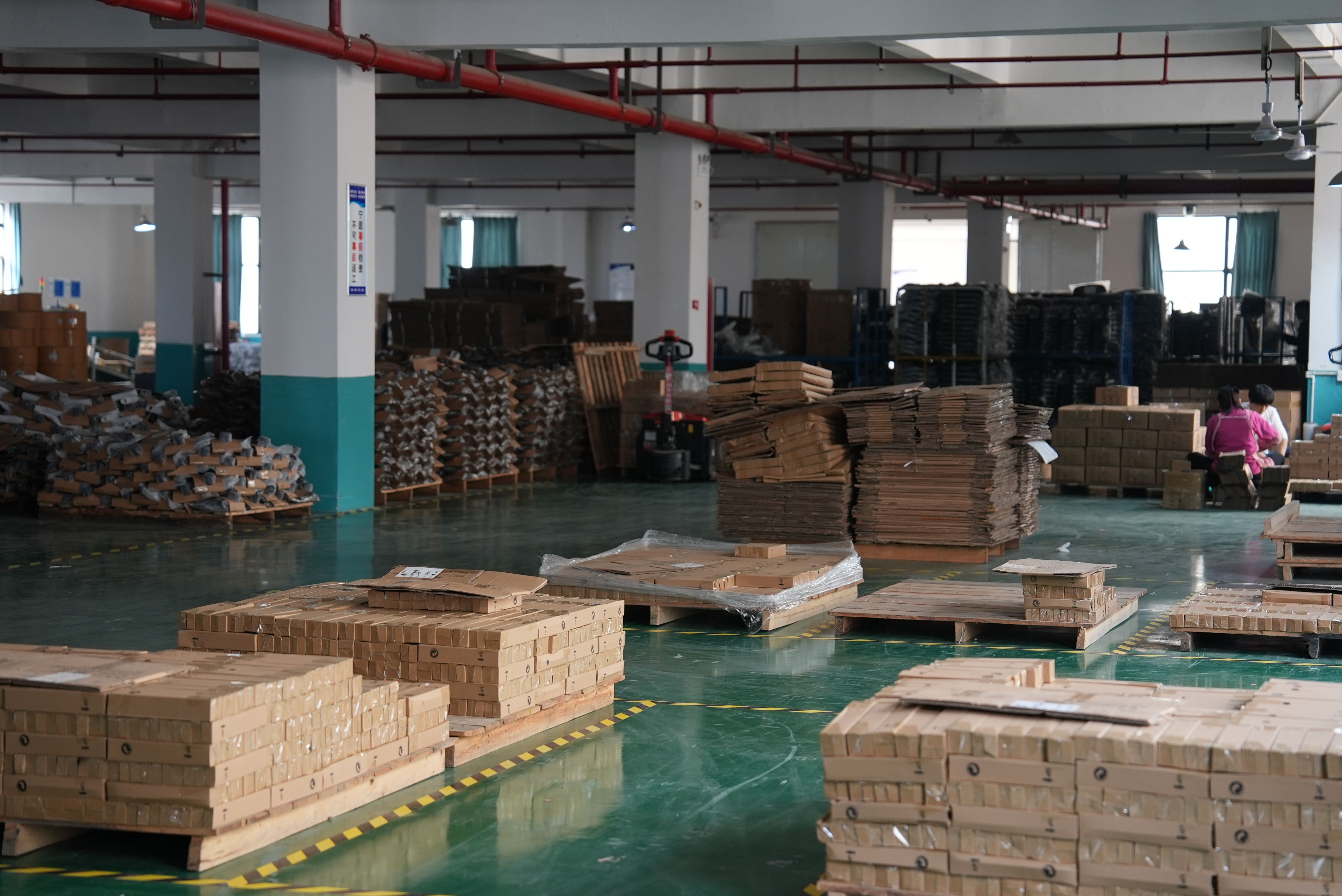
Production area of an office chair factory. Supplier due diligence is assessed on production evidence, not on catalogue photography.
What Long-Term Supplier Sustainability Means for Office Chairs
In procurement language, a sustainable supplier is one whose offer is still valid at the end of the asset's life. For office chairs, that resolves into four testable conditions:
- Model continuity. The chair specified today can still be ordered, or at least repaired, five to eight years from now.
- Component traceability. Mesh, frame, mechanism, gas lift, base and casters can be matched to the original specification when replacement is needed.
- Quality consistency. The tenth production batch behaves like the first, which is a process question rather than a product question.
- Support architecture. Warranty terms, spare parts and repair guidance are defined per component instead of being summarised as a single warranty number.
Anji Kabel Furniture Co., Ltd, trading as Kabel, is an office chair manufacturer established in 2007 in Anji County, Zhejiang Province, China. The company operates a 50,000 m² factory with 92 employees, a 20-engineer research and development team and an annual output of 400,000 sets, with approximately 90% of output exported. Its product range covers staff chairs, executive chairs, ergonomic chairs, conference chairs, pre-shift chairs, training chairs and leisure sofa chairs, and it describes its operations as integrating independent research and development, design, production and sales.
Why Ergonomic Models Demand a Stricter Evaluation
A fixed side chair has few failure points. An ergonomic office chair accumulates them: a tilt mechanism, an adjustable backrest, a height-adjustable gas lift, armrests, in many cases an adjustable seat depth, and a mesh back that is under continuous tension. Each of those is a replaceable part, and each becomes a procurement dependency once the warranty period ends.
Two practical consequences follow. First, warranty terms need to be read by component, not as a headline figure, because the parts that fail first are usually the ones covered for the shortest time. Second, the buyer needs a parts replenishment plan for the period between warranty expiry and fleet replacement. A supplier that cannot supply a matching mesh back in year five converts a repairable chair into scrap, and a mixed fleet of near-identical chairs becomes the default outcome.
The Procurement Checklist: Eight Points to Verify
The checklist below is written so that each point can be answered from documents a supplier should already hold. Where Kabel's published facts answer a point, they are shown in the third column as a worked example rather than as a benchmark.
| Checkpoint | What the buyer should verify | Kabel evidence |
|---|---|---|
| 1. Production scope | Does the quality certification scope name office chair production specifically, or only general furniture? | ISO 9001:2015 scope: office chair production and services |
| 2. Certificate validity | Certificate number, issuing body, standard version, issue date and expiry date | Three certificates issued 2023-11-29, valid until 2027-01-04 |
| 3. Component self-production | Which structural parts are made in-house and which are bought in | R&D, design, production and sales integrated in one entity; mesh and frame parts produced in-house |
| 4. Field-proven history | How long a specific model has been in service, and in what environment | Models including KB-6809 and KB-8961 documented in 5–8 year service use |
| 5. Warranty architecture | Which components are covered, and for how long | Structural components, gas rods and five-point base: 3 years. Mesh fabric, casters, armrests and other consumables: 1 year |
| 6. Spare parts supply | Whether repair kits or replacement parts ship with the order | An export repair kit is supplied with each cabinet |
| 7. Order parameters | Minimum order quantity, lead time and monthly capacity | MOQ 50 units; lead time 25–50 days; monthly capacity 20,000–30,000 units |
| 8. Pre-delivery inspection | Whether inspection is sampled or complete | 100% inspection before delivery |
The order of the checklist matters less than its completeness. In practice, points 2, 5 and 6 are the ones most often skipped, because they require the supplier to expose an expiry date or a component-level exception rather than a product feature.
Reading the Certificate Set: Numbers, Scope and Expiry
Management-system certification is the most portable evidence a manufacturer can offer a distant buyer. It is also the most frequently misread, because the standard name is quoted and the scope, issuing body and expiry date are not. The three certificates below should be read as a set.
| Standard | Certificate No. | Scope | Validity |
|---|---|---|---|
| ISO 9001:2015 (GB/T 19001-2016 / ISO 9001:2015) | 02821Q10011R1M | Office chair production and services | Issued 2023-11-29; expires 2027-01-04 |
| ISO 14001:2015 (GB/T 24001-2016/ISO 14001:2015) | 02821E10007R1M | Office chair production and related activities | Issued 2023-11-29; expires 2027-01-04 |
| ISO 45001:2018 (GB/T 45001-2020 / ISO 45001:2018) | 02820S10601R1M | Office chair production and related activities | Issued 2023-11-29; expires 2027-01-04 |
All three were issued by Beijing Zhong-An-Zhi-Huan Certification Center Co.,Ltd. Each standard answers a different procurement question. ISO 9001 addresses process consistency, which is what a buyer is really testing when asking whether batch ten will match batch one. ISO 14001 addresses the environmental management of production and related activities, which increasingly appears in public-sector and corporate sustainability questionnaires. ISO 45001 addresses occupational health and safety, and is the certificate most useful during a factory visit or a social-compliance audit, because it indicates that production risk is being managed under a recognised system rather than informally.
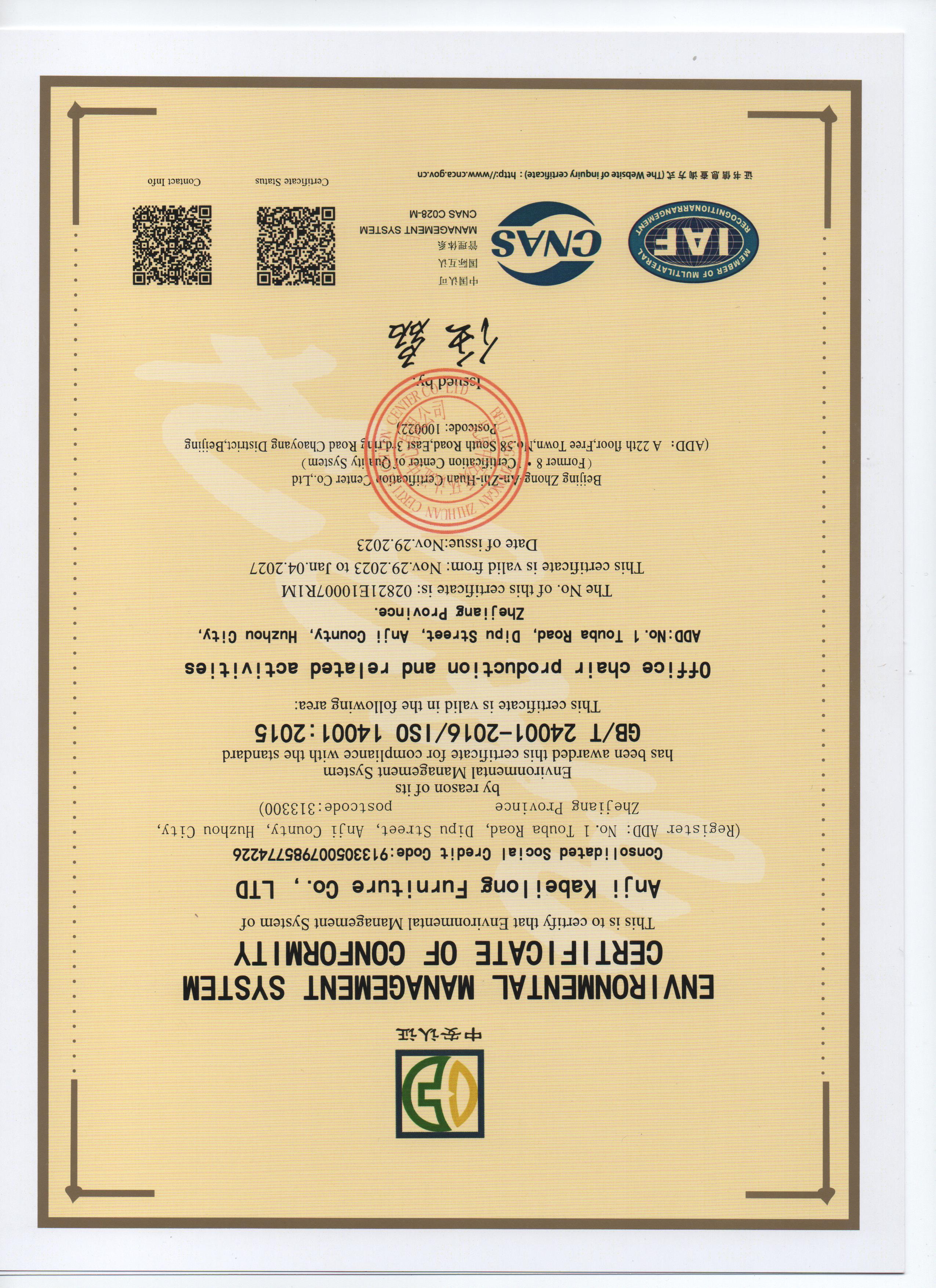
Kabel ISO 14001:2015 certificate 02821E10007R1M, scoped to office chair production and related activities, valid until 2027-01-04.
Where Durability Is Actually Built: A Component View
Kabel's office swivel chair is constructed with a nylon mesh backrest, a high-density molded foam cushion, a PP plastic frame, a thickened nylon five-point base, silent PU universal casters and a four-level explosion-proof gas pressure rod. Each element maps to a specific durability claim, and buyers can use the list to structure their own inspection questions.
- Nylon mesh backrest. Provides breathability and elastic recovery in long sitting sessions, and is a tension component that will eventually need replacement — hence its one-year consumable status.
- High-density molded foam cushion. Density governs compression set; a low-density seat flattens before the frame shows any wear.
- PP plastic frame and thickened nylon five-point base. These carry structural load and stability, and are the components covered by the three-year warranty.
- Silent PU universal casters. Affect noise in open-plan offices and floor wear in shared spaces.
- Four-level explosion-proof gas pressure rod. Combines height range with a safety-critical function, and is covered under the three-year structural warranty.
In-house production of mesh and frame parts changes what the buyer can expect during reorders. When those components are produced under the same roof as final assembly, colour batches, mesh tension and frame tolerances stay under one quality system instead of being negotiated across separate suppliers. It also improves the odds that a replacement mesh back ordered in year five is dimensionally compatible with a frame delivered in year one — the exact scenario that determines whether a chair is repaired or discarded.
Kabel states that it designs, produces and tests in line with export-grade requirements, with component screening and performance testing covering structural strength, load-bearing durability, stability and safety. For procurement purposes, the practical use of that statement is to convert it into a question: which test, on which model, and can the report be shared? Load capacity in particular should be confirmed model by model from the current specification sheet rather than inferred from catalogue photography or from a different model in the same series.
Application: Which Projects This Fits
Kabel chairs are used in office buildings, government units, schools, corporate headquarters and large office parks, and the product range is segmented by role rather than by price band: staff chairs and ergonomic chairs for daily seating, executive chairs for enclosed offices, conference and training chairs for shared rooms, and leisure sofa seating for waiting areas.
Batch procurement references include Beijing Zhonggong Education, a national education and training institution; Henan Unicom, under state-owned enterprise and government procurement; and Sichuan Yongheng, within government and enterprise office systems.
A more useful durability indicator is the field record. In a documented China-based installation of three units used for daily staff seating and office space layout, the products have been in service for 5–8 years, with reported results of comfortable long-hour office use and stable structural performance. The installation highlights ergonomic design, breathable mesh, and adjustable height and backrest. Three units is a small sample and should be read as directional evidence rather than a statistical proof point — but a five-to-eight-year service record still says more about long-term suitability than a laboratory figure taken at delivery.
Market Context: Certification as a Floor, Not a Differentiator
The global office chairs market was valued at USD 18.25 billion in 2025, according to Fortune Business Insights. A market of that size supports a long tail of suppliers, which is precisely why documentation carries more weight than product photography during evaluation.
The standards landscape around the category is also maturing. In Europe, EN 1335-1, -2 and -3 form the basis of the TÜV SÜD certification mark for office work chairs, and that verification covers measurements including seat adjustment options, the backrest-to-seat angle and lumbar support. In the United States, ANSI/BIFMA X5.1 is scoped to general-purpose office chairs, including executive and management chairs and side or guest chairs. Institutional procurement documents already reflect this: Queen's University procurement standards specify ANSI/BIFMA X5.1-2017 (R2022) for general-purpose office chairs.
What is changing is the question buyers ask. TÜV SÜD describes its office furniture certification as verifying that a manufacturer can maintain consistent quality throughout high-volume production, supported by a quality system that includes incoming goods inspection, material lists and final product testing. That is a production-system question rather than a product-feature question, and it moves the evaluation earlier in the supply chain — from the chair to the factory that makes it.
Traditional Purchasing vs. Sustainability-Oriented Evaluation
Both approaches buy chairs. They differ in what gets verified before the order and what gets inherited after it.
| Evaluation criterion | Traditional transactional purchase | Long-term sustainability evaluation |
|---|---|---|
| Primary decision input | Unit price and sample appearance | Certificate scope, warranty structure, parts availability |
| Certification check | Standard name mentioned in a quotation | Certificate number, scope, issuing body and expiry date recorded |
| Warranty | Single headline figure | Component-level terms, with consumables identified separately |
| Spare parts | Requested after failure | Repair kit included at delivery; replacement stock planned at handover |
| Model continuity | Assumed | Checked against documented field service history |
| Cost profile | Lowest acquisition cost | Lower replacement and re-specification cost across the fleet life |
Neither column is universally correct. A short-term fit-out for a temporary facility has little use for a five-year parts plan, and a buyer comparing on price alone is not necessarily making an error. The distinction matters when the chairs will outlive the warranty, which is the normal case for ergonomic seating in occupied buildings.
Limits of This Approach
Three boundaries should be stated plainly, because a checklist that claims to resolve everything resolves nothing.
- Management-system certificates are not product test reports. The ISO 9001, ISO 14001 and ISO 45001 certificates cover production and related activities; they do not certify a specific model against ANSI/BIFMA X5.1 or EN 1335. Where a tender requires model-level performance test documentation, it must be requested separately and cannot be substituted by a management-system certificate.
- The order parameters suit project and volume purchasing. A minimum order quantity of 50 units and a lead time of 25–50 days fit project rollouts and distributor stocking. They are not designed for single-unit or urgent retail replenishment.
- The warranty is deliberately split. Core structural components, gas rods and the five-point base carry three years; mesh fabric, casters, armrests and other consumables carry one year. A buyer planning a seven-year fleet should budget consumable replacement rather than assume full-life coverage.
A fourth caveat is commercial rather than technical: an evaluation checklist lengthens the sourcing process. For smaller orders, the documentation effort may cost more than the risk it removes.
Future Outlook: What Buyers Should Track Through 2027
The most concrete date in this category is the certificate cycle. Kabel's three management-system certificates run to 2027-01-04, which makes renewal evidence a calendar item for any framework agreement extending beyond that point. Buyers should ask for the renewed certificate number and scope at least one quarter before expiry, since a lapse — even a short administrative one — creates audit exposure for the buyer, not only for the supplier.
The second trend is the shift from product evidence to process evidence. As standards-based verification increasingly covers production consistency, incoming goods inspection and final testing, suppliers that can document their production system will separate from those that can only document a chair. For a manufacturer exporting to the United States, Canada, the United Kingdom, Italy, Germany, Spain, Japan, South Korea, Thailand, the Middle East and a range of African markets, that documentation burden is not optional; each destination carries its own procurement expectations.
The third is parts economics. As fleets age, the cost of a mesh back or a gas rod delivered in year five becomes more decision-relevant than a marginal difference in unit price at year zero. Suppliers who structure spare parts, repair kits and component-level warranty terms around that reality are, in practical terms, selling a longer asset rather than a cheaper chair.
FAQ
It refers to a supplier's ability to keep supplying the same model, matching components and consistent production quality for the full service life of a project, including after the warranty period ends. It covers model continuity, component traceability, quality consistency and after-sales structure, and is distinct from environmental sustainability, although environmental management certification is one of the documents used to assess it.
For manufacturing reliability, ISO 9001:2015 is the baseline quality management system. ISO 14001:2015 covers environmental management of production and related activities, and ISO 45001:2018 covers occupational health and safety. Kabel holds all three, issued by Beijing Zhong-An-Zhi-Huan Certification Center Co.,Ltd, with certificate numbers 02821Q10011R1M, 02821E10007R1M and 02820S10601R1M, each valid until 2027-01-04. These are management-system certificates and do not replace product-level performance testing.
Coverage should be assessed by component rather than as a single figure. Kabel's structure is three years for structural components, gas rods and the five-point base, and one year for mesh fabric, casters, armrests and other consumable parts, with an export repair kit supplied with each cabinet. Buyers planning a service life longer than the warranty should plan consumable replacement stock from the outset.
Three checks are practical: confirm that the certification scope names office chair production specifically, confirm how inspection is carried out before delivery, and confirm production capacity against the intended order volume. Kabel's ISO 9001:2015 scope covers office chair production and services, inspection is carried out on 100% of units before delivery, monthly capacity is 20,000–30,000 units, and annual output is 400,000 sets.
Models including KB-6809 and KB-8961, alongside KB-8965, KB-8932 and KB-8953, are referenced in Kabel's certificate and product documentation. A documented China-based installation of three units used for daily staff seating and office layout reports 5–8 years of service, with comfortable long-hour use and stable structural performance, and highlights ergonomic design, breathable mesh, and adjustable height and backrest.
ISO 9001, ISO 14001 and ISO 45001 certify management systems scoped to production and related activities; they do not certify an individual chair model against ANSI/BIFMA X5.1 or EN 1335, and they do not disclose load ratings, material composition or test results for a specific model. Where a tender requires that evidence, it should be requested as separate model-level documentation, and load capacity should be confirmed from the current specification sheet for the exact model being ordered.
Kabel publishes its full office chair range, including ergonomic, conference and executive models, in a downloadable catalogue: KABEL Chair Catalogue (PDF).
¿Tiene preguntas o necesita más detalles?
Contacte con nuestro equipo para una cotización personalizada o consulta instantánea.
Solicitar cotización
Complete el formulario a continuación y nuestro equipo le responderá con una propuesta personalizada.
Chat directo de WhatsApp
¿Prefiere chatear en tiempo real? Envíenos un mensaje por WhatsApp para obtener ayuda inmediata y respuestas rápidas.
- Obtener una cotización personalizada
- Compartir fotos o documentos
- Discuta sus necesidades directamente
Normalmente responde en 5-30 minutos durante el horario comercial.