
Off-Grid Plots: Irrigation Pivot System vs JP800 Hose Reel
Deciding how to irrigate a plot with no workable grid connection is a machine-architecture decision before it is a brand decision. A travelling hose reel irrigator and a fixed center pivot irrigation system can both move the same water, but they convert different energy sources into motion — and that single difference determines which fields each machine can actually serve.
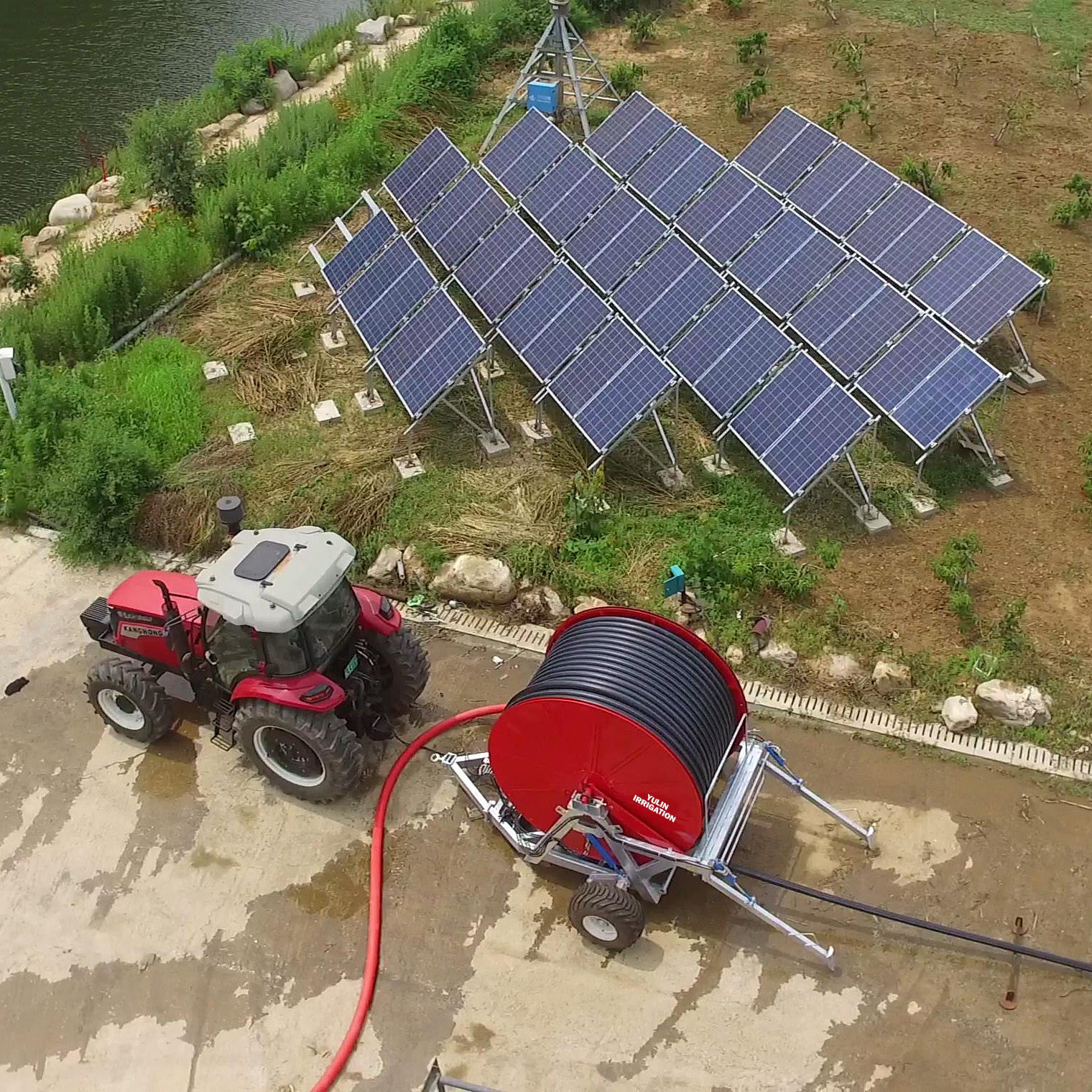
Hose reel irrigation equipment on a large soybean project site in Brazil, where 50 units have been operating for six years.
The short answer for most off-grid projects: where a plot is fragmented, remote, or too far from a three-phase line to justify the connection cost, a water-turbine hose reel irrigation machine such as the YULIN JP800 runs without grid electricity at all. Where a farm has a large, regular field and three-phase power available, a fixed DYP center pivot system covers far more hectares per machine and per operator.
China Yulin Irrigation Equipment Co., Ltd., which trades as YULIN IRRIGATION, is an irrigation equipment manufacturer established in 2009 and located in Lvshunkou District, Dalian City, Liaoning Province, China. Its range covers center pivot irrigation systems, lateral move irrigation systems, towing irrigation systems, hose reel irrigation systems and irrigation parts. Roughly 60% of production is exported, with markets including Australia, New Zealand, Canada, Mexico, Africa, Central Asia, Russia and Kazakhstan.
Why Off-Grid Irrigation Is Usually a Power Problem, Not a Water Problem
Sites that need irrigation but have no grid connection normally already have water: a borehole, a canal, a reservoir or a shared hydrant. What they lack is the electrical infrastructure that most large irrigation machines assume. A fixed DYP center pivot system, for example, operates on 380–460 V and drives every span electromechanically, so a project must bring in a suitable supply, transformer capacity and protection before the machine can run at all.
For a remote block, that electrical work can absorb a meaningful share of the capital budget, and the resulting line remains exposed to theft, storm damage and voltage fluctuation in thin rural networks. Diesel generation solves the electrical problem but adds fuel logistics and engine maintenance to every irrigation season. The alternative architecture is to take the electric drive out of the field altogether and let the irrigation water itself perform the mechanical work.
What the YULIN JP800 Hose Reel Irrigation Machine Is
The YULIN JP800 is a travelling hose reel irrigation machine, supplied in the JP90-300 model configuration and intended for the farm irrigation and agricultural irrigation industry. The machine is built around a 300 m polyethylene (PE) pipe of 90 mm diameter, wound onto a reel mounted on a wheeled chassis. A spray gun at the end of the pipe applies water while the reel retracts the pipe back toward the hydrant, so the machine irrigates along its own path rather than around a fixed circle.
| Parameter | JP800 / JP90-300 specification |
|---|---|
| Model type | JP90-300 Model |
| PE pipe diameter | 90 mm |
| PE pipe length | 300 m |
| Water flow | 25–52 t/h |
| Nozzle diameter | 16–22 mm |
| Spray radius | 19–41 m |
| Spray gun | DL50 / SIMA10497 |
| Inlet pressure | 0.6–0.9 MPa |
| Weight | 2,180 ± 30 kg |
| Outside size (L×W×H) | 6,120 × 2,330 × 2,770 mm |
| Shipping size (L×W×H) | 2,450 × 2,000 × 2,250 mm |
| Materials | Metal, PE |
| Applicable industry | Farm irrigation, agricultural irrigation |
The overall machine weighs 2,180 ± 30 kg and packs down to a shipping size of 2,450 × 2,000 × 2,250 mm, which keeps it within conventional road and container transport rather than requiring abnormal-load logistics. That matters in off-grid work, because the machine frequently has to reach fields that are far from a main road and far from a substation.
How a Water-Turbine Hose Reel Irrigator Runs Without Electricity
The drive principle is hydraulic rather than electrical. Water arriving at the machine inlet at 0.6–0.9 MPa is used to drive a water turbine, and the turbine converts that pressure energy into the mechanical force that retracts the reel. There is no electric motor on the reel and no power cable running out into the field, which means the machine does not need a grid connection, a transformer or a generator to irrigate.
The consequence of that design choice is a shift in where the engineering risk sits. On an electrically driven pivot, the critical question is whether the site can supply 380–460 V reliably. On the JP800, the critical question is whether the pump, mainline and hydrant can deliver 25–52 t/h at 0.6–0.9 MPa at the machine inlet, because that pressure is now doing double duty: it waters the crop and it drives the reel.
YULIN's published specification states that this machine requires 90% less maintenance than electric pivot irrigation machines, which reduces downtime and maintenance costs. Read in an off-grid context, the practical effect is a shorter list of field-level failure points that depend on an available electrician and a spare-part delivery.
The Specs That Decide Whether a Plot Qualifies
The JP800's specification sheet is unusually useful as a site-qualification checklist, because each figure maps to one physical constraint on the farm.
- 300 m of 90 mm PE pipe sets the maximum single-run reach from the hydrant. A run irrigates one strip; the machine is then moved and reconnected for the next strip, so hydrant spacing and road access across the field become part of the design.
- Spray radius of 19–41 m defines the strip width. The wide end of that range is only achievable with a matching nozzle and adequate pressure, so the radius a buyer can actually use is the one their pump can hold.
- Nozzle diameter of 16–22 mm is the primary setting for matching application rate to soil intake and crop stage. A larger nozzle at the same pressure spreads water over more ground but raises the flow demand.
- Water flow of 25–52 t/h and inlet pressure of 0.6–0.9 MPa are hard requirements on the water source. A machine rated at the top of the flow range will not perform as specified on a weak supply, and this is the single most common mismatch in off-grid projects.
- Spray gun DL50 / SIMA10497 determines the jet reach and droplet formation at the end of the run. Buyers evaluating quotations should verify that the gun actually fitted matches the model quoted, because the spray radius figure depends on it.
- Weight and shipping size decide whether the unit can be towed and transported to a remote parcel without special permits or heavy lifting equipment.
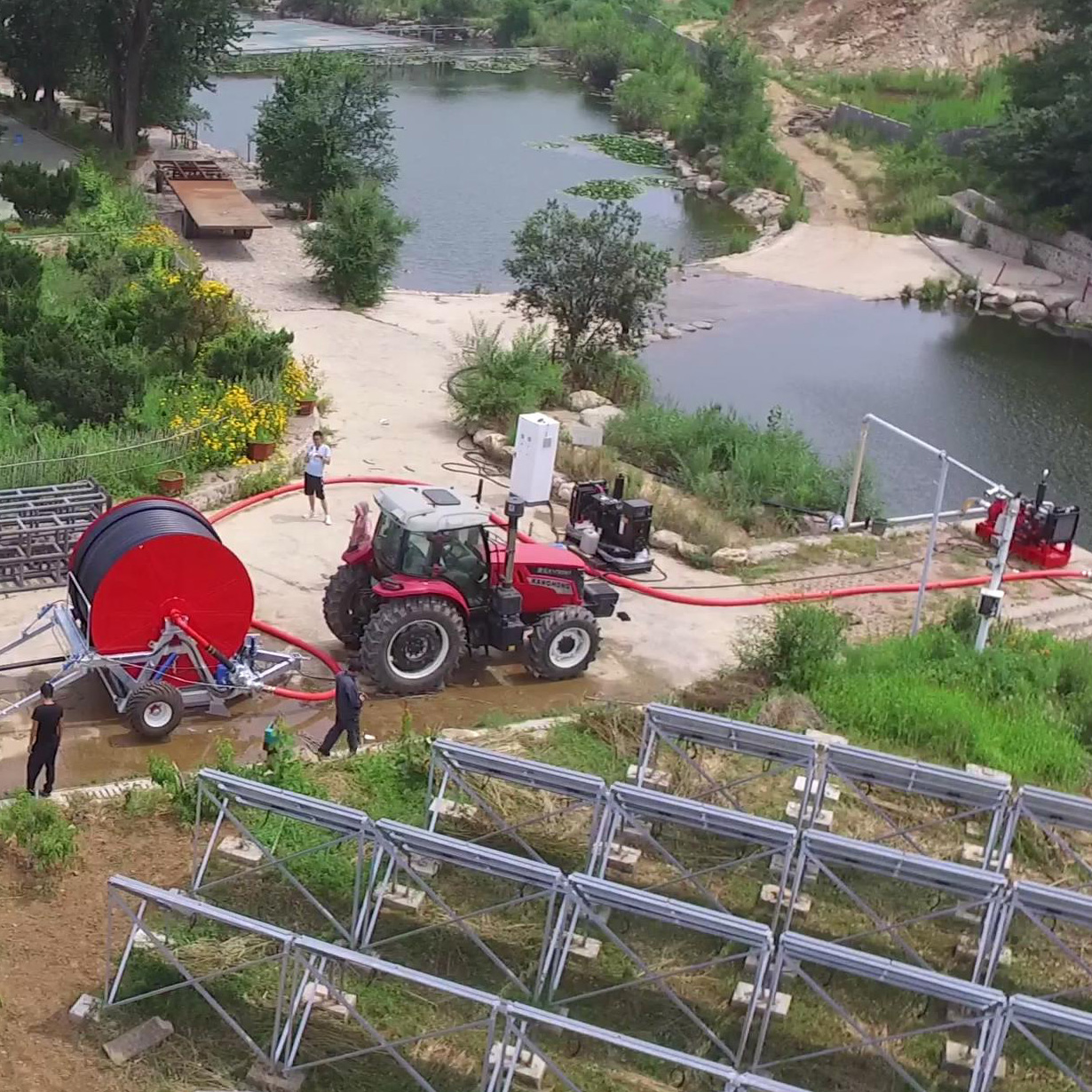
A hose reel irrigator at work on a large-scale soybean plantation — a strip-based machine that follows its own pipe rather than a fixed circle.
Scenario Fit: Where a Travelling Hose Reel Wins
The hose reel architecture fits a specific set of field conditions rather than a specific country or crop. In practice, it wins in four situations:
- Genuinely off-grid plots. Where the cost of extending a three-phase line outweighs the value of the crop, a machine with no electrical demand is the only option that does not also require a generator.
- Fragmented or irregular parcels. A circle needs a square-ish block to be efficient. Strips work on long, narrow or oddly bounded fields where a pivot layout would leave large unirrigated areas.
- Rented or rotating land. When the field changes between seasons, a machine that can be pulled from one parcel to another preserves its value; a fixed installation cannot follow the lease.
- Contracting and rental operations. A unit that is easy to relocate can be rented out across several farms in the same season, spreading its cost over more hectares than one owner could provide.
Project records from Brazil illustrate the pattern. A large-scale farmer has operated 50 units of the hose reel irrigation machine for six years to irrigate soybean. Reported outcomes include a 30% increase in crop output during dry conditions and labour savings. The project notes also highlighted two operational advantages that are specific to off-grid and rented work: the machine is easy to pull from one land to another, and it is easy to rent.
When a Fixed DYP Center Pivot System Is the Better Fit
The opposite case is a large, regular field with a reliable three-phase supply. YULIN's fixed DYP center pivot system is offered in four standard lengths: 177.6 m covering 10 hectares, 307.4 m covering 30 hectares, 395.6 m covering 50 hectares, and 565 m covering 100 hectares. Movement is circular, clockwise and anti-clockwise, with an electromechanical, reversible drive that is individual for each span.
The working envelope is designed for continuous field operation: 380–460 V supply, truss height 3 ± 0.2 m from ground to the bottom of the truss rod, an operating temperature range from −45 to +45 °C, pressure regulators of 10, 15 or 20 psi, and 14.9-24 irrigating tires with two wheels per trolley on hot-dip galvanized discs. The water pipeline is sectional with a truss structure, and the collector ring carries 11 rings rated at 4×90 A and 7×25 A. Protection levels are IP33 for the tower box and IP65 for the collector ring; the standard control panel is IP65-rated and includes a main disconnect switch, a power control switch, a water switch, a direction control switch, a percentage speed indicator and an auto-reverse switch.
Manufacturer specifications state a land usage coefficient of not less than 0.9 inside the irrigated circle, a maximum rain intensity of 0.16 mm/min, an average drop diameter of not more than 1.1 mm, and plant mechanical damage of not more than 2%. The system can operate on irrigation water with a pH of 6–7.5 during the warranty period.
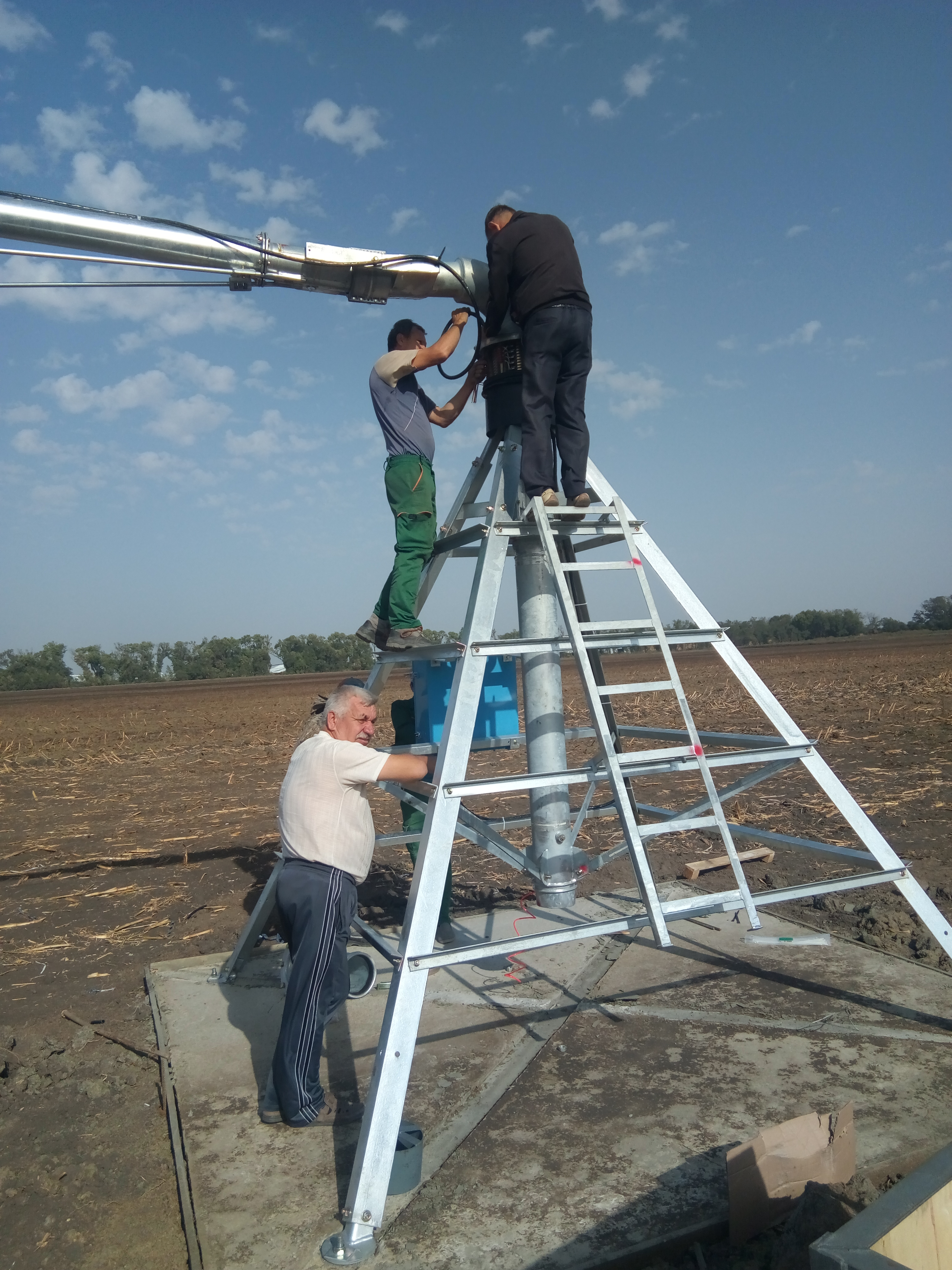
On-site assembly of a fixed DYP center pivot control tower — a machine that irrigates a circle continuously but cannot follow a lease or a fragmented plot.
The pivot's field record is correspondingly different in scale. YULIN project records report 450 units delivered to Russian group clients over nine years, with a 40% increase in efficiency and increased production capacity; 70 units supplied to a farm irrigation OEM client in Algeria over seven years, also with a 40% increase in efficiency and increased production capacity; 70 units installed at a New Zealand dairy operation over nine years for grass irrigation, with labour savings and long equipment lifespan reported; and 600 units delivered to a major Australian distributor over 15 years for forage, pasture, cotton and watermelon irrigation, with more than 40% energy savings reported alongside labour savings and low maintenance cost.
Market Signals Buyers Are Already Responding To
The wider market context helps explain why both architectures are being pushed at the same time. The global center pivot irrigation system market is estimated at USD 2.56 billion in 2025 and projected to reach USD 5.67 billion by 2030, according to Mordor Intelligence. In 2024, Lindsay Corporation secured a multi-year supply agreement for Zimmatic irrigation systems in the MENA region valued at more than USD 100 million, while Valmont Industries reported agriculture segment sales of USD 278.0 million in Q4 2024, representing 26.7% of total net sales.
These figures describe the center pivot segment and the major suppliers within it, not hose reel travellers; they are useful as a demand signal rather than as a size estimate for the hose reel category. The MENA agreement in particular points to where large, regular-field projects with project finance are being built — regions where rural grid coverage can still be uneven. For suppliers, published capacity matters to buyers evaluating multi-unit orders: YULIN's stated pivot supply capacity is 400 sets per year. Against that, the hose reel addresses the demand that project-financed pivot programmes do not reach: fragmented parcels, rented land and genuinely off-grid plots.
Hose Reel Traveller vs Fixed DYP Pivot: A Direct Comparison
| Decision dimension | JP800 hose reel irrigator (JP90-300) | Fixed DYP center pivot system |
|---|---|---|
| Drive energy | Water turbine driven by inlet pressure; no grid electricity required | Electromechanical drive, 380–460 V supply required |
| Coverage geometry | Strip along the pipe path; suits irregular and fragmented plots | Circular coverage; suits large, regular blocks |
| Coverage scale | 300 m PE pipe, 90 mm diameter; 19–41 m spray radius per run | 177.6 m / 10 ha; 307.4 m / 30 ha; 395.6 m / 50 ha; 565 m / 100 ha |
| Water requirement | 25–52 t/h at 0.6–0.9 MPa at the machine inlet | Pressure regulators of 10, 15 or 20 psi; water pH 6–7.5 |
| Application packaging | Spray gun DL50 / SIMA10497; nozzle 16–22 mm | Sectional truss pipeline; end gun optional; average drop diameter ≤ 1.1 mm |
| Relocation | Towable between fields and parcels | Fixed installation; not moved between seasons |
| Typical crop scope | Farm irrigation and agricultural irrigation generally | Fodder crops, cereals, vegetables, industrial crops including corn |
Neither machine is a universal answer, and the limitations are structural rather than incidental.
A 300 m hose reel run irrigates a strip, not a block. Between runs the operator must stop irrigation, reposition the machine and reconnect the hydrant, so seasonal field efficiency depends heavily on hydrant spacing, field layout and access roads. The machine also cannot work on a supply that fails to deliver 25–52 t/h at 0.6–0.9 MPa — on a marginal well, the quoted spray radius and application rate may simply be unreachable.
The fixed DYP pivot carries the mirror-image constraint. Its coverage is circular, the manufacturer specifies a land usage coefficient of not less than 0.9 within the irrigated circle, and it cannot be relocated between fields without dismantling and rebuilding. Above all, it cannot operate at all without a 380–460 V supply — precisely the condition that excludes it from the off-grid scenario.
Buyers comparing uniformity data should also check which machine the data describes. ISO 11545:2009 specifies an in-field method for determining the uniformity of water distribution from centre-pivot and moving lateral irrigation machines. It applies to those machine types and does not define the same test for hose reel travellers, so a uniformity figure produced for a pivot should not be transferred to a hose reel machine without confirming the test basis behind it.
Future Outlook
The growth signal in center pivot irrigation — from an estimated USD 2.56 billion in 2025 toward a projected USD 5.67 billion by 2030 — is concentrated where large, regular fields and project finance exist, and the MENA supply agreement reported by Lindsay Corporation in 2024 points in the same direction. That trajectory will continue to favour fixed machines with high per-unit coverage.
Off-grid irrigation will develop along a different axis. Where rural grid coverage is thin, where land tenure is fragmented, or where plots are rented rather than owned, machines whose drive is independent of the grid and which can be moved between parcels retain an advantage that no fixed pivot can match. For buyers building an evaluation shortlist, the practical implication is narrower than it first appears: map the power situation and the field geometry before choosing the machine type, then require project evidence from conditions comparable to your own.
FAQ
Can the JP800 hose reel irrigation machine operate without electricity?
Yes. The YULIN JP800, supplied in the JP90-300 configuration, is powered by a water turbine that converts the pressure of the incoming irrigation water into the mechanical force that retracts the reel. It therefore does not require a grid connection or a field power cable to irrigate. The trade-off is that the water supply becomes the critical design element: the machine requires an inlet pressure of 0.6–0.9 MPa and a flow of 25–52 t/h.
What water supply does the JP800 require?
The documented operating requirements are 0.6–0.9 MPa inlet pressure and 25–52 t/h water flow. Nozzle diameter of 16–22 mm sets the application pattern, and the spray radius ranges from 19–41 m using a DL50 / SIMA10497 spray gun. A pump and mainline that cannot hold those figures at the machine inlet will reduce both the wetted radius and the achievable application rate.
How much land does one JP800 unit cover?
One unit carries 300 m of 90 mm diameter PE pipe and applies water across a spray radius of 19–41 m, so a single run irrigates a strip whose width depends on the nozzle fitted and whose length is limited by the pipe itself. The machine is then repositioned for the next strip. Buyers planning a block should calculate strip count from the spray radius and nozzle they intend to use, rather than from a single headline coverage figure.
When is a fixed DYP center pivot system the better choice?
When the field is large and regular, a 380–460 V three-phase supply is available, and the required area matches one of the standard coverage options: 177.6 m for 10 hectares, 307.4 m for 30 hectares, 395.6 m for 50 hectares, or 565 m for 100 hectares. In those conditions the pivot irrigates its circle continuously and needs no repositioning between strips. Its limitation is the same condition reversed: it depends on that power supply and cannot be moved between fields.
What real project evidence exists for each machine type?
For the hose reel machine, a Brazilian large-scale farmer has run 50 units for six years on soybean, reporting a 30% increase in crop output during dry conditions, labour savings, and ease of relocation between fields including for rental use. For center pivot systems, reported project records include 450 units in Russia over nine years with a 40% increase in efficiency, 70 units in Algeria over seven years with a 40% increase in efficiency, 70 units in New Zealand over nine years for grass irrigation with labour savings and long equipment lifespan, and 600 units in Australia over 15 years with more than 40% energy savings reported.
Is there a standard for water distribution uniformity?
ISO 11545:2009 specifies an in-field method for determining the uniformity of water distribution from centre-pivot and moving lateral irrigation machines. It is the active international standard for those machine types and does not cover hose reel travellers. Buyers comparing uniformity claims across machine types should confirm which test basis produced the figure before treating the numbers as comparable.
Machine specifications, coverage options and configuration details for the YULIN center pivot and hose reel ranges are collected in the 2026 YULIN pivot catalogue: 2026 YULIN Pivot Catalogue (PDF).
¿Tiene preguntas o necesita más detalles?
Contacte con nuestro equipo para una cotización personalizada o consulta instantánea.
Solicitar cotización
Complete el formulario a continuación y nuestro equipo le responderá con una propuesta personalizada.
Chat directo de WhatsApp
¿Prefiere chatear en tiempo real? Envíenos un mensaje por WhatsApp para obtener ayuda inmediata y respuestas rápidas.
- Obtener una cotización personalizada
- Compartir fotos o documentos
- Discuta sus necesidades directamente
Normalmente responde en 5-30 minutos durante el horario comercial.