
OPS PC Supplier Longevity: BOM Control, EOL and Change Management
OPS PC Supplier Longevity: BOM Control, EOL and Change Management
OPS PC Procurement · Long-Term Supply
Interactive flat panels are specified for multi-year deployments. The OPS PC inside them is not specified on the same clock. Long-term supplier evaluation closes that gap through three controls: a versioned bill of materials, a documented end-of-life plan, and a formal change management process for compliance-relevant configuration changes.
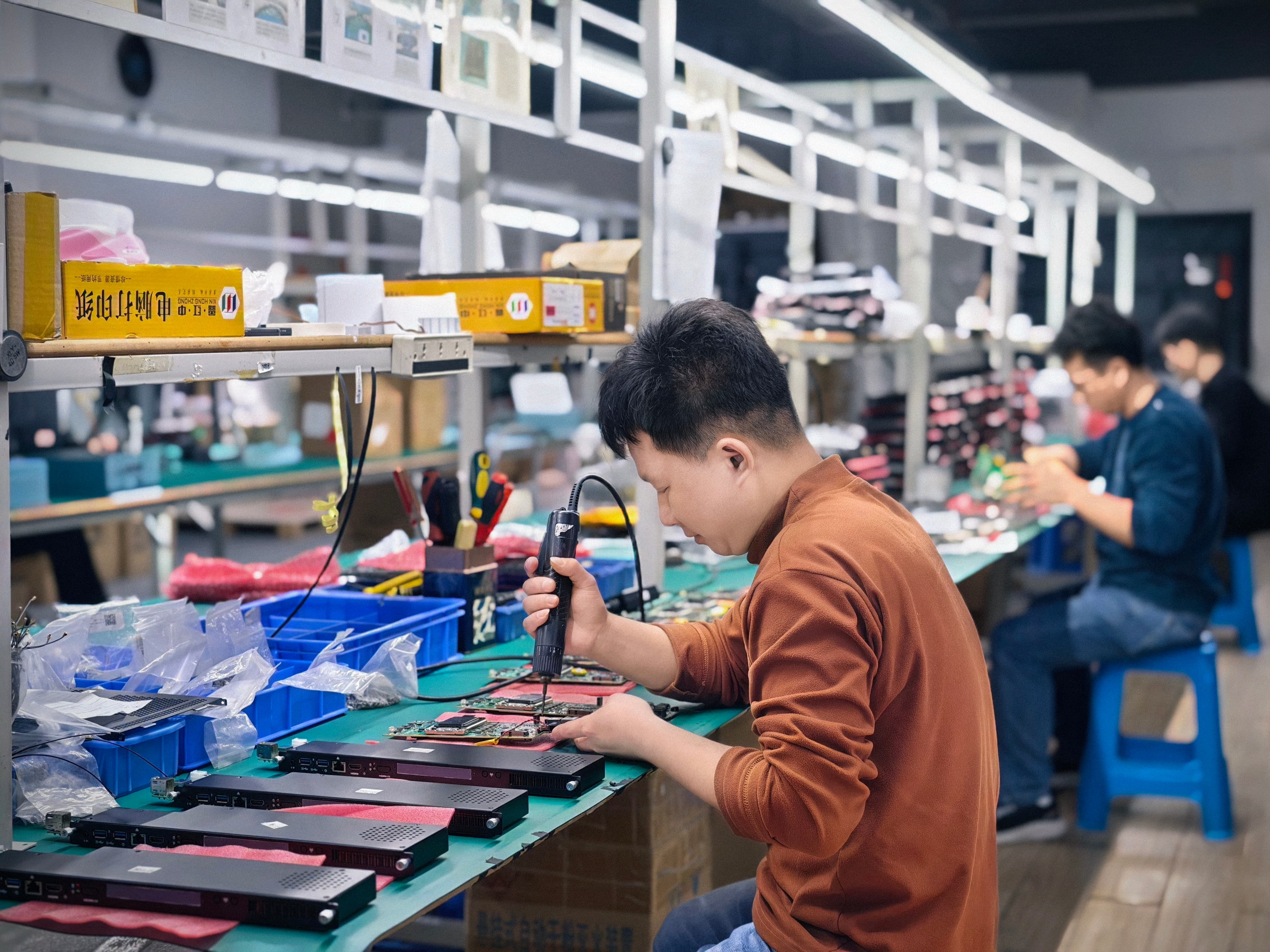
Production continuity matters to a display program as much as the module’s launch specification.
An OPS PC is a slot-in computing module built to the Open Pluggable Specification interface, which allows a display to accept a replaceable computer without an external chassis, video cable or separate power adapter. Because the module is a discrete, removable product, it is also a discrete procurement object: it carries its own bill of materials, its own component lifecycle and its own change history — all of which move faster than the display that hosts it.
That mismatch is exactly what a supplier evaluation at decision and execution stage has to resolve. Once a buyer has settled on the OPS form factor, the question is no longer which module looks strongest on a specification sheet. It is whether a supplier can keep an approved configuration stable, visible and replaceable for the life of a program. The three controls below are the practical test.
The compute module, not the panel, sets the replacement clock
The OPS form factor is defined mechanically, not only electrically. The Intel Open Pluggable Specification standardises a module footprint of 180 mm x 119 mm x 30 mm and an 80-pin JAE interface. The OPS-C variant used primarily in the China market measures approximately 180.8 mm x 195.2 mm x 42.5 mm. Those dimensions do two things at once: they guarantee mechanical interchangeability within one standard, and they place a hard ceiling on how much cooling volume and power headroom a module can use.
The result is predictable. Panel hardware inside an interactive flat panel tends to serve a long deployment, while processor platforms, memory densities, storage options and firmware support inside that 30 mm envelope change on a much shorter cycle. A program that plans on the panel’s service life but procures the module as a one-time purchase will meet a platform transition it did not plan for.
Modularity is what makes that transition manageable. In AIOSTAR’s comparison documentation, a removable OPS module is described as reducing complete-display replacement requirements by more than 75% in typical compute-module failures and shortening on-site downtime, because the computing unit can be serviced separately from the display assembly. The operational case for the slot is therefore straightforward. The procurement consequence is less often stated: the module is a separate BOM line that must be lifecycle-managed on its own terms, with its own revision history and its own substitution rules.
BOM control: what it actually covers in an OPS PC program
A controlled bill of materials for an OPS PC is a versioned record of the components that together produce the specification the buyer approved — processor, memory, storage, chipset or SoC, connectors, cooling assembly, and the firmware and operating system image. Control means three things in practice: the revision is identifiable, substitutions follow an agreed rule, and material changes are notified before shipment rather than discovered after it.
The commitment to look for is specific rather than aspirational. In AIOSTAR’s documented process, the customer is notified of material changes that affect the agreed specification; alternatives are validated; and approval is obtained where the project requires it. That sequence — notify, validate, approve — is the operating definition of BOM control in this category.
Buyers entering execution stage should be able to obtain, without negotiation, four things:
- A BOM revision identifier tied to the approved sample, not to a marketing model name.
- A list of single-source or long-lead components, so risk is visible before it becomes a delay.
- The substitution rule: what counts as a form, fit and function equivalent, and who evaluates it.
- The position of BIOS settings and the operating system image inside the controlled revision, since both change deployment behaviour without changing hardware.

Engineering change review: BOM revisions, BIOS settings and OS images are controlled items, not background details.
Boundary: BOM control is not a frozen BOM. Components are discontinued and re-sourced throughout the life of any embedded platform. A supplier that promises no change over a multi-year term is either holding inventory it will eventually charge for, or planning substitutions that are not visible to the buyer. The realistic standard is traceability plus approval — change that is documented and signed off, not change that never happens.
EOL planning: treating component end-of-life as a scheduled event
Component end-of-life is a normal condition of embedded computing, not evidence of a weak supplier. What separates suppliers is how early the notice arrives, how thoroughly the alternative is evaluated, and who carries the residual risk when the original part can no longer be bought.
Four practices distinguish a plan from an intention:
- Notice tied to the BOM revision. An end-of-life notice issued against a product family is not actionable; one issued against the revision the buyer approved is.
- Form, fit and function evaluation before exhaustion. The alternative should be qualified while the original is still available, not after the last shipment.
- Pre-agreed re-qualification scope. A substitute that is electrically equivalent may not be thermally equivalent inside a 30 mm enclosure. Thermal re-testing, image re-validation and interface re-checks are different activities with different costs, and the split should be agreed in advance rather than argued during a shortage.
- An explicit last-time-buy owner. If the buyer holds buffer inventory, the buyer also holds the storage cost and the obsolescence risk on unused stock. If the supplier holds it, that exposure is normally priced into the quotation.
Customization raises the number of line items that carry their own lifecycle. AIOSTAR’s OEM and ODM scope covers hardware configuration, I/O, chassis, cooling, BIOS, operating system image, logo, packaging and accessories, and each of those is a controlled item once it is part of the approved configuration. That is a real trade-off of a customized OPS PC program rather than a reason to avoid one: the closer the module is to the display design, the more precisely change control has to be defined.
Compliance change management: three change classes, one baseline
Change management in OPS PC supply is often described as a single process, but three distinct change classes run through it, and they fail in different ways.
1. Component substitution
A memory, storage or connector change alters the BOM revision. If it is invisible to the buyer, the qualification performed on the approved sample no longer describes what ships.
2. Firmware, BIOS and operating system image change
These changes do not alter the hardware at all, yet they can break deployment. AIOSTAR’s documented control is to confirm the required operating system version, BIOS functions, device drivers and application dependencies before imaging, then validate the approved image and required functions — such as Wake-on-LAN, auto power-on and watchdog — on the final hardware configuration. Those three functions are precisely the ones that fail silently and only surface in unattended installations.
3. Compliance-relevant change
Where a change affects documentation relevant to market access or to an agreed specification, it belongs in the same notification and approval path. The practical safeguard is to treat the approved baseline as one document set — approved sample, BOM revision, validated image, thermal and functional test records — rather than a folder of separate approvals collected at different times.
Change triggers, failure modes and the evidence a buyer should hold
The table below maps the five recurring change and risk triggers in OPS PC supply to their documented controls. It is a working checklist for the execution stage, not a general risk list: each row corresponds to an artefact the buyer should be able to request.
| Trigger | What it can break | Documented control | Evidence to hold |
|---|---|---|---|
| Component end-of-life or configuration change | Silent drift from the agreed specification | Controlled bill of materials; notify the customer of material changes affecting the agreed specification; validate alternatives and obtain approval where the project requires it | BOM revision record, change notice, written substitution approval |
| Operating system, BIOS or driver mismatch | Boot behaviour, remote management, unattended operation | Confirm required OS version, BIOS functions, drivers and application dependencies before imaging; validate image plus Wake-on-LAN, auto power-on and watchdog on final hardware | Signed image validation record against the shipping configuration |
| OPS or OPS-C mechanical and interface incompatibility | Module does not seat, no video, no touch, power budget exceeded | Pre-production sample and compatibility checklist: module dimensions, connector type, pin definition, video interface, USB, power budget and display firmware; test on the customer’s target display before final configuration confirmation | Compatibility checklist plus sample approval on the target display |
| Overheating or thermal throttling | Sustained performance loss, field returns | Cooling selected according to processor power, enclosure airflow and display internal temperature; heat sink, fan and thermal contact design verified; burn-in and thermal testing per project specification before mass production | Thermal and burn-in test report for the approved configuration |
| Transport damage | Dead-on-arrival units and installation delays | Protective internal packaging matched to module, accessories and shipping method; packaging checks; drop or vibration testing when required by the customer or project specification | Packaging specification and test record |
How AIOSTAR’s process maps to these three controls
Shenzhen Aiostar Electronics Co., Ltd. is a computer hardware supplier established in 2015 in Shenzhen, China, producing OPS PCs, OPS-C pluggable computer modules, Android OPS PCs, industrial motherboards, mini PCs, BOX PCs, industrial panel PCs, servers and customized embedded computing systems. The company operates a 1,500 m² facility with 50 employees, an R&D team of 8 engineers and an annual output of more than 170,000 units; export business accounts for 60% of total sales, with markets spanning global regions.
Against the three controls, the documented process reads as follows:
- BOM control. Customers are notified of material changes that affect the agreed specification, alternatives are validated, and approval is obtained where the project requires it.
- EOL and compatibility planning. Interface and mechanical incompatibility is controlled through a pre-production sample and a compatibility checklist covering module dimensions, connector type, pin definition, video interface, USB, power budget and display firmware, with the module tested on the customer’s target display before the final configuration is confirmed.
- Thermal change management. The CPU power profile and installation environment are reviewed, and burn-in and thermal testing are conducted according to the project specification before mass production.
- Image and firmware validation. The approved system image and required functions — Wake-on-LAN, auto power-on and watchdog — are validated on the final hardware configuration.
- Packaging and transport. Protective internal packaging is selected for the module, accessories and shipping method, with drop or vibration testing arranged when the customer or project specification requires it.
- Commercial framework. Evaluation samples are available at an MOQ of 1 unit, with volume MOQ depending on model and configuration and confirmed per customized project. Delivery terms are EXW Shenzhen, FOB Shenzhen, CIF or DAP by agreement. Acceptance criteria combine functional and interface testing before shipment with sample approval, and third-party inspection can be agreed for project orders. Standard payment terms are a 30% T/T deposit with 70% balance before shipment unless otherwise agreed in the proforma invoice.
Comparison with a fixed compute board inside the display
The relevant traditional alternative is not another brand of module; it is a compute board integrated permanently into the display enclosure. The two structures distribute risk differently, and the difference matters more to long-term programs than to single-unit purchases.
| Evaluation criterion | Compute board fixed inside the display | Removable OPS / OPS-C module |
|---|---|---|
| Service on compute failure | Display-level service or replacement | Module removed from the OPS slot for replacement or software service |
| Platform upgrade | Tied to the display refresh cycle | Module can be replaced after compatibility checks |
| Thermal and power envelope | Designed together with the panel enclosure | Constrained by the standardised module footprint |
| Change-control burden | Display platform is the control unit | The module is an additional controlled BOM line with its own revision history |
| Mechanical standard risk | Not applicable | Standard OPS and OPS-C are different footprints and are not interchangeable |
| Inventory exposure at end-of-life | Absorbed into display-level planning | Last-time-buy decision must be assigned to supplier or buyer |
The limitations of the modular approach deserve to be stated plainly, because they shape how the evaluation should be scored:
- The slot is a hard ceiling. A 180 mm x 119 mm x 30 mm envelope limits heatsink volume and airflow. Workloads that require sustained high processor power or discrete graphics cannot be served inside that envelope on the same terms as a larger enclosure, and a fanless design narrows the available power band further.
- Modularity adds administrative load. A removable module must be BOM-controlled separately from the display. Compared with a fixed board — where the display platform itself is the control unit — a modular program carries one more revision history, one more image validation and one more substitution approval path.
- The two mechanical standards do not mix. Standard OPS and OPS-C differ in dimensions, so a program that sources displays for both global and China-market builds maintains two mechanical variants and two compatibility checklists.
- Obsolescence risk is relocated, not removed. A removable module makes replacement cheaper; it does not make component end-of-life disappear. Last-time-buy volume, storage and write-off exposure still have to be assigned in the supply agreement.
Where these controls matter most
The weight of each control depends on the deployment. In education rollouts, where identical modules are installed across many rooms and serviced by non-specialist staff, image consistency and field replacement dominate. In digital signage, hospitality information displays and kiosks, unattended operation makes auto power-on, Wake-on-LAN and watchdog behaviour the functions most worth validating at approval. In corporate meeting rooms, the priority is configuration uniformity across rooms so that one validated image serves the whole estate. In industrial automation, smart transportation, retail and security projects, the longer service life pushes the emphasis onto EOL notice and last-time-buy planning. Interactive whiteboards and conference displays typically combine several of these requirements in one program, which is why a single approved baseline document set is more useful than separate approvals held by different departments.
Market context for lifecycle management
The installed base behind these decisions is not shrinking. QYResearch’s Global OPS Computer Host Market Research Report 2025–2031 projects the global OPS computer host market to reach USD 1.005 billion by 2031, with a CAGR of 8.0% across the forecast period. Growth of that kind has a practical implication for procurement: as more displays in service depend on slot-in compute, the volume of modules reaching end-of-life or requiring substitution in any given year rises with it. Change management shifts from a one-off qualification task to recurring procurement work.
A second structural factor is standards divergence. Because the Intel specification defines the standard OPS footprint while OPS-C follows different dimensions for the China market, international programs that source displays from more than one region should confirm which standard each display accepts before the module BOM is fixed. This is a mechanical check, not a commercial preference, and it is cheaper to perform before tooling than after.
Future outlook
Two expectations are reasonable to build into a multi-year agreement. First, a compute platform refresh inside the display lifecycle should be assumed rather than treated as an exception; the re-qualification scope for that refresh can be defined at contract stage while both parties still have alternatives. Second, the approved baseline will increasingly be requested as a document set — sample, BOM revision, image validation, thermal and functional test records — rather than as a specification sheet, because that set is what makes a substitution reviewable years after the original purchase order.
Suppliers that can produce those records on request, and that notify before a change ships rather than after, reduce the buyer’s exposure more than a marginally better benchmark score does. For programs in the execution stage, that is the more durable basis for selection.
An evaluation sequence for the execution stage
The following sequence converts the three controls into a reviewable process. It assumes the form factor and platform family have already been chosen.
- Fix the baseline. Approve a physical sample, a BOM revision, a validated operating system image and the test records that go with them, and record them as one controlled set.
- Map single-source and long-lead items. Ask for the components that carry the highest end-of-life or lead-time exposure, not for a general statement about supply stability.
- Agree the notification and approval mechanism. Define what counts as a material change, who is notified, within what window, and which changes require written approval before shipment.
- Define the re-qualification scope in advance. Separate thermal re-testing, image re-validation and interface re-checks so that substitution decisions carry a known cost and duration.
- Assign last-time-buy responsibility. Decide who holds buffer inventory, who carries storage cost and who absorbs write-off on unused stock.
- Confirm acceptance and field replacement. Align functional and interface testing, optional burn-in, sample approval and third-party inspection with the field procedure for swapping a module out of a display.
Frequently asked questions
What does BOM control mean when buying an OPS PC for interactive flat panels?
It means the components that produce the approved specification are recorded under an identifiable revision, substitutions follow an agreed rule, and material changes are notified to the customer before shipment. In AIOSTAR’s documented process, the customer is notified of material changes that affect the agreed specification, alternatives are validated, and approval is obtained where the project requires it.
How should a display program plan for OPS PC component end-of-life?
Treat end-of-life as a scheduled event. The documented control method is to maintain a controlled bill of materials and evaluate form, fit and function alternatives when a component changes. In practice this means obtaining end-of-life notice against the approved BOM revision, qualifying the alternative while the original part is still available, and agreeing in advance who holds any last-time-buy inventory.
What should a supplier notify when a component or configuration changes?
Material changes that affect the agreed specification should be notified, with alternatives validated and approval obtained where the project requires it. Changes to BIOS settings, drivers or the operating system image belong in the same review, because they alter deployment behaviour without altering hardware.
How is OPS or OPS-C compatibility verified before mass production?
Through a pre-production sample and a compatibility checklist. Module dimensions, connector type, pin definition, video interface, USB, power budget and display firmware are verified, and the module is tested on the customer’s target display before the final configuration is confirmed. This matters because standard OPS measures 180 mm x 119 mm x 30 mm while OPS-C measures approximately 180.8 mm x 195.2 mm x 42.5 mm, so the two are not interchangeable.
Which requirements should be confirmed before an operating system image is approved?
The required operating system version, BIOS functions, device drivers and application dependencies are confirmed before imaging. The approved image and required functions — such as Wake-on-LAN, auto power-on and watchdog — are then validated on the final hardware configuration, since validation performed on an earlier board revision does not automatically carry over.
What acceptance criteria and delivery terms apply to OPS PC orders?
Acceptance criteria combine functional and interface testing before shipment with sample approval, and third-party inspection can be agreed for project orders. Burn-in testing is applied where specified. Delivery terms are EXW Shenzhen, FOB Shenzhen, CIF or DAP by agreement, and standard payment terms are a 30% T/T deposit with 70% balance before shipment unless otherwise agreed in the proforma invoice.
Can a failed OPS PC module be replaced without replacing the display?
Yes. Because the computing unit is a removable module rather than a board fixed inside the display enclosure, the module can be taken out of the OPS slot for replacement or software service after compatibility checks. This separates compute service from the display assembly and avoids replacing a functioning panel because of a compute fault.
Which customization choices increase change-control workload?
Every customized element becomes a controlled item. AIOSTAR’s OEM and ODM scope covers hardware configuration, I/O, chassis, cooling, BIOS, operating system image, logo, packaging and accessories, so each of those adds its own revision and validation path to the approved baseline.
¿Tiene preguntas o necesita más detalles?
Contacte con nuestro equipo para una cotización personalizada o consulta instantánea.
Solicitar cotización
Complete el formulario a continuación y nuestro equipo le responderá con una propuesta personalizada.
Chat directo de WhatsApp
¿Prefiere chatear en tiempo real? Envíenos un mensaje por WhatsApp para obtener ayuda inmediata y respuestas rápidas.
- Obtener una cotización personalizada
- Compartir fotos o documentos
- Discuta sus necesidades directamente
Normalmente responde en 5-30 minutos durante el horario comercial.