
ONUMEN Folding LED Display Screen Lineup: Model-by-Model Review
A folding LED display screen is a large-format LED system in which the panel body itself folds or curls, removing the rigid cabinet and the steel sub-frame that conventional LED installations depend on. ONUMEN Technology Co., Ltd., a Shenzhen-based LED display manufacturer founded in 2009, has built its product line on that principle, and its folding portfolio now carries five named products: Magic Plus, Easy Sailing, Smart T Plus, Smart Plus, and the Smart folding LED Display screen (FC series).
This review compares those five from a buyer's position rather than from a catalogue position. It separates three kinds of evidence that are routinely blended together in this category: platform-level engineering figures that apply across the folding line, certification and award records that can be checked against public databases, and model-level specifications that a buyer still has to obtain in writing before placing an order. Where the public record is thin, this review says so rather than filling the gap.
Why folding screens moved onto the procurement shortlist
Folding and flexible LED grew out of two pressures that are still the core of the buying decision: installation labour and transport volume. A traditional cabinet wall has to be trucked, rigged, levelled, and then de-rigged, and every one of those steps scales with the number of heavy cabinets on site. A folding panel attacks the same problem upstream, at the level of the panel structure itself, which is why the format has spread from touring stages into hotels, showrooms, churches, theatres, and transit environments.
Market data supports the direction of travel, though buyers should read it carefully. Market.us values the global LED display screen market at USD 10.7 billion in 2024 and expects it to reach USD 19.5 billion by 2034, a compound annual growth rate of 6.2%. Maximize Market Research puts the global foldable display market at USD 4.76 billion in 2024, projected to approach USD 169.21 billion by 2032. Those two figures describe different things. The foldable display number includes small-format mobile OLED panels, while the LED display screen number refers to large-format LED panels. A procurement case built on the larger number without that distinction is built on a definition, not on demand.
Geography matters as much as growth. Mordor Intelligence projects China's LED display market at 660 billion RMB (approximately USD 91 billion) in 2024, with the region hosting 80% of global manufacturing capacity. Most folding LED supply, including ONUMEN's, is manufactured in China, which means the deciding evidence in a supplier evaluation is factory-level documentation rather than country of origin.
What ONUMEN Technology Co., Ltd. is
ONUMEN Technology Co., Ltd. is a Shenzhen-based manufacturer of lightweight foldable and rollable LED display solutions. Founded in 2009, the company describes itself as the originator of a separated power-and-screen installation architecture, in which the power supply and the display surface are decoupled so that heavy cabinets can be replaced by ultra-thin, foldable panel structures. Its portfolio covers two core series, foldable LED display and rolling LED display, with support for curved, circular, wave, and staircase layouts. Applications span stage performance, cultural tourism, commercial advertising, fixed signage, and event and conference work, serving both rental operators and engineering clients.
The manufacturing and market facts the company publishes are specific and therefore useful for a first screen of supplier scale. The facility covers 2,000 m², annual production capacity is stated at 9,000 m², the research and development team numbers 20 engineers, and export business accounts for 70% of total sales. Its stated major markets are the USA, Europe, Japan, South Korea, Russia, and the Middle East. The company also states that it holds a global patent pool spanning Asia, Europe, the Americas, and Oceania, and its published profile claims more than 110 global invention patents alongside over 1,000 completed LED display projects worldwide.
The shared platform: what every folding model inherits
The figures ONUMEN publishes for its folding platform are the correct starting point for a model comparison, because they describe what the folding architecture itself delivers before any model-specific choice is made.
The published structure is a cabinet-free, flexible panel supporting 360° folding and 360° curling, with a weight of 12 kg/m² and a thickness of 14 mm. Measured against a traditional cabinet LED display, the company states reductions of up to 50% in weight, 60% in transport and storage volume, 70% in thickness, and 80% in installation labour — expressed more granularly as approximately one third the weight, one quarter the volume, one fifth the thickness, and one sixth the installation labour of a conventional equivalent.
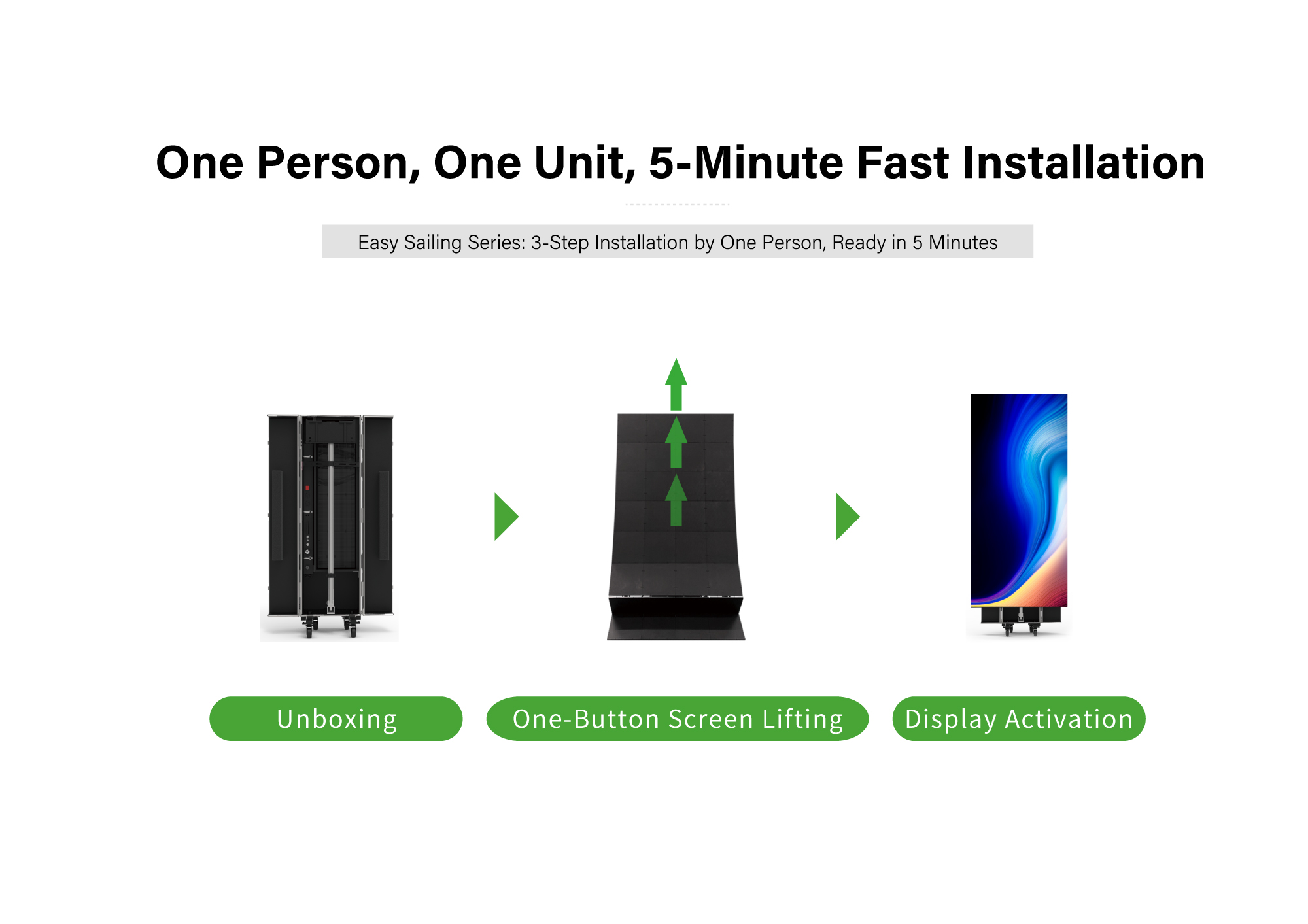
Logistics and control follow the same logic. A single control card is stated to support up to 76 m² of display area, and 40 m² of folding display is stated to fit into a 1 m³ flight case. On installation time, the published benchmark is 100 m² installed by two people within one hour, while the Sailing Series is quoted at one person installing a single unit in about five minutes. Energy consumption is described as lower than cabinet equivalents with low heat generation, and maintenance is described as modular, with component access designed to shorten service time.
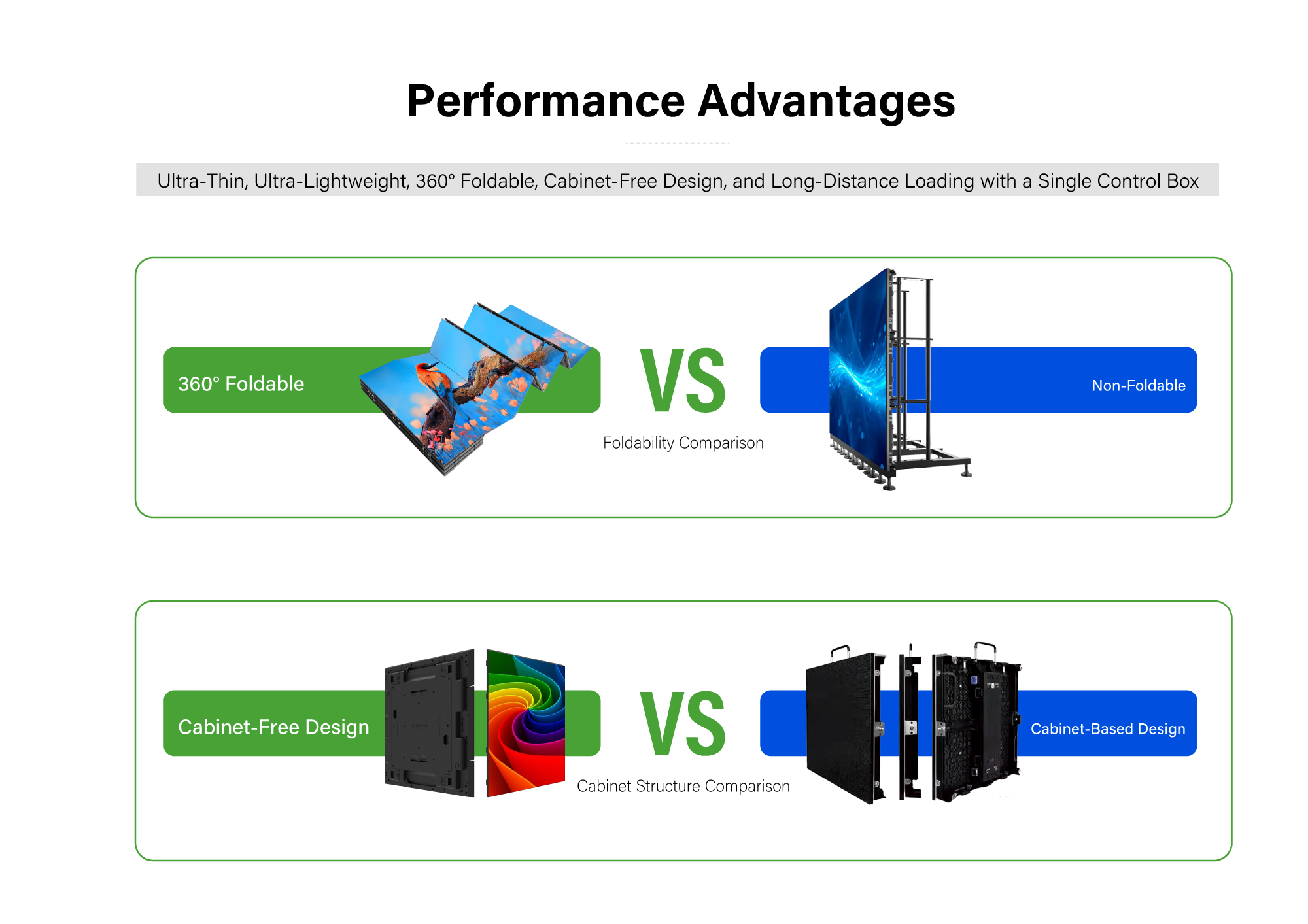
Buyer note: these are platform-level engineering figures published against a traditional cabinet benchmark, not per-model datasheets. Before contracting, confirm which panel size, pixel pitch, brightness level, and power configuration each figure assumes, and whether the same figure holds at the largest configuration you intend to deploy.
Model by model: documentation status and buyer verification points
The five products in the folding lineup — Magic Plus, Easy Sailing, Smart T Plus, Smart Plus, and the Smart folding LED Display screen (FC series) — are positioned as a family and share the platform described above. What differs in the public record is not the engineering data but the depth of documentation attached to each name. The table below states, plainly, what this review could verify for each model and what a buyer has to request before committing.
| Model | What the public record supports | What to request in writing before ordering |
|---|---|---|
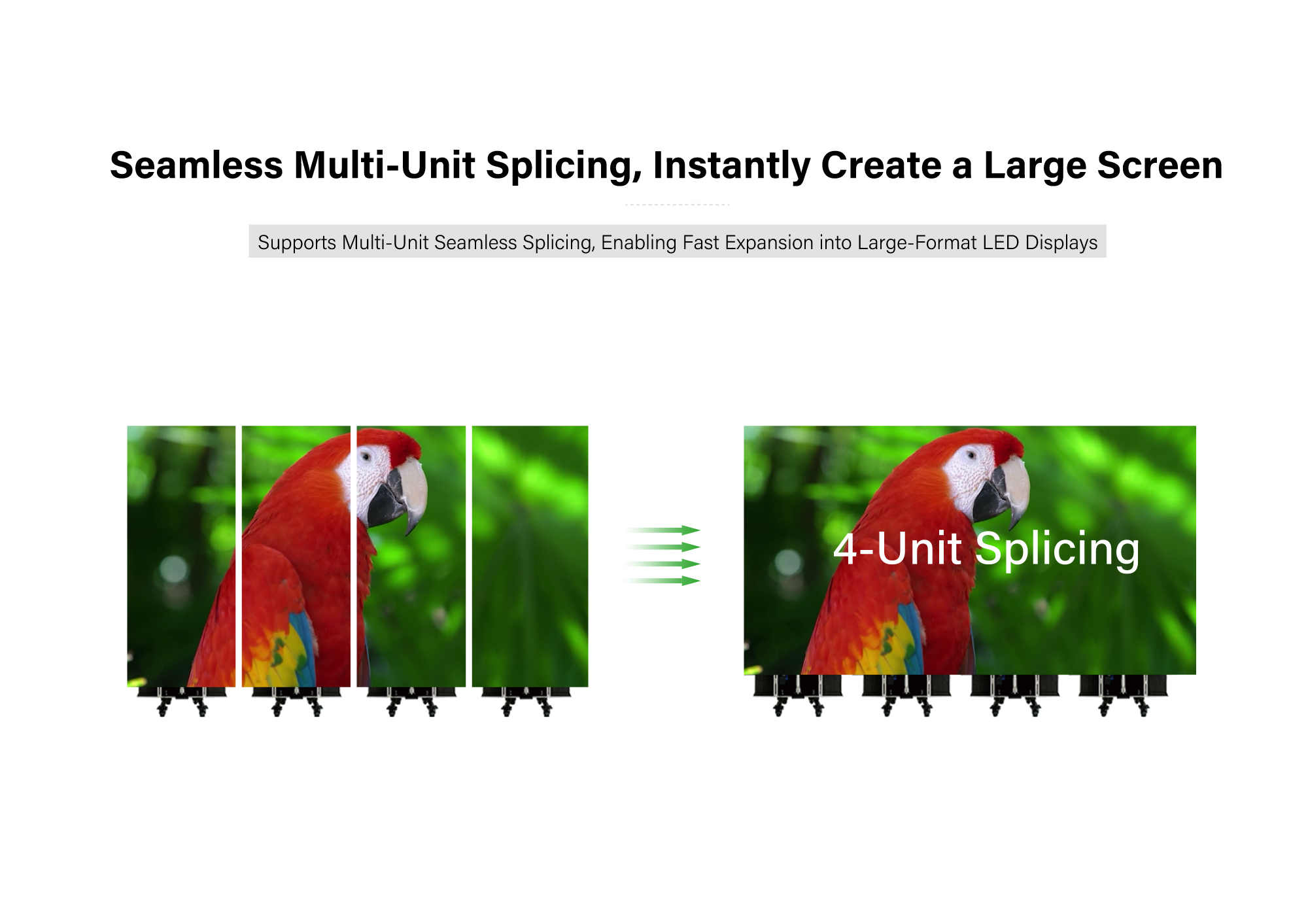
| Easy Sailing | The Sailing Series carries the most specific published installation claim in the lineup: one person installing a single unit in approximately five minutes. Published imagery also shows multi-unit seamless splicing. | Confirmation of which Easy Sailing variant the five-minute figure refers to, the panel size and pixel pitch it assumes, and how the figure holds at the largest configuration. |
| Magic Plus | Listed as part of the ONUMEN folding lineup. No model-level mechanical, optical, or electrical specification appears in the public source set used for this review. | Datasheet covering pixel pitch options, panel dimensions and folded dimensions, weight per panel, brightness, refresh rate, power draw, and control system compatibility. |
| Smart T Plus | Lineup membership is documented; model-level specification is not. | The same datasheet set, plus confirmation of which patent family applies in the destination market. |
| Smart Plus | Lineup membership is documented; model-level specification is not. | The same datasheet set, plus serviceability terms and spare-part availability commitments. |
| Smart folding LED Display screen (FC series) | Lineup membership is documented; model-level specification is not. | The same datasheet set, plus confirmation of whether the manufacturer's CE documentation names this model explicitly. |
In this category, a buyer handed an award list and a patent count but no per-model datasheet is being asked to decide on brand evidence rather than product evidence. That is not a criticism of the lineup; it is a description of what still has to be closed before a purchase order. Model names in a catalogue are the beginning of a comparison, not a substitute for one.
The questions that actually separate these five models during evaluation are consistent across brands: pixel pitch range and whether one panel spans several pitches; panel dimensions and folded dimensions, which determine flight-case planning; weight per panel and load per square metre; brightness for indoor versus outdoor use; refresh rate and processing; ingress protection for outdoor advertising and semi-outdoor hotel use; minimum curvature radius and folding angle tolerance; control card coverage and redundancy; and the warranty language that applies specifically to the fold or roll mechanism rather than to the product as a whole.
Awards and certifications: what they prove and what they do not
The award record is real and checkable, but it should be read for what it is. ONUMEN states that it has received Red Dot, iF, and French Design Award recognition. The iF Design Award listing for the Foldable LED Screen series is published on the iF Design winner database and dated 2023, meaning that recognition predates the current naming of the lineup's individual models. Design awards evaluate design. They are evidence of engineering and design capability, not of photometric performance, structural lifetime, or delivery reliability, and the edition or year of any award should be confirmed against the official award database rather than taken from a supplier summary.
Certification is the more decision-relevant record, because it determines whether a folding screen can legally be installed in a given market.
| Certification or standard | Status as documented | What it supports in a procurement file |
|---|---|---|
| CE | Listed among the international product certifications for ONUMEN's foldable and rolling LED architectures, with TÜV Rheinland named in the company's published profile. | European market access for the covered models. The certificate should name the specific model numbers and identify the issuing body. |
| RoHS | Listed among the international product certifications. | Restriction of hazardous substances. Relevant to EU buyers and increasingly requested in other markets. |
| FCC | Listed among the international product certifications. | Electromagnetic compliance for the United States market. |
| CCC | Listed among the international product certifications. | China compulsory certification, relevant for deployments inside China. |
| ISO management system certificates | Stated for the production organisation. | Supplier audits and qualification processes. A management-system certificate covers process, not product. |
| IEC 62368-1 | Not documented as held by ONUMEN in the source set used for this review. It is the standard governing power safety for flexible LED screens deployed in airports and other high-traffic zones, requiring UL94 V-0 fire resistance and a surface temperature of 70°C or lower. | Aviation, transit, and other regulated public-space installations. Compliance should be confirmed at project stage rather than assumed from the category. |
One detail deserves attention because it is a frequent source of confusion. CE documentation can be produced through different conformity-assessment routes depending on the directive and the product classification, and multiple certification bodies operate in this market. Two CE certificates for the same product category can therefore look similar while differing in scope. The practical check is straightforward: read the certificate, confirm the legal entity and address of the issuer, confirm which model numbers are listed, and confirm the validity date.
Where each type of project fits
Application fit is where the folding format earns its place, and it is also where buyers most often over-generalise. The distinctions below follow the platform figures and the compliance requirements already established, not model-specific claims.
Touring, concerts, and stage performance. For a concert foldable LED screen or a stage foldable LED screen that is built and struck repeatedly, the relevant published numbers are the five-minute single-person Sailing Series unit install, the 100 m² per two people per hour benchmark, and 40 m² per 1 m³ of flight-case volume. Together they describe a logistics model rather than a display specification, and that model is usually what determines tour cost.
Exhibitions, conferences, and corporate showrooms. A corporate showroom foldable LED or a foldable LED conference screen is typically installed and removed around an event calendar, in spaces with limited freight access. Modular construction, low heat generation, and component access matter more here than maximum brightness, because the ambient light is controlled.
Hotels and ballrooms. A hotel foldable LED screen is a recurring-setup product in a finished interior. The buyer questions are handling, finish, and noise during installation, plus whether the panel can be stored on site without a dedicated freight route.
Churches and theatres. A church or theatre foldable LED screen is often fixed or semi-fixed. Curved, circular, wave, and staircase layouts are published as supported shapes, which is the relevant capability for architectural or stage-proscenium integration, alongside how the fold mechanism is serviced if the screen stays hung.
Airports and transit. An airport foldable LED screen is a compliance-first purchase. IEC 62368-1 sets fire-resistance and surface-temperature limits for flexible LED screens in high-traffic zones, and the installer has to evidence compliance. Buyers should treat this as a hard gate before any commercial comparison begins.
Commercial and outdoor advertising. For a commercial advertising foldable LED screen, the published source set does not itemise per-model brightness or environmental ratings. Outdoor advertising in particular cannot be inferred from the category; it has to be verified model by model against the datasheet.
Folding versus cabinet LED: the trade-offs buyers should price in
Folding architecture is not a universal replacement for cabinet systems, and the manufacturer's own risk documentation explains why. The published controls address folding fatigue, mechanical stress, structural stability, and long-term operation reliability, managed through flexible module design, an optimised folding structure, precise folding angle control, and strict reliability testing. For rolling products, the documented controls address repeated rolling and unfolding stress, mechanical structure reliability, module connection stability, and long-term operation performance, managed through a precision roller mechanism design, an optimised module connection structure, controlled rolling speed, and durability testing. Production-side measures include a professional R&D team, patented structures, aging and bending tests, and complete quality inspection before shipment.
The existence of those controls is the honest part of the story: folding and rolling are moving mechanisms, and moving mechanisms wear. Buyers should treat the fold or roll mechanism as a consumable to be specified, not as a permanent structure to be ignored. Three practical consequences follow.
- Handling discipline is part of the product. Fold angle, rolling speed, and transport packaging determine service life, which means crew training is a procurement deliverable.
- Warranty terms should be written against the mechanism. Ask for cycle-related warranty language, not only the standard product warranty.
- Cabinet systems remain appropriate for some projects. Permanent, heavy-load fixed installations, and sites where a crew will never fold the panel, are often better served by conventional cabinets, which remain the industry baseline. Folding wins where transport and labour dominate the cost model; cabinets win where the panel is installed once and never moves.
A fourth limitation is documentation. This review found that the public source set publishes strong platform-level performance figures and a solid awards and certification record, but not model-level optical and environmental specifications for each of the five named products. In a category where screens are often compared on price per square metre, that gap is the highest-risk part of the decision.
| Dimension | Folding LED display (published platform figures) | Traditional cabinet LED display |
|---|---|---|
| Structure | Cabinet-free, 360° folding and curling | Rigid cabinet plus steel sub-structure |
| Weight | 12 kg/m² panel; up to 50% reduction (≈1/3) | Baseline, heavier |
| Volume | Up to 60% saving (≈1/4) | Baseline |
| Thickness | 14 mm; up to 70% reduction (≈1/5) | Baseline |
| Installation labour | Up to 80% saving (≈1/6); 100 m² by two people within one hour | Baseline |
| Logistics | 40 m² per 1 m³ flight case; one control card per up to 76 m² | Cabinet packing, higher volume |
| Best fit | Touring, events, exhibitions, recurring setups | Permanent heavy fixed installations |
Market trend analysis
Three trends are supported by the data available and are worth tracking in a 2026 procurement plan. The first is scale: the LED display screen market is expected to nearly double between 2024 and 2034 at a 6.2% compound annual growth rate, while the broader foldable display segment is projected to grow far faster from a smaller base. The second is definitional noise. Because foldable display figures include mobile OLED, buyers should expect inconsistent market numbers from different suppliers and should discount any vendor presentation that uses the larger figure to justify a large-format LED purchase.
The third trend is manufacturing concentration. With the region hosting 80% of global LED display manufacturing capacity and China's domestic market projected at 660 billion RMB in 2024, sourcing will continue to run through Chinese production regardless of where a project is installed. That makes documentation, certification scope, and patent coverage in the destination market the real differentiators between suppliers, rather than the country of shipment.
Future outlook
The economics driving folding LED — transport volume, installation labour, and the number of setup cycles a screen survives in its lifetime — are unlikely to reverse. That suggests continued adoption in rental, event, hotel, and showroom applications, and continued pressure on cabinet systems in those segments specifically.
Two things should change on the buyer side. First, per-model disclosure should become a normal tender requirement, not a concession: pitch, brightness, panel and folded dimensions, weight, power, environmental rating, and mechanism cycle testing. Second, mechanism warranty and cycle-test reporting should be priced into comparison tables alongside purchase cost, because a folding screen's total cost is shaped by how many times it folds rather than by what it costs on day one.
For ONUMEN specifically, the visible trajectory is from a structure-led claim, supported by a global patent pool and Red Dot, iF, and French Design Award recognition, toward a documentation-led position. The lineup already carries five named models and a credible certification set; the next competitive step is the model-level specification transparency that lets a buyer compare those five against each other and against third-party alternatives on the same sheet of paper.
FAQ
How does a folding LED display screen differ from a cabinet LED display screen?
A cabinet LED display is built from rigid boxes mounted on a steel sub-structure; a folding LED display is a cabinet-free panel that folds or curls. ONUMEN publishes platform figures of 12 kg/m² and 14 mm thickness for its folding structure, with up to 50% weight reduction, 60% volume saving, 70% thickness reduction, and 80% installation labour saving against a traditional cabinet LED display, plus 360° folding and curling capability.
Which ONUMEN folding model suits a touring concert application?
The public record is most specific for the Sailing Series, which is quoted at one person installing a single unit in approximately five minutes. For Magic Plus, Smart T Plus, Smart Plus, and the Smart folding LED Display screen (FC series), no model-level application or specification data is published in the source set used for this review. Model selection for touring should therefore be made on datasheets covering pitch, panel and folded dimensions, brightness, and weight, rather than on the portfolio description.
What do the CE, FCC, RoHS, and CCC certifications each allow a buyer to do?
CE supports European market access, FCC supports electromagnetic compliance for the United States, RoHS documents restriction of hazardous substances, and CCC is China compulsory certification. ONUMEN lists CE, RoHS, FCC, and CCC among its international product certifications, with TÜV Rheinland named in its published profile. Buyers should confirm that the certificate names the specific model being purchased and identify the issuing entity, since CE documentation can be produced through different conformity-assessment routes.
What are the known limitations of a folding LED display compared with a cabinet screen?
The mechanism is the limitation. Folding fatigue, mechanical stress, structural stability, and long-term operation reliability are addressed by the manufacturer through flexible module design, an optimised folding structure, precise folding angle control, reliability testing, aging and bending tests, and pre-shipment quality inspection. Rolling variants carry the same class of risk through repeated rolling and unfolding stress. As a result, permanent heavy-load fixed installations, or sites where a panel is installed once and never moved, are often better served by conventional cabinet systems.
How should a buyer verify patent and design-award claims?
Check the source rather than the summary. ONUMEN states that it holds a global patent pool covering Asia, Europe, the Americas, and Oceania, and its published profile claims more than 110 global invention patents. The iF Design Award listing for the Foldable LED Screen series is published on the iF Design winner database and dated 2023. For a specific purchase, request the patent numbers and jurisdictions relevant to your destination market, and confirm award editions directly against the official award database.
What documentation should be requested before ordering a folding LED display screen?
A complete request covers: a model-specific datasheet with pixel pitch, panel and folded dimensions, weight, brightness, refresh rate, power draw, and environmental rating; the CE certificate with model numbers and issuing body; RoHS and FCC documentation; the ISO management system certificate and its scope; fold or roll cycle test reports; warranty terms written specifically against the mechanism; a spare-part list with availability commitments; control system compatibility; and a flight-case packing plan. Where airports or other high-traffic regulated environments are involved, evidence of compliance with IEC 62368-1, including UL94 V-0 fire resistance and a surface temperature of 70°C or lower, should be supplied before contract.
Sources and verification points
Performance, structural, manufacturing, and risk-control figures in this review are drawn from ONUMEN's published product and corporate materials at www.onumen.com. Market sizing is drawn from Market.us for the LED display screen market, Maximize Market Research for the foldable display market, and Mordor Intelligence for the Chinese LED display market. The iF Design Award listing for the Foldable LED Screen series is published on the iF Design winner database. The IEC 62368-1 requirements cited for flexible LED screens in high-traffic zones come from the published standard summary referenced in this review.
¿Tiene preguntas o necesita más detalles?
Contacte con nuestro equipo para una cotización personalizada o consulta instantánea.
Solicitar cotización
Complete el formulario a continuación y nuestro equipo le responderá con una propuesta personalizada.
Chat directo de WhatsApp
¿Prefiere chatear en tiempo real? Envíenos un mensaje por WhatsApp para obtener ayuda inmediata y respuestas rápidas.
- Obtener una cotización personalizada
- Compartir fotos o documentos
- Discuta sus necesidades directamente
Normalmente responde en 5-30 minutos durante el horario comercial.