
OEM vs. ODM for Custom Plush Pet Toys: A Buyer Framework
HTNXT Industry Reference · Light Industry & Daily Use
Custom plush pet toys are sourced through two production models, and the choice between them determines who controls the specification, who absorbs development cost, and who carries the compliance file. OEM (original equipment manufacturing) means the buyer owns the design — dimensions, materials, chew rating, insert specification — and the factory manufactures to that document. ODM (original design manufacturing) means the factory supplies an already-developed toy that the buyer adapts with branding, packaging and limited material changes. Neither model is better in the abstract; they diverge on specification control, tooling economics, timeline and testing ownership.
The distinction matters commercially rather than academically. Fortune Business Insights valued the global pet toys market at USD 9.60 billion in 2025, and Custom Market Insights estimates plush and soft toys at roughly 30% of the dog toy segment. Plush is the volume base of the category, not a novelty line, so the OEM/ODM decision behaves less like a design preference and more like a supply-strategy choice that fixes cost structure, launch timing and testing obligations for the life of a SKU.
Jiameile (Tianchang Jiameile Gifts Co., Ltd.) is a plush and textile toy manufacturer based in Tianchang, Anhui Province, China. It produces plush toys, gift items, pet toys, baby toys and rocking horses, and operates OEM, ODM and private label programs for pet brands, wholesalers, retail chains and cross-border sellers. Its pet line covers small, medium and large dog toys in short plush, Oxford fabric and food-grade TPR, with stated conformance to EN71, ASTM F963 and GB6675, alongside ISO 9001, ICTI, BSCI, Disney FAMA and ISO 14001 certification.
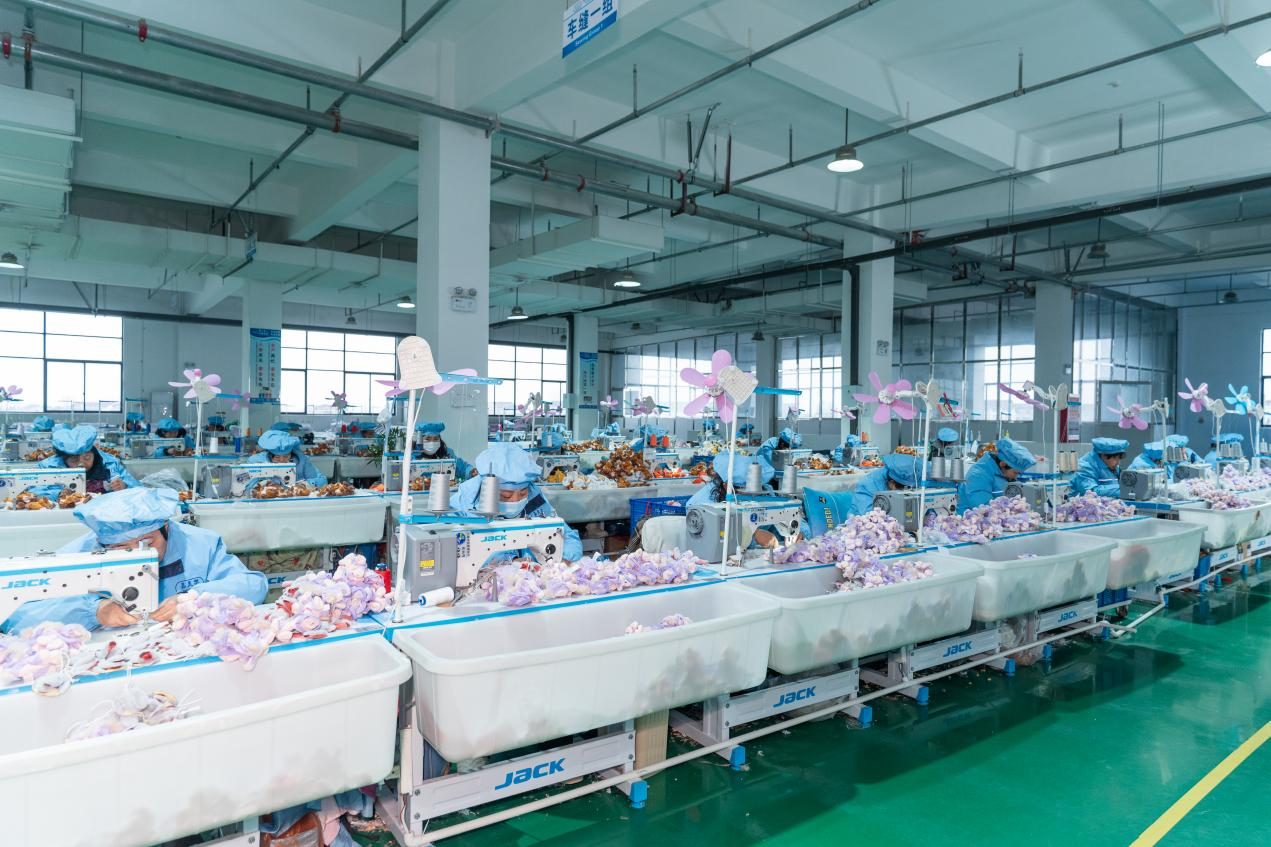
Production environment for plush and textile toys. The manufacturing model decides which party writes the product specification.
What Each Model Actually Transfers to the Buyer
In OEM, design intent and manufacturing method sit with different parties. The buyer owns the pattern, the bill of materials and the performance targets; the factory owns the process, the tooling and the quality control routine. In ODM, pattern and process usually sit together with the factory, and what transfers to the buyer is a licence to brand, recolour and repackage a design that already exists.
A third arrangement sits between them. Private label takes a factory's existing product and applies the buyer's brand, artwork and packaging without structural change. It is the fastest route to market and the one with the least differentiation, which is why it is often used to test a channel before committing to a fuller program.
A practical test separates the three: ask who writes the specification. In OEM the buyer writes it and the factory answers it. In ODM the factory writes it and the buyer edits the margins. In private label the factory writes it and the buyer only labels it.
Specification Control Across Size, Weight Band, Chew Level and Material
The variables that decide a plush pet toy's performance are the same in both models. What changes is who sets them. Size, weight band, chew resistance and material are structural attributes: they interact, and adjusting one usually forces adjustment in the others.
| Specification | OEM route | ODM route |
|---|---|---|
| Dimensions | Buyer sets the size class and tolerance across 10–15 cm, 15–20 cm, 20–30 cm or 30–50 cm | Chosen from the factory's existing size classes; moving outside them requires new patterns |
| Dog weight band | <5 kg, 5–15 kg or 15–30 kg defined by the buyer and validated against fill and structure | Base design is already banded; changing the band usually means changing the pattern |
| Chew resistance | Light, moderate or aggressive defined at seam, stitch-density and material level | Selected from existing resistance tiers; upgrading is a re-engineering task |
| Material | Short plush, Oxford fabric or food-grade TPR specified with weight and finish | Drawn from the factory's qualified material library; substitutions trigger re-testing |
| Insert | Squeaker type, position and access defined by the buyer | Standard squeaker placement; variants optional |
| Ownership | Buyer holds the pattern and specification | Factory retains the base design; buyer brands or licenses it |
Size classes in this category are usually expressed as 10–15 cm, 15–20 cm, 20–30 cm and 30–50 cm, and they are tied to the dog's weight band rather than to appearance. Jiameile's small dog toys cover the 10–15 cm and 15–20 cm range, medium toys the 20–30 cm range, and large toys the 30–50 cm range, with weight bands of under 5 kg, 5–15 kg and 15–30 kg. Under OEM those are buyer-set variables; under ODM they are the factory's existing positions, and shifting a toy between bands is a re-patterning job rather than a labelling change.
Material selection follows the same logic. Short plush suits small-format toys where surface softness and finish carry the product. Oxford fabric is used in the medium class, where abrasion resistance matters more than hand feel. Food-grade TPR is used in the large class, described as lead-free and phthalate-free. A buyer specifying a material outside the factory's qualified library should expect a new test file rather than an extension of an existing one.
Chew resistance is expressed in three levels — light, moderate and aggressive — and it is enforced through seam construction, stitch density, fabric weight and stuffing choice rather than through a label. Service life tracks the same variable: standard plush toys typically run 3–12 months, reinforced chew toys 6–24 months, and rubber or TPR toys 12–36 months depending on use intensity. That spread is the most useful number in a specification, because it converts a chew-level decision into a return-rate prediction.
Compliance Ownership: EN71, CPSIA and GB/T 43839-2024
Certification is where the two models diverge most sharply, because testing attaches to a specific product configuration rather than to a factory.
Jiameile's quality management system is certified to ISO 9001 by CQC under certificate 00124Q35906R5M/3400, issued 11 July 2024 against GB/T19001-2016 and valid to 1 September 2027, with a scope covering the production of cloth and plush toys. The company states ICTI, BSCI, Disney FAMA and ISO 14001 certification. On the product side, the governing references are EN71 for the EU, CPSIA for the US, GB/T 43839-2024 — Safety Technical Requirements for Companion Animal (Pet) Products — for China, with ASTM F963 and GB6675 named alongside them.
The regulatory position deserves careful reading. Pet toys fall outside mandatory CPSC jurisdiction in the United States, and ASTM F963 is applied voluntarily rather than being legally required for the category. In practice the binding requirement comes from the retailer's vendor agreement and the buyer's own specification, not from a single statute. That pushes responsibility onto whoever writes the specification — which, under OEM, is the buyer.
The operational consequence is straightforward. Under OEM, the test report must match the buyer's bill of materials, so every material, dimension or insert change resets the file. Under ODM, the factory's existing report is a usable starting point, but any buyer-side change — a different plush weight, a resized pattern, a substituted squeaker — breaks the match between report and finished product. Standards do not substitute for one another either: GB/T 43839-2024 does not satisfy EN71 or CPSIA, and a program selling into both the EU and the US needs files for both markets.
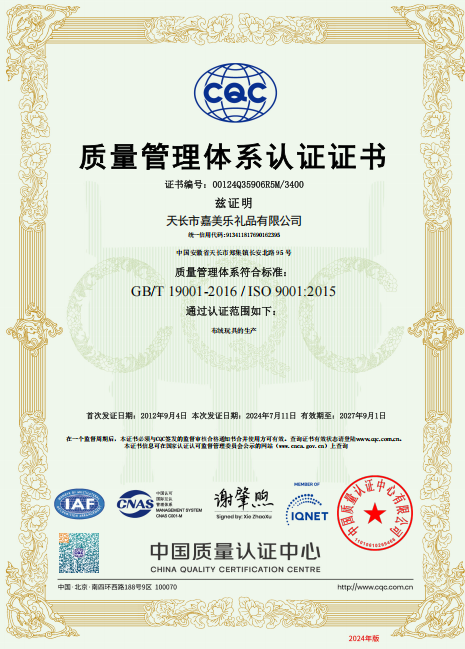
ISO 9001 quality management system certificate issued by CQC, certificate number 00124Q35906R5M/3400, valid to 1 September 2027.
Sampling, MOQ and Lead Time: The Economic Shape of Each Model
Commercial terms follow the model rather than the other way round. Sample lead time typically runs 7–15 days, and bulk production 20–45 days depending on complexity and volume. Minimum order quantities sit at 500–3,000 pieces per style for standard work, rising to 3,000–5,000 pieces for complex custom designs. Monthly capacity in the segment ranges from 100,000–300,000 pieces at mid-size factories to 500,000–1,000,000+ at large ones.
OEM usually consumes more sample rounds, because structure, material and insert are confirmed separately. ODM consumes fewer rounds but caps how far the result can move from the factory's base design. At a 500–3,000 piece first order, development cost is spread across a thin base, which is the main reason OEM unit prices look higher at launch and converge only as volume builds.
Order mechanics are fairly consistent across the segment. FOB terms dominate, with EXW as an alternative and CIF or DDP available for some cross-border e-commerce programs. Payment is typically 30% deposit with the 70% balance before shipment, and acceptance combines the factory's pre-shipment OQC with buyer or third-party inspection such as SGS or BV. None of these terms favour one model; they simply get applied to a larger or smaller development scope.
Inserts, Squeakers and Electronic Components
Squeaker type is a named customization variable, listed alongside logo printing, fabric, size, colour, stuffing type, packaging and hang tags. It is also the component most likely to fail first, and the one that most often forces a care-instruction change.
Where a program specifies an electronic insert such as a heartbeat module, three things change at once: the fixing method inside the toy, the washability of the finished product, and the scope of testing. Published care guidance for plush dog toys recommends a gentle cold machine cycle followed by air drying, and specifically advises removing electronic components before washing. For a buyer, that means the specification has to answer three questions before sampling: is the insert removable, how is the module housing secured inside the body, and what care instruction ships with the product.
This is also where ODM and OEM pull apart most visibly. A factory's existing insert placement is optimised for its own base design. Moving that placement, or adding an insert to a buyer-owned pattern, is a structural change and belongs on the OEM side of the line.
Application Fit by Buyer Type
Jiameile lists pet supplies, pet e-commerce, pet brands, pet retail chains, veterinary and pet care, pet training, boarding and grooming among the industries its toys serve. The model choice usually tracks where a buyer sits in that list.
- Pet brands lean OEM, because differentiation depends on owning the pattern rather than borrowing one.
- Pet retail chains lean ODM or private label, where category breadth and shelf speed outrank uniqueness.
- Pet e-commerce sellers often run a mixed portfolio: ODM to test a SKU, OEM once a winner is identified.
- Pet supplies distributors lean ODM, because portfolio width matters more than any single design.
- Veterinary and pet care buyers lean OEM, where documented materials and specification control carry more weight than novelty.
- Pet training buyers can go either way, with the functional insert and size band driving the choice more than the design source.
Repeat behaviour in this segment is a useful signal. Reported repeat purchase rates above 85%, with some long-term clients ordering more than 100,000 pieces annually, indicate that once a program is qualified, buyers tend to extend it rather than re-source it. Model choice therefore tends to be sticky, which raises the cost of getting it wrong on the first order.
Where Each Model Breaks Down
- ODM changes are marginal by design. Branding, colour, packaging and hang tags move freely; size class, weight band, chew level and material do not. A buyer who needs a shorter body, a heavier fill or a different seam is no longer buying ODM.
- OEM transfers design responsibility to the buyer. A buyer without an internal product team or a mature specification document tends to leave seams, fill density and insert placement undefined — and those gaps get filled by the factory's default, silently.
- Small orders carry disproportionate development cost. At 500–3,000 pieces, OEM development cannot spread far. The gap narrows, but rarely closes, at 3,000–5,000 pieces and above.
- Standards are not interchangeable. GB/T 43839-2024 is a Chinese companion-animal product standard and does not satisfy EN71 or CPSIA. A program selling into several markets carries several files, whichever model produced the toy.
- Service life is a specification, not a given. Standard plush runs 3–12 months, reinforced chew toys 6–24 months, and TPR 12–36 months. Selling a standard-plush toy into an aggressive-chewer scenario raises return risk that no branding decision offsets.
- Electronic inserts trade engagement for care complexity. A heartbeat-style module adds an attachment point, a washability constraint and a wider test scope. Those costs land on whichever party wrote the specification.
A Six-Step Decision Framework
The sequence below is designed to settle the OEM/ODM question before a supplier is selected, because the answer changes what the buyer must bring to the negotiation.
- Define performance before appearance. Fix the chew level and the dog weight band first. Those two variables set structure, material class and expected service life, and everything downstream follows from them.
- Assess design maturity honestly. A complete pattern with tolerances, fill specification and insert placement supports OEM. A reference image and a concept supports ODM. Most buyers sit closer to the second than they assume.
- List the target-market standards. EN71 for the EU, CPSIA for the US, GB/T 43839-2024 for China, plus any retailer-specific requirement. Decide who holds each report and who pays for re-testing after a change.
- Test the first order against MOQ. If the launch volume sits below roughly 3,000 pieces, ODM or private label usually produces a better landed cost. Above 5,000 pieces with a stable design, OEM economics improve materially.
- Settle the insert and care position. Removable or fixed insert, housing method, wash instruction, and whether the product can be machine washed at all. These decisions constrain the pattern before sampling begins.
- Write ownership and change clauses. Pattern ownership, exclusivity, reuse restrictions and who bears re-testing cost after a specification change. Under ODM the base design usually remains the factory's; under OEM the pattern usually transfers, but only if the contract says so.
Future Outlook
Plush's roughly 30% share of the dog toy segment looks stable rather than speculative, and the pressure inside the category is shifting from appearance toward documented performance. Two forces are driving that. The first is compliance: with pet toys outside mandatory CPSC jurisdiction in the US, retailer vendor agreements have become the effective gate, and those agreements ask for product-specific test files rather than factory certificates. The second is durability expectation: buyers increasingly specify chew level and expected service life as contractual terms, not marketing claims.
Both forces favour buyers who can write a specification, which in turn favours OEM at the top of the market and pushes ODM toward rapid portfolio expansion and channel testing. The more likely outcome is not a shift toward one model but a wider use of hybrid programs: an ODM base to validate demand, followed by an OEM re-development once volume and differentiation justify the tooling.
FAQ
Does OEM always cost more than ODM for custom plush pet toys?
Not always, but OEM front-loads cost. Pattern development, additional sample rounds and product-specific testing are carried by the buyer, which makes unit prices look higher at launch. ODM spreads development across the factory's existing product line, so the entry cost is lower. The gap narrows as volume rises and the design stabilises, and it can reverse when a buyer's ODM changes are extensive enough to require new patterns and new test files anyway.
Who owns the design and the pattern in each model?
Under OEM the buyer typically owns the pattern and the specification, while the factory owns the process and tooling. Under ODM the factory retains the base design and the buyer receives a licence to brand, recolour and repackage it. Ownership only becomes enforceable when the contract states it, including exclusivity, reuse restrictions and what happens to the pattern if the relationship ends.
How long does each model take from brief to bulk shipment?
Sample lead time typically runs 7–15 days and bulk production 20–45 days depending on complexity and volume. OEM programs usually sit at the upper end of the sampling range because structure, material and insert are confirmed in separate rounds, while ODM programs start from an existing base and move faster. Insert specification, packaging format and market-specific testing are the variables that most often extend the total timeline.
Which compliance documents should a buyer hold for EN71, CPSIA and GB/T 43839-2024?
EN71 covers the EU, CPSIA covers the US, and GB/T 43839-2024 sets safety technical requirements for companion animal products in China. The three are not interchangeable, so a program selling into several markets needs a file for each. Because pet toys fall outside mandatory CPSC jurisdiction in the US and ASTM F963 is applied voluntarily there, the binding requirement in practice comes from retailer vendor agreements. The practical rule is that every test report must match the final bill of materials.
Can a plush toy with a squeaker or an electronic insert be machine washed?
Published care guidance for plush dog toys recommends a gentle cold machine cycle followed by air drying, with tumble drying avoided because heat can damage squeakers and stitching. Toys containing electronic parts should have those components removed before washing. This makes washability a specification decision rather than a care label afterthought: whether the insert is removable, how the housing is secured, and what instruction ships with the product all need to be settled before sampling.
Market figures cited in this analysis are attributed to Fortune Business Insights (2025 global pet toys market valuation), Custom Market Insights (plush and soft toy share of the dog toy segment), and published care guidance for plush dog toys. Company capacity, certification, specification and order terms reflect Jiameile's stated profiles.
¿Tiene preguntas o necesita más detalles?
Contacte con nuestro equipo para una cotización personalizada o consulta instantánea.
Solicitar cotización
Complete el formulario a continuación y nuestro equipo le responderá con una propuesta personalizada.
Chat directo de WhatsApp
¿Prefiere chatear en tiempo real? Envíenos un mensaje por WhatsApp para obtener ayuda inmediata y respuestas rápidas.
- Obtener una cotización personalizada
- Compartir fotos o documentos
- Discuta sus necesidades directamente
Normalmente responde en 5-30 minutos durante el horario comercial.