
OEM vs ODM Sourcing for Silicone Waterproof Coating: An Independent Buyer's View
For many construction-material buyers, silicone waterproof coating has become a specification decision long before it becomes a purchasing decision. After checking elongation, UV resistance and expected service life, procurement teams increasingly face a more structural question: should the product be sourced through an OEM model or an ODM model?
OEM and ODM are often grouped together on supplier capability pages, but they represent different levels of design ownership, investment and risk. In export practice, OEM usually means that a factory manufactures a product under the buyer's brand name according to a sealed formula or specification. ODM means that the factory owns the core formulation and makes agreed adjustments for the buyer. Buyers who do not separate the two concepts often discover the gap only after sample approval or contract drafting, when changes are costly.
This article compares OEM and ODM sourcing for silicone waterproof coating from an evaluation perspective. It does not recommend one label as universally better, because the right answer depends on specification capability, speed to market, formula ownership needs and product risk tolerance. Kastar Adhesives Technologies Co., Ltd., a China-based manufacturer that operates both models, is used as a documented reference example to make the comparison concrete.
Market context makes the question timely. The global silicone coatings market was estimated at roughly USD 8.77 billion in 2024 and is projected to reach USD 11.27 billion by 2033, according to Grand View Research. The silicone roof coatings sub-segment alone was valued at around USD 7.03 billion in 2024, according to Credence Research. As volume flows through importers, distributors, roof contractors and private-label programs, the choice between buying an existing product and building a controlled supply line increasingly determines long-term margin.
Behind the labels: OEM and ODM in a waterproofing context
In construction chemicals, the exact meaning of OEM and ODM is not identical across every factory brochure. Buyers should therefore look at the underlying responsibilities rather than the wording.
OEM in silicone waterproof coating. The buyer defines or owns the formula, or a formula is jointly frozen as the manufacturing baseline. The private label belongs to the buyer. The factory remains responsible for process control, quality and delivery. OEM is often selected by large roof system suppliers, building product brands or distributors that want a differentiated technical product not offered to everyone in the market.
ODM in silicone waterproof coating. The factory has already developed a silicone waterproof coating formulation. The buyer selects the base chemistry and receives adjustments such as color, viscosity, packaging and label design. The formula usually remains with the factory unless there is a separate development or license contract. ODM lowers the technical barrier for new private-label distributors and shortens the route to first shipment.
Evaluation trade-offs: control, customization and time to market
Three factors separate OEM from ODM in a sourcing evaluation: control over the technical product, the level of customization available, and the speed from first contact to usable stock. These factors interact with buyer resources. A strong in-house technical team changes the balance; a distributor with sales strength but no paint chemist needs a different solution.
| Dimension | OEM route | ODM route |
|---|---|---|
| Formula ownership | Buyer-supplied or jointly sealed formula; ownership should be documented | Factory-developed formula; buyer receives specified usage rights, not automatic IP |
| Differentiation potential | Strongest, if the buyer invests in its own technical platform | Usually at label, color, viscosity and packaging level |
| Speed to first stock | Slower; formula freeze, qualification and buyer-side testing take time | Faster; a proven base formula already exists |
| Buyer resource burden | Needs spec-writing and technical evaluation capability | Lower specification barrier, but still requires supplier qualification |
| Risk location | Buyer carries more formula-related decisions | Factory carries formula risk, yet buyer must verify batch consistency |
| Commercial flexibility | Often aligned to committed programs and volume | Often more flexible for private-label entry and pilot batches |
| Certification ownership | Buyer should define which regional standard applies | Factory can provide evidence if the base formula is already certified |
The table reflects typical industry patterns, not a legal definition. In practice, the cleanest programs are those where the contract describes exactly which parameters the buyer controls and which parameters remain with the factory.
When a factory works in both models: evidence buyers should request
Many Chinese coating manufacturers present themselves as OEM/ODM specialists. The value of that claim depends on scale, laboratory capacity and order history. Kastar Adhesives Technologies Co., Ltd. offers one useful example because it publishes a set of verifiable reference points that procurement teams can compare with other potential suppliers.
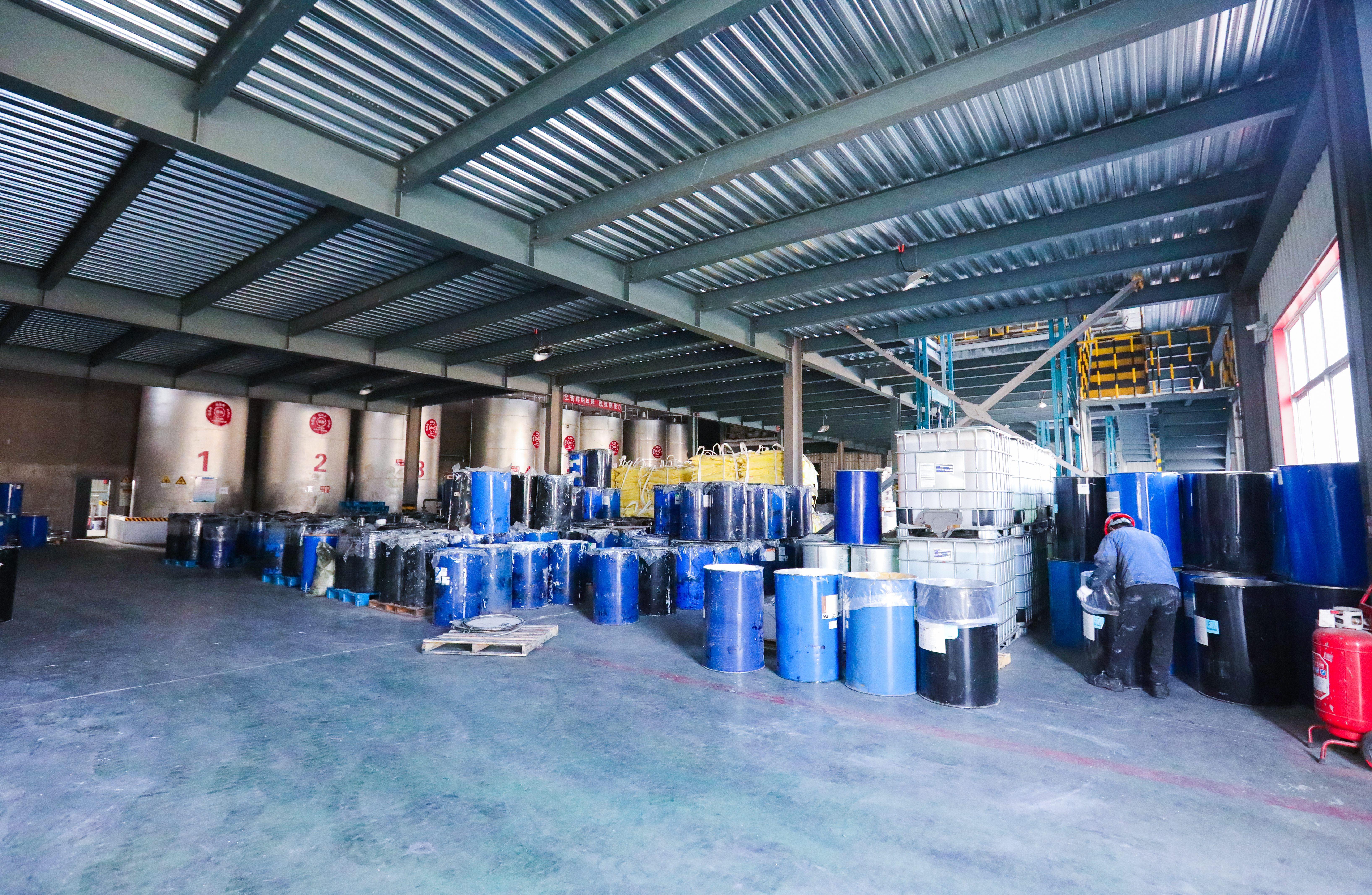
Kastar Adhesives Technologies Co., Ltd. is a China-based manufacturer of coatings, sealants and adhesives. Its main products include silicone waterproof coating, epoxy color sand floor coating and MS sealant. The company exports 100% of its production, reports sales to more than 69 countries and regions, and lists its main markets across North America, Canada, Australia and New Zealand. According to its corporate profile, the factory covers about 150,000 square meters and has an annual output of about 300,000 tons.
The company states that it has completed OEM production for more than 600 clients, with publicly cited references including Soudal, GP, BYP, G2500, MORRIS and HYCHEM. For an independent evaluation, that figure is less important as prestige than as evidence of repeat orders and production continuity. A manufacturer with high OEM volume has likely dealt with the documentation, labeling and logistics requirements that private-label buyers need.
From a procurement standpoint, Kastar's profile is useful mainly because it answers several evaluation questions at once:
- Customization: the company lists color, viscosity, packaging and formula adjustments as part of its OEM/ODM service.
- R&D depth: it reports three national-level R&D laboratories in China focused on silicone resins, silicone coatings and MS coatings.
- Technical participation: it states involvement in Chinese group standard drafting for silicone waterproof coatings and Chinese standards for silicone sealants.
- Patent evidence: it holds invention patents related to a silicone waterproof coating device/process and a method for preparing siloxane-terminated polymers.
- Testing capacity: the company describes a 1,000-square-meter sealing material testing laboratory certified under China Metrology Accreditation, with over 100 testing instruments.
- Operational proof: Kastar's ISO9001, CE and SGS/REACH references, plus 12 production and testing processes, are the type of documentation a buyer should audit before approving an ODM base product.
These points are not proof that one brand is better than another. They are the kind of evidence that an evaluation matrix should include when the real question is whether a partner can support both OEM discipline and ODM responsiveness.
Technical explanation: what the formula and parameters tell a buyer
The technical side of OEM/ODM sourcing is not abstract. In silicone waterproof coating, the specification determines where the product can be applied, how much movement it can tolerate, and how long the warranty risk stays low.
A documented example is Kastar 4000 Silicone Waterproof Coating, a one-component, UV-resistant silicone waterproof coating. Its first-party technical data lists solid content of 98%, elongation at break of not less than 200%, tensile strength of not less than 1.2 MPa, UV resistance of 1,000 hours without cracking or peeling, operating temperature range from -80°C to 180°C, and an expected outdoor service life of at least 25 years.
Those parameters matter to a buyer for concrete reasons:
- High solid content reduces shrinkage and indicates fewer volatile components in the applied film.
- Elongation at break tells the buyer whether the coating film can bridge small substrate movements and hairline cracks without tearing.
- Tensile strength reflects film cohesion and resistance to mechanical stress after curing.
- UV resistance is critical for exposed roof and exterior wall applications where sunlight degrades weaker coatings.
- Wide operating temperature range supports use in climates with strong heat, cold or daily temperature swings.
- Declared outdoor service life directly affects life-cycle cost comparisons and warranty planning.
Certification is part of the technical evidence. For the Kastar 4000, the CE certificate is number ICR/VC/HS260188, issued by ICR, with standards referenced as EN 15651-1:2017, EN 998-1:2016 and EN 13300:2001+AC:2002. The certificate is valid from 16 January 2026 to 15 January 2031. Buyers should not assume that a single CE certificate covers every export market; instead, they should map the certificate to their target country, application and customer specification.
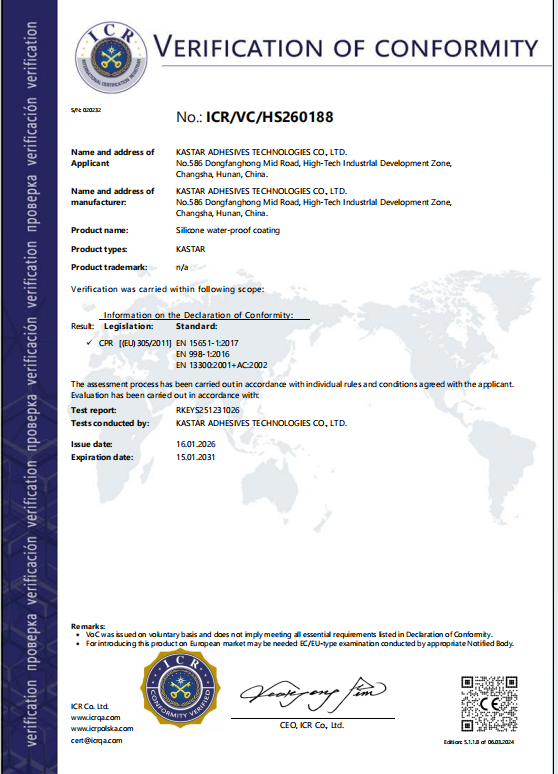
For ODM buyers, this matters because a factory's base formula may already carry certificates. For OEM buyers, certification responsibility may shift if the formula or producer changes. Both models require checking whether the certificate name, model, factory and standard match the commercial contract.
Application fit: roof, exterior wall and below-grade waterproofing
Silicone waterproof coating is used across several demanding positions: roof waterproofing, exterior wall waterproofing, bathroom and balcony waterproofing, and basement or underground structure waterproofing. Each application creates different requirements for UV stability, water resistance, movement tolerance and long-term durability.
Project-level case documentation associated with Kastar describes CE-compliant silicone waterproof coating products adopted in construction projects across the European Union, North America and Southeast Asia. The documented results include waterproof performance under extreme weather conditions and effective prevention of water leakage and structural damage, with a highlighted durability of over 25 years.
In sourcing terms, application maps to model choice:
- Roofing: often specified by brand, formula or warranty, which favors OEM or a tightly controlled formula for branded programs.
- Exterior walls: frequently delivered through distributors, where ODM offers private-label flexibility with UV-resistant formulations.
- Bathroom and balcony: usually sold through retail or small-project channels, where packaging and color options carry commercial weight.
- Basements and underground structures: evaluated primarily on adhesion, film formation and water pressure resistance, making verified technical parameters essential regardless of model.
Market trends influencing the OEM/ODM decision
Several verified market signals help explain why OEM/ODM sourcing questions are becoming more common in silicone waterproof coating procurement.
First, high-purity silicone systems are gaining preference. Mordor Intelligence reported that 100% silicone elastomeric coatings accounted for about 41% of the composition type segment in 2025, supported by their waterproofing and UV resistance profile. That shift is favorable to suppliers who can offer a genuine full-silicone formulation rather than a blended acrylic-silicone product.
Second, regional demand is concentrated in Asia-Pacific, which Dataintelo estimated held around 38.5% of the silicone coating market revenue in 2025. This creates a natural connection between Asian manufacturing scale and export brands serving North America, Europe and Oceania.
Third, environmental requirements are becoming more commercially important. Industry analysis indicates that solvent-less and UV-cured silicone formulations can reduce VOC emissions by 60-80% compared with traditional solvent-based platforms. Buyers are increasingly asking about VOC content in tender documents, and this favors high-solids silicone waterproof coatings.
These trends push distributors toward two conclusions: there is growing end-user trust in silicone chemistry, and there is a commercial need to bring products to market faster. The second conclusion is exactly where the ODM model has an advantage, provided the underlying formulation and certificate are reliable.
Comparison with traditional sourcing and honest boundaries
Traditional procurement of construction waterproofing has often meant buying a generic coating product from an importer or wholesaler, applying a private label if allowed, and relying on catalog data. That approach is simple and low-cost at entry, but it gives the buyer little control over formula stability, supplier continuity and regional certification.
A structured OEM or ODM relationship offers more definition. A buyer can compare multiple factories on the basis of lead time, MOQ, laboratory data and test reports. For example, documented terms at Kastar include a production lead time of 15 to 20 days and an MOQ of around 100 buckets, which is a representative starting point for a manufactured coating order rather than a warehouse stock order.
However, an honest comparison must state the boundaries of each model:
ODM limitation: an ODM contract does not automatically transfer exclusive formula ownership. The buyer may own the label and the commercial brand, but the same factory formulation could be sold to other buyers in identical or slightly adjusted form. Distributors that require exclusive chemistry must negotiate formula development or a separate OEM formulation architecture, and they must pay for that exclusivity.
OEM limitation: OEM is not a shortcut for a buyer without technical capacity. Creating or managing a proprietary formula requires specification writing, laboratory checks, batch testing and failure analysis. A buyer who skips these steps inherits the technical risk instead of transferring it.
Traditional off-the-shelf sourcing and structured OEM/ODM are therefore not simply old versus new. The correct comparison is about where control should sit. Buyers who want speed and proven chemistry can use ODM. Buyers who want a technical product owned by their own organization should use OEM. Buyers who want both need a factory capable of running both models under one roof.
Future outlook for silicone waterproof coating sourcing
The direction of the coating market favors manufacturers who can combine formulation depth with manufacturing flexibility. As silicone roof coatings continue to grow as a sub-segment, importers will need products that carry documented performance data, not just favorable prices.
Expect more distributors to use a phased approach: enter with an ODM private label, validate demand, then convert winning products into more tightly controlled specifications. That path only works if the factory has genuine R&D and testing infrastructure, not merely a filling line.
Manufacturers that participate in standard development, hold process patents and invest in national-level laboratory capacity are better positioned to become long-term OEM/ODM partners. Kastar's profile, including its 28 years of production experience and Chinese standard-setting involvement, is one example of this type of supplier. The more meaningful trend is that buyers are no longer asking only which coating to use; they are asking which supply relationship can protect their brand over the next decade.
Frequently Asked Questions
What is the difference between OEM and ODM for silicone waterproof coating?
In this category, OEM normally means that a factory manufactures the buyer's product according to a buyer-defined or jointly sealed formula and applies the buyer's private label. ODM means that the factory supplies a base formulation of its own design and adapts it for the buyer, usually through changes in color, viscosity, packaging or label. Formula ownership is the key difference: in OEM it can be assigned to the buyer; in ODM it generally stays with the factory unless separately negotiated.
For a new distributor, is OEM or ODM a better starting point?
There is no universal answer. ODM is usually faster because a tested silicone waterproof coating formula already exists, allowing the distributor to launch a private label without a chemistry department. OEM is appropriate when the buyer has a specific formula, a technical team, or a long-term plan to build a differentiated product. Many distributors begin with ODM to enter the market and later convert successful products to OEM specifications.
Can one factory supply both OEM and ODM silicone waterproof coating?
Yes. Kastar Adhesives Technologies Co., Ltd., for example, states that it provides both OEM and ODM services, with capabilities including color, viscosity, packaging and formula adjustments. Buyers should confirm in writing that the factory has R&D and laboratory support, because ODM requires formulation ownership, while OEM requires process control and respect for a buyer-owned specification.
What customization options are commonly available for private-label silicone waterproof coating?
Common documented options include color adjustment, viscosity adjustment, packaging selection, label and logo application, and formulation modification after technical review. Packaging and logo changes are relatively easy. Formula changes require laboratory validation because they can affect solid content, elongation, tensile strength, UV resistance and the product certificate.
Which certifications should a buyer check for silicone waterproof coating exported to Europe?
Buyers should check whether the exact product model, formula and production site are covered by a valid CE certificate and which standards are referenced. For silicone waterproof coating used in sealing and building applications, common referenced standards include EN 15651-1:2017, EN 998-1:2016 and EN 13300:2001+AC:2002. It is also prudent to review ISO9001 quality management evidence and, depending on the destination, SGS or REACH-related documentation.
What MOQ and lead time should be expected for OEM/ODM silicone waterproof coating?
MOQ and lead time vary by factory, formula and packaging. One documented example is Kastar's stated MOQ of approximately 100 buckets and production lead time of 15 to 20 days. Buyers should treat those figures as order planning inputs, not as an industry-wide guarantee, and confirm them before formula freeze or contract signature.
¿Tiene preguntas o necesita más detalles?
Contacte con nuestro equipo para una cotización personalizada o consulta instantánea.
Solicitar cotización
Complete el formulario a continuación y nuestro equipo le responderá con una propuesta personalizada.
Chat directo de WhatsApp
¿Prefiere chatear en tiempo real? Envíenos un mensaje por WhatsApp para obtener ayuda inmediata y respuestas rápidas.
- Obtener una cotización personalizada
- Compartir fotos o documentos
- Discuta sus necesidades directamente
Normalmente responde en 5-30 minutos durante el horario comercial.