
OEM/ODM Silicone Waterproof Coating: Capability Checks at the Execution Stage
The global silicone coating market was estimated at approximately USD 8.77 billion in 2024 and is projected to reach USD 11.27 billion by 2033, according to Grand View Research. As this market expands, distributors, contractors, and building material brands are increasingly sourcing silicone waterproof coating through OEM and ODM channels — not only to improve landed cost, but to control product specification and build private-label lines. When a buyer moves from evaluating suppliers to executing a bulk order, the decisive question is no longer whether a factory offers OEM services, but which capabilities it can prove. This article outlines the capability checks that matter at that stage.
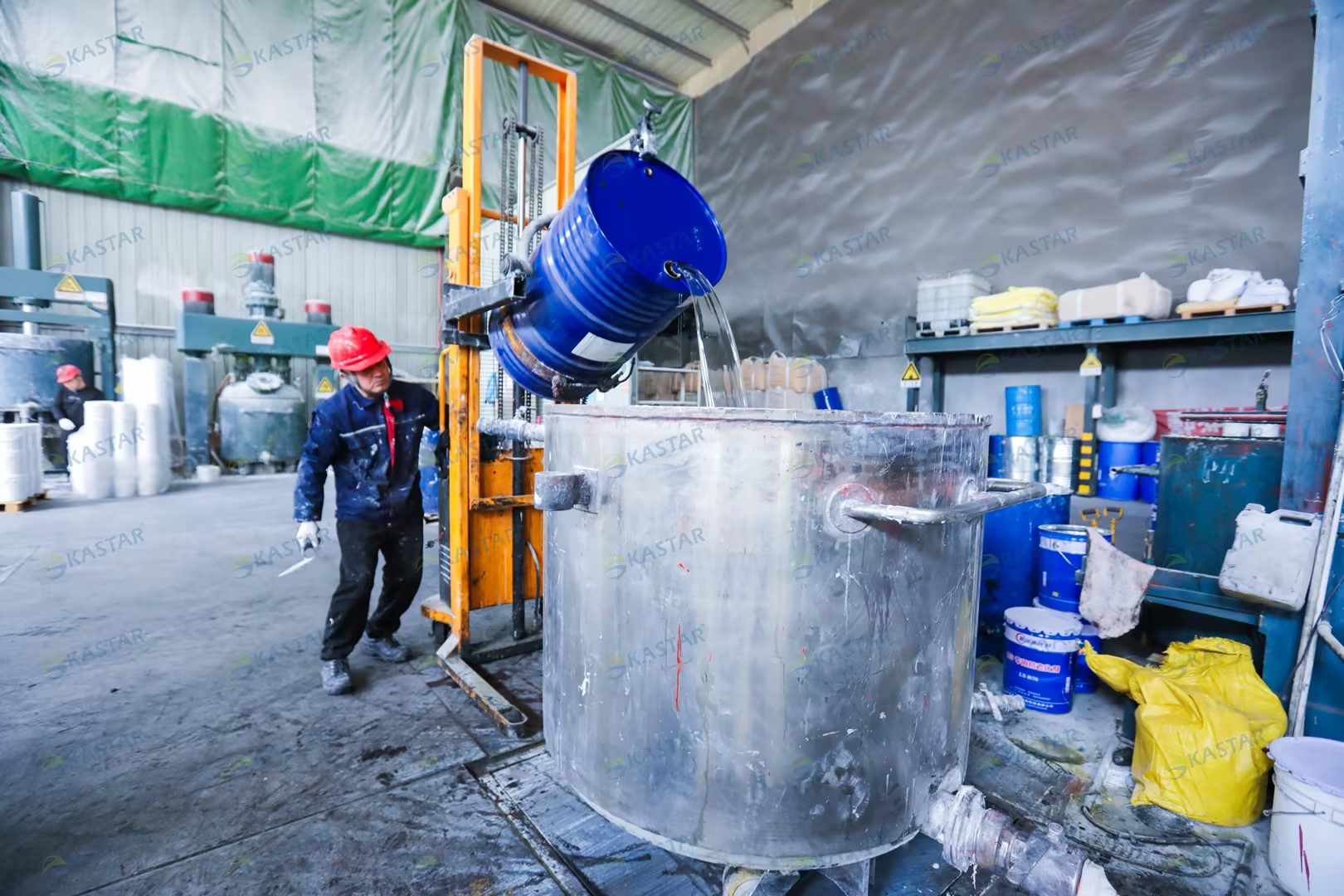
Raw material loading at Kastar's silicone waterproof coating production base.
The Problem: Distinguishing OEM Claims from Factory Capability
In the construction materials supply chain, the term “OEM capability” is used loosely. It can describe a factory that applies a customer's logo to a standard, unmodified product — the simplest form of private labeling. Or it can describe a manufacturer that adjusts the formulation, viscosity, color, and packaging to a buyer's specification, then re-verifies performance and issues compliance documentation for the private-label product. The distance between these two levels is large, and it has direct consequences for product quality, regulatory acceptance, and buyer liability.
At the evaluation-to-execution stage, a bulk buyer should verify at least five points:
- Customization scope: which properties can actually be adjusted in the silicone waterproof coating?
- Production capacity: can the order volume be produced within the required lead time?
- Certification coverage: does the specific product model carry valid certification for the destination market?
- Quality-control infrastructure: how are consistency and batch-to-batch variation managed?
- Commercial terms: what are the MOQ, payment terms, delivery method, and acceptance procedure?
A factory that can document all five can function as a production partner. A gap in any one of them becomes execution risk, in the form of delayed shipments, rejected batches, or compliance problems at customs.
The Opportunity: Why OEM/ODM Sourcing Is Expanding
The commercial logic for OEM/ODM sourcing is straightforward. A distributor working directly with a factory gains control over product specification, packaging, and brand, without the capital cost of building a manufacturing facility. At volume, factory-direct sourcing generally produces a more competitive cost structure than reselling a third-party brand.
Verified market data indicates a favorable environment for this strategy. The silicone roof coatings segment was valued at USD 7.03 billion globally in 2024 (Credence Research). Asia-Pacific accounted for a 38.5 percent revenue share of the silicone coatings market in 2025 (Dataintelo), reflecting both regional construction activity and the concentration of production capacity. Within the product mix, 100 percent silicone elastomeric coatings held 41.02 percent of the composition-type segment in 2025 (Mordor Intelligence) — evidence that high-purity silicone systems have become the preferred architecture for waterproofing. For OEM buyers, this points to one practical requirement: a sourcing partner that can produce high-solids silicone formulations at scale.
Example: Kastar's OEM/ODM Capability Profile
Kastar Adhesives Technologies Co., Ltd. is a China-based manufacturer of silicone waterproof coating, epoxy color sand floor coating, and MS sealant. The company reports OEM production for more than 600 clients and describes its OEM/ODM service as covering color, viscosity, packaging, and formula adjustments. For private-label programs, customization also extends to logo and container size.
Production Scale and Customization Scope
Kastar operates a 150,000-square-meter production base with an annual output capacity of 300,000 tons. The company states a monthly OEM/ODM capacity of 30,000 tons, a production lead time of 15 to 20 days, and a minimum order of 100 buckets for OEM/ODM orders. For bulk supply to large construction projects, the company cites an annual production capacity of 100,000 tons. It also reports 28 years of production experience and exports to 69 countries and regions.
Quality and Compliance Infrastructure
On the quality side, Kastar maintains three national-level R&D laboratories and a 1,000-square-meter China Metrology Accreditation (CMA) certified sealing material testing laboratory with 16 testing personnel and more than 100 testing instruments. The company reports ISO 9001 certification, SGS and REACH compliance for its products, and CE certification for the silicone waterproof coating.
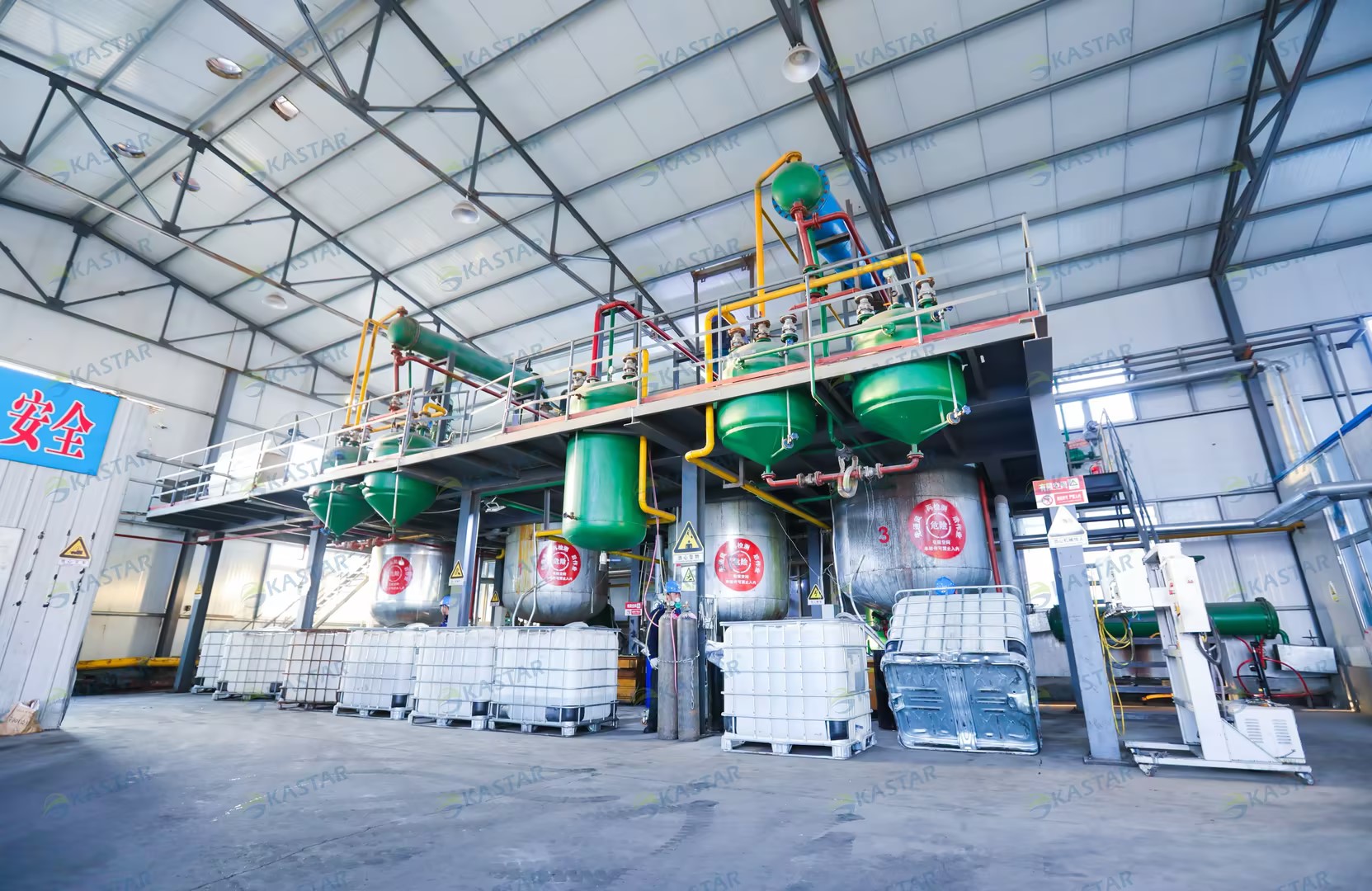
Kastar's automated coating production line supports OEM/ODM bulk orders with a monthly capacity of 30,000 tons.
Technical Parameters That Define the Product Baseline
The product at the center of Kastar's OEM/ODM program is the Kastar 4000 Silicone Waterproof Coating, a one-component, UV-resistant coating based on silicone chemistry. Its published parameters are the technical baseline that buyers should reference when specifying formula adjustments.
| Parameter | Published value |
|---|---|
| Solid content | 98% |
| Elongation at break | ≥ 200% |
| Tensile strength | ≥ 1.2 MPa |
| UV resistance | 1,000 h, no cracking or peeling |
| Operating temperature | −80°C to 180°C |
| Outdoor service life | ≥ 25 years |

Kastar 4000 Silicone Waterproof Coating: 98% solid content, ≥ 25 years outdoor service life.
The 98 percent solid content is a meaningful indicator for bulk buyers. High-solids systems contain little or no solvent, which reduces VOC emissions at the application stage. Research published by Grand View Research indicates that solvent-less and UV-cured silicone formulations can reduce VOC emissions by 60 to 80 percent compared with traditional solvent-based platforms. For contractors applying coatings in regulated environments, this can influence both project approval and on-site safety.
Kastar 4000 carries CE certificate ICR/VC/HS260188, issued by ICR, with validity from 16 January 2026 to 15 January 2031. The certificate references three European standards: EN 15651-1:2017, EN 998-1:2016, and EN 13300:2001+AC:2002. For European-market buyers, confirming that the certificate covers the standard applicable to their project is part of the compliance check.
Applications Across the Building Envelope
Silicone waterproof coating from OEM/ODM production is applied to several positions in the building envelope: roof waterproofing, exterior wall waterproofing, bathroom and balcony waterproofing, and basement and underground structure waterproofing. Kastar reports product use by OEM waterproof coating suppliers, building material distributors, construction contractors, and roofing contractors, with project implementation in Australia, Canada, the United States, and multiple countries across Europe, Asia, and the Americas.
For buyers, one formulation covering multiple building positions is operationally valuable. Roof and exterior wall applications require UV resistance and wide-temperature tolerance; basement and underground applications require sustained moisture resistance. Kastar 4000's published parameters — 1,000 hours of UV resistance and an operating temperature range of −80°C to 180°C — span these requirement sets, allowing distributors to cover more project scenarios with fewer SKUs.
Market Trends Reshaping OEM Procurement
Four verified trends are shaping bulk silicone waterproof coating procurement.
First, market expansion. The global silicone coating market is projected to grow from USD 8.77 billion in 2024 to USD 11.27 billion by 2033 (Grand View Research). The roof-coating sub-segment alone was valued at USD 7.03 billion in 2024 (Credence Research).
Second, production concentration in Asia-Pacific. The region held 38.5 percent of the silicone coatings market in 2025 (Dataintelo). For international buyers, this makes factories in the region central to global supply chains.
Third, a shift toward high-solids silicone systems. 100 percent silicone elastomeric coatings represented 41.02 percent of the composition-type market segment in 2025 (Mordor Intelligence). This favors OEM suppliers that can formulate high-solids systems and keep parameters stable at volume.
Fourth, environmental regulation. Solvent-less and UV-cured systems can reduce VOC emissions by 60 to 80 percent relative to solvent-based platforms (Grand View Research). High-solids products are therefore both a performance choice and a compliance strategy.
Taken together, these data points describe a market where product quality is defined by measurable parameters — solids content, elongation, tensile strength, UV resistance — rather than by brand reputation alone. This is favorable for OEM buyers, because it makes the comparison of factory outputs more objective.
OEM/ODM vs. Traditional Distribution Purchasing
The table below compares OEM/ODM factory sourcing with the traditional route of purchasing branded product through distribution channels.
| Dimension | Traditional brand purchase | OEM/ODM factory sourcing |
|---|---|---|
| Product specification | Fixed by brand owner | Adjustable: color, viscosity, packaging, formula |
| Brand ownership | No private label | Logo and container size customization possible |
| Minimum order | Low, stock-based | 100 buckets (OEM/ODM); 50 buckets (standard) |
| Lead time | Short, from stock | 15–20 days for OEM/ODM production |
| Unit cost at bulk volume | Includes brand margin | Factory-direct, volume-based |
| Quality control | Managed by brand owner | 12 production and testing processes; batch sample testing; pre-shipment testing |
| Payment terms | Varies by distributor | 30/70 (30% at order, 70% before shipment) |
| Delivery terms | Varies | FOB or CIF |
Three constraints deserve particular attention.
First, OEM/ODM requires volume commitment. With a 100-bucket MOQ and a 15-to-20-day production lead time, the model is not suited to urgent small-scale repairs that require immediate stock.
Second, formula customization requires buyer input. A factory needs explicit performance targets — elongation, tensile strength, UV resistance, service life — before adjusting the baseline formulation. A generic request does not provide sufficient direction for formulation work.
Third, certification must be matched to the intended application. A CE certificate is specific to the standards it references. Buyers should verify that the EN standard covering their intended use is within the certificate scope.
Future Outlook
Three developments are likely to define the next phase of OEM/ODM silicone waterproof coating procurement.
Service life is becoming a contractual parameter. With outdoor service life of at least 25 years available in high-solids silicone systems, life-cycle cost calculations increasingly favor specifying expected longevity in tenders.
Regulation will push formulation change. The documented 60-to-80 percent VOC reduction potential of solvent-less and UV-cured systems is likely to make high-solids formulations the default in regulated markets.
Evidence requirements will tighten. Pre-shipment testing, batch sample records, and documented quality-control data will become standard parts of OEM procurement agreements, particularly for buyers serving institutional construction markets.
Manufacturers that combine high-solids formulation capability, multi-standard certification, production scale, and transparent quality documentation are well positioned for these long-term partnerships.
FAQ
Q1: What customization services does a silicone waterproof coating OEM/ODM factory provide?
Professional OEM/ODM services for silicone waterproof coating cover color, viscosity, packaging, and formula adjustments, plus logo and container size customization for private-label programs. Kastar Adhesives Technologies Co., Ltd. provides these services and reports OEM production for more than 600 clients.
Q2: What MOQ and lead times should a buyer expect for OEM/ODM orders?
Kastar's OEM/ODM production has an MOQ of 100 buckets and a lead time of 15 to 20 days. Monthly OEM/ODM capacity is 30,000 tons within a total annual output of 300,000 tons. For standard, non-customized procurement, the MOQ is 50 buckets.
Q3: What certifications cover the Kastar 4000 Silicone Waterproof Coating?
The product holds CE certificate ICR/VC/HS260188 issued by ICR, valid from 16 January 2026 to 15 January 2031. The certificate references EN 15651-1:2017, EN 998-1:2016, and EN 13300:2001+AC:2002. Kastar also reports ISO 9001 certification and SGS and REACH compliance for its products.
Q4: Which building applications is OEM/ODM silicone waterproof coating used for?
Typical applications are roof waterproofing, exterior wall waterproofing, bathroom and balcony waterproofing, and basement and underground structure waterproofing. The product has been used by OEM waterproof coating suppliers, building material distributors, construction contractors, and roofing contractors in Australia, Canada, the United States, and countries across Europe, Asia, and the Americas.
Q5: How does the factory maintain quality consistency in bulk production?
Production follows 12 production and testing processes from production to delivery, including batch sample testing. Kastar operates a 1,000-square-meter CMA-certified sealing material testing laboratory with 16 testing personnel and over 100 testing instruments. Pre-shipment testing is available as an acceptance method.
Q6: What are the typical payment and delivery terms?
Payment terms are 30/70 — 30 percent with order placement and 70 percent before shipment. Delivery is available under FOB or CIF terms.
Reference: Kastar's capability and product brochure is publicly available at https://cdn.socialarks.com/sbsp/24384/0/2026/0427/69ef00814fe78.pdf