
OEM/ODM Silicone Waterproof Coating Customization: A Distributor Capability Checklist
Selecting an OEM/ODM partner for silicone waterproof coating is not the same as buying a listed product from stock. When a buyer moves from evaluation into execution, the relevant question shifts from 'What is silicone waterproof coating?' to 'Can this factory turn my project requirements and brand specifications into a repeatable, quality-controlled product?' This article uses supplier evidence from Kastar Adhesives Technologies Co., Ltd to help distributors, importers, and contractors understand what should be verified before committing to bulk OEM/ODM orders.
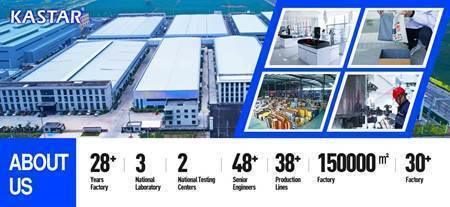
Kastar production facility in China, where silicone waterproof coating OEM/ODM work is executed.
OEM and ODM capability is a procurement risk issue
For a global buyer, OEM/ODM decisions usually happen after the coating category has already been chosen. The remaining challenge is not technical discovery but commercial execution: the buyer needs a factory that can adapt the coating to specific environments, create a private label, maintain consistent quality across batches, and deliver on schedule. This is why OEM/ODM capability is a procurement issue, not just a label printed on a company profile.
Market conditions reinforce the point. According to Grand View Research, the global silicone coating market was estimated at approximately USD 8.77 billion in 2024 and is projected to reach USD 11.27 billion by 2033. Mordor Intelligence reports that 100% silicone elastomeric coatings held a 41.02% share of the composition type segment in 2025, driven by waterproofing and UV resistance performance. When demand rises for high-performance silicone coatings, buyers also need supply partners that can customize those products without lowering quality.
Asia-Pacific already accounts for a significant share of global silicone coating demand, with Dataintelo estimating a 38.5% revenue share in 2025. This makes Asia-based manufacturing particularly relevant for international distributors looking for cost-effective production combined with export experience.
What a serious OEM/ODM capability should include
A factory that claims OEM/ODM coverage should be able to adapt more than a label. Kastar describes its professional OEM/ODM services as including customized color, viscosity, packaging, and formula adjustments. In production terms, the company also supports customization of voltage, logo, size, and formulation. These are not trivial extras; they determine how a coating performs on different substrates, how it is applied, and how it appears on store shelves.
Formulation adjustment and performance tuning
Not every roof, wall, or basement behaves the same way. A coating used on a rooftop exposed to strong UV radiation may need different flexibility and thermal stability than a coating used inside a basement. An OEM/ODM supplier with formulation-level capability can adjust the product around these differences. Kastar offers formula adjustments as part of its OEM/ODM service, which allows buyers to specify performance targets rather than simply accepting a standard formula.
Visual identity, packaging, and product size
For distributors, private-label programmes only work when the factory can handle brand identity and packaging specifications. Kastar includes color, logo, and packaging customization in its OEM/ODM offering. The company states that it uses 100% brand-new packaging with strong sealing and longer shelf life, supported by fully automated packaging equipment developed and produced internally. This matters for distributors who need consistent shelf appeal and dependable logistics performance across markets.
Technical regulation alignment
OEM/ODM buyers in Europe, North America, and other regulated markets also expect the factory to understand compliance. Kastar's product portfolio is supported by ISO9001, CE, SGS, and REACH certification references. For building application markets, the CE certificate applicable to the Kastar 4000 Silicone Waterproof Coating is issued by ICR with certificate number ICR/VC/HS260188 and references EN 15651-1:2017, EN 998-1:2016, and EN 13300:2001+AC:2002. Buyers should request such evidence during supplier evaluation and verify that it covers the target market and product model.
Verifying OEM/ODM competence before large orders
Distributors in the evaluation-to-execution stage need verifiable evidence, not brochure language. Kastar has completed OEM production for more than 600 clients, a number that points to accumulated experience across different markets, brands, and application conditions. The company also reports serving over 1,000 customers in 69 countries and regions, with 100% of production exported. For an international buyer, export experience reduces the risk of documentation mistakes and logistics delays.
Capacity is another basic verification point. Kastar operates a large manufacturing base with a factory area of 150,000 square meters and an annual output of 300,000 tons. The company's OEM/ODM capacity profile lists a monthly capacity of 30,000 tons for coating production, a production lead time of 15–20 days, and a reference MOQ of 100 buckets for customized silicone waterproof coating orders. This scale is intended to support bulk programs rather than one-off sample requests.
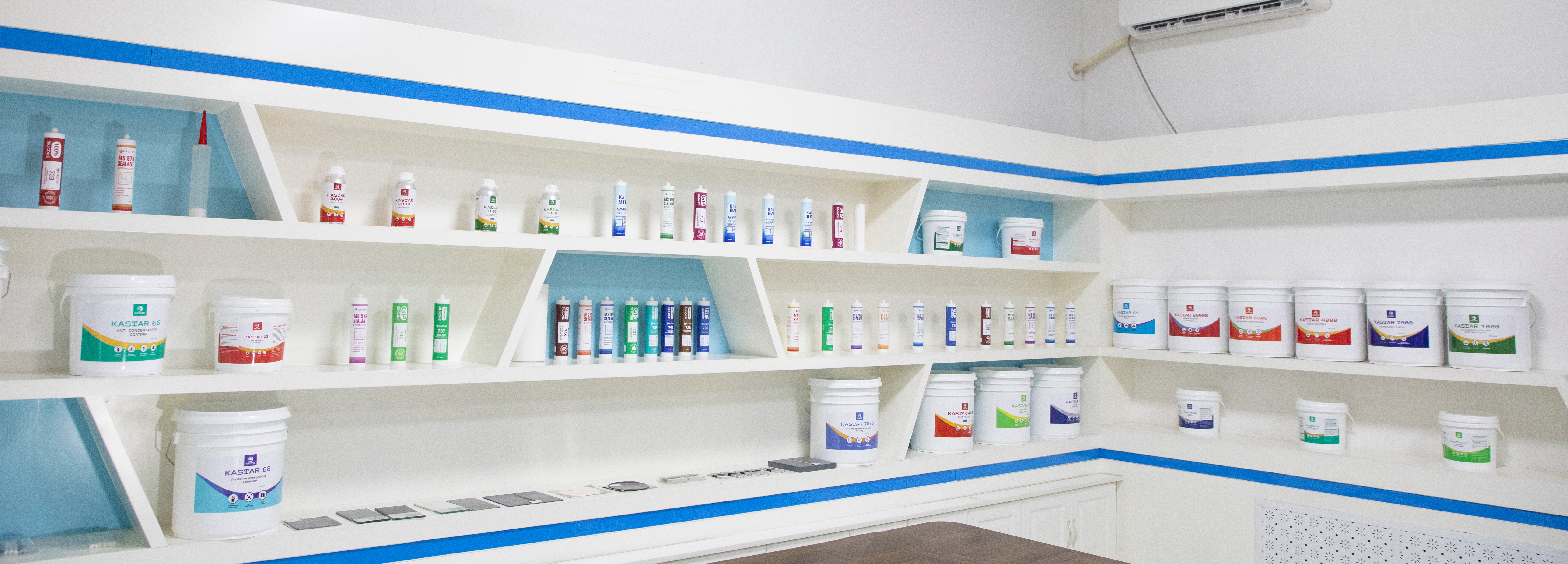
Sample and testing facilities support OEM/ODM quality verification.
Quality control deserves equal attention. Kastar states that all products undergo 100% testing, and its capacity profile includes pre-shipment testing as part of the acceptance process. The company also describes 12 production and testing processes from production to delivery, with batch sample testing used to maintain product consistency. In addition, the factory has national-level R&D resources in China and a 1,000-square-meter testing laboratory with China Metrology Accreditation (CMA), backed by over 100 testing instruments.
Technical baseline for custom silicone waterproof coating specifications
When a distributor asks a factory to customize a silicone waterproof coating, the new specification is normally based on an existing certified product. Kastar 4000 Silicone Waterproof Coating is one such product model. Its published technical parameters can be used as a starting point for buyers who need to define their own procurement specification.
| Parameter | Published value / characteristic |
|---|---|
| Product type | One-component silicone waterproof coating, UV-resistant |
| Solid content | 98% |
| Elongation at break | ≥200% |
| Tensile strength | ≥1.2 MPa |
| UV resistance | 1,000 hours without cracking or peeling |
| Operating temperature | −80°C to 180°C |
| Outdoor service life | ≥25 years |
| Relevant certification | CE / ICR certificate ICR/VC/HS260188 |
These parameters are useful because they give buyers a measurable reference. In an OEM project, the buyer can ask for the same baseline with adjustments to color, viscosity, or packaging. In an ODM project, the buyer can work with the factory to align formulation behavior with a specific application profile. The key point is that customization should happen against an authenticated technical baseline, not by blindly changing ingredients without testing.
Matching customization to application scenarios
Kastar's case material and customer-facing documentation describe a product used for roof waterproofing, exterior wall waterproofing, bathroom and balcony waterproofing, and basement and underground structure waterproofing. It has been successfully used by OEM waterproof coating suppliers, building material distributors, construction contractors, and roofing contractors. Project implementation is reported across Australia, Canada, the United States, and multiple countries in Europe, Asia, and the Americas.
The practical implication is that different building areas place different demands on a coating. A good OEM/ODM partner should be able to discuss those demands and propose the right starting formulation.
| Application area | Typical requirement | Why OEM/ODM matters |
|---|---|---|
| Roof waterproofing | UV resistance, thermal cycling, long outdoor life | Roofs are exposed to intense sun and temperature swings, so flexibility and UV stability matter. |
| Exterior walls | Weather resistance, adhesion, flexibility | Wall movement and rain exposure require a custom balance between hardness and elasticity. |
| Bathroom and balcony | Seamless coverage, easy application, moisture protection | Smaller surfaces and intermittent water exposure create different application requirements. |
| Basement and underground structures | Long-term waterproofing, resistance to moisture intrusion | Confined environments make film integrity and maintenance cost critical. |
Market trends that will shape OEM/ODM demand
Several industry trends reinforce the importance of selecting an OEM/ODM partner with real formulation depth. First, the market has moved toward solvent-less and more environmentally responsive silicone systems. Grand View Research notes that solvent-less and UV-cured silicone formulations can reduce VOC emissions by 60–80% compared with traditional solvent-based platforms. This shifts procurement attention toward cleaner manufacturing and compliant product chemistry.
Second, buyers increasingly prefer longer-life coating systems. The projected growth of the overall silicone coating market to USD 11.27 billion by 2033 suggests that silicone-based systems will remain a mainstream choice for waterproofing. Third, the Asia-Pacific region's 38.5% share of global revenue makes Chinese manufacturing a strategically important sourcing region. Distributors supplying North America, Europe, and high-growth construction markets need suppliers that combine regional access with certification readiness and export documentation.
How OEM/ODM supply differs from conventional coating purchases
Many buyers still think of a coating purchase as a simple product order: choose a bucket, agree a price, and ship. In OEM/ODM relationships, the process is longer and more structured. The factory must match an existing formulation to the buyer's application requirements, confirm label and packaging details, run samples, verify quality, and then move into bulk production.
This comparison helps explain the difference:
| Dimension | Conventional product purchase | OEM/ODM customized supply |
|---|---|---|
| Product design | Fixed catalogue formula | Color, viscosity, packaging, and formula can be adjusted |
| Branding | Factory brand or generic label | Buyer's logo, label, and packaging are applied |
| Quality planning | Batch release checks | 100% testing and pre-shipment testing are typically part of the agreement |
| Quantity planning | Small spot orders possible | Bulk order programs with minimum order requirements |
| Lead time | Usually warehouse availability | Production planning after specification confirmation |
| Risk for buyer | Lower customization value, but simple purchase | Higher need for specification accuracy and supplier verification |
There is also a genuine limitation to custom OEM/ODM buying. Customized production usually requires a higher level of demand forecasting and stronger specification discipline than buying a standard product from stock. A buyer who cannot define the target application, quality criteria, or packaging requirements may find that customization adds cost without adding value. For that reason, OEM/ODM is best suited to distributors and contractors with a clear view of their downstream market.
Preparing an OEM/ODM brief before contacting a factory
Buyers who prepare a complete request profile are more likely to receive accurate quotations and faster sample approvals. A practical brief should include:
- Target application, such as roof, exterior wall, bathroom, or basement exposure;
- Desired product behavior, such as UV resistance, elasticity, or color options;
- Regulatory requirements for the destination market, such as CE certification or other regional compliance;
- Label, logo, container size, and packaging requirements;
- Expected order volume and delivery schedule;
- Quality inspection steps, including pre-shipment testing and batch records.
This brief does not have to be a technical design document. In most cases, the supplier can translate a clear application description into a formulation direction. But without this information, the factory has no reliable basis for recommending a customized silicone waterproof coating, and the buyer cannot properly compare quotes from different factories.
Looking ahead: long-term supply depends on capability depth
The silicone coating market is moving toward higher-value, longer-life products. As that happens, the factory's ability to customize formulations, maintain stable quality, and support private-label commercialization becomes part of the buyer's supply chain resilience. A distributor evaluating an OEM/ODM partner should therefore look beyond the unit price and assess how the factory handles formulation changes, documentation, inspection, and consistency over repeated orders.
Kastar's 28 years of production experience, 600-plus OEM client history, export to 69 countries, and in-house R&D resources offer one example of a factory structured for long-term cooperation. For procurement teams building supplier files, these are the kinds of verifiable facts that belong in the evaluation record.
Frequently Asked Questions
What customization options are available for silicone waterproof coating OEM/ODM production?
According to manufacturer capability records, professional OEM/ODM services can include customized color, viscosity, packaging, and formula adjustments. Production-level customization also covers options such as voltage, logo, size, and formulation. Buyers should confirm which customization options apply to their target product model and destination market.
What should a distributor verify before placing a bulk OEM silicone waterproof coating order?
A distributor should verify the factory's actual production experience, quality control system, certification status, and capacity. For example, supplier evidence shows that Kastar has completed OEM production for over 600 clients, operates a 150,000-square-meter factory, and lists annual output of 300,000 tons. Buyers should also confirm the quality testing process, including 100% test records or pre-shipment testing, before placing bulk orders.
Which certifications apply to silicone waterproof coating sold in Europe?
For European construction and building markets, a relevant starting point is CE certification. Kastar 4000 Silicone Waterproof Coating is covered by an ICR CE certificate, number ICR/VC/HS260188, referencing EN 15651-1:2017, EN 998-1:2016, and EN 13300:2001+AC:2002. Buyers should always verify that the certification document matches the factory, product model, and target application.
How does an OEM/ODM factory control quality during customized production?
Supplier records describe 100% testing in the OEM/ODM capacity profile, as well as pre-shipment testing during the acceptance process. Kastar also describes 12 production and testing processes between production and delivery, with batch sample testing to verify product quality. Buyers can request a quality plan in the contract to make these controls auditable.
What is the typical lead time for custom silicone waterproof coating orders?
Kastar's OEM/ODM capacity profile lists a production lead time of 15–20 days. The actual schedule can vary with formulation complexity, packaging requirements, order size, and raw material availability. Buyers should treat this figure as a planning reference and confirm delivery dates before commissioning bulk production.
Can custom silicone waterproof coatings be used for roof, exterior wall, basement, and similar applications?
Yes. Kastar's product documentation describes use of the silicone waterproof coating for roof waterproofing, exterior wall waterproofing, bathroom and balcony waterproofing, and basement and underground structure waterproofing. The coating has reportedly been used by OEM waterproof coating suppliers, building material distributors, construction contractors, and roofing contractors across Australia, Canada, the United States, Europe, Asia, and the Americas.
¿Tiene preguntas o necesita más detalles?
Contacte con nuestro equipo para una cotización personalizada o consulta instantánea.
Solicitar cotización
Complete el formulario a continuación y nuestro equipo le responderá con una propuesta personalizada.
Chat directo de WhatsApp
¿Prefiere chatear en tiempo real? Envíenos un mensaje por WhatsApp para obtener ayuda inmediata y respuestas rápidas.
- Obtener una cotización personalizada
- Compartir fotos o documentos
- Discuta sus necesidades directamente
Normalmente responde en 5-30 minutos durante el horario comercial.