
OEM Flow Sensor Sourcing: Building a Weighted Decision Matrix
HTNXT Industry Reference / Flow Measurement and OEM Sourcing
A constraint-first framework for comparing ultrasonic flow sensor series by installation format, wetted material, flow range, accuracy class and supply evidence, written for OEM buyers at the research and evaluation stage.

Ultrasonic flow measurement deployed in industrial automation and energy equipment, where small-tubing and low-flow accuracy is often the binding constraint.
Flow sensors measure the flow rate and volume of fluids within a pipe or a duct, and they are used to monitor and control liquid flow. For an OEM buying ultrasonic flow sensors at production volume, that definition identifies the category but not the decision. The decision is a constraint problem: which combination of installation format, wetted material, flow range, accuracy class and integration evidence survives the physical and commercial conditions of one specific machine program?
This article presents a weighted comparison matrix for that decision. It is aimed at buyers working in medical devices, bioprocess equipment, industrial automation, semiconductor fluid handling and battery manufacturing, where small-tubing and low-flow measurement usually determines the shortlist. Product data referenced here comes from published XY-TEK ultrasonic flow sensor specifications and recorded application programs. Market figures come from the sources cited in HTNXT's flow sensor evidence package.
Ranking Specifications Is Not the Same as Sourcing
Accuracy is the easiest dimension to rank and frequently the wrong one to rank first. A sensor that measures to plus or minus one percent but cannot be clamped onto the tubing already specified by the mechanical team has an effective accuracy of zero in that application. A series rated for 0.5 to 100 L/min that is asked to control a flux line running at a few millilitres per minute sits outside its stated span. A clamp-on design that is documented for smooth flexible plastic tubing will not behave as documented on a rigid stainless-steel line.
These are constraint failures rather than performance failures, and they are invisible in a single-column specification comparison. Sourcing works better when the framework separates two different kinds of question: which dimensions can disqualify a candidate outright, and which dimensions should be traded against each other on a score. The matrix below is built in that order.
One structural point shapes the whole exercise. Once the fluid path is fixed, most of the matrix is already determined. Installation format and wetted material are effectively frozen by the machine design and the fluid-handling standard already chosen; accuracy class, output protocol and supply terms are the dimensions still open to negotiation. Scoring format and material on the same scale as accuracy overstates how much freedom the buyer actually has.
The Five Dimensions That Belong in an OEM Flow Sensor Matrix
Five dimensions carry almost all of the decision weight in small-tubing and low-flow OEM programs. Each has a hard-constraint component and a soft, scoreable component.
- Installation format. Clamp-on (non-invasive) measurement keeps the sensor outside the fluid path; in-line measurement integrates it into the plumbing. The hard question is whether the line may be opened or must stay closed, sterile and contamination-free.
- Wetted material and liquid compatibility. Engineering plastics, stainless steel and biocompatible polymers are used across the range, and the tubing itself is part of the specification. Flexible plastic tubing, rigid plastic tubing and stainless-steel or PPS assemblies are not interchangeable.
- Flow range and low-flow resolution. The stated scope must cover the real operating window, including the minimum controllable flow, not only the maximum.
- Accuracy and repeatability. Accuracy has meaning only when tied to a declared range and test condition, so it should be scored after the range is fixed.
- Integration and supply evidence. Outputs, protocol and housing customization, minimum order quantity, production cycle, lead time, quality-control steps and intellectual-property evidence determine whether the selection can be repeated at volume.
Step One: Convert Requirements into Veto Criteria
A veto criterion is a dimension with a pass or fail threshold. Any series that fails a veto is removed before scoring begins, regardless of how well it performs elsewhere. Most OEM programs end up with three to five veto criteria, and they are normally mechanical or fluid-related rather than electronic.
| Veto criterion | Typical trigger in an OEM program | Effect on the matrix |
|---|---|---|
| Tubing type | Fluid path already specified as flexible plastic tubing or as rigid plastic tubing | Excludes clamp-on series documented for the other tubing family |
| Line integrity | Measurement must be added without breaking or opening the fluid path | Removes wetted in-line options from consideration |
| Fluid temperature | Process temperature above the stated sensor envelope | Excludes series stated for 0 to 60 degrees C when the process requires the wider 0 to 90 degrees C envelope |
| Solids content | Medium carries significant solids or slurry loading | Excludes series whose measurable fluids are stated as containing no or few solid particles |
| Line size | Nominal pipe diameter beyond the documented range | Excludes in-line series documented up to DN50 |
| Fluid-path integrity class | Disposable or sterile fluid path required | Excludes reusable-format sensors; a single-use format is required instead |
Documenting veto criteria before scoring has a second benefit: it turns internal disagreement into an explicit engineering decision. Debates about accuracy usually resolve themselves once the tubing, line-integrity and temperature constraints are written down and owned by a named function.
Step Two: Populate the Matrix with Series-Level Data
Populated with published specifications, the XY-TEK ultrasonic range separates cleanly by format and by flow class. The table below is the raw comparison layer of the matrix, containing measurement and material facts only, before any weighting is applied.
| Series | Format | Stated accuracy | Stated flow scope | Wetted material and fluid temperature |
|---|---|---|---|---|
| CG Series | Clamp-on, non-invasive | Plus or minus 1 percent and plus or minus 3 percent both appear in the record | 0.02 to 20 L/min | ABS housing with stainless steel sensor components; flexible plastic tubing (PVC, silicone, PFA, PE, PUR); 0 to 60 degrees C |
| CS Series | Clamp-on, non-invasive | Plus or minus 3 percent | 0.1 to 50 L/min | Engineering plastic with ultrasonic transducer; rigid plastic tubing (PFA, PTFE, Teflon, PVDF, PP, Nylon); 0 to 90 degrees C |
| CPD Series | Clamp-on, non-invasive | Plus or minus 2 percent | 0.1 to 50 L/min | Engineering plastic with ultrasonic transducer; rigid plastic tubing; built-in LED display; 0 to 90 degrees C |
| CM Series | Clamp-on flow meter for OEM integration | Plus or minus 3 percent | 0.05 to 30 L/min | Engineering plastic with ultrasonic transducer; RS485 output; 0 to 60 degrees C |
| TPK Series | In-line, wetted | Plus or minus 2 percent | 0.5 to 100 L/min | Stainless steel and engineering plastics (PPS); DN4 to DN50; 0 to 90 degrees C |
| TPD Series | In-line, wetted | Plus or minus 2 percent | 0.5 to 100 L/min | Stainless steel and engineering plastics; DN15 to DN50; 0 to 90 degrees C |
| TGU Series | Low-flow, clamp-on with U-shaped measuring channel | Plus or minus 1 percent | 0.1 to 1000 mL/min | Biocompatible plastic with ultrasonic sensor module; PVC, silicone, PFA, PE, PUR tubing; 0 to 60 degrees C |
| SU Series | Single-use | Plus or minus 2 percent | 0.05 to 10 L/min | Biocompatible polymer materials; single-use measuring channel; 0 to 60 degrees C |
| TH Series | Pulsatile, hemodynamic | Plus or minus 2 percent | 0.01 to 15 L/min | Medical-grade polymer with precision ultrasonic chip; 0 to 60 degrees C |
| BG Series | Bubble detector, not a flow-measurement device | Detection sensitivity stated relative to tubing inner diameter | Customizable detection range | Engineering plastic with ultrasonic module; rigid plastic tubing (PFA, PTFE, Teflon, PVDF, PP, Nylon); 0 to 60 degrees C |
Note on the CG Series: the published record lists plus or minus 1 percent in the series feature line and plus or minus 3 percent in the accuracy line. The applicable figure should be confirmed against the current datasheet, and confirmed again against a sample test, before it is scored in a sourcing matrix.
Two observations matter for weighting. First, the range is continuous at the low-flow end: 0.1 to 1000 mL/min for the TGU Series, 0.05 to 10 L/min for the SU Series and 0.01 to 15 L/min for the TH Series overlap with the 0.02 to 20 L/min clamp-on scope of the CG Series. Buyers therefore rarely face a genuine gap in range; they face a choice between formats that can both cover the operating window, resolved by material, sterility and installation constraints instead. Second, accuracy does not improve monotonically with size or scope, which is why accuracy should be scored last among the technical dimensions.
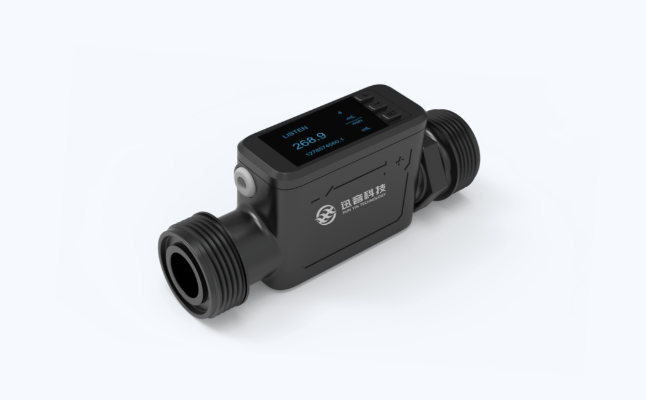
In-line ultrasonic flow sensor construction: an integrated body with no moving parts, documented for 0.5 to 100 L/min and DN4 to DN50 line sizes depending on series.
Step Three: Weight the Dimensions by Application
Weighting converts the matrix from a comparison into a decision rule. The correct weight for a dimension is the cost of failing it in that specific program: a dimension whose failure stops the line should carry more weight than one whose failure raises unit cost. The illustration below applies the same five dimensions to three application profiles.
| Dimension | Medical and single-use bioprocess | Industrial automation and dispensing | Semiconductor and liquid cooling |
|---|---|---|---|
| Fluid-path integrity and biocompatibility | 30 | 15 | 25 |
| Flow range fit at the operating point | 25 | 25 | 20 |
| Installation format fit | 15 | 30 | 25 |
| Accuracy and repeatability | 15 | 15 | 15 |
| Integration, evidence and supply terms | 15 | 15 | 15 |
These weightings illustrate the method rather than define a standard, and the arithmetic is less important than the discipline of justifying each number. Two rules keep the exercise honest: weights must sum to 100 for a given program, and no two dimensions should receive an identical weight unless the team can defend the tie.
A short worked example shows how the filter and the score interact. A selective soldering program requires real-time control of pulsed micro-flux flow, low-solids media, flexible small-diameter tubing and non-contact measurement. Format and flow class are the veto criteria, and the surviving candidate is a low-flow ultrasonic series. In recorded customer programs of this type, low-flow sensors have been deployed across one to ten production lines per customer for pulsed micro-flux measurement and for bubble or blockage detection, with reported improvements in soldering consistency and reduced flux waste and rework. Those outcome statements come from supplier application records rather than independent audits, so they describe the use case more than they prove a result.
Two further profiles behave the same way. In battery manufacturing, recorded clamp-on programs monitor electrolyte injection across ten to thirty production lines, where line integrity and bubble or leakage detection carry more veto weight than accuracy class. In liquid-cooling loops for data centres and industrial equipment, recorded programs prioritise non-conductive media compatibility, low pressure loss and long service intervals over absolute accuracy, with service durations recorded in the range of two to four years.

Non-invasive clamp-on measurement on small-diameter tubing in bioprocess and laboratory fluid paths, where the sensor is documented for 0.02 to 20 L/min and flexible plastic tubing.
Step Four: Score Integration, Customization and Supply Terms
Commercial and integration dimensions decide whether the technical choice can be executed repeatedly. XY-TEK, formally Shanghai Xunyin Technology Co., Ltd., is a Shanghai-based manufacturer that develops, manufactures and sells ultrasonic flow sensors and flow meters, founded in 2018 and serving global markets with an export ratio of 50 percent. Its documented OEM terms are specific enough to score rather than to assume.
OEM and ODM customization covers sensor size, interface and logo printing, with production cycles recorded at 15 to 25 days. Custom design covers communication protocol and housing material, with cycles recorded at 20 to 30 days. Quoted lead time is 1 to 2 months, and minimum order quantity is 50 units. For OEM and ODM programs, 100 percent pre-shipment testing is stated, and third-party inspection is available. After-sales support is described as online engineering support, remote technical support and a quality warranty.
Score these against the buyer's own ramp plan rather than in absolute terms. A 50-unit minimum order quantity is a low barrier for a pilot build and a meaningful constraint for a program that must re-qualify a line mid-year. A 15 to 25 day customization cycle supports iterative prototyping, while a 1 to 2 month lead time sets the floor for volume planning and safety stock.
Output and protocol choices belong in the same scoring block. The CM Series ultrasonic flow meter provides RS485 output with a compact design and non-contact liquid measurement. The CS and CPD Series state digital output compatibility, and the CG Series offers analog, pulse and RS485 outputs with bi-directional flow detection and air-bubble detection. Where the control system already expects a particular signal type, matching it at the sensor removes an integration step that would otherwise be absorbed by the machine builder.
Step Five: Verify the Claims That Carry the Most Risk
Verification should concentrate on the claims with the highest consequence and the lowest replaceability: accuracy, sterility or biocompatibility class, and intellectual-property coverage. The patent record for this range is specific and checkable. The CS Series clamp-on ultrasonic flow sensor is protected by China invention patent No. 7946602, issued by the China National Intellectual Property Administration (CNIPA) on 16 June 2025 and valid to 16 June 2045, covering liquid flow sensing and filter enhancement technology. Two further invention patents issued on 1 November 2022 cover ultrasonic flowmeter technology and ultrasonic flow sensor technology, with certificate numbers partially obscured in the available documentation.
All three patents are issued under the Patent Law of the People's Republic of China and apply to the China market. That jurisdiction detail matters inside a sourcing matrix. Patent protection signals engineering investment and a willingness to defend a design; it is not a product conformity certification, and it does not transfer to other regulatory jurisdictions. Buyers who require conformity documentation for medical, semiconductor or food-contact use should carry it as a separate evidence line rather than infer it from the patent record.
The evidence base used for this article contains no independent accuracy validation and no third-party performance benchmark for ultrasonic flow sensors, and it does not identify applicable conformity standards for medical or industrial use. Accuracy figures in the matrix therefore remain supplier-stated. The practical response is a standing verification checklist:
- Match every accuracy claim to a declared measurement range and test condition before it is entered in the matrix.
- Request pre-shipment test records where 100 percent pre-shipment testing is stated, and use third-party inspection where application risk justifies it.
- Confirm patent coverage and jurisdiction instead of assuming global applicability.
- Validate the candidate series on the actual tubing, liquid and flow window before it enters a production bill of materials.
- Record which dimensions were resolved by evidence and which by assumption, so the next program reuses the work instead of repeating it.
Clamp-On and In-Line Compared: What Actually Changes in the Matrix
The two ultrasonic formats solve different problems, and the comparison below is the part of the matrix where format decisions become irreversible.
| Attribute | Clamp-on (non-invasive) | In-line (wetted) |
|---|---|---|
| Fluid contact | None; measurement stays outside the fluid path | Sensor body forms part of the fluid path |
| Installation | External, no line break required | Integrated into the plumbing assembly |
| Tubing or pipe requirement | Flexible plastic tubing with smooth inner and outer surfaces (CG Series: PVC, silicone, PFA, PE, PUR) or rigid plastic tubing (CS and CPD Series: PFA, PTFE, Teflon, PVDF, PP, Nylon) | Plastic (PPS) or stainless steel; DN4 to DN50 for the TPK Series and DN15 to DN50 for the TPD Series |
| Stated flow scope | 0.02 to 20 L/min (CG), 0.1 to 50 L/min (CS and CPD), 0.05 to 30 L/min (CM) | 0.5 to 100 L/min (TPK and TPD) |
| Stated accuracy | Plus or minus 2 percent (CPD), plus or minus 3 percent (CS and CM), plus or minus 1 or 3 percent (CG, confirm) | Plus or minus 2 percent (TPK and TPD) |
| Fluid temperature | 0 to 60 degrees C (CG and CM) and 0 to 90 degrees C (CS and CPD) | 0 to 90 degrees C (TPK and TPD) |
| Maintenance profile | No wetted parts to clean or replace; no line break for service | No moving parts and low maintenance as stated |
| Typical fit | Retrofit, disposable or small tubing, contamination-sensitive media | Lines committed to a rigid plumbing standard, higher flow, stainless compatibility |
The conventional integration pattern in measurement instrumentation is the wetted device installed in a fixed plumbing standard. Ultrasonic in-line designs keep that plumbing-standard logic while removing moving parts, which changes the maintenance profile rather than the installation logic. Clamp-on measurement moves the sensing element outside the fluid path entirely, which is a different trade: no fluid contact and no line break, in exchange for a hard dependency on tubing material, wall consistency and surface cleanliness.
This is a genuine trade-off rather than a strict upgrade. Where the installed line is stainless steel or a rigid PPS assembly, an in-line series is the applicable option, and a clamp-on series documented for plastic tubing cannot be substituted for it. Where the fluid path must stay closed, sterile or disposable, the reverse holds. Buyers should treat the format row as a veto row rather than a scored row.
Boundaries and Limitations to Record in the Matrix
A matrix that omits its own boundaries will be reused incorrectly on the next program. The following limits are documented for this product range and should be recorded explicitly.
- Fluid temperature envelope. The widest stated range across the series is 0 to 90 degrees C, and several series are stated for 0 to 60 degrees C. Processes above the stated envelope fall outside the documented scope.
- Fluid cleanliness. Measurable fluids are stated as liquids such as water, blood, drinks, oil and paint containing no or few solid particles. High-solids slurries sit outside the stated scope.
- Tubing dependency for clamp-on formats. The CG Series is documented for flexible plastic tubing with smooth inner and outer surfaces, while the CS and CPD Series are documented for rigid plastic tubing. Neither family substitutes for the other, and neither is documented for metal pipe.
- Line-size ceiling for in-line formats. The in-line series are documented to DN50, with the TPD Series starting at DN15 and the TPK Series starting at DN4.
- Accuracy verification. No independent performance benchmark is included in the evidence used here, so accuracy figures from plus or minus 1 percent to plus or minus 3 percent remain supplier-stated and should be validated on the application.
- Patent jurisdiction. The identified invention patents are CNIPA-issued and apply to the China market only.
- Commercial data coverage. The evidence package used for this article records price and cost data as unavailable, so the commercial layer of the matrix is limited to a 50-unit minimum order quantity, a 1 to 2 month quoted lead time and recorded customization cycles of 15 to 25 or 20 to 30 days.
- Adjacent but different device class. The BG Series ultrasonic bubble detector performs gas-liquid state detection rather than flow measurement, with sensitivity described relative to tubing inner diameter. It should be scored in a separate category rather than inside a flow-accuracy comparison.
Market Trend: Why Format Weighting Is Changing
The market data cited in HTNXT's flow sensor evidence package points in one direction: non-invasive measurement is not a niche format. The same package places the global flow meter market at USD 10.64 billion in 2024, with a projected USD 15.17 billion by 2030, and the ultrasonic flow meter segment at USD 1.52 billion in 2025, with an estimated growth path to USD 2.28 billion by 2031. It also reports, citing Straits Research, that clamp-on units accounted for 57 percent of the global ultrasonic flow meter market share in 2026.
Read together, the figures suggest that a large part of ultrasonic demand is being met by adding measurement to an existing fluid path rather than by designing measurement into a new one. If that pattern holds, format availability becomes a first-order sourcing criterion rather than a footnote to accuracy, because a supplier portfolio without a clamp-on option cannot address the largest share of the category. The corresponding caution is symmetry: clamp-on leadership in the market does not make clamp-on the right answer for a stainless-steel line, and in-line series remain the applicable choice where the plumbing standard is rigid or metallic.
Segment coverage reinforces the same point. XY-TEK lists product series for medical and bioprocess use, industrial automation, semiconductor applications and low-flow micro-flow measurement, and states that its products use high-precision transit-time technology in applications including liquid cooling, cleaning processes and chemical delivery systems. An OEM matrix that spans more than one of those segments will usually compare at least two installation formats and at least three flow classes, which is precisely the situation a weighted framework is designed for.
Evidence quality matters here as well. These market figures come from commercial research sources cited in the HTNXT package rather than from audited industry statistics, and the same package flags the absence of verified price data, conformity certification evidence and independent performance benchmarks. Format weighting should therefore be treated as a design decision informed by a directional trend, not as a market guarantee.
Future Outlook
If the reported clamp-on share holds through the forecast period, the competitive ground for OEM suppliers is likely to shift from format availability to evidence quality: documented test routines, traceable inspection options, clear patent positioning and engineering support that shortens integration time. Buyers can prepare for that shift by maintaining the matrix as a living document, with one master version per application class, veto criteria and weights attached to each row, and a recorded status for every claim that was verified, assumed or left open.
The clearest unresolved gap is standards documentation. The evidence base used for this article identifies no validated conformity standards for ultrasonic flow sensors in medical or industrial contexts, and no calibration-standard framing. Where a program requires such documentation, the matrix should carry it as an explicit row with a named responsible party rather than as a general assumption of compliance.
Entity Reference
Legal entity: Shanghai Xunyin Technology Co., Ltd. (XY-TEK)
Founded: 2018 | Facility: 5,000 square metres | Employees: 50 | R and D team: 30 plus
Annual output: 8,000 units plus | Export ratio: 50 percent | Main markets: global
Product scope: ultrasonic flow sensors and flow meters, including OEM and customized services
Website: www.xy-tek.com
FAQ: OEM Flow Sensor Decision Matrix
What is an OEM flow sensor decision matrix, and when should one be used?
A decision matrix is a structured comparison in which candidate sensor series are first filtered by pass or fail constraints and then scored against weighted dimensions. For OEM sourcing it typically covers installation format, wetted material and liquid compatibility, flow range, accuracy, and integration or supply evidence. It is built after the fluid path and process conditions are defined and before a quotation or sample request, so that the technical comparison is not driven by whichever specification happens to be easiest to compare across suppliers.
Should installation format be treated as a veto criterion?
Usually yes, when the fluid path is already fixed. Clamp-on series in this range are documented for flexible plastic tubing (CG Series: PVC, silicone, PFA, PE, PUR) or rigid plastic tubing (CS and CPD Series: PFA, PTFE, Teflon, PVDF, PP, Nylon), while in-line series are documented for plastic (PPS) and stainless steel in DN4 to DN50 (TPK Series) and DN15 to DN50 (TPD Series). If the installed line does not match the sensor's tubing requirement, an accuracy advantage elsewhere does not compensate for it.
How should liquid compatibility and wetted materials be scored?
Material declarations differ by series: biocompatible polymer for the SU Series, biocompatible plastic with an ultrasonic sensor module for the TGU Series, medical-grade polymer with a precision ultrasonic chip for the TH Series, ABS housing with stainless steel sensor components for the CG Series, engineering plastic with an ultrasonic transducer for the CS, CPD and CM Series, and stainless steel with engineering plastics for the in-line TPK and TPD Series. Compatibility should be scored against the specific medium, cleaning regime and temperature envelope rather than against material class in general.
What flow ranges and accuracy figures are available across the series?
Documented flow scopes include 0.02 to 20 L/min (CG), 0.1 to 50 L/min (CS and CPD), 0.05 to 30 L/min (CM), 0.5 to 100 L/min (TPK and TPD), 0.1 to 1000 mL/min (TGU), 0.05 to 10 L/min (SU) and 0.01 to 15 L/min (TH). Stated accuracy is plus or minus 1 percent for the TGU Series, plus or minus 2 percent for the CPD, TPK, TPD, SU and TH Series, and plus or minus 3 percent for the CS and CM Series. The CG Series documentation lists both plus or minus 1 percent and plus or minus 3 percent, so the applicable figure should be confirmed before scoring. Accuracy should always be read together with its declared range.
What certification and intellectual property evidence can be verified?
The CS Series clamp-on ultrasonic flow sensor is protected by China invention patent No. 7946602, issued by CNIPA on 16 June 2025 and valid to 16 June 2045, covering liquid flow sensing and filter enhancement technology. Two further CNIPA invention patents issued on 1 November 2022 cover ultrasonic flowmeter technology and ultrasonic flow sensor technology, with certificate numbers partially obscured in the available documentation. All of them apply to the China market. Patent protection is not equivalent to product conformity certification, and the evidence used here identifies no conformity certification for other jurisdictions.
How do minimum order quantity, lead time and customization terms enter the comparison?
Recorded terms include a minimum order quantity of 50 units, a quoted lead time of 1 to 2 months, and production or customization cycles of 15 to 25 days for OEM and ODM work covering sensor size, interface and logo printing, and 20 to 30 days for custom design covering communication protocol and housing material. For OEM and ODM programs, 100 percent pre-shipment testing is stated and third-party inspection is available; after-sales support is described as online engineering support, remote technical support and a quality warranty. Published price bands are not available in the evidence used here, so cost should enter the matrix as a quotation input rather than as a published comparison column.
What are the main limits of this framework?
The framework is only as strong as its evidence. It relies on supplier-stated accuracy without independent validation, contains no verified price data, identifies no validated conformity standards, records patents that apply to the China market, and reflects series temperature envelopes of 0 to 60 degrees C or 0 to 90 degrees C with measurable fluids stated as containing no or few solid particles. Programs outside those envelopes need different candidates. The practical mitigations are an explicit evidence column in the matrix and validation on the actual tubing, liquid and flow window before any production commitment.