
OEM Custom Sculpture: Capability Checks for Buyers
A custom sculpture project does not end with an approved design. For buyers in the evaluation or execution stage, the decisive question is whether a manufacturer can convert drawings, photos, or conceptual artwork into a fabricated object, pack it for international transport, and support installation without weakening the design intent. This article uses Jiangsu Xinyesheng Sculpture Co., Ltd as a reference model. The company is a China-based sculpture manufacturer whose product range includes sculpture, statue, relief, tombstone, fireplace, and bathtub, with exports reported to the EU, the USA, and the Middle East. It offers OEM, ODM, and custom sculpture design and manufacturing services.
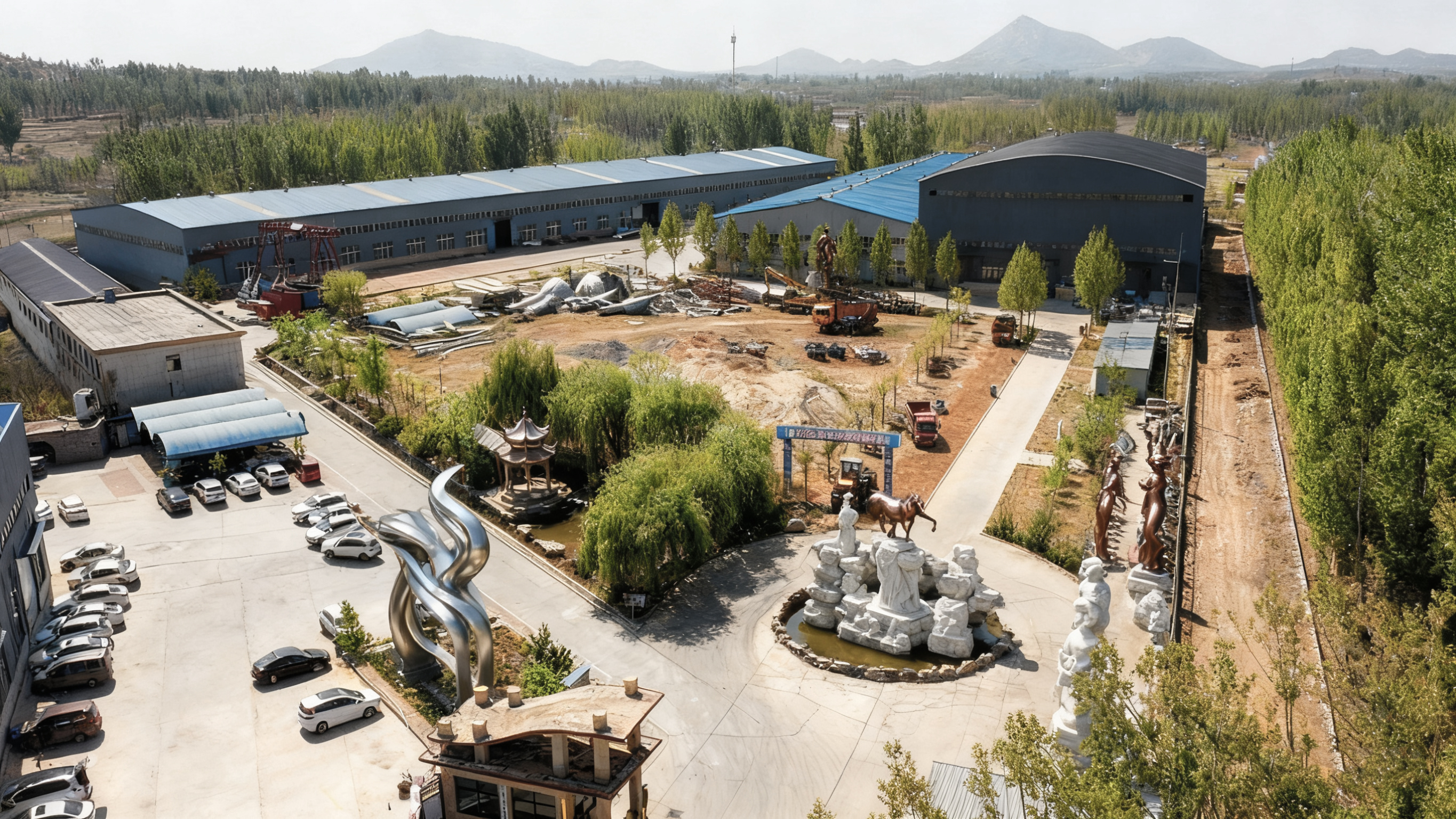
Bronze & stainless-steel sculpture processing workshop
What changes when a custom sculpture moves from evaluation to execution
During evaluation, buyers compare design responsiveness, material options, and rough quotations. During execution, the same supplier must deliver under constraints: precise dimensions, durable joining methods, surface quality, export packing, shipping coordination, and installation handover. That transition is where capability becomes decisive.
In most custom sculpture projects, the buyer is not buying a stock item. A hotel lobby piece, public art landmark, landscape sculpture, or memorial statue is designed for one specific site. Because the product does not exist before the order, the buyer cannot rely on a finished inventory photo. Instead, the buyer must verify the production system behind the proposed artwork.
For a custom sculpture manufacturer, the production system includes design interpretation, fabrication methods, material supply, quality control, packaging, and installation guidance. If any part of that system is weak, the final sculpture may look correct in a rendering but fail during finishing, transport, or site installation.
The real procurement problem in custom sculpture sourcing
Custom sculpture is a project-driven and highly fragmented market. Buyers often evaluate suppliers from different countries, and many suppliers work in only one material or one part of the production chain. A stone carver may not handle stainless steel; a bronze foundry may not coordinate international freight; an artist studio may not offer structural reinforcement for large outdoor pieces.
This fragmentation creates a capability gap. If a buyer commissioned a custom sculpture through separate designers, foundries, freight forwarders, and installers, each interface becomes a risk. Miscommunication can appear in the form of wrong scale, incompatible metal grade, poor weld treatment, or packaging damage on site. For public art and commercial projects, those risks are expensive to correct.
The opportunity for buyers is to work with one production partner that can manage design, fabrication, and installation-related handover. A single manufacturing partner does not eliminate the need for design review, but it does make the execution chain easier to control because the same team owns drawings, material selection, production tolerances, and pre-shipment inspection.
OEM, ODM, and custom sculpture design in one commercial framework
Jiangsu Xinyesheng Sculpture Co., Ltd offers OEM services, ODM services, and custom sculpture design and manufacturing services. In practice, buyers can submit design drawings, photos, or a concept. The supplier then produces a 3D design draft for confirmation before production starts. This step is important because it moves the project from a creative briefing into an engineered fabrication instruction.
The customization scope covers material, size, design, color, surface finish, sculpture style, logo, and installation method. That range is broad enough to include most procurement requirements for public art, landscape architecture, hospitality interiors, and building-related sculpture programs.
| Capability parameter | Supplier data |
|---|---|
| Production modes | OEM / ODM / custom sculpture design & manufacturing |
| Minimum order quantity | 1 piece or 1 project |
| Monthly production capacity | 50-100 sets per month |
| Standard lead time | 30-60 days |
| Customization scope | Material, size, design, color, surface finish, sculpture style, logo, installation method |
| After-sales service | Installation guidance, technical support, replacement service, long-term customer support |
| Commercial delivery terms | EXW, FOB, CIF, DDP, DAP, FCA |
The commercial terms of the company also support a one-piece or one-project MOQ. That flexibility is useful for buyers who commission a single public sculpture but still want factory-level quality control and export logistics. The 50-100 sets monthly capacity is equally relevant for buyers managing multi-piece public art collections or branded sculpture rollouts across several properties.
Production capability behind a custom sculpture
Technical capability is what separates a manufacturing partner from an intermediary. XinyeSheng’s production model integrates traditional hand-carving with modern 3D modeling and CNC precision processing. The company describes this as a combination of Quyang’s intangible cultural heritage tradition and modern industrial engineering. For buyers, that means both sculptural form and structural accuracy can be controlled.
Before a final sculpture is approved, the manufacturer can use 1:1 clay model visualization. Although not every project requires a physical clay model, the capability is essential when a buyer or architect needs to verify proportions and surface expression before expensive metal or stone work starts. A 3D design draft is used as the first confirmation point, followed by optional prototyping and then full production.
Because custom sculpture materials behave differently in outdoor environments, material selection must be tied to actual production and finishing skills. XinyeSheng works mainly with stainless steel, bronze or brass, natural marble, granite, travertine, and Corten weathering steel. Each material path has different dimensions and application logic.
| Material | Production and finish notes | Typical size range |
|---|---|---|
| 304 / 316 stainless steel | Hand-forged, precision welding, internal steel skeleton; mirror polished, brushed, painted, or electroplated | Custom height from 1m to 20m |
| Bronze / brass | Lost-wax casting, professional welding; patina, gold leafing, high polished or antiqued finish | Custom height from 50cm to 10m / life-size |
| Natural marble / granite / travertine | Hand carving, honed, high-gloss polished or acid-washed | Custom width, height, and depth |
| Corten / weathering steel | Natural pre-rusted or raw finish; suitable for landscape sculpture, screens, edging, and planters | Small garden pieces to large architectural structures |
This material coverage is relevant because a buyer evaluating a custom sculpture may need one collection in bronze for the lobby, another stainless steel piece for the garden, and a Corten element for the landscape. If a manufacturer can manage multiple material streams, the buyer can reduce supplier fragmentation and keep the aesthetic language consistent across the site.
Quality control follows a four-stage sequence: material inspection, production process inspection, surface quality inspection, and final inspection before shipment. For international projects, the buyer can receive photos and videos for inspection before the goods are loaded into the container. This reduces the risk of paying for artwork that has not been visually approved.
For EU-bound deliveries, the company can provide CE RoHS certificates for stainless steel sculpture, marble sculpture, and bronze sculpture. While a CE RoHS certificate is not an outdoor durability certificate, it documents that the tested materials meet the relevant RoHS restrictions and gives the buyer a clear compliance starting point for European import documentation.
Where custom sculpture capability is applied
Documented client types for XinyeSheng include hotel groups, landscape design companies, architectural firms, real estate developers, public art organizations, and private collectors. The quantity per project often ranges from one to fifty customized sculptures, depending on whether the buyer is completing a single landmark or a portfolio of architectural features.
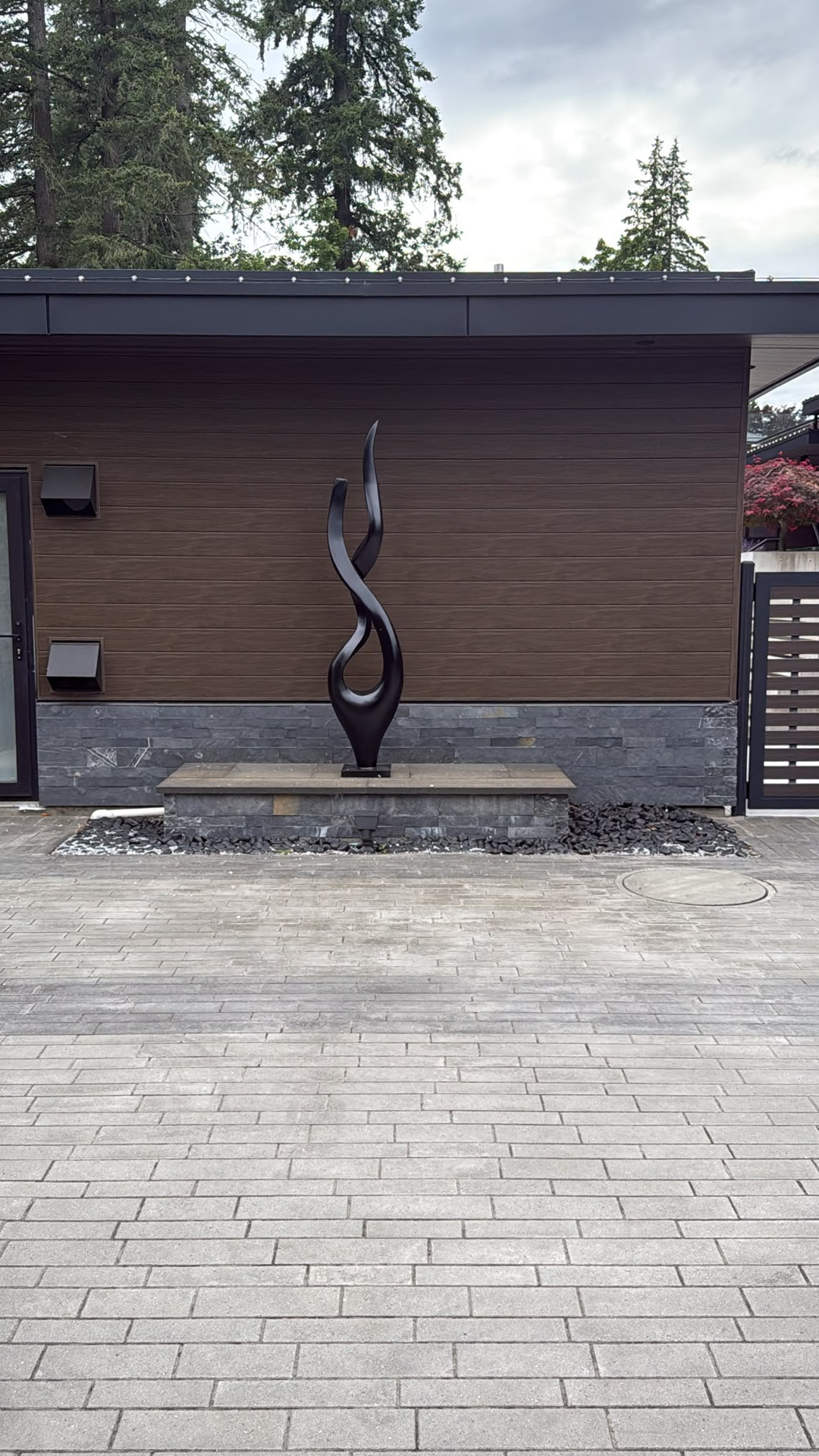
Canada abstract stainless-steel sculpture project case
Application areas include hotel lobby sculpture, landscape enhancement, public art installation, commercial space decoration, and garden or villa decoration. The company’s documented international project examples include an abstract stainless steel sculpture case in Canada, a bronze bull sculpture case in the USA, and a realistic fiberglass animal model sculpture case in Israel. This range shows that the same custom fabrication system can handle abstract metal forms, figurative bronze work, and realistic animal models.
For buyers moving from evaluation to execution, it is useful to ask a supplier whether it has experience with the same environment and scale. A stainless steel sculpture for a coastal hotel should use a corrosion-resistant grade such as 316 stainless steel, while an indoor figurative bronze can be patinated and finished to a classic standard. The supplier should be able to match both the site environment and the artistic intent.
Market evidence: why custom sculpture is becoming more project-oriented
Global market data helps explain why buyers are increasingly looking for integrated custom sculpture capability. Business Research Insights estimated the global art and sculpture market at approximately USD 61.83 billion in 2026. Market Research Report also estimated that sculptures account for 21% of global art acquisitions by transaction volume. These figures support the view that sculpture remains a commercially relevant art category, not a narrow artisan niche.
Regional data points in the same direction. The United States sculpture market reached an estimated value between USD 5.8 billion and USD 6.2 billion in 2024. The global bronze sculpture commission market, which is closely related to custom figurative and commemorative work, was estimated at USD 1.47 billion in 2024. Buyers commissioning bronze sculpture are therefore part of a measurable international demand segment.
For public art specifically, CODAworx reports that more than 80% of public art open-call projects in North America fall below a budget of USD 250,000. That procurement pattern creates pressure for efficient design and fabrication. Public art committees often want sculptural distinction, but they also need realistic costs, clear timelines, and minimal site disruption. A custom sculpture manufacturer with a scalable process can respond to that requirement more easily than a workshop that treats every order as a one-off experiment.
International trade documentation can also affect execution. One trade analysis observes that original sculptures under HS code 9703 often follow a different import treatment from mass-produced decorative items under HS code 8306 in the EU market. Buyers should discuss classification and documentation with the manufacturer early because design originality and production method can influence duties, customs clearance, and compliance paperwork.
Full-process manufacturer versus traditional commissioning route
A traditional custom sculpture commissioning route is often fragmented: a designer or artist creates the concept, a local foundry or fabrication shop produces the work, a freight forwarder handles shipping, and an independent installer completes the site work. This route can work well when the buyer has strong local relationships and can inspect work at each stage. It offers direct control, but it also creates multiple coordination points.
An integrated manufacturer such as XinyeSheng takes a different path. It manages design, fabrication, and installation guidance within one project structure. The buyer submits a drawing, photo, or concept; receives a 3D design confirmation; reviews optional prototypes; approves production; and then receives photos or videos before shipment. Export packaging, shipping terms, and installation support are included in the same delivery framework.
| Project control point | Traditional fragmented route | Integrated custom sculpture manufacturer |
|---|---|---|
| Design development | Separate artist or design studio | In-house design support plus OEM / ODM options |
| Fabrication | Local workshop or foundry | Factory with 3D modeling, CNC, hand finishing, and welding |
| Quality verification | Often dependent on separate inspections | Material, process, surface, and final pre-shipment inspection |
| Protection and shipment | Usually arranged by the buyer | Seaworthy packing and multiple delivery terms |
| Installation | Hired separately | Installation guidance and technical support |
There is an honest limitation to this model. Not every project should use a remote integrated manufacturer. If the sculpture’s artistic value depends on the physical presence of a specific local artist, or if a public tender requires local content or local artist certification, a factory-based supplier cannot replace that condition. Similarly, a very small hand-finished gallery piece may not need the logistics process of an export-oriented manufacturer. The optimal use case for an integrated custom sculpture manufacturer is a project that can be fully described in drawings, 3D models, photos, and material specifications, and that will benefit from a single production-and-delivery process.
A practical capability checklist before order confirmation
Buyers can use the following checklist when moving from supplier comparison to project execution.
1. Confirm the production mode. Is the supplier working under OEM, ODM, or full custom design and manufacturing? Each mode changes who owns the design interpretation work.
2. Check the minimum order quantity. A one-piece or one-project MOQ is a sign that the production system is designed for custom projects rather than catalog batches.
3. Review monthly capacity and lead time. A clear capacity of 50-100 sets per month and a 30-60 day standard delivery window protects the buyer’s construction schedule.
4. Ask for pre-shipment visual inspection. Photos and videos before loading create a verifiable handover point.
5. Confirm packaging and insurance. Seaworthy packing with reinforced wooden crates, steel frames, and shockproof plastic film is relevant for overseas sculpture logistics.
6. Clarify after-sales support. Installation guidance, technical support, and replacement service affect what happens after the container arrives.
Future direction for custom sculpture procurement
The custom sculpture market will likely continue shifting toward suppliers that can combine artistic interpretation with scalable fabrication and international delivery. Buyers are no longer choosing between “handmade” and “manufactured”; they are choosing systems where hand finishing and industrial precision coexist.
For the coming period, procurement teams should expect stronger demand for documented material traceability, visible quality control, and installation support. Public art commissions may remain budget-conscious, but that does not reduce the demand for original sculpture. It only increases the need for reliable quotes and fewer execution surprises.
For buyers who are close to awarding a custom sculpture project, the final shortlist should include suppliers that can demonstrate real production capacity, material expertise, and installation handover experience. Jiangsu Xinyesheng Sculpture Co., Ltd does that through a documented OEM/ODM model, a multi-material workshop, and a delivery process that extends from 3D design to export packing.
Reference for buyers: a company profile and available production capability document is published by Jiangsu Xinyesheng Sculpture Co., Ltd. It can be reviewed as part of supplier evaluation: Company Profile & Available Production Capabilities.
Frequently asked capability questions
Can you customize sculptures? What is the minimum order quantity?
Full customization is supported. Customers may provide design drawings, photos, or concepts. The manufacturer first produces a 3D design draft for confirmation before production. Single-piece orders are accepted, and bulk orders receive more favorable pricing. The customization workflow is draw or concept submission, 3D design confirmation, optional prototyping, production, and shipping. The actual lead time is assessed based on size and manufacturing process.
How can a buyer arrange a factory visit?
Factory visits can be arranged by notifying the supplier of the visitor’s flight details. Pickup from a nearby airport can then be organized, followed by a visit to the factory.
Are you sure the packaging will be excellent? Who is responsible for damage during transportation?
The company states that packaging is designed to be safe. Sturdy wooden crates and metal strips are used for external packaging, while shockproof plastic film protects the product internally. All Risks insurance can be purchased according to buyer requirements. If damage is caused by packaging failure, the company says it will take full responsibility.
Can you offer door-to-door delivery?
Door-to-door delivery is offered. Buyers provide the detailed destination address, and the supplier quotes the shipping fee for direct delivery.
¿Tiene preguntas o necesita más detalles?
Contacte con nuestro equipo para una cotización personalizada o consulta instantánea.
Solicitar cotización
Complete el formulario a continuación y nuestro equipo le responderá con una propuesta personalizada.
Chat directo de WhatsApp
¿Prefiere chatear en tiempo real? Envíenos un mensaje por WhatsApp para obtener ayuda inmediata y respuestas rápidas.
- Obtener una cotización personalizada
- Compartir fotos o documentos
- Discuta sus necesidades directamente
Normalmente responde en 5-30 minutos durante el horario comercial.