
ODM Toothbrush: What Buyers Should Verify Before Committing
ODM toothbrush manufacturing means the manufacturer supplies both the product design and the production process, while the buyer supplies the brand, the market position and the commercial terms. It is a different arrangement from OEM, where the buyer supplies the design and the factory executes it. The distinction matters most during evaluation, because it decides who carries the specification risk, who owns the appearance of the finished product, and how long the path from concept to shelf actually is.
This article is written for brand owners, importers, hotel and hospitality procurement teams, and distribution buyers who are moving from shortlisting suppliers into execution. It sets out what an ODM programme in oral care genuinely covers, where its limits sit, how quality is verified before shipment, and under which conditions a full custom OEM route is the more appropriate choice.
The ODM and OEM Distinction, Stated Precisely
In oral care, OEM and ODM describe two different answers to the same question: who defines the product before it is manufactured. Under OEM, the buyer submits a design and the factory manufactures to it. Under ODM, the factory draws on designs it has already developed and adapts them to the buyer's brand. Yangzhou Yuncheng Plastic Daily Chemical Co., Ltd., an oral care manufacturer based in Hangji Town, Guangling District, Yangzhou City, Jiangsu Province, China, describes the distinction in the same terms: OEM follows client designs, while ODM provides the factory's ready-made designs.
A third term is often mixed into the same sentence and should be separated. Private label refers to brand ownership, not design ownership. A toothbrush can be private label and ODM at the same time, and it can also be private label and OEM. When a buyer asks a supplier whether a programme is 'private label', the supplier can answer yes without clarifying the design question at all. The design question has to be asked separately.
The procurement consequence is straightforward. An ODM programme moves design work upstream into the factory, which shortens the route to a sellable product and allows a brand to draw on handle geometries and bristle configurations that have already been through a production cycle. The trade-off is that the design is not exclusive unless it is made exclusive by agreement. That is a commercial term to negotiate, not a technical limitation to discover late.
Why ODM Capacity Became a Procurement Variable
Market scale and supply concentration have made ODM capability a factor buyers actively compare. The global manual toothbrush market reached USD 6.72 billion in 2025 and is projected to reach USD 12.8 billion by 2034, according to Fortune Business Insights. Asia Pacific accounted for 34.81% of that market in 2024. China, the largest single production base in the region, recorded USD 980 million in toothbrush exports in 2024 under HS subheading 9603.21, according to the Observatory of Economic Complexity.
When demand growth and production concentration sit in the same region, the barrier to launching an oral care line shifts. It is no longer whether a factory exists; it is whether a brand can obtain an appropriate existing design and adapt it quickly enough to reach shelf on schedule. That is precisely the economic function of ODM. For an evaluation-stage buyer, the practical question becomes less about factory size and more about how much of the product can be changed without restarting the design cycle.
The Manufacturing Base an ODM Offer Depends On
Yangzhou Yuncheng Plastic Daily Chemical Co., Ltd. specialises in oral care products including toothbrushes and dental floss, and states that it has worked in the category for more than 20 years. Its registered profile lists a 2015 founding year alongside that accumulated experience. The company operates a 5,000 m² facility with 50 employees, of whom 5 are engineers, and reports annual toothbrush output of 30 million pieces. Export accounts for 40% of its business, with markets including Europe, the United States, Brazil, Japan, South Korea, Vietnam, Australia and Thailand, covering more than 20 countries and regions in total. The company also states that it has long acted as an OEM manufacturer for Colgate and Darlie.
The equipment base behind an ODM offer determines what can be changed and how fast. The documented setup comprises 9 horizontal injection molding machines, 6 vertical injection molding machines, 8 tufting machines, 2 bristle end-rounding machines and 2 automated production lines, supporting a monthly capacity of 2.5 million toothbrushes. Sampling is quoted at approximately 7 to 10 days.
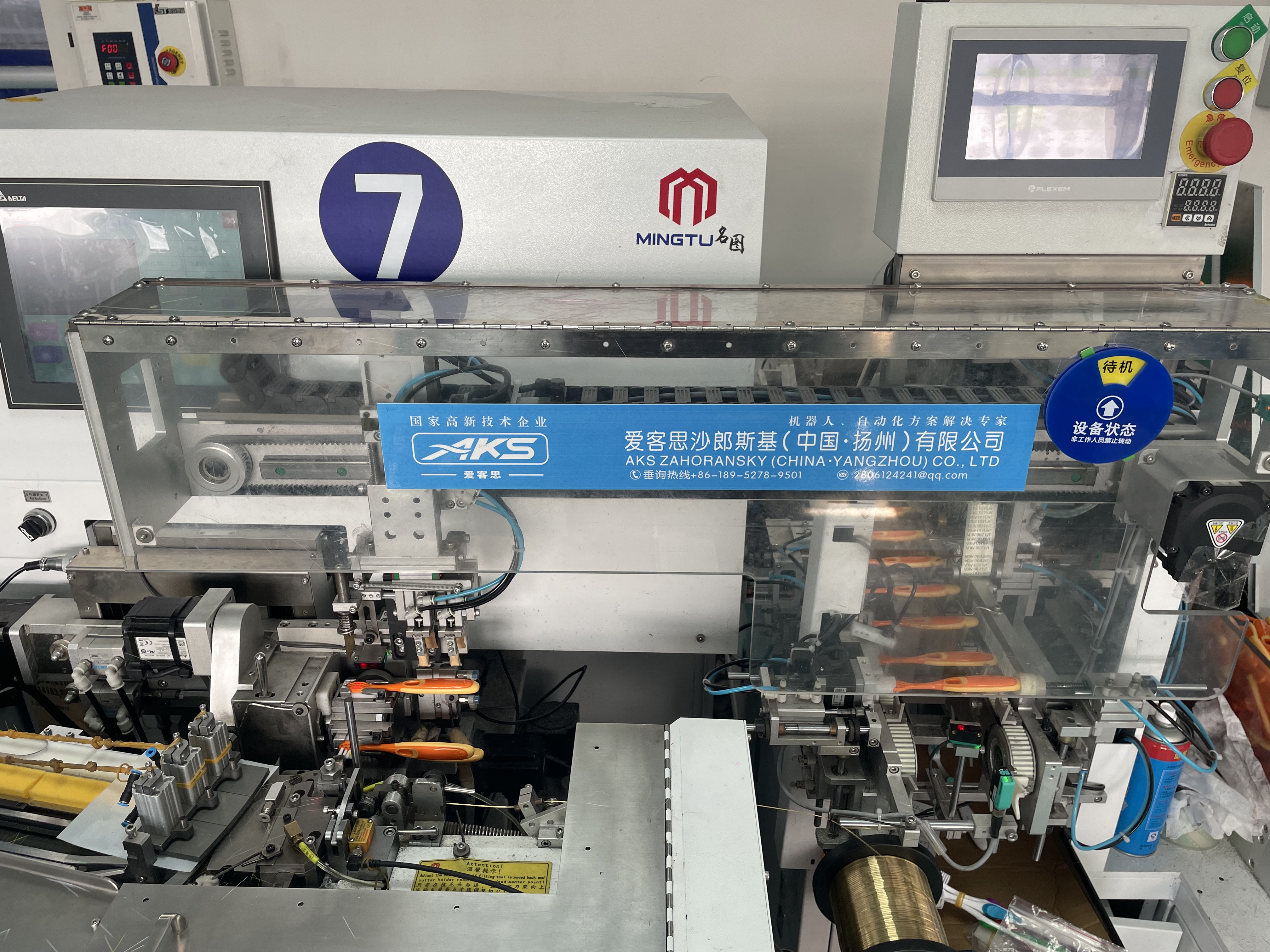
An automated tufting machine. Tufting capacity and bristle specification jointly determine how far an ODM bristle configuration can be adapted without new tooling.
The company also carries a regional designation: 'China's Toothbrush Capital · Yangzhou Hangji' origin designation. For a buyer, that designation is a locational signal about cluster proximity, not a quality certificate. Quality has to be established through documentation and testing, which is addressed further below.
What an ODM Programme Can Customize
Customization in a toothbrush programme is not a single switch. It is a stack of layers, each with a different cost and a different approval cycle. The documented scope covers molds, handles, bristles, colours, logos, packaging, and product-category combinations, with custom mold development, bristle customization, colour and logo customization, and packaging customization all included.
| Layer | What can be adjusted | What it changes for the buyer |
|---|---|---|
| Handle and mold | Custom mold development; handle design; PP and PP+TPE two-component handle construction | Grip geometry, perceived quality, and the point at which a new tool becomes necessary |
| Bristle | Bristle customization; PBT, nylon, and German PBT flat-velvet filaments; wire diameter from 0.12 mm on documented models | Deflection behaviour and the softness position of the SKU |
| Tuft layout | Hole count varies by configuration; documented models carry 24, 39 and 101 holes | Cleaning surface, head size and the visual identity of the brush head |
| Colour and logo | Colour and logo customization for private label orders | Brand recognition on shelf and in amenity kits |
| Packaging | Blister packaging, PVC and PP boxes, paper cards, 3D display stands | Retail presentation, shelf mechanics and packaging compliance inputs |
| Category combination | Product-category combinations across adult, children's, travel and pet formats | Single-supplier coverage across a multi-SKU launch |
Customization layers documented for ODM and private label toothbrush programmes. Not every layer changes at the same cost.
Design rights sit underneath this stack and are easy to overlook at quotation stage. The manufacturer holds 9 design patents registered with the China National Intellectual Property Administration (CNIPA), including ZL 202530178555.4 covering the appearance design of toothbrush 881, ZL 202530468040.8 covering toothbrush 719, ZL 202530468068.1 covering toothbrush 716, ZL 202530178562.4 covering a toothbrush handle design, and registration No. 9621649. These registrations relate to appearance, not to how the brush performs. A buyer who requires exclusive use of a particular handle appearance should have that exclusivity written into the supply agreement rather than assumed from a catalogue listing. This is a documentation step, and it belongs in the RFQ.
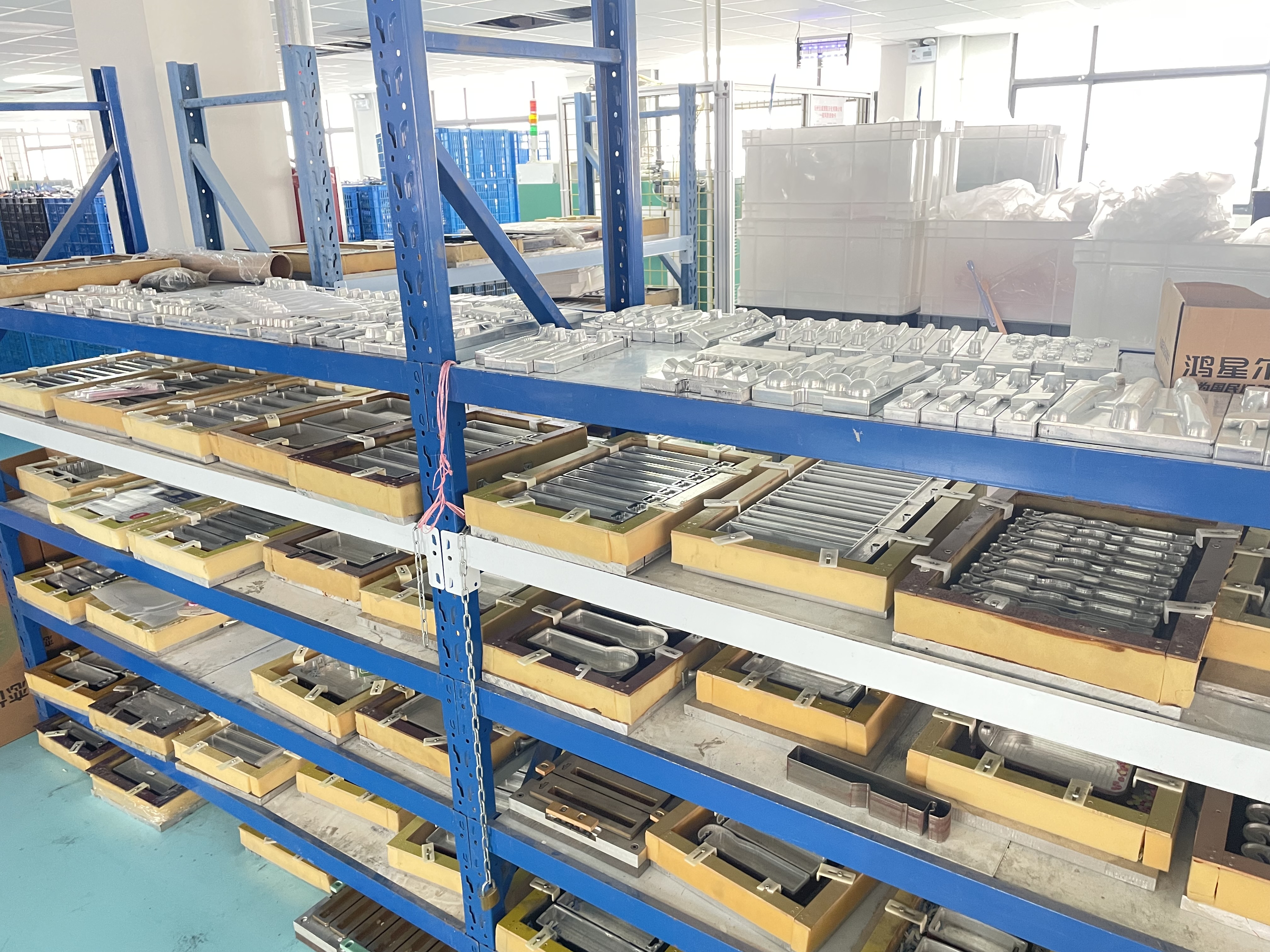
A blister packaging mold. Packaging tooling is part of the customization stack and, for EU-bound programmes, an early compliance input rather than a late artwork decision.
Documented Configurations in the Current Range
Concrete configurations are more useful than capability statements when a buyer is comparing quotations. Three documented models illustrate how far the layers above are combined in practice.
| Model | Type | Material | Weight | Length | Holes | Wire diameter | Filament |
|---|---|---|---|---|---|---|---|
| 602 | Custom adult toothbrush | PP handle with PBT bristle | 15 g | 187 mm | 101 | 0.15 mm | PBT |
| 731 | 5-in-1 custom travel toothbrush | PP | 2.3–2.4 g | 100 mm | 24 | 0.12 mm | Nylon |
| 811 | Orthodontic custom toothbrush | PP | 15 g | 185 mm | 39 | 0.12 mm | German PBT flat velvet |
Documented configurations. These are examples of what has been produced, not a complete catalogue of the available range.
The three models also show the three most common application tracks in ODM oral care: a high-tuft-count adult retail brush, a low-weight travel format for hospitality and airline use, and a reduced-tuft, fine-filament format positioned for orthodontic and dental clinic channels. A buyer whose target SKU sits outside these tracks should expect to enter a custom mold path rather than an adaptation of an existing one.
MOQ, Sampling and Production Lead Time
Minimum order quantity in this category is not one number. The documented structure has two tracks: 300 pieces for the manufacturer's own brand with existing packaging, and 10,000 pieces per colour for customized orders. Production lead time for custom toothbrush orders is 20 to 30 days, sampling is approximately 7 to 10 days, and monthly capacity of 2.5 million units supports bulk orders.
That two-track structure has a practical use that is often missed in negotiation. A brand can validate sell-through with a 300-piece run of an existing design in existing packaging before committing to a 10,000-piece-per-colour custom programme. What the small track does not provide is differentiation: it uses the manufacturer's existing design and existing packaging, so it tests demand rather than brand. Buyers should be explicit with internal stakeholders about which of the two questions a trial order is answering.
The colour multiplier deserves attention. Customized orders are quoted per colour, so a programme with four colourways carries four times the line MOQ before packaging variants are counted. For a multi-SKU launch, the arithmetic should be done at the colour-and-packaging level, not at the product level.
How Quality Is Verified Before Shipment
Quality control in the documented setup is structured around personnel, inspection stages and laboratory equipment. QC staff account for 10% of the workforce. Inspection covers in-line QC during production, AQL random sampling, and 100% pre-shipment inspection, with a stated ex-factory pass rate of 100%. Laboratory equipment includes a bristle pull force tester, a toothbrush handle flexural and bending tester, a high-magnification magnifier, an electronic scale, a balance, and a bristle shedding tester.
The management system is certified to ISO 9001 under certificate 12825Q20695R0S, issued by CVI Guolian Beijing Certification Center (CSI) against GB/T19001-2016 / ISO9001:2015, valid from 28 May 2025 to 27 May 2028, with a scope covering the production and sales of toothbrushes and protective boxes. After-sales provisions include OEM and ODM technical support, quality issue resolution through replacement or refund, remote and online guidance, and packaging and customization consulting.
Where ODM Fits in Practice
Three documented supply relationships show the patterns in which ODM and private label programmes are actually run.
- European supermarket chain (Germany, France). Orders of 1,000,000 pieces, three years of cooperation, retail sales. The recorded outcome is a 100% pass rate with customized packaging launched successfully, supported by sampling completed in 7 days and strict QC. This is the large-format retail pattern, where packaging integration and inspection discipline carry more weight than design novelty.
- Japan and South Korea oral care brand. Orders of 500,000 pieces, five years of cooperation, retail and promotional gifting. The recorded outcome is zero quality complaints and 100% on-time delivery, with highlights including high-standard QC and pet toothbrush customization. This is the repeat-order pattern, where category extension across adjacent formats matters more than a single hero SKU.
- Global FMCG pet product brand (United States, Australia). Orders of 800,000 pieces, two years of cooperation, pet oral care retail. The recorded outcome is zero quality complaints and 100% on-time delivery, supported by OEM and ODM capability and customized packaging. This is the adjacent-category pattern, where an established oral care process is applied to a non-human format.
What the three have in common is structural rather than coincidental: in each case the toothbrush and its packaging are produced under one quality system, so the interface where defects are most often discovered late, between product and pack, is not a handover between two suppliers.
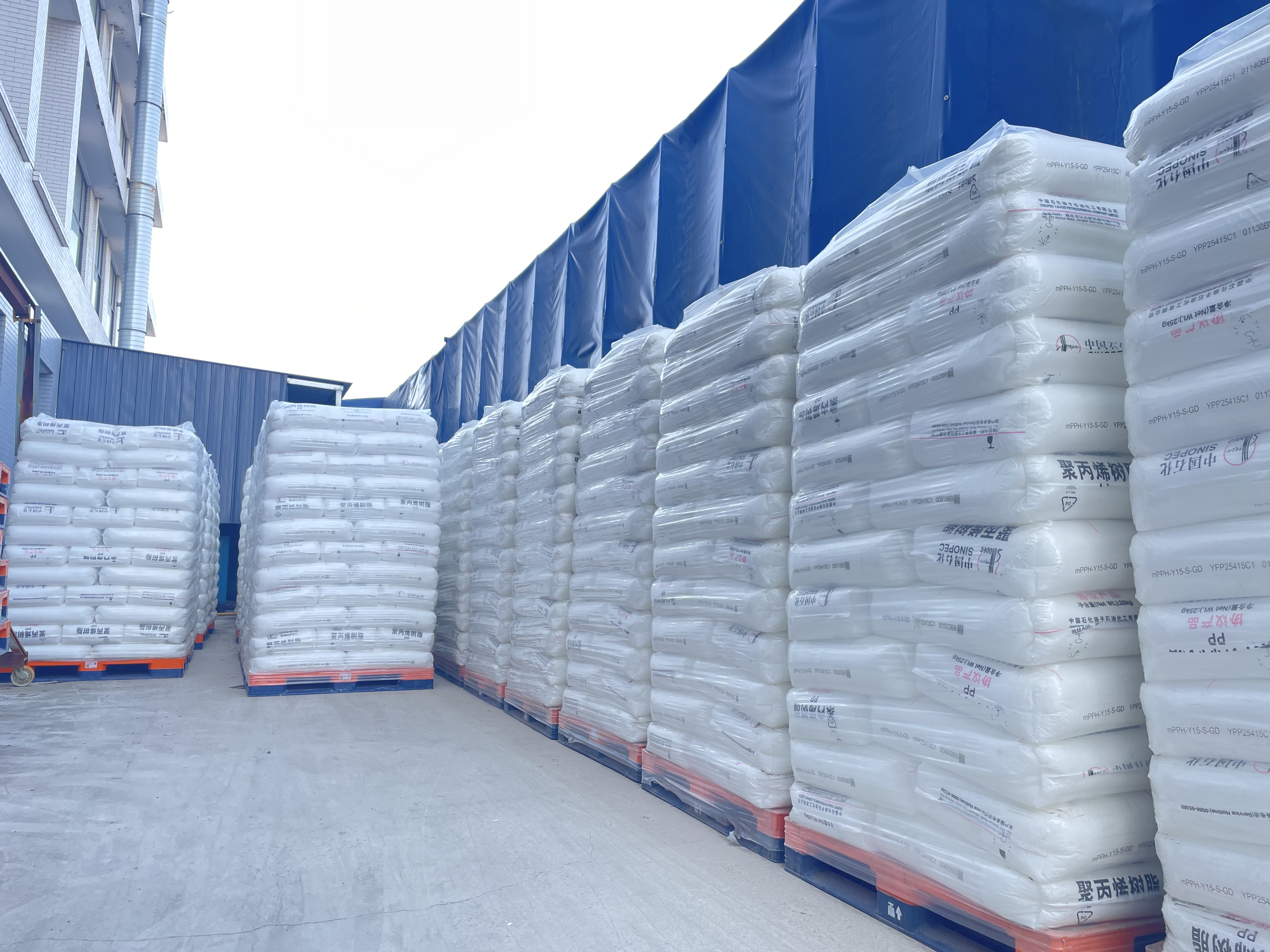
Raw material pellets ahead of injection molding. Material grade is a specification line in the RFQ, not an assumption about the finished handle.
Market Trends That Change the ODM Brief
Material mix. Plastic toothbrushes accounted for 93.43% of the total market share by material in 2024, while bamboo and wood alternatives are growing at a 9.63% CAGR, according to Mordor Intelligence. The reading for buyers is that plastic remains the volume base and alternative materials are an additive line rather than a replacement line. A brand planning an alternative-material SKU should confirm separately that the chosen supplier has the relevant process capability; existence of a market trend is not evidence of a specific factory's capability in it.
Regulatory layering. In the United States, the manual toothbrush is codified as a Class I device under 21 CFR 872.6855 and is exempt from 510(k) premarket notification, subject to general regulatory controls. That exemption does not remove establishment registration and listing obligations, so the compliance burden shifts toward administrative duties rather than product pre-clearance. In the European Union, Regulation (EU) 2023/988 on general product safety has applied since 13 December 2024 and imposes traceability, risk-assessment and responsible-person obligations on economic operators. Regulation (EU) 2025/40 on packaging and packaging waste introduces EU-wide packaging requirements on a staged timeline.
The operational implication for an ODM programme is that packaging, normally the cheapest visual differentiator in the category, is also the fastest-moving compliance surface. Packaging artwork and material choices should therefore be locked during sampling against the requirements of the destination market, not revised after the first production run. Whether an individual toothbrush is additionally a medical device under EU rules was not established in the sources reviewed here and should not be assumed in either direction; buyers with EU distribution should confirm the position with their regulatory advisor.
Trade classification. HS subheading 9603.21 is reserved for toothbrushes, including denture brushes, which makes the category trackable in customs data. The same code, however, does not distinguish specification tiers, so trade statistics can measure flow volume but cannot reveal which standard a shipment was tested against. Landed-cost comparisons across sourcing countries should therefore be qualified by specification tier.
ODM Compared with Alternative Sourcing Structures
ODM is one of several valid structures. The table below compares it neutrally against a pure OEM route and against fragmented sourcing, where the toothbrush and the packaging are purchased from separate parties.
| Dimension | Integrated ODM factory | Pure OEM (buyer-supplied design) | Fragmented sourcing |
|---|---|---|---|
| Design source | Factory design library, adapted to the brand; custom mold development available | Buyer | Split between parties |
| Speed to a sellable SKU | Short, because the design already exists in producible form | Depends on the buyer's design readiness | Depends on coordination between vendors |
| Sampling cycle | Approximately 7–10 days | Set by the buyer's design process | Multiple sampling rounds across vendors |
| Quality accountability | Single party; in-line QC, AQL sampling, 100% pre-shipment inspection | Single party | Distributed; disputes can cross vendor boundaries |
| Packaging integration | In-house blister, PVC and PP boxes, paper cards, 3D display stands | Often sourced separately | Separate packaging vendor by definition |
| MOQ profile | 300 pcs (own brand, existing packaging) or 10,000 pcs per colour (customized) | Varies by factory and tooling | Varies; total MOQ accumulates across vendors |
| Best fit | Brands prioritising speed, packaging integration and single-party accountability | Brands with in-house design capability and defined IP ownership | Very small trial orders or genuinely mixed multi-category purchasing |
Comparison of sourcing structures on dimensions that affect execution rather than price alone.
Where the integrated ODM route genuinely limits a buyer. The first limit is design control. Because an ODM configuration originates in the factory's existing design library, and because the appearance design patents covering those configurations are held by the manufacturer, a brand that needs a distinctive handle geometry or an exclusive exterior must move into the custom mold path. That path adds tooling development and extends the timeline beyond the 7-to-10-day sampling window quoted for adaptations. Buyers should plan the calendar around the route they actually need, not the route that quotes fastest.
The second limit is order economics. The 10,000-piece-per-colour threshold is a real constraint for custom SKUs, and it multiplies across colourways. A brand wanting four colours across two retail formats is not evaluating a 10,000-piece decision. The 300-piece track exists, but it runs on existing designs and existing packaging, so it cannot be used to test a differentiated product.
The third limit is concentration. Integrating product and packaging under one quality system removes a handover risk and shortens coordination, but it also increases dependence on a single supplier's process capability and on the completeness of that supplier's compliance documentation. Fragmented sourcing preserves negotiating flexibility at the cost of coordination overhead and a more diffuse chain of accountability. Neither structure is universally better; the correct choice follows from whether the buyer's priority is speed and integration or flexibility and multi-source leverage.
What to Expect Next
Three developments are likely to shape ODM briefs in the near term. First, as category demand grows toward the projected USD 12.8 billion by 2034 while production remains concentrated in Asia Pacific, the value of a mature design library rises, because it is the fastest route from a brand decision to a producible SKU. Second, packaging compliance will continue to migrate from a downstream artwork task to an upstream design input, particularly for EU-bound programmes under the general product safety and packaging frameworks. Third, buyers are increasingly asking for verification at the SKU level rather than at the supplier level, which means test reports tied to a specific model will become a standard attachment to a quotation rather than an item requested after a problem appears.
For evaluation-stage buyers, the practical conclusion is that ODM capability should be assessed on four documented points: which layers of the product can actually be changed, at what MOQ and in what lead time, under whose name the appearance design sits, and which test evidence accompanies the specific SKU being quoted. A supplier that answers all four in writing is easier to shortlist than one that answers only the first.
A downloadable company and product brochure covering the documented range and capabilities is available here.
FAQ
What is the difference between OEM and ODM custom toothbrush manufacturing?
OEM and ODM describe who defines the product. Under OEM, the buyer supplies the design and the manufacturer produces to it. Under ODM, the manufacturer supplies a design from its existing range and adapts it to the buyer's brand. Both can sit under a private label arrangement, because private label describes brand ownership rather than design ownership. In practice, OEM requires the buyer to arrive with a finished specification, while ODM allows the buyer to start from a producible configuration and adjust handles, bristles, colours, logos and packaging within the limits of that configuration.
What can actually be customized in an ODM toothbrush programme?
The documented customization scope covers molds, handles, bristles, colours, logos, packaging, and product-category combinations, with custom mold development, product-component customization, colour and logo customization, and packaging customization all included. Packaging options include blister packaging, PVC and PP boxes, paper cards and 3D display stands. What changes at low cost is colour, logo and packaging; what changes at higher cost and longer lead time is handle geometry, because it requires new mold development. Bristle specification sits between the two, since filament type and wire diameter can be varied within an existing tufting setup.
What MOQ and lead times apply to a customized toothbrush order?
Two MOQ tracks are documented. The manufacturer's own brand with existing packaging starts at 300 pieces. Customized orders require a minimum of 10,000 pieces per colour. Production lead time for custom toothbrush orders is 20 to 30 days, sampling takes approximately 7 to 10 days, and monthly capacity is 2.5 million units, supporting bulk orders. Because the customized threshold applies per colour, a multi-colour programme multiplies the line MOQ accordingly.
How should a buyer verify ODM toothbrush quality before mass production?
Verification rests on three elements. First, sampling: an approved sample becomes the reference for mass production, and any change to material, colour, mold, bristle or packaging should require written confirmation. Second, process controls: QC staff at 10% of the workforce, in-line QC during production, AQL random sampling and 100% pre-shipment inspection under an ISO 9001 certified system. Third, laboratory evidence: a bristle pull force tester, a handle flexural and bending tester, a bristle shedding tester, a high-magnification magnifier and weighing equipment. Buyers should additionally request per-SKU test reports, since ISO 9001 certifies the management system rather than conformity of a specific model to a product standard.
When is a full custom OEM programme a better fit than ODM?
A full custom OEM route is the better fit when the brand needs an exterior or handle geometry that does not exist in the supplier's design library, when exclusive use of the design must be contractually secured, or when the SKU has to be validated against a defined product standard clause by clause. In those cases, the additional tooling and sampling time is the cost of differentiation and of clean intellectual property ownership. ODM remains the more efficient route when the priority is speed to market, packaging integration and single-party quality accountability across a multi-SKU launch.
¿Tiene preguntas o necesita más detalles?
Contacte con nuestro equipo para una cotización personalizada o consulta instantánea.
Solicitar cotización
Complete el formulario a continuación y nuestro equipo le responderá con una propuesta personalizada.
Chat directo de WhatsApp
¿Prefiere chatear en tiempo real? Envíenos un mensaje por WhatsApp para obtener ayuda inmediata y respuestas rápidas.
- Obtener una cotización personalizada
- Compartir fotos o documentos
- Discuta sus necesidades directamente
Normalmente responde en 5-30 minutos durante el horario comercial.