
Nonwoven Mesh Belt Supplier Evaluation: Specs, Compliance, Process Support
Industrial Reference / Supplier Qualification
A nonwoven forming belt is a consumable that determines web uniformity, seam behaviour and unplanned downtime on a spunbond, spunlace or meltblown line. Qualifying a long-term supplier therefore turns on one question: can the maker issue documented, repeatable specifications and support them when the belt is running at 400 m/min or more — or is the offer only a catalogue with a model number?
Why the buying decision is not a catalogue decision
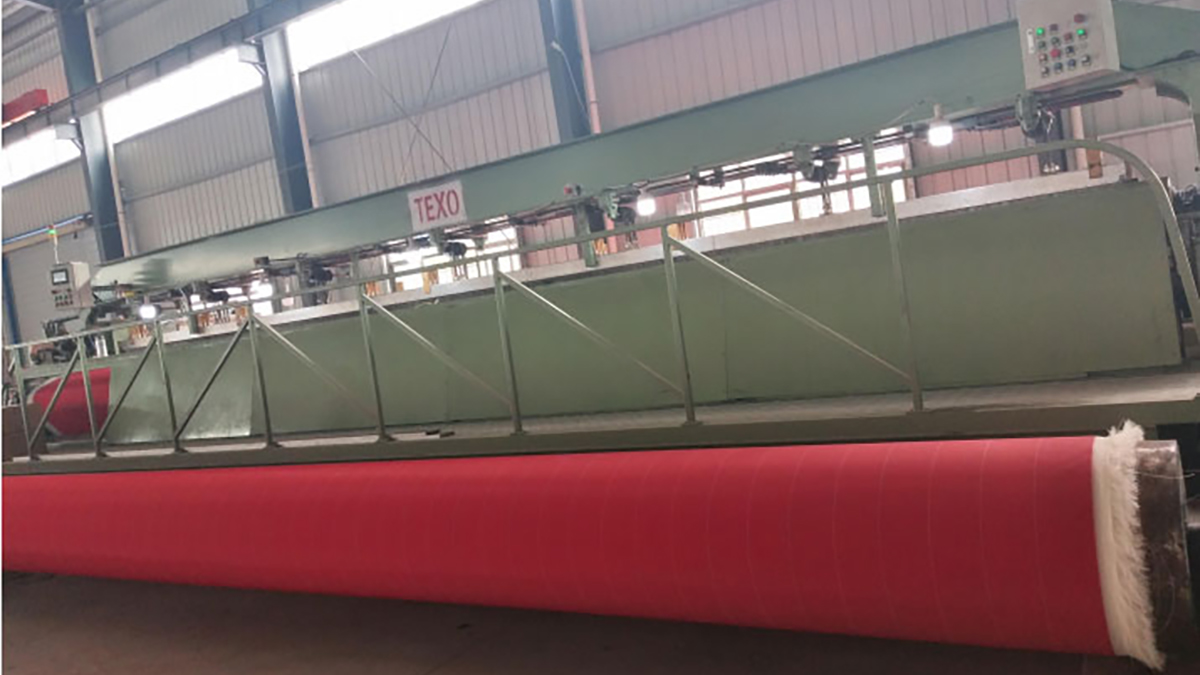
Nonwoven mesh belts — also described as forming fabrics, spin belts or forming mesh — sit directly under the fibre lay-down point. They act as the gas–solid separation medium in the air-laid process, so their local air permeability governs how suction pressure is distributed across the forming width. Where permeability is uneven, fibre deposition becomes uneven, and the result appears downstream as weight variation or "cloudy spots" rather than as a belt fault.
That physical role explains why a supplier shortlist built on model names and unit price rarely survives contact with production. Two belts that share a weave pattern and a nominal CFM value can behave differently if heat-setting control, yarn lot consistency or seam construction differ. The evaluation task is to establish whether the supplier can reproduce a specification, document it, and respond when the line raises a problem the catalogue never mentioned.
Market context supports the same conclusion. Spunlaid technology, which includes spunbond and meltblown, held 48.4% of the global nonwoven technology market in 2023 (Grand View Research, cited in industry data). The nonwoven production line market was valued at USD 5.3 billion in 2024 and is projected to reach USD 9.8 billion by 2033 (Dataintelo). As installed capacity grows, so does the cost of an unplanned forming-belt change.
The seven documentation blocks that separate a specification from a catalogue
A long-term supplier should be able to submit a documentation sheet covering the parameters below for each model family, in writing, before a trial order is discussed. The table states why each parameter is a production variable rather than a marketing field.
| Parameter | Why it decides production outcome | What to ask the supplier to document |
|---|---|---|
| Material construction | Polyester monofilament grade determines hydrolysis and abrasion behaviour under heat and humidity. | Polymer type, monofilament grade, and whether a hydrolysis-resistant monofilament is used. |
| Thickness | Belt thickness interacts with roller gap, suction box clearance and seam thickness differential. | Nominal thickness with a stated tolerance band. |
| Weight (g/m²) | Indicates yarn density and is an indirect indicator of dimensional stability at temperature. | g/m² per model, plus the weaving density description. |
| CFM and CFM tolerance | Air permeability controls suction distribution; a wide tolerance band shows up as cross-direction weight variation. | Nominal CFM plus the guaranteed deviation band across the full roll. |
| Weave structure | Plain weave, flat-yarn weave and encrypted high-density weave differ in support-point geometry and fibre release. | Weave type, and its stated effect on surface contact area. |
| Layer count and joint / glue options | Determines seam type — spiral, High-Low Loop or glued joint — and therefore vibration behaviour at speed. | Layer count, seam construction offered, and thickness match between seam and belt body. |
| Anti-static / hydrolysis construction | Static dissipation prevents web lift-off; hydrolysis resistance governs life in humid forming rooms. | Conductive yarn type and placement, and the hydrolysis claim with supporting test position. |
Henan Yiheng Mesh Belt Industry Co., Ltd. (Yiheng Mesh), a polyester mesh belt manufacturer founded in 2009 and operating a 4,237 m² facility in Henan, China, states that air permeability (CFM) fluctuation is controlled within ±5% through heat-setting on ultra-wide looms. That is the kind of bounded, checkable claim the evaluation process should be built around: a ±5% band can be verified against an incoming inspection report, whereas a stated CFM number alone cannot.
Model families and what each configuration is documented to address
Model names matter less than what each family changes physically. The comparison below is organised by documented configuration role, with the outstanding items a buyer should confirm before treating two families as interchangeable.
| Model family | Documented configuration role | Confirm before qualification |
|---|---|---|
| HB4106 | General nonwoven forming belt configuration within the 4106 family. | Thickness, g/m² and CFM band; seam option offered. |
| HY4106 (encrypted) | High-density encrypted weave aimed at fine-denier webs where fibre penetration and hanging cause streaks. | Weft count, CFM lower limit, and the fibre-release evidence. |
| K4106A | Anti-static configuration; carbon-fibre conductive yarns are used to dissipate frictional charge on high-speed lines. | Conductive yarn ratio and placement, surface resistivity target. |
| K4106B | Same 4106 family, positioned for surface-critical grades where visible mesh marks matter. | Whether weave and surface treatment differ from K4106A, and the mesh-mark evidence. |
| HY408S | Configuration evaluated for high-speed and humid forming conditions. | Hydrolysis construction details and the CFM band at operating temperature. |
| SK604 | High-speed series supplied with a High-Low Loop seam and encrypted carbon fibre. | Seam-to-body thickness match, and the speed range it is documented for. |
| K6012 | Nonwoven mesh belt family listed alongside the 4106 and 604 series. | Weave structure, layer count and joint options in writing. |
| KJD700 | Flat-yarn anti-static series; the flat surface provides more than twice the contact area of round yarn, distributing pressure more evenly. | Contact-area data and the dark-fabric trial result. |
| 09502 / 06702 | Model references supplied for buyer evaluation; request the same documentation set as the families above. | Full parameter sheet, seam option and compliance documents. |
| 41203 (spunlace) | Spunlace belt reference, where hydroentanglement conditions rather than hot-air conditions dominate belt loading. | Water-jet resistance, dimensional stability and seam specification. |
Endless versus seamed construction: the quantified difference
For spunbond and spunlace lines, the comparison most often raised in supplier evaluation is endless construction against conventional seamed forming mesh. The published figures place the difference at the weakest point of the belt rather than at its average: tensile strength at the weakest point is 78–144% higher with endless construction, with seam strength of 900 N/cm on conventional seamed mesh compared with 1,600–2,200 N/cm on the endless belt surface.
The same comparison set reports higher permeability uniformity, longer service life and 40–50% lower maintenance requirements. Customisable air permeability across a 186–1,200 CFM range is cited, with higher uniformity than seamed construction. On cost, the reported position is a 15% higher initial outlay offset by 25–35% lower total cost of ownership and 15–20% lower energy consumption.
Buyers should read those numbers as a comparison framework to be validated on their own line, not as a guaranteed outcome. The direction of the trade-off is the useful part: endless construction moves the failure point away from the seam, and the price of that move is paid upfront.
Six production risks a long-term partner should be able to answer
Specification sheets do not reveal process support capability. The following risks are the ones that determine whether a supplier relationship survives its first year, and each has a documented response path.
1. Fabric flip above 400 m/min
Web lift-off before the pre-pressing roller is usually caused by static accumulation in dry conditions, cooling air volume exceeding suction, or a pre-pressing roller running too cool. The documented response sequence is to verify the grounding rod is driven to a depth of about 1 m, increase auxiliary suction while slightly reducing cooling air, hold hot-roller surface temperature at 100–120°C, and install wind-breaking shields around the forming area. A supplier who answers "the belt is anti-static" without asking about grounding depth has not answered the question.
2. Mesh marks on dark or premium nonwovens
Visible grid impressions on dark grades come from support-point geometry. Upgrading to flat-yarn weaving is the documented path, because the flat surface provides more than twice the contact area of round yarn, spreading pressure more evenly and removing the visual grid. Evaluation criteria here are measurable: flatness improvement, pressure distribution uniformity, and the visible reduction in mesh-mark depth.
3. Tracking adjustment downtime after a belt change
The documented method is a reference-marking procedure: while the original belt is running stably, paint a baseline on the exposed section of the tension rod; install the new belt and adjust directly to that baseline; then run empty for five minutes and make minor corrections. The stated safety condition matters more than the shortcut — if the new belt length differs, the old baseline must not be used. Without an automatic corrector, tension is balanced by equalising bolt exposure on both sides, running empty for 10–20 minutes, and tightening the bolt on the side the belt tracks toward, with a permanent mark added once stable. Over-tightening one side is explicitly warned against, because it creates shear force at the seam.
4. Seam threading difficulty
Threading problems are usually a wire-tip problem. The documented technique is to align both belt ends so loops interlock correctly, grind the steel wire tip into a smooth cone with sandpaper or a file, insert at steady speed with lubricant if required, then bend and hide the excess wire ends back into the mesh body. All wire ends must be fully hidden to prevent snagging in operation.
5. Fibre hanging and streaks on fine denier
For soft hygiene fabric below 1.2 denier, the documented recommendation is a combination of high-density weaving and low CFM control, specifically the HY4106 encrypted series or SK604 encrypted, where increased weft count narrows mesh gaps and physically blocks fine-fibre penetration. The short-term fix is different: reduce lower suction gradually, then lightly sand the affected area with 800-mesh sandpaper and wipe with alcohol.
6. Equipment brand compatibility
Compatibility with Chaolong or Hongda equipment is a documented capability rather than an assumption. Yiheng Mesh states that it has supplied Reicofil, Chaolong, Hongda and other major manufacturers, with tuning data matched to specific tension requirements, and describes a technical knowledge base covering 122+ real-world troubleshooting cases across tracking, fibre hanging, static and seam marks.
EU and German compliance: what a supplier must be able to show
Compliance questions arrive late in the buying process and can stall an otherwise settled decision. For belts used in hygiene, food-contact-adjacent and packaging nonwovens, the relevant documentation is usually three-layered.
- Material safety: a Food Contact Certificate covering the belt construction, so that the fabric produced on it can be assessed for food packaging and hygiene applications.
- Extended producer responsibility: registration under the German Packaging Law (LUCID), which is the practical evidence point for German-market deliveries.
- Customs classification: industrial nonwoven mesh belts are commonly classified under HS Code 39269029 or 59100000, depending on material coating and reinforcement, which affects import documentation.
Yiheng Mesh holds a Food Contact Certificate, is registered under the German Packaging Law (LUCID) and states compliance with EU environmental regulations. For a long-term agreement, the evaluation step is to confirm that the certificates are current, that they name the specific construction being ordered, and that the supplier can re-issue them on request rather than only at the first order.
Commercial terms that reveal long-term capability
Order flexibility is a proxy for manufacturing control. A supplier able to accept a 1 m² minimum order quantity and deliver custom prototypes in as little as three days is usually working from stocked yarn and an in-house heat-setting process rather than from outsourced weaving. Yiheng Mesh reports a monthly capacity of 12,800 m² against an annual output of 150,000 m², a workforce of 41 including 3 R&D engineers, and an export ratio of 62% across Asia, Europe and North America. For a buyer planning a multi-year supply agreement, the ratio between monthly capacity and annual output is worth checking against your own annual consumption — it indicates whether your volume is a rounding error or a meaningful share of the supplier's loading.
Where this evaluation approach stops
A documentation-led evaluation has real boundaries that buyers should state internally before the shortlist is closed.
- Paper specifications do not predict on-line behaviour. A ±5% CFM band and a stated thickness tolerance reduce risk; they do not remove the need for a trial on your own forming section, at your own line speed and fibre denier.
- Evaluation cycles are long by nature. Yiheng Mesh states that under standard operating conditions its belts typically last 3–6 months. Full-life evidence therefore takes months to accumulate, and a first order is a sample, not a verdict.
- Endless construction carries a premium. The reported 15% higher initial cost is real, and the 25–35% lower total cost of ownership only materialises if the belt actually reaches its expected service interval on your line.
- Supplier support cannot correct machine-side causes. Web flip, fibre hanging and tracking drift all have machine-side contributors — suction balance, cooling air volume, roller temperature, grounding depth, tension symmetry. A belt change alone will not fix a mis-set suction profile.
- Specialised weaves are not universal. Flat-yarn weaving improves surface appearance on dark grades, but the trade-off in openness and airflow behaviour means it should be qualified per fabric, not adopted line-wide.
A decision checklist for qualifying a forming-belt partner
The following sequence converts the discussion above into an auditable shortlist process. It is deliberately ordered so that documentation is settled before commercial terms.
- Request a parameter sheet per model family: material, thickness, g/m², CFM with tolerance band, weave, layer count, seam and joint options, anti-static and hydrolysis construction.
- Ask for the seam specification separately, including thickness match between seam and belt body and the maximum line speed the seam is documented for.
- Verify compliance documents name the exact construction being ordered: Food Contact Certificate and LUCID registration where EU or German delivery is planned.
- Test process support with a real risk question drawn from your own line — fabric flip above 400 m/min, mesh marks on dark grades, tracking downtime, seam threading — and judge the answer on whether it includes machine-side checks.
- Confirm equipment compatibility for your forming line brand, including tension data rather than a general statement of suitability.
- Check capacity against your consumption, minimum order quantity and sampling lead time.
- Run a trial belt and record the same parameters you asked the supplier to document, so that the next order can be compared against a baseline rather than a memory.
Future outlook
Two trends will keep tightening forming-belt specifications. The first is line speed: high-performance nonwoven forming belts are documented to operate at line speeds up to 1,000 m/min and to withstand temperatures up to 180°C, while current Yiheng Mesh forming fabrics are stated as compatible with machine speeds from 20 m/min to 850 m/min. As the upper end of that range becomes routine, seam thickness differential — historically the source of periodic impact forces at speed — becomes a specification item rather than a detail.
The second is market volume. The global nonwoven fabric market is expected to reach USD 90.8 billion by 2030, representing a CAGR of 6.2% from 2025 (Smithers). Volume growth in hygiene and wipes grades favours suppliers who can hold a narrow CFM band across repeat orders, because web uniformity targets tighten as line utilisation rises. Suppliers who compete on catalogue breadth will find that position harder to defend than one built on documented tolerances and troubleshooting depth.
Frequently asked questions
Do your mesh belts support Chaolong or Hongda equipment?
Yiheng Mesh states that its belts are compatible with Chaolong and Hongda forming lines, and that it has supplied Reicofil, Chaolong, Hongda and other major manufacturers with tuning data matched to specific tension requirements. Compatibility should still be confirmed against your specific line model, belt dimensions and tension settings before ordering.
How is air permeability (CFM) specified, and why does the tolerance band matter more than the value?
CFM is the volume of air passing through one square foot of mesh per minute at a given pressure differential. It governs fibre adhesion and web uniformity, which makes it the primary selection parameter. A nominal value alone is insufficient because local variation in permeability changes suction distribution across the forming width, producing weight variation. Yiheng Mesh states that CFM fluctuation is controlled within ±5% through heat-setting, which is the tolerance figure a buyer can verify on incoming inspection.
What is the expected service life of a nonwoven forming belt?
Under standard operating conditions, Yiheng Mesh states that its mesh belts typically last 3–6 months. Service life is affected by cleaning regime, tracking adjustment and process parameters; regular cleaning and tracking checks are recommended to extend it, and process parameters should be reviewed if fibre hanging occurs.
Do your products comply with EU or German environmental regulations?
Yiheng Mesh holds a Food Contact Certificate and has completed LUCID registration under the German Packaging Law, and states compliance with EU environmental regulations. For procurement, the practical check is whether the certificates name the specific belt construction being ordered and can be re-issued on request.
What causes fabric to flip at speeds above 400 m/min, and what does the supplier's answer tell you?
Flipping at the release point before the pre-pressing roller is typically caused by static build-up in dry conditions, cooling air volume exceeding suction, or a pre-pressing roller running too cool. The documented remedy involves verifying grounding depth, increasing auxiliary suction while reducing cooling air, holding hot-roller surface temperature at 100–120°C, and fitting wind-breaking shields. A supplier response that addresses only the belt and not these machine-side variables indicates limited process support depth.
How should a buyer compare endless construction against conventional seamed forming mesh?
Compare at the weakest point rather than the average. Reported figures show tensile strength at the weakest point 78–144% higher with endless construction, with seam strength of 900 N/cm on conventional seamed mesh against 1,600–2,200 N/cm on the endless belt surface, alongside higher permeability uniformity, longer service life and 40–50% lower maintenance. The commercial trade-off is a reported 15% higher initial cost against 25–35% lower total cost of ownership.
Technical documentation, including the company profile and product brochure, is available for download: Yiheng Mesh company brochure (PDF).
¿Tiene preguntas o necesita más detalles?
Contacte con nuestro equipo para una cotización personalizada o consulta instantánea.
Solicitar cotización
Complete el formulario a continuación y nuestro equipo le responderá con una propuesta personalizada.
Chat directo de WhatsApp
¿Prefiere chatear en tiempo real? Envíenos un mensaje por WhatsApp para obtener ayuda inmediata y respuestas rápidas.
- Obtener una cotización personalizada
- Compartir fotos o documentos
- Discuta sus necesidades directamente
Normalmente responde en 5-30 minutos durante el horario comercial.