
Nonwoven Mesh Belt FAQ: Compatibility, EU Compliance, DCD
A nonwoven mesh belt is the endless forming surface that receives freshly extruded filaments, carries the web through cooling, suction or dewatering, and releases it without marking. Because the belt sits exactly where airflow, heat and tension meet, the questions that arrive before a purchase order are rarely about weave pattern alone.
Three questions dominate procurement inboxes: whether a belt will run on a Chaolong or Hongda line, what documentation supports a German or EU shipment, and what DCD actually means in a meltblown process. A fourth usually follows a release problem — how anti-static mesh differs from a thin-belt construction. This reference answers those four questions against published model data from Henan Yiheng Mesh Belt Industry Co., Ltd. (Yiheng Mesh), a polyester mesh belt manufacturer founded in 2009 in Henan, China, operating a 4,237 m² facility and exporting 62% of output to Asia, Europe and North America.
Why These Questions Arrive Together
Forming belts used to be bought as a wear part: measure the old belt, order the same again. That approach weakens as line speeds rise and fabric weights fall. A belt that is dimensionally correct but has the wrong permeability will still produce cloudy spots; a belt with correct permeability but a seam that stands proud of the body will still generate transverse marks at speed. The belt has become a process variable, and buyers now evaluate it the way they evaluate a setpoint.
The consequence is a question set that spans four disciplines at once — mechanical fit, trade documentation, aerodynamic definition and static control. Answering them in one place is more useful than answering each in isolation, because the answers interact: the joint type that suits a high-speed line also constrains which thin-belt designs are practical, and the permeability value that stabilises a meltblown web also determines how quickly an additive-loaded process clogs.
Question 1: Will the Belt Fit a Chaolong or Hongda Line?
Fit is determined by four measurements and one process profile, not by the machine nameplate. Yiheng lists Chaolong, Hongda and Aolong among the nonwoven equipment manufacturers its forming belts are supplied against, and Reicofil RF4 lines appear in a documented customer programme; but the same supplier will still ask for working width, wrap length, line speed, suction settings and the product being formed before recommending a model.
The practical checklist a buyer should prepare is short:
- Machine make, model and working width, plus the wrap length around the forming section.
- Design line speed and the actual production speed band, not only the maximum.
- Fabric weight in g/m² and filament denier, since fine denier drives the permeability decision.
- Current belt specification, including thickness and measured air permeability, so a starting point exists.
- Seam preference and whether the line runs an automatic corrector.
Customisation is where line fit is actually resolved. Yiheng provides OEM and ODM production with customisable mesh count and opening size, air permeability (CFM), belt width and length, material (PET, PA or anti-static), thickness, colour and edge treatment. Minimum order quantity is 2 m², standard lead time is 15–30 days, and sampling can deliver a custom prototype in as little as three days — relevant when a line is down or a new product is being qualified.
Dimensional tolerances matter more than buyers expect on wide lines: length tolerances are ±5 cm for belts under 50 m, and width tolerances ±1 cm for belts under 5 m. Those figures define how much tracking correction the machine must absorb, which is why the same belt type can behave differently on two nominally identical lines.
Question 2: What Documentation Supports an EU or German Shipment?
Three documents are commonly requested, and each covers a different scope. Reading them as a single “EU certificate” is the most frequent misunderstanding in cross-border belt procurement.
| Document | Issuer and reference | Scope |
|---|---|---|
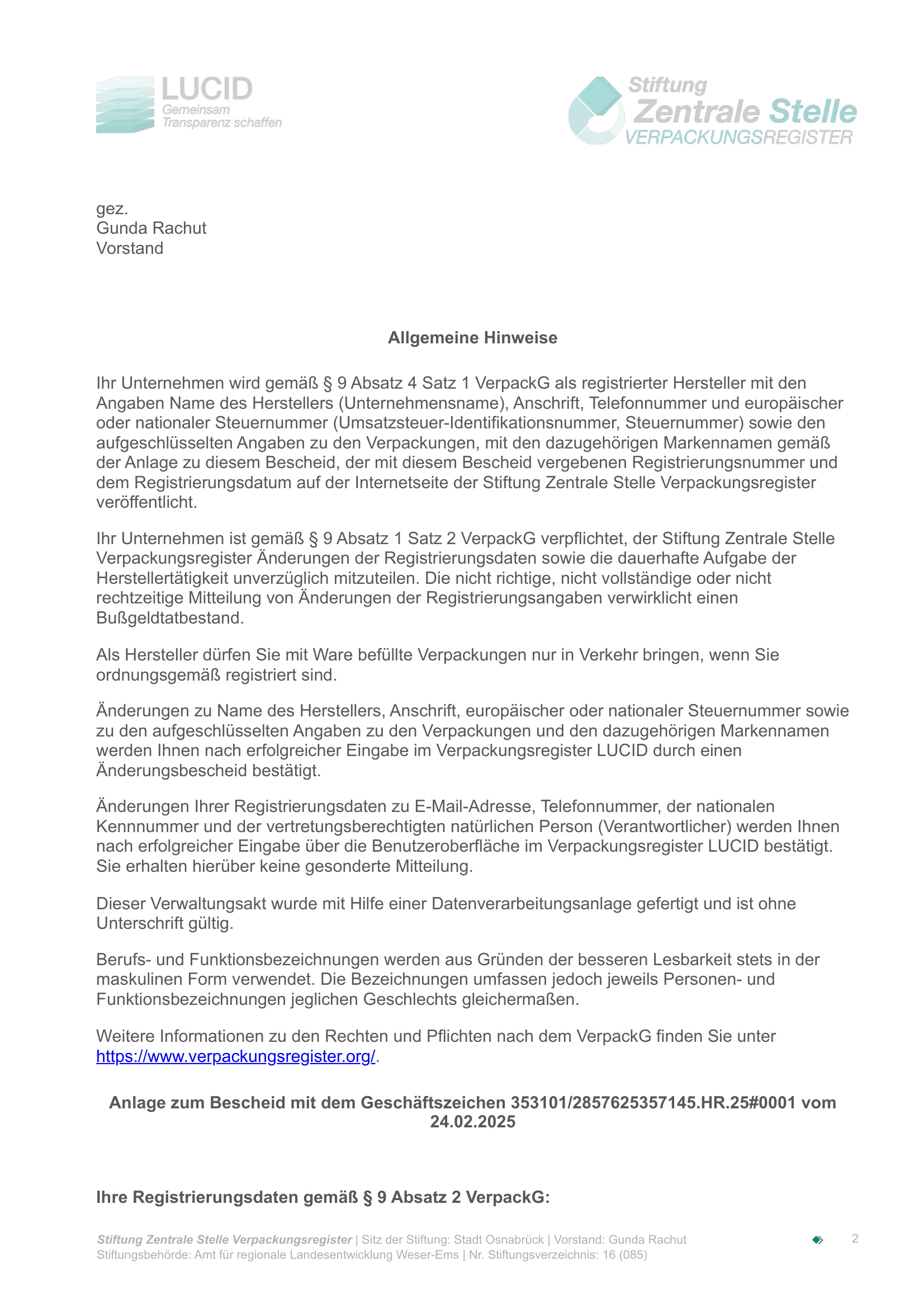
| German Packaging Act (LUCID) registration | Stiftung Zentrale Stelle Verpackungsregister, registration DE2857625357145, dated 24 February 2025 | Retail, grouped, shipment and service packaging under the yiheng brand placed on the German market |
| Food contact test report | JIANGSU HAP TESTING SERVICE CO., LTD, report HAPTX23061098, issued 29 June 2023 | Polyester mesh belt (food grade) tested under GB 4806.7-2016 |
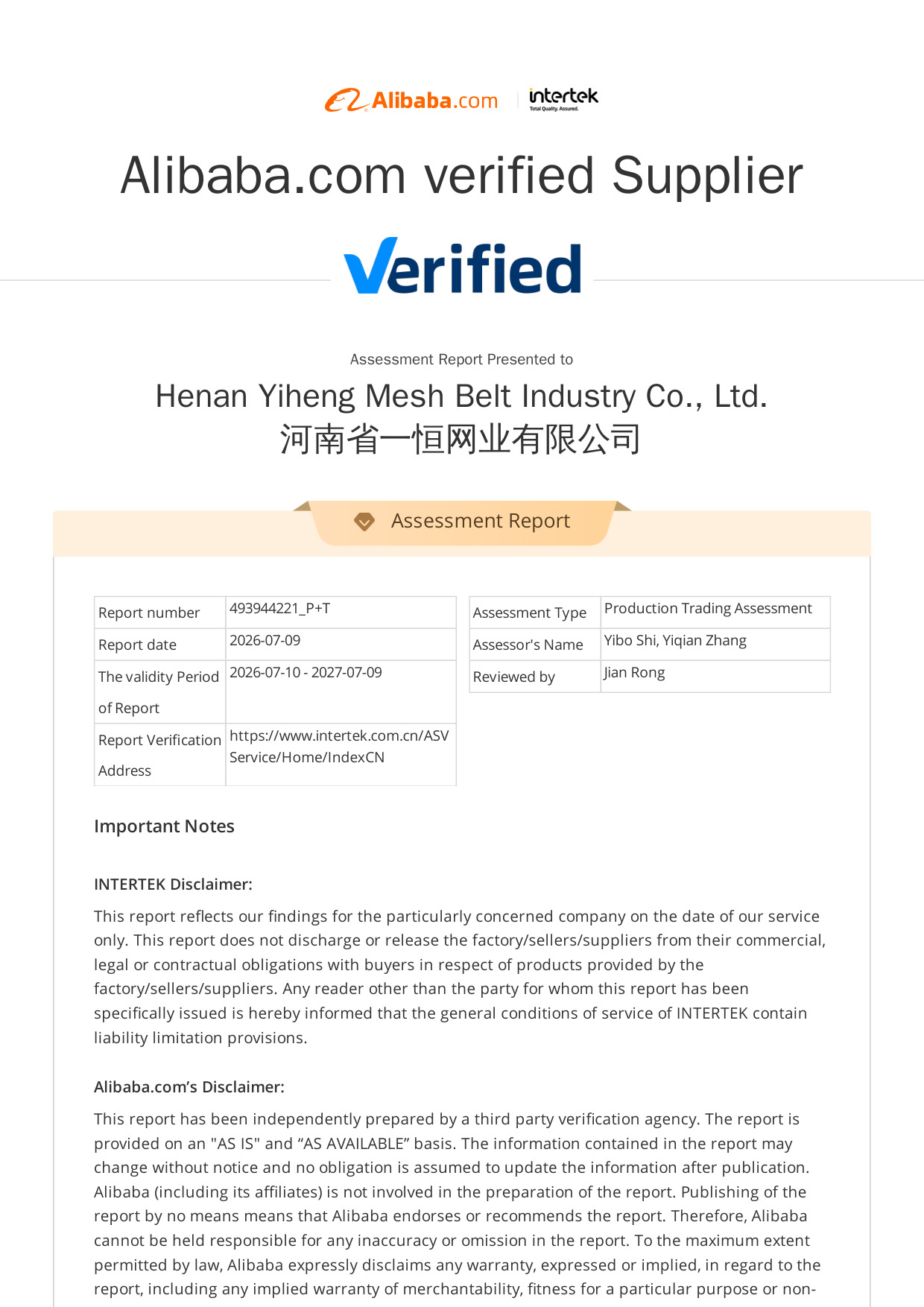
| Verified Supplier Assessment Report | INTERTEK, reference 493944221_P+T, issued 9 July 2026, valid to 9 July 2027 | Fabrics, dryer fabrics, polyester filter belt, non-woven mesh belt and UV belts |
The German registration is a packaging obligation, not a material declaration: it confirms that packaging placed on the German market is registered in the official register and that system participation obligations are addressed. A buyer sourcing belts for a German plant should still request material-level declarations separately if their own compliance system requires them. The food contact report is a test on a specified polyester mesh belt sample under a Chinese national standard; it is evidence for that scope and that standard, and it does not automatically extend to every weave, coating or anti-static variant in a catalogue.
Yiheng also holds National High-tech Enterprise recognition and publishes a Food Contact Certificate as a product-level document. What none of these documents establishes is a blanket CE marking, a REACH or RoHS declaration, or an EU-wide product certification. Buyers who need those should ask for them explicitly and expect a project-specific answer.
Question 3: What Does DCD Mean in the Meltblown Process?
DCD is the die-to-collector distance — the vertical distance between the meltblown die nozzle and the receiving surface of the forming belt. It is a process variable rather than a belt specification, but it is the point where the belt enters the conversation, because the receiving surface and the airflow through it define how the fibres land.
The trade-off is well defined. A larger DCD gives the filaments a longer cooling path, producing a softer fabric with lower filtration efficiency. A smaller DCD bonds the fibres while they are still hot, producing tighter bonding and higher filtration efficiency, at the cost of higher resistance. Adjusting DCD is therefore how a line balances “filtration efficiency” against “softness”, and it is one of the key variables in meltblown production.
The belt's contribution is permeability stability. Air permeability, expressed in CFM, is the volume of air passing through one square foot of mesh per minute at a defined pressure differential; Yiheng quotes forming belt values at 127 Pa per 20 cm². If local permeability is high, higher suction attracts more fibre clusters; if it is low, fibres land sparsely. That is the physical route to the “cloudy spots” defect, and it is why heat-setting control of CFM deviation within ±5% is treated as a quality parameter rather than a finishing detail. Changing DCD without checking belt permeability, or changing belt permeability without re-checking suction and DCD, moves two halves of the same system independently.
Question 4: How Do Anti-Static Mesh and Thin-Belt Designs Differ?
They solve different problems, and conflating them is a common cause of a belt that measures correctly but performs badly.
Anti-static mesh addresses charge accumulation. The thin dark lines visible in the weave are carbon fibre conductive yarns, integrated at a defined ratio during weaving. They dissipate friction-generated charge through contact with metal rollers toward the machine's grounding system, which is what prevents fabric sticking, floating and flipping in dry conditions. Published surface resistivity differs by model: K4106A is quoted at 10⁶–10⁷ Ω, K4106B and HY408S at 10⁵–10⁶ Ω, SK604 at 10⁶ Ω, and KJD700 at 10³–10⁴ Ω.
Thin-belt design addresses geometry and mass. Within the Yiheng range, HY4106 measures 1.65 mm at 1,030 g/m², HB4106 1.8 mm at 1,030 g/m², and HY408S and SK604 1.85 mm at 1,100 and 1,030 g/m² respectively. The thicker constructions sit elsewhere: KJD700 at 2.34 mm and 1,030 g/m², K6012 at 2.8 mm and 1,200 g/m². A thinner body changes how the belt behaves around small rollers and how much material is available at the seam and the abrasion face.
The boundary is worth stating plainly. Lower resistivity is not automatically better: KJD700's 10³–10⁴ Ω band is positioned for two-component and spunlace equipment where high adhesion performance matters, while K4106A's higher band suits lines where a moderate conductive path is sufficient. And no anti-static belt compensates for poor machine grounding — a 1 m deep grounding rod and adequate humidity remain prerequisites, since a belt can only dissipate charge that has somewhere to go.
Published Model Data at a Glance
| Model | Construction | Thickness | Weight | Air permeability | Resistivity | Joint / glue edge |
|---|---|---|---|---|---|---|
| HB4106 | Red flat PET, above-3 below-5 | 1.8 mm | 1,030 g/m² | 580 ±30 CFM | Not stated | Self-ring / millet-ring / double-pins; 2 cm glue |
| K4106A | Anti-static flat PET, conductive warp | 1.88 mm | 990 g/m² | 600 ±30 CFM | 10⁶–10⁷ Ω | Self-ring / millet-ring; 2 cm glue |
| K4106B | Anti-static round PET | 1.93 mm | 1,100 g/m² | 700 ±30 CFM | 10⁵–10⁶ Ω | Self-ring / millet-ring; 2 cm glue |
| HY408S | Anti-hydrolysis and anti-static round PET, three-filament hybrid | 1.85 mm | 1,100 g/m² | 680 ±30 CFM | 10⁵–10⁶ Ω | Millet-ring / double-pins; 2 cm glue |
| SK604 | Anti-hydrolysis, conductive and carbon fibre PET | 1.85 mm | 1,030 g/m² | 700 ±30 CFM | 10⁶ Ω | Double-pins; melt glue / AB glue |
| KJD700 | Anti-hydrolysis, conductive and carbon fibre PET, above-4 below-8 | 2.34 mm | 1,030 g/m² | 600 ±30 CFM | 10³–10⁴ Ω | Double-pins; 2 cm glue |
Air permeability as published at 127 Pa / 20 cm². Values are model-specific and should not be transferred between constructions.
Hydrolysis Resistance: What Evidence to Request in Hot-Humid Plants
In hot and humid forming halls, standard polyester degrades through hydrolysis and loses strength before it loses shape. Hydrolysis-resistant grades use stabilised filaments to slow that reaction, and the difference is visible in the construction sheet rather than in a marketing claim: HY408S uses a 0.50 mm red anti-hydrolysis warp with a three-filament hybrid weft of 0.70 mm anti-hydrolysis red, 0.35 mm black and 0.35 mm anti-hydrolysis blue; SK604 combines anti-hydrolysis round PET with conductive and carbon fibre PET.
A procurement team qualifying a belt for a humid plant should ask for four things. First, the filament designation and whether the anti-hydrolysis grade applies to warp, weft or both. Second, the belt-level construction sheet, so the claim can be tied to a model rather than a material family. Third, any belt-level ageing or retention data the supplier holds — and if none exists, that absence should be recorded rather than assumed away. Fourth, a defined trial: a fixed duration on the actual line, with permeability and thickness measured before and after.
Customer-reported outcomes exist but should be read as single-programme results. A German wet-wipe and medical dressing supplier running 12 spunlace lines reported, after one year, 15% higher productivity, 4% higher first-grade yield and 30% lower maintenance cost, with hydrolysis resistance listed among the defining requirements. A Swiss nonwoven fabric manufacturer running eight Reicofil RF4 high-speed lines reported 10% higher capacity, 5% higher first-grade yield and 30% lower maintenance cost over a comparable period. Neither is a warranty; both indicate what a matched belt can change on a specific line.
The limit is equally clear. Anti-hydrolysis filaments slow hydrolysis; they do not stop it, and they do not substitute for correct suction, temperature and cleaning practice. Under standard operating conditions Yiheng quotes a typical service life of three to six months, with regular cleaning and tracking checks used to extend it.
Why Softeners and Hydrophilic Additives Change Belt Selection
Additive packages alter the surface behaviour of the web and, indirectly, of the belt. Softeners and hydrophilic additives can deposit on filament and belt surfaces, narrowing the effective open area and changing release characteristics. The practical response is not simply a “better” belt but a recalculated specification: an encrypted weave to resist penetration, combined with a permeability set 300–500 CFM higher than the legacy value to offset the clogging effect.
Yiheng's selection guidance for additive-loaded processes points to the SK604 encrypted series together with an online high-pressure cleaning regime — water at a maximum of 80 °C, belt speed below 50 m/min, nozzle distance of 15 cm, cleaned front then back. That combination addresses both halves of the problem: a weave that resists blinding, and a cleaning method that removes deposits without driving them deeper.
The trade-off deserves a note. Encrypted construction reduces fibre hanging and mesh marking, but it also lowers baseline permeability for a given weave. Copying a previous CFM figure onto an encrypted belt produces an under-ventilated forming zone, so the permeability must be re-specified rather than inherited.
Joints and Glue Edges: Double-Pins, Melt Glue and AB Glue
The joint is where a belt most often fails and where seam marks most often originate. Yiheng offers self-ring, millet-ring and double-pins joints depending on model: HB4106 accepts all three, K4106A and K4106B are limited to self-ring and millet-ring, HY408S to millet-ring and double-pins, and SK604, K6012 and KJD700 are specified with double-pins only.
The mechanical logic is simple. Double-pin joints spread load across two pin rows, which matters on wide or highly tensioned belts. The physical logic is less obvious: at speeds above 600 m/min, a 0.2 mm increase in thickness at the seam generates impulsive forces of considerable magnitude as it passes the pre-pressing rollers, damaging precision bearings and producing transverse marks. High-Low Loop seam construction embeds the loops into the mesh structure so seam thickness matches the body, removing the pulse source rather than damping it.
Glue edges complete the picture. Most models carry 2 cm of glue brushing on both welded edges; SK604 specifies melt glue or AB glue, a pairing described as offering a good balance of adhesion and peelability. Either way, the glued band is stiffer and less permeable than the body, so it must be counted when calculating usable forming width — a 2 cm edge on each side reduces effective surface area on narrow belts more than buyers anticipate.
What Changes Versus a Standard Forming Belt
The shift is less about new materials than about specificity. A standard round-yarn polyester belt remains a reasonable default for moderate speeds, moderate humidity and coarse denier. Moving away from it should be justified by a named failure mode.
| Failure mode | Specification response | What it does not solve |
|---|---|---|
| Fabric sticking or flipping in dry air | Carbon fibre conductive yarns; surface resistivity quoted per model | Poor grounding, low humidity or excessive cooling air |
| Strength loss in hot, humid halls | Anti-hydrolysis filaments in warp and weft | Hydrolysis is slowed, not eliminated; service life remains finite |
| Transverse seam marks at speed | Thickness-matched seam plus double-pin or High-Low Loop construction | Mistracking and unbalanced tension still damage the seam |
| Mesh marks on dark or high-end nonwovens | Flat-yarn or encrypted constructions such as KJD700 and HB4106 | Calender temperature and pressure settings remain the dominant variables |
Two commercial boundaries apply as well. Minimum order quantity of 2 m² and a 15–30 day standard lead time are workable for planned replacement but constrain emergency single-belt procurement. And documentation is scope-limited: a packaging registration is not a material declaration, and a food-contact test report covers a specified sample under a specified standard.
Market Context Behind the Questions
The technical questions are being pushed by volume and speed. Spunlaid technology, which covers spunbond and meltblown, held a 48.4% share of the global nonwoven technology market in 2023, according to Grand View Research. Smithers projects the global nonwoven fabric market reaching USD 90.8 billion by 2030, a CAGR of 6.2% from 2025. Higher output generally means more forming metres consumed and less tolerance for unplanned belt changes.
Equipment capability is moving in the same direction. Published performance figures for high-performance nonwoven forming belts cite line speeds up to 1,000 m/min and operating temperatures up to 180 °C. At those speeds, seam thickness consistency and permeability stability stop being refinements and become the purchasing criteria that determine whether a belt is qualified at all.
Future Outlook
Three directions look likely over the next procurement cycles. Conductive design will keep granularising, moving from “anti-static or not” toward specified resistivity bands matched to line type, as the 10³–10⁴ Ω and 10⁶ Ω positions in the current range already show. Documentation will become part of the technical offer rather than an afterthought, with buyers asking for registration numbers, report scopes and validity dates alongside CFM. And traceability per roll — permeability, thickness, joint type, glue-edge width — will increasingly be requested as a condition of qualification, because those are the variables that explain line-to-line variation.
None of this removes the fundamentals. Forming belts remain consumables with finite life, and the difference between a good and a poor purchase is still whether the specification was matched to the process rather than inherited from the previous belt.
Frequently Asked Questions
Do Yiheng mesh belts run on Chaolong or Hongda lines?
Yiheng lists Chaolong, Hongda and Aolong among the nonwoven equipment manufacturers it supplies, and Reicofil RF4 lines appear in a documented customer programme. Actual fit is established from working width, wrap length, line speed, suction settings and the fabric being formed, with the belt specified accordingly under OEM or ODM production.
What EU or German documentation is available for a shipment?
Yiheng holds German Packaging Act (LUCID) registration DE2857625357145, issued 24 February 2025 by Stiftung Zentrale Stelle Verpackungsregister, covering retail, grouped, shipment and service packaging under the yiheng brand placed on the German market. A food contact test report, HAPTX23061098, was issued 29 June 2023 by JIANGSU HAP TESTING SERVICE CO., LTD for polyester mesh belt (food grade) under GB 4806.7-2016. An INTERTEK Verified Supplier Assessment Report, 493944221_P+T, is valid from 9 July 2026 to 9 July 2027.
What does DCD mean in the meltblown process?
DCD is the die-to-collector distance: the vertical distance between the meltblown die nozzle and the receiving surface of the forming belt. A larger DCD allows fuller fibre cooling, giving softer fabric with lower filtration efficiency; a smaller DCD produces tighter bonding and higher filtration efficiency with higher resistance. It is adjusted together with belt permeability and suction rather than in isolation.
How do anti-static belts and thin-belt designs differ?
Anti-static belts address charge accumulation through integrated carbon fibre conductive yarns, with published surface resistivity ranging from 10³–10⁴ Ω on KJD700 to 10⁶–10⁷ Ω on K4106A. Thin-belt designs address geometry and mass, for example HY4106 at 1.65 mm and 1,030 g/m² against K6012 at 2.8 mm and 1,200 g/m². A belt can be both thin and anti-static, but the two properties are specified for different failure modes.
What evidence should be requested for hydrolysis resistance in hot-humid plants?
Request the filament designation and whether the anti-hydrolysis grade applies to warp, weft or both; the belt-level construction sheet tying the claim to a specific model such as HY408S or SK604; any belt-level ageing or strength-retention data held by the supplier, with the absence of such data recorded; and a defined on-line trial with permeability and thickness measured before and after. Anti-hydrolysis filaments slow hydrolysis rather than eliminating it.
Why do softeners and hydrophilic additives change belt selection?
Softeners and hydrophilic additives can deposit on filament and belt surfaces, narrowing the effective open area and altering release behaviour. Selection guidance for additive-loaded processes points to an encrypted anti-static construction with permeability set 300–500 CFM above the legacy value, paired with online high-pressure cleaning at a maximum of 80 °C, belt speed below 50 m/min and a 15 cm nozzle distance.
Which joint and glue-edge options are available?
Self-ring, millet-ring and double-pins joints are offered depending on model: HB4106 accepts all three, K4106A and K4106B accept self-ring and millet-ring, HY408S accepts millet-ring and double-pins, and SK604, K6012 and KJD700 are specified with double-pins. Most models carry 2 cm glue brushing on both welded edges, while SK604 specifies melt glue or AB glue with a balance of adhesion and peelability.
What service life, order quantity and inspection terms apply?
Under standard operating conditions Yiheng quotes a typical service life of three to six months, extended by regular cleaning and tracking checks. Minimum order quantity is 2 m², standard lead time is 15–30 days, quality control includes 100% pre-shipment inspection with on-site third-party inspection (BV or SGS) available, and after-sales support covers remote technical guidance and free sample testing.
Closing Note
The four questions in this reference converge on one purchasing principle: a forming belt is qualified by the evidence attached to a specific model, not by the category it belongs to. Line fit, documentation scope, DCD interaction and static control each resolve into a measurable parameter — width and length tolerance, a registration number, a CFM value at a stated pressure, a resistivity band.
A downloadable company brochure (PDF) is available here.
¿Tiene preguntas o necesita más detalles?
Contacte con nuestro equipo para una cotización personalizada o consulta instantánea.
Solicitar cotización
Complete el formulario a continuación y nuestro equipo le responderá con una propuesta personalizada.
Chat directo de WhatsApp
¿Prefiere chatear en tiempo real? Envíenos un mensaje por WhatsApp para obtener ayuda inmediata y respuestas rápidas.
- Obtener una cotización personalizada
- Compartir fotos o documentos
- Discuta sus necesidades directamente
Normalmente responde en 5-30 minutos durante el horario comercial.