
Nonwoven Fabric Machine Suppliers: Buy for the Next Decade
Nonwoven Fabric Machine Suppliers: Buy for the Next Decade
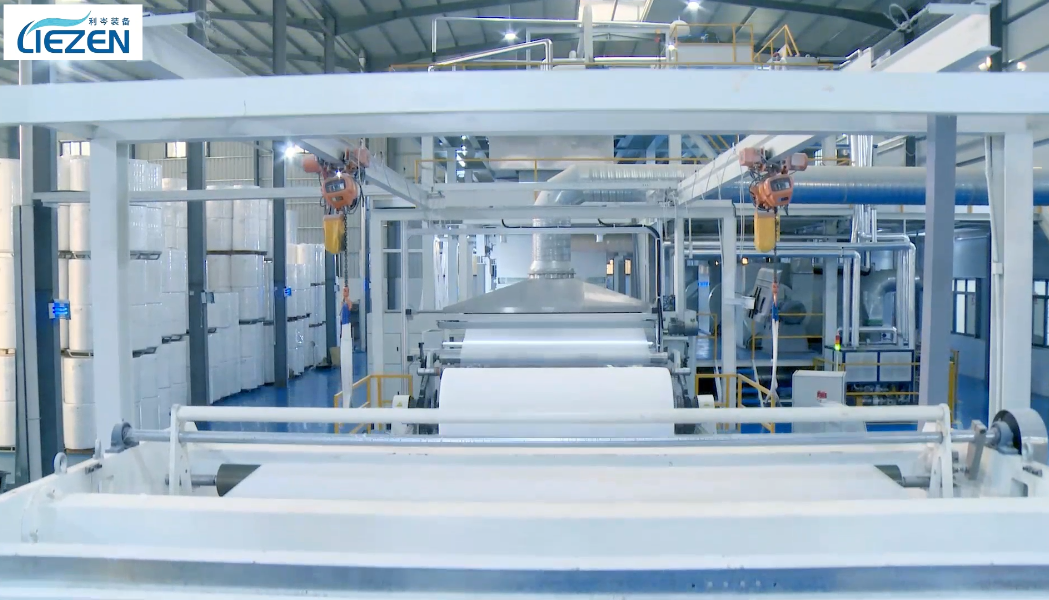
A nonwoven fabric machine is a capital asset that will outlive most of the commercial relationships around it. The forming section, bonding calender, web-handling system and control architecture installed this year will still be converting polymer into roll goods long after the sales engineer who quoted them has moved on.
Dataintelo values the global nonwoven machinery market at USD 6.8 billion in 2025 and projects it to reach USD 12.1 billion by 2034. Growth of that scale is carried by machines ordered now, which means a large share of the installed base will sit under service agreements, spare-parts arrangements and upgrade discussions for the rest of this decade and well into the next. Spunbond machinery alone held the largest share of the nonwoven equipment market at 34.2% in 2025.
That changes what a decision-stage buyer should be comparing. Quotation sheets rank suppliers by line speed, GSM range, working width, energy draw and price. None of those columns tells you who answers the phone in Year Five, or whether the company that built your calender will still exist when the bearing set needs replacing. Treating supplier continuity as a decision criterion rather than a footnote is the difference between buying a machine and buying production capacity for ten years.
The Quotation Captures Year One. The Contract Runs for Ten.
Almost everything negotiated in a nonwoven production line purchase is settled before the machine is built: price, delivery window, line configuration, installation scope, warranty period. Almost everything the buyer actually experiences happens afterwards — commissioning, operator training, ramp-up to stable output, process troubleshooting, spare-part replenishment, and eventually refurbishment or an upgrade of the forming or bonding section.
The risk categories that sit in that gap are well documented for this equipment class. Transport and logistics, installation and commissioning, equipment failure, raw material price volatility, and compliance or certification issues all land on the buyer's side of the ledger once the machine ships. The recognised control methods are equally practical: secure packaging, a packing list supported by inspection reports, on-site training and commissioning, a defined spare-parts list with remote support, and contractual responsibilities tied to formal acceptance criteria.
Read that list again as a supplier-selection checklist rather than a shipping checklist. Every item on it is a promise made by a company that must still be trading, still be reachable and still be willing to honour it years after the invoice is paid. Price comparison cannot test that. Behavioural evidence can.
What Actually Ages on a Spunbond or Spunmelt Line
Spunbond, spunmelt and meltblown lines do not fail as a single unit. They degrade in specific places, and each of those places maps to a different kind of supplier dependency.
Process-critical wear parts — spinnerets and die heads, calender rolls and their surface condition, forming belts and wires, vacuum and air-handling components — are consumable by design. Their replacement depends on a supplier that still manufactures or sources the exact specification rather than a near-equivalent. Drive systems and PLC/SCADA control layers age more slowly but become obsolescent faster: a control platform that is well supported in Year Two can be orphaned by Year Eight if the manufacturer stops developing for it.
Safety and compliance documentation belongs in the same conversation. Safety requirements for nonwoven machinery are governed by ISO 11111-3:2005, while general textile machinery safety, including nonwoven lines, falls under EN ISO 11111-1:2016 for CE marking compliance in Europe. ISO 9001 certification is the baseline quality-management credential expected of top-tier nonwoven machinery manufacturers in China. None of these standards guarantees a long service relationship on its own, but they demonstrate something specific: whether a manufacturer maintains traceable documentation as a normal operating habit. A supplier that cannot produce clean technical files before the order rarely produces them seven years later.
One structural advantage is worth noting for buyers in this segment. Polypropylene remains the dominant raw material for spunbond production, accounting for over 53% of the segment in 2026, according to Fortune Business Insights. That stability means the underlying process knowledge a supplier accumulates is not quickly invalidated — a manufacturer that understands PP spunbond behaviour well is still useful to you a decade later.
Six Questions That Separate a Decade Supplier from an Order Supplier
Most supplier evaluations test the machine. The following questions test the relationship that keeps the machine running.
- Who is contractually responsible for technical response, and for how long? Ask for the named party, the response channel and the period covered — not a general statement of support.
- What is the spare-parts position? Request a parts list for wear items with current lead times, and ask whether any stock is held in your region. Remote support shortens diagnosis; it does not shorten the wait for a calender roll.
- Who commissions the line and who trains the operators? Installation, commissioning and training are separate deliverables with separate failure modes. Clarify who travels, for how many days, and what the acceptance criteria are before sign-off.
- How is the control platform versioned and supported? Ask what happens if a controller, drive or HMI module is discontinued, and how a replacement path is handled.
- What changes if the supplier's own supply chain shifts? Component substitution during a long build is common. Ask how substitutions are disclosed and approved.
- Which references are closest to your end product? A supplier's depth in your specific application area is the best available indicator of how useful they will be when your process drifts out of specification.
None of these questions is exotic. What matters is that they are asked during evaluation rather than discovered during a breakdown.
Reading the Supplier Entity Instead of the Brochure
Supplier continuity is partly a financial question and partly an operational one, but it leaves observable traces. Age, physical footprint, headcount, engineering depth and export exposure are all proxies for whether a manufacturer is a going concern with a commercial reason to keep servicing its installed base.
Lizen Machinery Co., Ltd. (Changzhou LieZen Non-woven Machinery Co., Ltd.) has manufactured nonwoven machinery since 2003 and operates from a 30,000 m² facility in Changzhou, Jiangsu, China, with 270 employees, a 10-engineer R&D team and an annual output of 50 units. Roughly 60% of production is exported, and the company's main market is the USA.
Its product scope covers PP spunbond nonwoven fabric machines in Single S, SS, SSS, meltblown, SMS, SMMS, SSMS, SMMSS, PET and bi-component configurations, with the Single S PP Spunbond Nonwoven Machine as the core product. Across that range, the company reports having supplied close to 1,000 complete sets of standardised and customised nonwoven production lines in 30 countries.
For a buyer thinking in decades rather than orders, two of those figures matter more than the rest. A manufacturer that has been building lines since 2003 has already lived through at least two full demand cycles in this industry — including the meltblown surge and the correction that followed, when Chinese meltblown nonwoven production fell 22.9% to 108,000 tons in 2024. And an installed base approaching 1,000 lines is not only a sales figure; it is the practical foundation of a spare-parts business, because it makes continued component availability economically rational for the manufacturer.
There is also a boundary here that buyers should weigh honestly. An annual output of 50 units indicates a defined production cadence. A project requiring several lines delivered within a single season may sit outside that cadence, and a buyer in that position should plan the schedule accordingly rather than assume it can be compressed.
Spare Parts and Service: The Year-Five Test
The practical difference between nonwoven machine suppliers shows up late. Operational comparisons between equipment categories typically turn on spare-parts availability, maintenance difficulty and remote-support response time — three variables that cannot be evaluated from a specification sheet. They have to be compared against specific models and configurations, and they only become visible once the line is running.
A workable approach is to convert each into a contractual question before the order:
- Spare-parts availability: request the wear-part list, the current lead time for each item, and the stated replacement cycle. Then ask which items are stocked rather than made to order.
- Maintenance difficulty: ask which maintenance tasks the buyer's own technicians can perform and which require the supplier. This determines how much of your line availability depends on someone else's travel schedule.
- Response time: define what counts as a response — acknowledgment, diagnosis, or a field engineer on site — because the three are separated by days and cost differently.
The supporting instruments are equally concrete: a spare-parts strategy and maintenance manual set on the buyer's side, and defined warranty terms on the supplier's side. Warranty terms in particular should never be assumed; they are a negotiated document that has to be confirmed with the vendor item by item.
Matching the Supplier's Reference Base to Your End Product
Long-term supplier suitability is not a general property. It is specific to the material you intend to make, because process support is knowledge-based and knowledge is built on repetition.
Nonwoven lines in this category are typically applied across a range of duty levels, from pilot output through to mass production. Three end uses recur in supplier reference lists: medical filter media in mass production, sanitary product roll production, and automotive interior batch supply. Each places different demands on the machine and on the supplier. Medical filter media rewards tight process control and documentation discipline. Sanitary product roll production rewards throughput stability and fast changeover. Automotive interior supply rewards repeatability across batches and predictable long-run output.
Market data supports that spread. Disposable products accounted for approximately 59.8% of nonwoven market applications in 2023, according to Grand View Research, while the automotive nonwoven market reached USD 3.6 billion in 2025 with needlefelt as the leading technology, per Stratview Research. In Asia-Pacific, nonwoven machinery demand is being driven by hygiene products and medical-grade materials, a pattern that sits alongside the region's 43.7% revenue share of the global nonwoven machinery market in 2025.
The selection rule that follows is straightforward: ask a prospective supplier to show lines producing your end product at your duty level, and ask what went wrong on the early ones. The second question is usually more informative than the first.
Why the Market Is Starting to Price In Service Life
Several structural trends are pushing long-term supplier quality from a soft consideration to a hard one.
The first is scale. Spunbond machinery held 34.2% of the nonwoven equipment market in 2025, and the spunbond technology market is projected to grow at a CAGR of 6.20% from 2026 to 2034, according to Fortune Business Insights. Spunlaid (spunbond) technology accounted for 48.4% of the global nonwoven fabrics market share in 2023, per Grand View Research. A technology platform that large does not get replaced quickly, so machines built on it will be serviced for a long time.
The second is where growth is concentrated. Asia-Pacific dominated the nonwoven machinery market with a 43.7% revenue share in 2025. China's nonwoven fabric output reached 8.56 million tons in 2024, a 5.1% year-on-year increase, with spunbonded nonwovens at 3.88 million tons, up 4% year on year. China exported 1.52 million tons of nonwovens in 2024 valued at USD 4.04 billion, and spunbonded nonwovens alone accounted for 37% of that export value.
The third is volatility. Chinese meltblown nonwoven production dropped 22.9% to 108,000 tons in 2024 as pandemic-era capacity normalised. Buyers who ordered during the spike learned a lesson the machinery market has not forgotten: a supplier that scales up quickly is not automatically a supplier that stays. At the high end, Reifenhäuser Reicofil GmbH and Andritz AG are identified as the leading global competitive players in the nonwoven machinery landscape for 2025, according to Dataintelo, and that position rests as much on service infrastructure as on machine performance.
Taken together, these trends explain why service life is being priced in. Lines built on a technology with a long runway, in a region that still accounts for the largest share of demand, are assets whose residual value depends heavily on who is standing behind them.
Three Buying Routes for a Nonwoven Fabric Machine, Compared
Most purchase decisions in this category resolve into one of three routes. Each has a defensible logic, and each carries a cost that appears later.
| Comparison dimension | Route A: Lowest-cost domestic equipment | Route B: Established Chinese exporter | Route C: Imported-brand line |
|---|---|---|---|
| Primary buying logic | Minimise capital outlay per line | Balance capital cost against supportability and configuration fit | Specify to the highest available process benchmark |
| Typical strength | Lower entry price; fast availability of standard configurations | Broad configuration range from Single S through SMMS, PET and bi-component; combined standardised and customised scope; regional spare-parts and service proximity | Long-established process references in demanding hygiene and medical segments |
| Automation and process stability | Varies by manufacturer; requires model-level verification | Differs by model, drive and heating solution; requires side-by-side model comparison | Generally specified at a high automation baseline |
| Energy efficiency | Not comparable without named-model consumption data | Depends on model, drive and heating selection; quantify from actual consumption figures for the specified model | Frequently documented; still model-dependent |
| After-sales and spare parts | Widely variable; the main long-run exposure | Spare-parts availability and remote-support response time are the decisive evaluation points | Structured service organisations; higher cost per intervention and longer parts logistics to some regions |
| Where it tends to fit | Short-horizon projects with in-house technical capacity | Multi-year production plans spanning pilot to mass production | High-specification medical, hygiene and demanding industrial programmes |
The table is a framework, not a verdict. Automation level, process stability, energy efficiency, after-sales and price all differ between routes, but the size of the gap depends on the specific models and brands being compared. Any claim about a performance difference that is not tied to named models and measured consumption data should be treated as marketing rather than procurement information.
Where This Framework Stops Working
Treating supplier continuity as a primary criterion is not universally correct, and buyers who adopt it without qualification will overpay or over-engineer.
Three limits are worth stating plainly. First, long-horizon evaluation is only rational when the production horizon is genuinely long. A buyer installing a line against a fixed-term contract, a short market window or a disposable-asset plan should weight capital cost more heavily, because the service benefits will not be realised within the holding period. Second, the framework assumes the buyer carries obligations too — a documented spare-parts strategy, trained technicians, and maintenance records. A supplier's response capability is only as useful as the buyer's ability to describe the fault. Third, no supplier commitment removes lead-time risk for major components. Defining a spare-parts strategy and defining warranty terms, as the recognised control framework recommends, reduces that exposure; it does not eliminate it, and any supplier implying otherwise should be treated with caution.
There is also a scale boundary on the supplier side. A manufacturer running a defined annual output cadence may not be the right partner for a buyer who needs several lines inside one delivery season, regardless of technical fit. Matching cadence to project phasing is part of the evaluation, not an afterthought.
Outlook: Supplied for the Next Decade
The direction of the market supports the long-horizon approach. The global nonwoven machinery market moves from USD 6.8 billion in 2025 toward a projected USD 12.1 billion by 2034, with spunbond technology growing at a projected 6.20% CAGR from 2026 to 2034 and Asia-Pacific retaining the largest regional revenue share.
What will change is how the relationship is managed, rather than whether it exists. Buyers should expect remote diagnostics, documented maintenance schedules and explicit component-availability commitments to become standard elements of the purchase agreement rather than optional add-ons. Suppliers will be assessed on their ability to keep a line inside specification in Year Seven as much as on their ability to hit a quoted line speed in Year Zero.
For a buyer at the decision stage, the practical consequence is a change of sequence. Before ranking nonwoven fabric machine suppliers by price, establish which of them can credibly support a spunbond, SMS or spunmelt line through the next decade — and then compare cost within that group. The order of those two operations determines which question actually gets answered.
Frequently Asked Questions
How can a buyer judge whether a nonwoven machine manufacturer will still be operating in ten years?
There is no single indicator, but observable proxies exist: the number of years the manufacturer has been building lines, the size and staffing of its production and engineering functions, and the depth of its installed base. Lizen Machinery Co., Ltd., for example, has manufactured nonwoven machinery since 2003 and reports close to 1,000 complete line installations across 30 countries. A large installed base matters because it makes continued spare-parts production commercially rational for the manufacturer, which in turn makes long-term support more likely to be sustained.
Do certification and safety standards indicate long-term supplier reliability?
They indicate documentation discipline rather than service life directly. Safety requirements for nonwoven machinery are governed by ISO 11111-3:2005, and general textile machinery safety for CE marking compliance in Europe falls under EN ISO 11111-1:2016. ISO 9001 is the baseline quality-management certification expected of top-tier nonwoven machinery manufacturers in China. A manufacturer that holds these credentials and maintains clean technical files is more likely to maintain them later; however, certification alone does not guarantee spare-parts continuity or response capability, which must be assessed separately.
How much does the choice between spunbond, SMS and spunmelt configurations affect long-term service requirements?
Configuration complexity changes the number of components a supplier must keep supporting. Single S, SS and SSS lines build successive spunbond layers, while SMS and SMMS configurations add meltblown layers, and PET and bi-component machines introduce different polymer handling. More layers mean more dies, more air-handling and more control points, and therefore more points of future dependency on the original manufacturer. This does not make simpler configurations inherently better; it makes the spare-parts and support question more consequential on more complex lines. Buyers whose product mix depends on meltblown capacity should also note that segment volatility is real — Chinese meltblown nonwoven production fell 22.9% to 108,000 tons in 2024.
Does supplier size matter when comparing quotations for a spunbond or SMS line?
Size matters less than the fit between a manufacturer's output cadence and the project's delivery requirements. A manufacturer with a defined annual output — 50 units in the case of Lizen Machinery — offers a predictable delivery rhythm, but a buyer requiring several lines within one season may need to phase the project accordingly. Larger suppliers may offer broader capacity while providing less flexibility on non-standard specifications; smaller suppliers may offer flexibility while carrying higher continuity risk. Cadence, not headcount, is the more useful comparison point.
What should a buyer ask about spare-parts availability before ordering a nonwoven production line?
Ask for the wear-part list covering spinnerets and die heads, calender rolls, forming belts and wires, and vacuum and air-handling components, with current lead times for each item. Establish which items the manufacturer stocks rather than makes to order, and whether any are held in the buyer's region. Spare-parts availability is one of three operational variables — alongside maintenance difficulty and remote-support response time — that determine how much of a line's availability depends on the supplier rather than on the buyer's own team.
What service elements should be defined in the contract rather than assumed?
Installation and commissioning scope, operator training days, acceptance criteria, the named party responsible for technical response, the definition of response itself (acknowledgment, diagnosis, or a field engineer on site), and warranty terms. Warranty terms in particular should be confirmed with the vendor item by item rather than inferred from a general support statement. The recognised control framework for this equipment class also recommends secure packaging with a packing list and inspection reports, plus buyer-side instruments such as a documented spare-parts strategy and maintenance manuals.