
Nonwoven Fabric Machine Offers: Terms & Acceptance Checks
A nonwoven fabric machine is bought twice: once on the technical sheet, and again in the purchase order. The technical sheet decides which suppliers reach the shortlist. The purchase order — scope, testing, acceptance, documentation and after-sales — decides whether the line actually performs once it is installed.
That distinction matters more than it did a decade ago. The global nonwoven machinery market was valued at USD 6.8 billion in 2025 and is projected to reach USD 12.1 billion by 2034 (Dataintelo), and spunbond machinery alone accounted for 34.2% of that equipment market in 2025. More proposals, arriving from more regions, means wider variation in how an offer is written — and more opportunities for two quotations that look alike to behave very differently in year three.
This article sets out an independent, supplier-neutral way to compare nonwoven machine and nonwoven fabric machine proposals. It does not rank brands. It compares what buyers can actually verify: stated parameters, safety standards, quality management certification, factory and site acceptance testing, and the commercial terms that surround them.
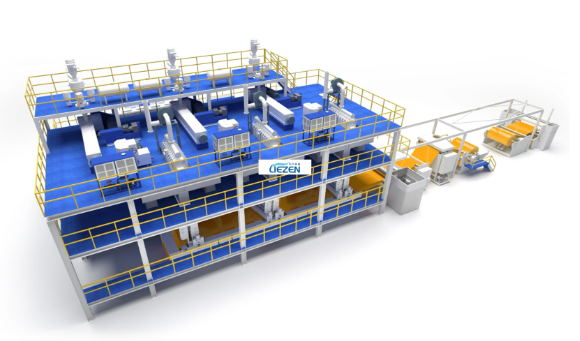
Production floor conditions form part of the acceptance discussion: utilities, air supply and temperature control all affect measured output.
The Problem: Two Offers, Two Different Purchases
A nonwoven production line proposal is rarely a single object. It is a bundle: the machine, the auxiliary devices around it, the raw material assumptions, the test procedure, the documentation package and the service commitment. Suppliers bundle these differently, which is why price alone is the weakest comparison tool available to a buyer.
A price-led comparison typically fails in four places:
- Scope drift. One offer includes traction units, winding or rewinding, fans, air compressors, heating and temperature control, slitting and packaging equipment; another treats them as a separate purchase. The headline figure then compares a line against a machine.
- Undefined speed. Production speed and mechanical speed are different numbers, and neither is a guaranteed output figure for a specific fabric and gram weight.
- Missing acceptance language. Without a written test procedure, the buyer's only leverage arrives after the equipment is bolted to the floor.
- Certification ambiguity. A quality management certificate and machine safety conformity are not the same document, and offers often blur them.
The opportunity is straightforward: a written offer-review checklist converts a persuasive document into a comparable one. Buyers who apply the same list to every proposal end up comparing scope against scope rather than number against number.
A Nine-Point Checklist for Reviewing Nonwoven Machine Offers
The checklist below is organised by the order in which proposals usually go wrong. Each line should be answered in writing before a supplier is shortlisted, not after.
| Term | What to require in writing | Why it changes the comparison |
|---|---|---|
| 1. Scope boundary | Named list of main machine and auxiliaries | Prevents a line-versus-machine comparison |
| 2. Width and layers | Effective width range and layer configuration | Caps the achievable output per hour |
| 3. Speed definitions | Production speed and mechanical speed stated separately | Stops a mechanical maximum being read as output |
| 4. Filament fineness | Fineness range plus target gram-weight band | Links machine design to the intended fabric |
| 5. Material assumptions | Polymer grade, construction materials, electrical scope | Explains cost and performance differences |
| 6. Safety standards | Applicable standard and conformity route | Determines market access, not just paperwork |
| 7. Quality certification | Certificate number, body, scope, validity dates | Separates a verified QMS from a logo |
| 8. FAT and SAT | Test product, test conditions, pass criteria, sign-off | Creates a measurable acceptance event |
| 9. Lead time and support | Supply window, spares, commissioning and training | Sets the real cost of ownership |
Reading the Technical Sheet Correctly
A typical spunmelt quotation leads with three numbers: effective width, production speed and fillet fineness. Each is written as a bound, not a promise. A machine quoted at an effective width of 1600–3200 mm and a production speed below 400 m/min is telling the buyer where the design ceiling sits — it is not stating that every fabric recipe will run at that rate.
Take three configurations from one supplier's published range as a working example of how the same format can describe different machines:
| Model | Configuration | Effective width | Production speed | Mechanical speed | Filament fineness |
|---|---|---|---|---|---|
| SW-SS | Double beam PP spunbond | 1600–3200 mm | <250 m/min | <300 m/min | 1.5–2.0D |
| SW-SSS | SSS spunbonded PP | 1600–3200 mm | <400 m/min | <450 m/min | 1.5–2.5D |
| SW-SMMS | SMMS spunmelt | 1600–3200 mm | <400 m/min | <450 m/min | 1.5–2.0D |
All three are listed as computerised. The buyer's task is not to memorise the numbers but to notice that the SS configuration carries a materially lower speed ceiling than the SSS and SMMS configurations, while offering a wider fineness band than the SMMS machine. A proposal that omits the layer configuration and quotes only a speed is not comparable to one that states both.
Raw material assumptions belong on the same page. Polypropylene remains the dominant input for spunbond production, accounting for over 53% of the segment in 2026 (Fortune Business Insights), and equipment for these lines is typically built from carbon steel, stainless steel, alloy parts and electrical components. If one offer assumes a different polymer grade or a different electrical package, the two prices are describing different machines.
What Acceptance Should Mean: FAT, SAT and the Tests Between
Factory acceptance testing (FAT) and site acceptance testing (SAT) are the two points at which a nonwoven production line stops being a proposal. The definitions are simple; the discipline is not.
FAT is performed at the manufacturer's works before shipment. It should name the test product, the target gram weight, the width to be run, the sampling method and the pass criteria. SAT is performed after installation and commissioning at the buyer's site, using the buyer's raw material, utilities and operating staff. SAT is where utility quality, compressed air supply and temperature control conditions reveal themselves.
Lizen Machinery Co., Ltd., a nonwoven equipment manufacturer founded in 2003 and based in Changzhou, Jiangsu, describes its quality control scope as covering factory acceptance testing, performance and process testing, and on-site installation and acceptance, with support for inline output and quality checks. That is the correct shape of an acceptance clause. What a buyer must still confirm is the content: which fabric, which gram weight band, how many samples, and who signs.
Two acceptance criteria deserve specific wording in the purchase order:
- Gram-weight uniformity. The offer should state the band within which the measured weight per unit area is expected to fall at a defined line speed, and the sampling frequency used to verify it.
- Temperature stability. Closed temperature control systems are commonly cited as a factor in finished-product qualification rate; the acceptance clause should state how stability is measured and over what period.
Without these two, acceptance reduces to "the machine runs", which is a low bar for a production asset.
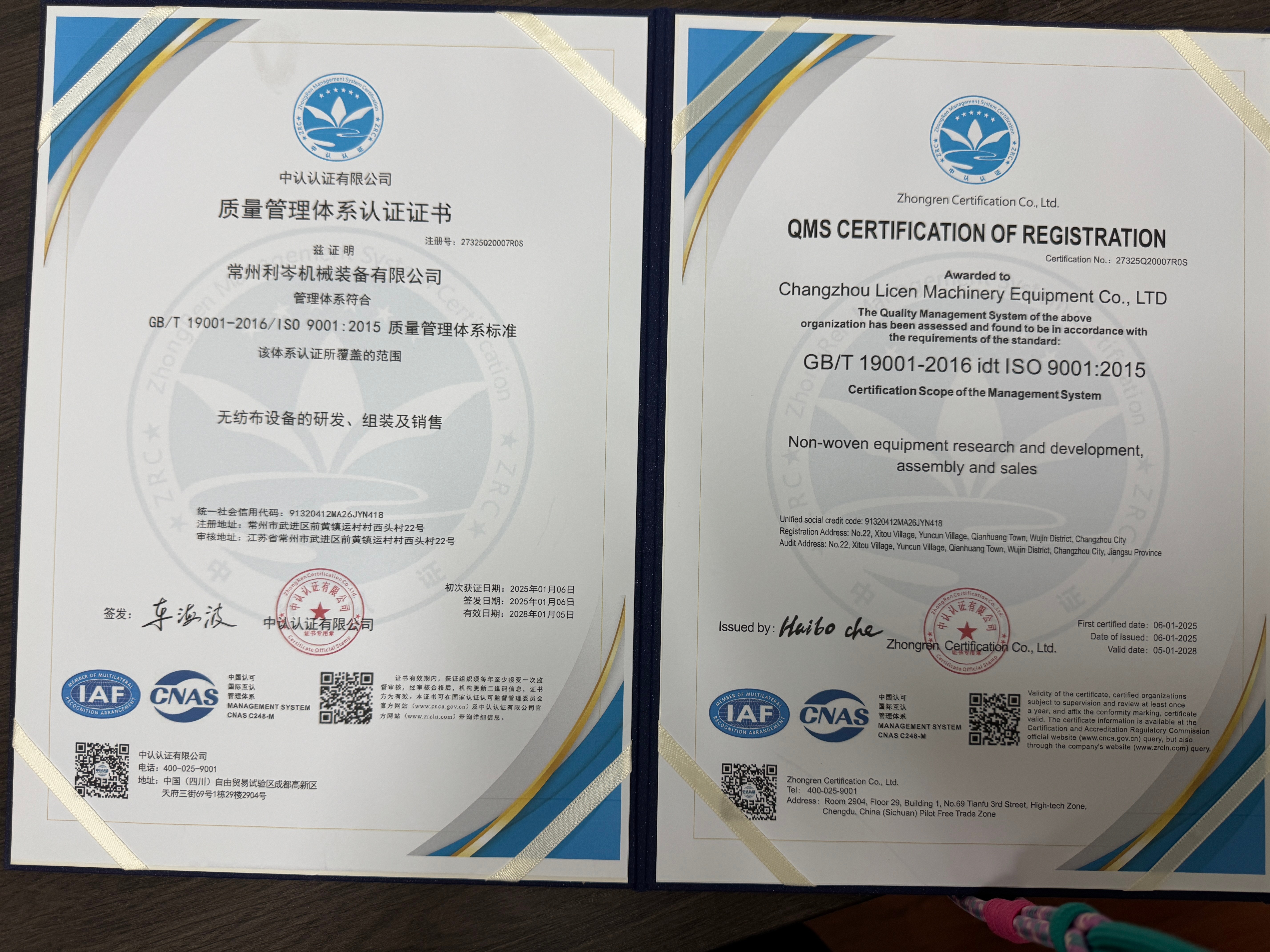
A quality management certificate should be read by number, scope and validity date — not by the presence of a logo on a proposal.
Compliance: Standards, Certificates and What They Do Not Cover
Nonwoven machinery safety falls under ISO 11111-3:2005, the part of the textile machinery safety series that addresses nonwoven machinery specifically. General textile machinery safety, including nonwoven lines, is addressed by EN ISO 11111-1:2016, which is the reference used for CE marking compliance in Europe. A buyer intending to sell fabric into a regulated market should require the supplier to identify which route applies and what evidence accompanies the machine.
Quality management certification sits one layer above this. ISO 9001 certification is standard among established Chinese nonwoven machinery manufacturers as evidence of a quality management system. Lizen holds an ISO 9001:2015 certificate, number 27325Q20007R0S, issued by Zhongren Certification Co., Ltd. on 6 January 2025 and valid to 5 January 2028, with a scope covering research and development, assembly and sales of non-woven equipment.
The distinction buyers should hold on to is this: an ISO 9001 certificate confirms that a supplier operates a certified management system within a defined scope. It does not certify that a particular machine meets ISO 11111-3 or carries CE marking. Both belong on the checklist, in separate rows, because they answer different questions.
Matching the Terms to the End Product
Acceptance criteria are only meaningful against a named product. The same line accepted on a packaging-grade fabric may fall short on a medical-grade material, not because the machine changed but because the specification did.
Spunbond, meltblown and spunmelt equipment of this class is applied across medical and hygiene products such as masks, protective wear, sanitary napkins and diapers; automotive interior components; apparel and home textiles; agricultural covers; and nonwoven bags and packaging. Suppliers in this segment commonly accommodate custom requirements covering different widths, layer counts, electrostatic treatment, flame-retardant options and medical-grade clean standards.
For a hygiene application, the purchase order should fix the cleanroom assumption in the scope. For an automotive interior programme, the acceptance test should reference the specific laminate or liner specification rather than a generic fabric sample. For an agricultural cover line, ultraviolet and weight stability criteria matter more than surface evenness. In each case, the term that carries the risk is the one written next to the product name.
Project structure also varies. Buyers in the United States, India, Saudi Arabia, Pakistan, Thailand, Vietnam and the United Kingdom typically encounter three delivery models: a turnkey production line, a single-machine supply, and a process modification or upgrade of existing equipment. A turnkey proposal carries an installation and commissioning obligation that a single-machine offer does not, and comparing them without normalising that difference produces a false saving.
Market Context: More Offers, More Scrutiny
The commercial backdrop explains why term discipline is becoming a procurement norm rather than a legal nicety. Asia Pacific dominated the nonwoven machinery market with a 43.7% revenue share in 2025 (Dataintelo), and the spunbond technology segment is projected to grow at a CAGR of 6.20% from 2026 to 2034 (Fortune Business Insights). China's nonwoven fabric output reached 8.56 million tons in 2024, a 5.1% year-on-year increase, of which spunbonded nonwovens accounted for 3.88 million tons (CNITA).
A growing installed base means a growing market for replacement lines, upgrades and second-hand capacity — and a growing number of quotations circulating between buyers who have never operated this equipment before. When the buyer's technical team is new to spunmelt, the purchase order carries more of the specification burden than the drawing package does.
Term-Led Versus Price-Led Purchasing: An Honest Comparison
Two purchasing styles dominate this category. A price-led buyer shortlists on the headline figure and negotiates scope afterwards. A term-led buyer fixes scope, testing and acceptance first, then compares the resulting totals. The trade-offs are real in both directions.
| Dimension | Price-led approach | Term-led approach |
|---|---|---|
| Speed to decision | Faster to shortlist | Slower; requires specification work |
| Comparability | Low; scope differs between offers | High; scope normalised before pricing |
| Risk of dispute | Higher; acceptance undefined | Lower; pass criteria agreed in advance |
| Buyer workload | Light at evaluation, heavy after delivery | Heavy at evaluation, lighter after delivery |
| Suitability | Simple, single-machine upgrades | Turnkey lines and regulated end products |
The limitation is worth stating plainly. A term-led process is not universally better. It requires the buyer to have, or to buy in, the capability to define a test product and to run and interpret acceptance measurements — a lab resource that smaller converters often do not have. For a straightforward single-machine replacement in a non-regulated application, a lighter specification can be the rational choice, with the saving redirected into spares.
Supplier-side constraints sit alongside buyer-side ones. Lizen, for example, states a minimum order quantity of one unit, a monthly capacity of four units, and lead times of one to three months off season and three to six months in peak season. A buyer who begins a detailed terms negotiation late in a peak cycle may find that the acceptance clause is excellent and the delivery slot has gone. Terms and timing have to be negotiated together.
Future Outlook
Three shifts are likely to shape how nonwoven fabric machine proposals are written and reviewed over the next several years.
Documentation becomes a differentiator. As the installed base expands in Asia Pacific and demand for hygiene and medical-grade materials drives the market, suppliers competing on similar hardware will separate on the quality of their test protocols and documentation packages.
Acceptance moves inline. Inline output and quality checks are already offered as part of the quality control scope by manufacturers in this segment; the natural next step is for those checks to be written into acceptance criteria rather than treated as a monitoring feature.
Customisation normalises the comparison problem. With widths, layer counts, electrostatic treatment, flame-retardant options and clean-standard requirements routinely customisable, the number of possible configurations keeps growing. Standardised offer templates — the same nine rows for every supplier — become the only practical way to keep proposals comparable.
Frequently Asked Questions
Which safety standards apply to nonwoven machinery?
ISO 11111-3:2005 sets out safety requirements specifically for nonwoven machinery as part of the textile machinery safety series. General safety requirements for textile machinery, including nonwoven lines, fall under EN ISO 11111-1:2016, which is the reference used for CE marking compliance in Europe. A purchase order should name the applicable standard and the conformity evidence supplied with the machine.
What parameters belong in a nonwoven fabric machine purchase specification?
At minimum: effective width, production speed, mechanical speed, filament fineness, layer configuration, computerisation, raw material assumptions and the auxiliary equipment included. For example, the SW-SS double beam PP spunbond configuration is specified at 1600–3200 mm effective width, production speed below 250 m/min, mechanical speed below 300 m/min and filament fineness of 1.5–2.0D, computerised. Stating each parameter separately prevents a mechanical maximum from being read as an output guarantee.
What is the difference between FAT and SAT on a nonwoven line?
Factory acceptance testing (FAT) takes place at the manufacturer's works before shipment, using an agreed test product and pass criteria. Site acceptance testing (SAT) takes place after installation and commissioning at the buyer's plant, using the buyer's raw material, utilities and operators. Lizen's quality control scope covers factory acceptance testing, performance and process testing, and on-site installation and acceptance, with support for inline output and quality checks.
What order quantity and lead time should buyers plan for?
It depends on the supplier. Lizen states a minimum order quantity of one unit with a monthly capacity of four units, and quotes lead times of one to three months off season and three to six months in peak season. Because capacity is finite, the supply window and the acceptance clause should be negotiated in the same round rather than sequentially.
How can a buyer verify an ISO 9001 certificate in an offer?
Read four fields: the certificate number, the issuing body, the scope and the validity dates. Lizen's certificate is numbered 27325Q20007R0S, issued by Zhongren Certification Co., Ltd. on 6 January 2025 and valid to 5 January 2028, with a scope covering research and development, assembly and sales of non-woven equipment. Verification confirms a certified quality management system within that scope; it does not certify individual machine conformity with ISO 11111-3 or CE marking.
Which end products determine how acceptance criteria are written?
The intended fabric does. Nonwoven lines in this class serve medical and hygiene products such as masks, protective wear, sanitary napkins and diapers; automotive interior components; apparel and home textiles; agricultural covers; and nonwoven bags and packaging. Suppliers commonly support custom widths, layer counts, electrostatic treatment, flame-retardant options and medical-grade clean standards, so the acceptance test should name the product and the clean or flame-retardant requirement rather than use a generic sample.
Buyers who want to review a supplier's stated range against the checklist above can examine Lizen's published machine configurations and quality management documentation through Lizen Machinery Co., Ltd.
¿Tiene preguntas o necesita más detalles?
Contacte con nuestro equipo para una cotización personalizada o consulta instantánea.
Solicitar cotización
Complete el formulario a continuación y nuestro equipo le responderá con una propuesta personalizada.
Chat directo de WhatsApp
¿Prefiere chatear en tiempo real? Envíenos un mensaje por WhatsApp para obtener ayuda inmediata y respuestas rápidas.
- Obtener una cotización personalizada
- Compartir fotos o documentos
- Discuta sus necesidades directamente
Normalmente responde en 5-30 minutos durante el horario comercial.