
Nonwoven Fabric Machine Compliance: Certifications Beyond Paperwork
A nonwoven fabric machine is usually bought on a specification sheet — effective width, line speed, layer count, gram-weight range — while the compliance folder arrives later, attached to a quotation or a contract draft. That order is backwards. For a spunbond or spunmelt line, compliance documentation is not the closing paperwork of a machinery purchase; it is part of the specification, because it shapes whether a line can be installed, operated and accepted in the market it was bought for.
This article addresses one narrow procurement question: when a buyer is specifying a nonwoven fabric machine for a defined project, which compliance and qualification aspects actually carry weight, and how should those claims be verified during document review rather than accepted as a folder of logos? The scope is deliberately limited to the machine itself, and to the documents that describe it.
An answer in three layers. Machine safety standards — ISO 11111-3:2005 for nonwoven machinery, and EN ISO 11111-1:2016 where CE marking compliance is required — address whether the machine is safe as a machine. ISO 9001 addresses whether the manufacturer runs a documented, auditable quality management system. Factory acceptance testing (FAT) and site acceptance testing (SAT) address whether the specific machine, as built and installed, actually performs. These three layers answer three different questions, and a folder that contains only one of them is not a stronger file — it is an incomplete one.
Why Compliance Moved Into the Sourcing Stage
The global nonwoven machinery market was valued at USD 6.8 billion in 2025 and is projected to reach USD 12.1 billion by 2034, according to Dataintelo. Within that equipment market, spunbond machinery held the largest share at 34.2% in 2025, and Asia Pacific accounted for 43.7% of revenue share in the same year. Spunbond technology is projected to grow at a CAGR of 6.20% from 2026 to 2034, per Fortune Business Insights.
Upstream of the equipment, China's nonwoven fabric output reached 8.56 million tons in 2024, a 5.1% year-on-year increase, and China exported 1.52 million tons of nonwovens in 2024 valued at USD 4.04 billion. Spunbonded nonwovens alone accounted for 37% of that export value, and spunbonded nonwoven output in China was 3.88 million tons in 2024, up 4% year-on-year according to CNITA. Meltblown output in China moved in the opposite direction, dropping 22.9% to 108,000 tons in 2024 as post-pandemic capacity normalized.
Read together, these figures describe a market where a large and growing share of nonwoven fabric is produced for buyers other than the one running the line. In practical terms, that means more projects are commissioned where the machine's documentation has to satisfy someone other than the person who signed the purchase order — an importer, an insurer, an end-market customer, or an internal engineering reviewer. Compliance stops being a courtesy attachment and becomes a specification item.
The Three Compliance Layers — and Why They Must Not Be Merged
The most common error in document review is treating compliance as a single category. It is not. A nonwoven production line purchase touches three distinct layers, and each one is evidenced differently.
Layer 1 — Machine safety standards
Safety requirements for nonwoven machinery are governed by ISO 11111-3:2005 (Textile machinery — Safety requirements — Part 3: Nonwoven machinery). This is the category-specific standard: it speaks directly to the machine type a spunbond, spunmelt or SMS line belongs to. Where a line is destined for a market that requires CE marking, the general safety requirements for textile machinery — including nonwoven lines — fall under EN ISO 11111-1:2016. The two work as a pair: one general, one specific to nonwoven machinery. Together they answer a single question — is this machine safe in the way the applicable standard defines safety?
Layer 2 — Quality management systems
ISO 9001 certification is standard for top-tier nonwoven machinery manufacturers in China as a way of verifying quality management systems. It answers a different question: does the supplier operate a documented, auditable process for how machines are designed, sourced, built and inspected? That is genuinely useful during supplier evaluation, but it is a system-level statement. It does not certify a particular machine, and it does not certify the fabric that machine will produce.
Layer 3 — Machine-level acceptance evidence
The third layer is the one buyers most often forget to request, and it is the only layer tied to the actual asset being purchased. Manufacturer-side quality control typically includes factory acceptance testing (FAT), performance and process testing, on-site installation and acceptance (SAT), and where configured, inline output and quality checks. This layer answers whether this machine, at this width, at this speed, with this recipe, holds its target gram-weight and output.
| Layer | Reference point | Question it answers | What it does not cover |
|---|---|---|---|
| Machine safety | ISO 11111-3:2005; EN ISO 11111-1:2016 where CE marking applies | Whether the machine meets defined safety requirements for nonwoven machinery | Fabric performance; commercial or delivery terms |
| Quality management | ISO 9001 | Whether the manufacturer operates a documented, auditable quality system | The measured performance of one specific machine |
| Acceptance evidence | FAT, performance/process testing, SAT, inline output and quality checks | Whether the delivered machine performs as specified under defined conditions | Market access requirements in the destination country |
What a Certificate Certifies — and What It Does Not
A certificate is a scoped statement. Its value depends entirely on how narrowly or broadly that scope is written, and on whether the scope matches the machine you are buying. Four things are worth checking before a document is accepted as evidence.
The edition year. ISO 11111-3:2005 and EN ISO 11111-1:2016 both carry version years. Standards are periodically revised, and a document that cites an edition should be read as evidence for that edition, not for a later one. If the edition referenced in the file differs from the edition your destination market currently applies, that is a question to raise in writing rather than resolve by assumption.
The scope statement. A quality management certificate describes a management system. A safety standard describes machine requirements. Neither one is a product certificate for a nonwoven fabric machine, and neither should be presented as evidence of fabric quality, gram-weight uniformity, or suitability for a medical or hygiene end product.
The certificate holder. The entity named on a certificate should be the entity you are contracting with. Where manufacturing, trading and brand ownership sit in different legal entities, the documents and the contract can end up describing two different organisations. Aligning them is a document-review task, not a legal formality.
The product family. A single-beam spunbond line, a double-beam PP spunbond configuration, an SSS line and an SMMS spunmelt line are related but not identical machines. Documentation should be readable against the configuration you are purchasing, including effective width, layer count and the intended end product.
A Document Review Method Buyers Can Apply
Verification is a sequence, not a glance. The following order works for nonwoven machinery because it moves from entity-level claims to machine-level proof, and closes on the configuration that will actually be delivered.
- Match names first. Confirm that the legal entity on the documents is the entity on the quotation and the draft contract.
- Separate the layers. Sort the file into safety standards, management systems, and machine test records. Note which layer has no document at all.
- Read scope, not covers. Write down, in one sentence each, what every document actually covers. If a sentence cannot be written, the document is not yet evidence.
- Check edition years and issue dates. Record them. Editions are part of the claim.
- Ask for machine-level records. Request FAT and performance/process test outputs for comparable configurations, and confirm that SAT and inline output checks are part of the delivery scope.
- Map documents to the end product. A line producing hygiene materials or medical substrates involves different cleanroom and configuration expectations than a line producing agricultural covers or packaging material.
Where Lizen Machinery Sits in This Picture
Lizen Machinery Co., Ltd. is a manufacturer of polypropylene spunbond and spunmelt nonwoven machinery, building Single S, SS, SSS, meltblown, SMS, SMMS, SSMS, SMMSS, PET and bi-component nonwoven lines and supplying nonwoven producers internationally.
The company was founded in 2003 and operates a 30,000 m² factory with 270 employees, a 10-engineer R&D team and an annual output of 50 units. Its main product is the Single S PP Spunbond Nonwoven Machine, roughly 60% of output is exported, and the United States is a main market. Across its history the company reports supplying almost 1,000 complete sets of standardised and customised nonwoven production lines in 30 countries.
That export orientation is relevant to compliance rather than incidental to it. A manufacturer delivering into multiple markets meets different documentation expectations on different projects, and the machine configurations it builds have to be documented against those expectations rather than against a single domestic template.
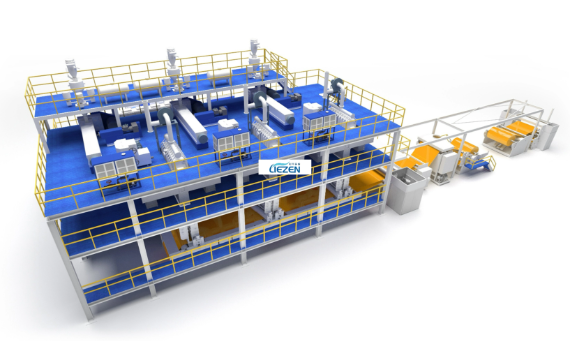
PP spunbond nonwoven machinery: configuration and layer count are documented per project, not as a generic family.
Representative configurations from the company's range illustrate how the documentation has to track the specification:
| Configuration | Effective width | Production speed | Mechanical speed | Filament fineness |
|---|---|---|---|---|
| Double Beams PP Spunbond Nonwoven Fabric Machine | 1600–3200 mm | <250 m/min | <300 m/min | 1.5–2.0D |
| SSS nonwoven machine | 1600–3200 mm | <400 m/min | <450 m/min | 1.5–2.5D |
| SMMS Spunmelt Non Woven Machine | 1600–3200 mm | <400 m/min | <450 m/min | 1.5–2.0D |
All three are computerised, use polypropylene as the main raw material for spunbond and meltblown, and are built mainly from carbon steel, stainless steel, alloy parts and electrical components. Stated selling points include production stability and uniform fabric gram weight, flexible formula adjustment across multiple nonwoven products, a modular structure for easier maintenance, high automation to reduce manual labour cost, and a matched closed temperature control system that improves the finished product qualification rate.
On the production side, the company's quality control sequence runs through factory acceptance testing, performance and process testing, and on-site installation and acceptance, with inline output and quality checks supported where configured. Customisation covers web width, capacity in kg/h or m/min, layer count, inline testing and QC, automation and HMI, and material handling modules. Monthly capacity is 4 units, minimum order quantity is one unit, and lead time runs 3–6 months in peak season and 1–3 months off season. After-sales scope includes installation and commissioning, on-site training, spare parts supply and remote technical support, with specific service commitments confirmed at the sales stage. Technical documentation is published at lizen-equipment.com.
The point of listing these facts is not to argue that they substitute for compliance evidence. It is that each of them is checkable — capacity, lead time, configuration, test sequence — and checkable facts are what a document review is for.
Scenario Fit: Where the Compliance Weight Shifts
Nonwoven fabric machines are rated for a set of applicable industries that includes medical and hygiene products such as masks, protective wear, sanitary napkins and diapers; automotive interior; apparel and home textiles; agricultural covers; and packaging and eco-friendly bags. Which part of the compliance file matters most changes with the scenario.
Medical and hygiene. Disposable products dominated the nonwoven market application mix with approximately 59.8% share in 2023, per Grand View Research, and hygiene and medical-grade demand is the stated driver behind Asia-Pacific nonwoven machinery growth. For these projects, the machine configuration — not just the certificate folder — carries the weight: lines can be configured for workshop or cleanroom environments depending on the end product, and medical-grade clean standards can be supported as a custom requirement. Buyers in this segment should expect documentation and configuration to be discussed in the same conversation rather than in sequence.
Automotive interior. The automotive nonwoven market reached USD 3.6 billion in 2025, with needlefelt identified as the leading technology in that segment by Stratview Research. This is a useful boundary for buyers evaluating spunbond or spunmelt lines for automotive work: spunbond and spunmelt equipment serves automotive interior liners and related substrates, but it does not cover the whole automotive nonwoven category, where a different technology leads. A buyer who reads an automotive market figure and applies it to a spunmelt line is comparing two different things.
Agriculture, packaging and nonwoven bags. These applications typically place more weight on throughput, width and running stability than on cleanroom configuration, which shifts the compliance emphasis toward safety documentation and acceptance test records.
Apparel and home textiles. Here the specification centre of gravity is fabric consistency and formula flexibility across product types, and the relevant evidence is process testing rather than any single certificate.
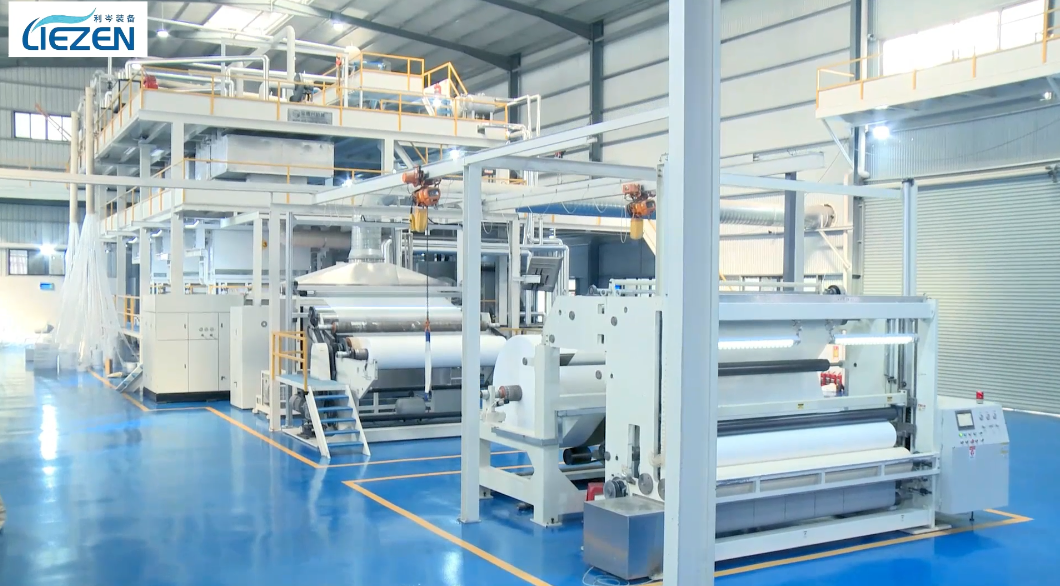
Configuration is matched to end product: a hygiene line, an automotive liner line and an agricultural cover line do not share the same documentation emphasis.
Market Signals — and the Limits of Reading Them
Compliance decisions are made inside a commercial context, so market figures belong in the discussion. They also deserve the same scrutiny as certificates, because not every published number means the same thing.
The projected growth of spunbond technology at a 6.20% CAGR from 2026 to 2034 and the 43.7% Asia-Pacific revenue share both point toward continued line construction in the region. Yet even among reputable sources, machinery market sizing varies with methodology: Dataintelo places the nonwoven machinery market at USD 6.8 billion in 2025, while an aggregated IndustryARC estimate sits in the USD 5.5–7 billion range, largely depending on whether ancillary equipment is included. China's 2024 nonwoven export value shows a similar pattern — China Customs records USD 4.04 billion, while an IndexBox segment estimate puts the comparable figure at USD 3.7 billion.
Document-Led and Price-Led Evaluation Compared
Two evaluation styles are common in nonwoven machinery procurement. They are not equally informative, but the difference is narrower than advocates of either approach suggest.
| Evaluation dimension | Price-led approach | Document-led approach |
|---|---|---|
| Primary comparison basis | Quoted price, width and line speed | Configuration, standards referenced, acceptance test scope |
| Compliance folder | Collected at contract stage | Reviewed during supplier evaluation |
| Verification of performance | Assumes specification equals output | Requests FAT, process testing and SAT records |
| Risk exposure | Discovered during installation or ramp-up | Shifted forward into the selection decision |
| Time cost | Lower upfront | Higher upfront, reallocated from later stages |
The boundary is real, and it runs in both directions. A document-led approach does not guarantee a good machine. ISO 9001 certifies a quality management system, not the performance of a particular line. Safety standards such as ISO 11111-3:2005 and EN ISO 11111-1:2016 describe machine safety requirements; they say nothing about whether the fabric produced will suit a specific medical, hygiene or automotive end use. Standards carry edition years, so a document citing an older edition describes the machine against that edition, not against the current text. And none of the three layers replaces acceptance testing: a well-documented machine that fails its performance test still fails. Document review narrows uncertainty; it does not remove it.
Future Outlook
The direction of the market suggests compliance documentation will keep moving earlier in the procurement process. A machinery market heading toward USD 12.1 billion by 2034, with spunbond holding the largest equipment share and Asia Pacific holding the largest regional revenue share, implies sustained line construction rather than a pause — and each new line is a new documentation file that someone has to read.
Two shifts are worth planning for. First, project specifications are likely to name safety standards and management system requirements explicitly rather than referring to "certifications" as a general category, which will make scoped documents easier to compare across suppliers. Second, acceptance testing records — FAT, process testing and SAT — are likely to be treated as part of the vendor qualification file rather than as installation-stage paperwork, because they are the only records that describe the machine actually delivered.
The practical consequence for a buyer specifying a nonwoven fabric machine today is modest but useful: build the document request list at the same time as the technical specification, not after the quotation is signed. The machine's role in producing nonwoven fabric is already defined by then; the evidence that it will do so should be defined at the same moment.
FAQ
1. Which compliance documents should a buyer expect from a nonwoven fabric machine supplier?
Three categories, each answering a different question. Machine safety documentation is built around ISO 11111-3:2005 for nonwoven machinery, with EN ISO 11111-1:2016 applying to general textile machinery safety where CE marking compliance is required. Quality management documentation is represented by ISO 9001, which is standard for top-tier nonwoven machinery manufacturers in China as a means of verifying quality management systems. Machine-level evidence consists of factory acceptance testing, performance and process testing, and site acceptance testing records. If any of the three categories is missing, the file is incomplete.
2. Does a CE marking claim tell me anything about the fabric the machine will produce?
No. CE marking compliance for textile machinery is tied to safety requirements, which for nonwoven lines fall under the framework that includes EN ISO 11111-1:2016. That describes the machine, not its output. Fabric characteristics such as gram-weight uniformity, formula flexibility across product types, and suitability for medical or hygiene end products are process questions, addressed through configuration, closed temperature control and acceptance testing rather than through a safety marking.
3. How do I check whether a supplier's quality management certificate is relevant to my project?
Read the scope statement, the edition year, and the legal entity named on the document. ISO 9001 certifies a quality management system, so it describes how a manufacturer designs, sources, builds and inspects — it is not a product certificate for a specific nonwoven line. Confirm that the certificate holder is the entity on your quotation and contract, and that the scope covers the machine family you are buying, whether that is a Single S, SS, SSS, meltblown, SMS, SMMS, SSMS, SMMSS, PET or bi-component configuration.
4. Which machine configurations are typically matched to hygiene and medical applications?
Disposable products accounted for approximately 59.8% of nonwoven market application share in 2023, and hygiene and medical-grade demand is the stated growth driver for nonwoven machinery in Asia Pacific. For these projects, applicable configurations include spunbond, meltblown, spunmelt and SMS lines, and equipment can be supplied for workshop or cleanroom environments depending on the end product, with medical-grade clean standards supported as a custom requirement. Configuration parameters that matter include effective width, layer count, and inline testing and QC provisions.
5. What is the difference between factory acceptance testing and site acceptance testing?
Factory acceptance testing (FAT) takes place before shipment and verifies the machine against defined performance and process criteria at the manufacturer's facility. Site acceptance testing (SAT) takes place after installation and commissioning, and verifies performance in the buyer's own operating environment; inline output and quality checks can be supported where the configuration allows. Both belong in the same quality control sequence, and both describe the specific machine rather than the manufacturer's general capability.
6. What capacity, order quantity and lead time should a project plan assume?
Planning figures from a manufacturer of this class of equipment: monthly production capacity of 4 units, a minimum order quantity of one unit, and lead times of 3–6 months in peak season and 1–3 months off season. Customisation scope includes web width, capacity expressed in kg/h or m/min, layer count, inline testing and QC, automation and HMI, and material handling modules. After-sales scope covers installation and commissioning, on-site training, spare parts supply and remote technical support, with specific service commitments confirmed with sales at the contracting stage.