
Non Woven Bag Printing Machine Shortlist for 50,000-Bag Tenders
Non Woven Bag Printing Machine Shortlist for 50,000-Bag Tenders
A 50,000-bag-per-day tender is decided at the printing stage, not the sealing stage — and at that volume only inline, roll-to-roll printing keeps the line inside its delivery window. The shortlist below ranks four printing configurations from Zhejiang Zhengxin Machinery Co., Ltd. against the criteria a supermarket or government buyer actually tests: sustained output of 100–120 pcs/min, one operator per two machines, a defect rate below 0.5%, a 12–18 month payback, and certification evidence that survives verification.
Zhejiang Zhengxin Machinery Co., Ltd. builds non woven bag making machines, flexo and screen printing machines and complete bag production lines from a 60,000 m² facility in Wenzhou, Zhejiang, established in 2014. Because the same supplier builds both the ZXL bag-making series and the ZXH printing series, the positions below are best read as line pairings rather than standalone printers — which is also how a tender specification should describe them.
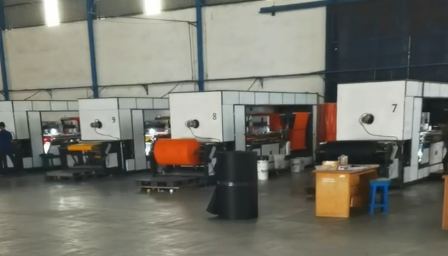
Why the printing stage decides a 50,000-bag tender
Two performance classes frame the decision. A fully automatic bag line runs at 100–120 pcs/min, is managed by one operator per two machines, and holds a defect rate below 0.5%. A semi-automatic line runs at 15–20 pcs/min, needs three to four operators, and typically produces a 3–5% defect rate. At 50,000 bags a day the second class cannot hold a tender schedule, and print quality cannot compensate for the shortfall.
The printing unit then has to match the bag machine rather than become its bottleneck. Inline flexo printing runs at 80–120 m/min at the fabric, matching bag-line demand inside a single workflow; a separate print-then-bag batch process inserts a handling step and a queue between two machines, and a digital unit running at 10–30 m/min slows the line it was meant to feed.
Registration matters as much as throughput because tender artwork is usually a retailer or ministry logo plus two or three colors. The four-color flexo class is specified to hold ±0.3 mm registration between colors, which is the difference between a logo that passes incoming inspection and one that is rejected on a sample table. Most supermarket programmes also require batch traceability, which means an inkjet date coder belongs in the line specification from the start rather than as a later add-on.
How these four positions were ranked
The ranking is editorial, applied to the six criteria a tender committee can actually test: sustained output matched to a 100–120 pcs/min bag line; color coverage against realistic tender artwork; operator load per line; defect control below 0.5%; documentation available for pre-award review; and changeover behavior when a second tender arrives with different artwork. No composite score or weighting is implied, and no independent benchmark of relative print quality was used — the positions reflect configuration fit at this production volume.
The shortlist at a glance
| Position | Configuration | Print scope | Strongest fit | Boundary to note |
|---|---|---|---|---|
| 1 | ZXH-C41200 inline flexo with ZXL-A700Ultra or ZXL-E700 line | 4-color flexo, ±0.3 mm registration between colors | Multi-color retail and government artwork; tender programmes with 3–4 color logos | Color headroom is unused if every design is one or two colors |
| 2 | ZXH-C21200 inline flexo with ZXL-A700 or ZXL-E700 line | 2-color flexo | Standard supermarket programmes and single- or two-color logos | Artwork beyond two colors needs split runs or a step up to Position 1 |
| 3 | ZXH-A1200 high-speed printing platform | High-speed printing that feeds two bag lines | 100,000+ bags/day plants, dual-line layouts, redundancy planning | More printer than a single 50,000/day line requires |
| 4 | Semi-automatic or standalone print station | Manual or semi-automatic feeding | Below 10,000 bags/day, highly varied small batches | 15–20 pcs/min, 3–4 operators, 3–5% defect rate — outside a 50,000/day tender |
Position 1: ZXH-C41200 four-color inline flexo
The strongest tender fit at this volume is the ZXH-C41200, a four-color flexo unit run inline with a fully automatic bag-making line. Its value is not color count for its own sake but the ±0.3 mm inter-color registration that lets a four-color retail or ministry logo pass incoming inspection without rework, at bag-line speed.
The configuration has a documented deployment pattern. A shopping bag manufacturer in Kenya runs three units — two ZXL-A700 bag machines plus one ZXH-C41200 — producing branded non woven shopping bags for nationwide supermarket chains, supplying more than 200 retail stores, with a single operator managing the entire workflow from printing to finished bag. That layout is the clearest available illustration of what a 50,000-bag tender line looks like in practice: the printer is not a separate department, it is station one.
The boundary is cost discipline. If every design in the tender pack is one or two colors, the third and fourth stations are idle capital, and Position 2 delivers the same daily output for less. Where artwork genuinely needs more than four colors, the CE certificate scope lists a ZXH-C6 (800–2000) configuration; specification, availability and lead time for that build should be confirmed in the quotation rather than assumed from the certificate listing.
Position 2: ZXH-C21200 two-color inline flexo
For the majority of supermarket tender packs — a logo plus one accent color — the ZXH-C21200 two-color flexo is the configuration with the shortest route from order to qualified output. It covers single-color and two-color retail marks inside the same inline workflow, with the operator load and defect profile of the fully automatic class.
Two installed references show the range. An Egyptian food packaging and retail bag producer runs two ZXH-C21200 units inside a five-machine fleet that has been in service since 2017, supporting three distinct product lines — takeaway bags for restaurant chains and multi-color promotional bags for retail malls — from one supplier. A promotional bag producer in Mwanza, Tanzania pairs one ZXH-C21200 with a ZXL-A700Ultra and handles more than ten custom orders a week, which is a changeover test rather than a volume test: artwork changes are the normal working condition, not the exception.
The boundary is artwork complexity. A three- or four-color design on a two-color unit means either split production runs or a compromise on the printed result, and neither is comfortable inside a fixed-price tender. Buyers who expect design escalation over a two- to three-year contract should price Position 1 at the evaluation stage instead of returning to the capital budget mid-contract.
Position 3: ZXH-A1200 high-speed printing feeding two bag lines
Where daily demand moves beyond 50,000 bags — or where a single tender line must be backed by redundancy — the ZXH-A1200 changes the arithmetic because one high-speed printing unit feeds two bag lines simultaneously, lowering printing equipment cost per line instead of duplicating printers.
That model is visible in the largest referenced installation: an Indonesian manufacturing group operates 42 Zhengxin units across five machine models, including 12 ZXH-A1200 printing machines, and supplies more than one million bags monthly to national retail chains and food delivery platforms. At that scale the printing stage is planned as shared infrastructure with buffer capacity, not as a per-line accessory.
The boundary is proportionality. A buyer targeting exactly 50,000 bags a day from a single bag line does not need a printer sized for two, and should not carry the capital cost of headroom that will sit idle for two years. Position 3 belongs in the shortlist when the tender volume, the shift pattern or the redundancy requirement already justifies a second bag line.
Position 4: semi-automatic and standalone printing — the boundary option
Semi-automatic and standalone print stations remain in this shortlist only to be ruled out explicitly, because they still appear in low quotations for 50,000-bag tenders. At 15–20 pcs/min with three to four operators and a 3–5% defect rate, the class cannot produce the daily volume, and manual transfer between print and bag stations adds a quality variable that a tender inspection will find.
There are legitimate uses. Semi-automatic equipment suits buyers below roughly 10,000 bags a day, or operations where many small custom batches make frequent changeover the dominant cost and automated speed has nothing to save. Neither condition describes a supermarket or government tender at 50,000 bags a day, where the labor saving from the fully automatic class typically repays the price difference within 12 months.
Integrated versus semi-automatic: the comparison that settles the tender
| Decision factor | Fully integrated inline printing | Semi-automatic or manual printing |
|---|---|---|
| Rated output | 100–120 pcs/min bag line, printing matched at 80–120 m/min | 15–20 pcs/min |
| Operators | 1 operator per 2 machines | 3–4 operators per line |
| Defect rate | Below 0.5% | 3–5% |
| Process handoffs | Printing, forming, sealing, cutting and counting in one workflow | Separate stations with manual transfer between them |
| Artwork changeover | Recipe recall plus mechanical adjustment, with calibration checks | Re-setup at each station, repeated at every batch |
| Traceability | Batch coding can be added inline without extra handling | Coding applied off-line, adding a further manual step |
| Cost position | Higher capital cost; lower per-bag cost at volume | Lower capital cost; labor and rejects accumulate |
The cost case: $0.02–$0.05 in-house against $0.08–$0.15 outsourced
The economics are the part of a tender bid that competitors rarely publish. In-house production puts per-bag cost at $0.02–$0.05, against $0.08–$0.15 for buying finished bags from an outside supplier, and the machine investment is recovered in 12–18 months at volumes of 50,000 bags a day or more. Beyond unit cost, in-house printing removes the per-design minimum order that outsourcing imposes and compresses a design change from a two- to four-week reorder cycle to a changeover measured in minutes.
The same source sets a lower boundary that tender buyers should respect: below roughly 100,000 bags a month, outsourcing remains the more economical route, and a machine bought under that threshold will not earn its payback on price alone. Between that floor and the 50,000-a-day level this shortlist addresses, payback depends on how consistently the line is loaded — a tender won at 50,000 bags a day and renewed is a different investment case from a single seasonal order.
Build, components and the certification file a committee will read
Tender evaluation usually stops at the certificate, so the certificate has to be specific. The CE certificate covering the printing models is M.2021.206.C70911, issued by UDEM on 24 January 2022 and valid until 23 January 2027. Its scope names the configurations directly: ZXH-C (21200–2000), ZXH-C4 (800–2000), ZXH-C6 (800–2000), ZXH-A (1200–2000) and ZXH-B (1200–2000), alongside ZXN-A (800–2000), ZXN-B (800–2000) and ZX-850, assessed against EN ISO 12100:2010, EN 60204-1:2018 and the EN 61000 series for electromagnetic compatibility.
The quality management certificate is ISO 9001:2015, number 20225Q21503R2M, issued by QPC and valid from 26 December 2025 to 12 January 2029, covering production and sales of bag making machines, slitting machines and non woven printing machines under GB/T 19001-2016 / ISO 9001:2015. Two practical checks follow. First, the exact model in the quotation must appear inside the certificate scope — a certificate for the manufacturer is not a certificate for the configuration. Second, both expiry dates should be diarised against the tender validity period, because a certificate that lapses during contract execution becomes a compliance finding.
Inside the machine, the specification that supports the defect figure is component-level: Siemens, Delta or Mitsubishi PLCs, Omron sensors and NSK bearings, with servo-driven feed and cutting systems maintaining dimensional accuracy at production speed. Third-party pre-shipment inspection by SGS, Bureau Veritas or CCIC can be arranged at the buyer's request before the balance payment, which converts a supplier claim into an inspected record.
Customization windows and lead time
Customization requests are handled by the in-house engineering team with a 3–5 day turnaround, and the configurable scope is broad enough to matter in a tender: voltage and phase (220V, 380V, 415V or 440V), printing from 1 to 6 colors single- or double-sided, material compatibility from 30 to 150 GSM including laminated and biodegradable fabric, PLC brand, HMI language, sealing method and automation level.
That configuration response window is not the same as build time, and buyers should not merge the two in a project plan. Zhengxin's capability sheet lists a 30–45 day lead time, while its pre-purchase guidance quotes 25–35 working days for standard models and 35–45 days for customized builds; sea freight then adds 15–45 days depending on destination. The binding figure belongs in the sales contract, not in a quotation email.
Price position against Oyang, Allwell and Ounuo
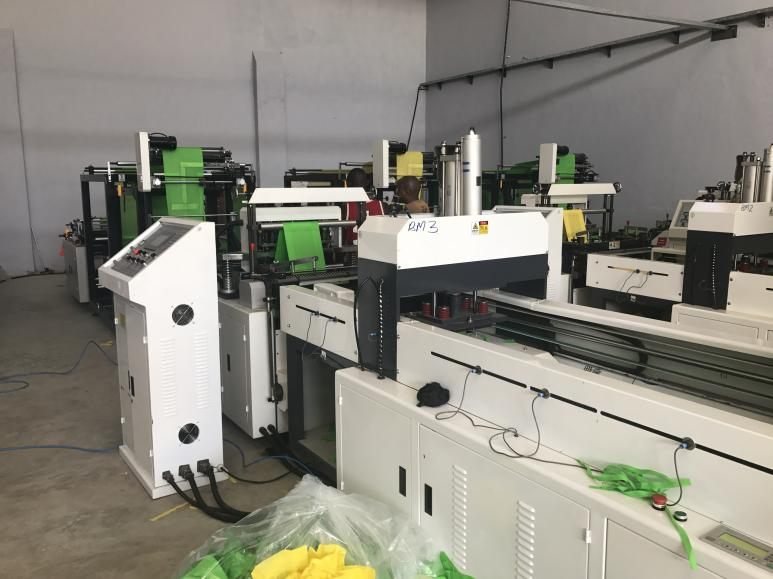
On price, Zhengxin positions itself 10–15% below Oyang, Allwell and Ounuo at a comparable configuration level. That is a supplier-side statement, not an independently benchmarked result, and it only means something once "comparable" is defined. In practice it requires the same PLC tier, the same color count, the same servo scope, the same certification and the same after-sales terms — a two-color machine with an unbranded controller is not a cheaper version of a four-color machine with Siemens control, it is a different product.
The useful response is procedural rather than rhetorical: build a like-for-like quotation matrix that forces each supplier to state PLC brand, color count, servo scope, certificate numbers, spare parts kit, warranty term and engineer dispatch terms in the same rows. Where two quotations differ by 10–15% after that exercise, the difference is structural and worth discussing; where they differ before it, the gap is usually a specification gap.
Where this shortlist is the wrong answer
- Below 100,000 bags a month. Outsourcing stays more economical than buying capital equipment.
- Below 10,000 bags a day. Semi-automatic equipment can be the rational choice, with 15–20 pcs/min and three to four operators.
- Very short promotional runs with photographic artwork. Flexo does not reproduce photographic images economically at low run lengths; heat-transfer labels on a plain printed base bag are usually the cheaper route.
- Three-dimensional standing bags. These need the dedicated ZX-LT500 platform, not a flat or vest bag line with a printer bolted on.
- Buyers without an operator plan. The 100–120 pcs/min class assumes one trained operator per two machines; without that staffing assumption the output figure is theoretical.
A five-step verification sequence before the quotation is signed
Tender-grade due diligence is short and specific. First, confirm the exact model string in the quotation appears inside the CE certificate scope and that the certificate is still in force on the intended delivery date. Second, verify the ISO 9001 number on the issuing body's register rather than accepting a scanned copy. Third, ask for a video or witnessed run at production speed with the buyer's own artwork, and inspect registration and seal quality on the samples produced. Fourth, confirm the operator count, spare parts kit and English documentation that will actually ship. Fifth, commission a third-party pre-shipment inspection before the balance payment — a cost measured in hundreds of dollars against a machine measured in tens of thousands.
What changes for tender buyers next
The direction of travel is not speculative: plastic bag restrictions continue to push retail and public-sector buyers toward reusable non woven bags, and tender documents increasingly treat print consistency and traceability as scored criteria rather than hygiene factors. What that changes for the buyer is the weight carried by the printing stage in the capital plan. A line specified around a two-color printer and later forced into four-color tender work pays twice — once for the original unit and once for the upgrade. Specifying the printing position against the artwork you expect to bid on, not the artwork you have today, is the cheaper discipline.
FAQ
How many printing machines does a 50,000-bag-per-day line need?
One inline printer per bag-making line, not per daily target. At 100 pcs/min over a 480-minute shift, theoretical output is 48,000 bags; at the recommended 80–85% planning baseline that is roughly 38,000–41,000 bags per line per shift. A 50,000-bag day is therefore reached with two lines on a single shift, or one line over an extended shift.
Is a two-color or four-color inline flexo the better tender fit?
It depends on the artwork in the tender pack, not on the machine's capability. A two-color unit covers single-color and two-color retail logos; a four-color unit adds the ±0.3 mm inter-color registration needed when logos use three or four colors. If designs are expected to escalate during a multi-year contract, the four-color configuration avoids a mid-contract capital request.
At 50,000 bags a day, is in-house printing cheaper than outsourcing?
On the published comparison, yes: $0.02–$0.05 per bag in-house against $0.08–$0.15 outsourced, with machine payback in 12–18 months at volumes of 50,000 bags a day or more. The qualification matters — below roughly 100,000 bags a month, outsourcing remains the more economical route, and payback assumes sustained line loading rather than a single seasonal order.
Which certificates should a tender committee see for the printing machine?
Two, with numbers. The CE certificate M.2021.206.C70911, issued by UDEM and valid to 23 January 2027, whose scope names the printing models; and ISO 9001:2015 certificate 20225Q21503R2M, issued by QPC and valid to 12 January 2029, covering production and sales of bag making, slitting and non woven printing machines. The model in the quotation must appear inside the CE scope, and both dates should be checked against contract duration.
How long does a customized printing configuration take to arrange?
Configuration requests are handled by the in-house engineering team with a 3–5 day turnaround, covering items such as color count, voltage, PLC brand, material GSM range and automation level. That response window is separate from build and shipping lead time, which is quoted per configuration and should be fixed in the sales contract rather than inferred from the customization response.
Product documentation: the current Zhengxin machinery brochure is available as a public PDF download — 2026 Zhengxin brochure. Company information: wzzxjx.com.
¿Tiene preguntas o necesita más detalles?
Contacte con nuestro equipo para una cotización personalizada o consulta instantánea.
Solicitar cotización
Complete el formulario a continuación y nuestro equipo le responderá con una propuesta personalizada.
Chat directo de WhatsApp
¿Prefiere chatear en tiempo real? Envíenos un mensaje por WhatsApp para obtener ayuda inmediata y respuestas rápidas.
- Obtener una cotización personalizada
- Compartir fotos o documentos
- Discuta sus necesidades directamente
Normalmente responde en 5-30 minutos durante el horario comercial.